

Importo totale (1 articolo articoli):
Destinazione ordine:

jiefei chen (9 risultati)
Vai alla pagina principale dei risultati di ricerca
Filtri di ricerca
Tipo di articolo
- Tutti i tipi di prodotto
- Libri (9)
- Riviste e Giornali (Nessun altro risultato corrispondente a questo perfezionamento)
- Fumetti (Nessun altro risultato corrispondente a questo perfezionamento)
- Spartiti (Nessun altro risultato corrispondente a questo perfezionamento)
- Arte, Stampe e Poster (Nessun altro risultato corrispondente a questo perfezionamento)
- Fotografie (Nessun altro risultato corrispondente a questo perfezionamento)
- Mappe (Nessun altro risultato corrispondente a questo perfezionamento)
- Manoscritti e Collezionismo cartaceo (Nessun altro risultato corrispondente a questo perfezionamento)
Condizioni Maggiori informazioni
- Nuovo (7)
- Come nuovo, Ottimo o Quasi ottimo (2)
- Molto buono o Buono (Nessun altro risultato corrispondente a questo perfezionamento)
- Discreto o Mediocre (Nessun altro risultato corrispondente a questo perfezionamento)
- Come descritto (Nessun altro risultato corrispondente a questo perfezionamento)
Legatura
- Tutte
- Rilegato (Nessun altro risultato corrispondente a questo perfezionamento)
- Brossura (9)
Ulteriori caratteristiche
- Prima ed. (Nessun altro risultato corrispondente a questo perfezionamento)
- Copia autograf. (Nessun altro risultato corrispondente a questo perfezionamento)
- Sovracoperta (Nessun altro risultato corrispondente a questo perfezionamento)
- Con foto (5)
- Non Print on Demand (5)
Lingua (1)
Prezzo
- Qualsiasi prezzo
- Inferiore a EUR 20 (Nessun altro risultato corrispondente a questo perfezionamento)
- EUR 20 a EUR 45
- Superiore a EUR 45
Spedizione gratuita
- Spedizione gratuita in U.S.A. (Nessun altro risultato corrispondente a questo perfezionamento)
Paese del venditore
Valutazione venditore
-

Optical Precursors: From Classical Waves to Single Photons (SpringerBriefs in Physics)
Libro 25 di 151: SpringerBriefs in PhysicsDa: Chiron Media, Wallingford, Regno Unito
Valutazione del venditore 5 su 5 stelle

EUR 56,13
Spedizione EUR 17,85
Spedito da Regno Unito a U.S.A.Quantità: Più di 20 disponibili
Aggiungi al carrelloPaperback. Condizione: New.
-

Optical Precursors : From Classical Waves to Single Photons
Libro 25 di 151: SpringerBriefs in PhysicsEUR 58,39
Spedizione EUR 60,75
Spedito da Germania a U.S.A.Quantità: 1 disponibili
Aggiungi al carrelloTaschenbuch. Condizione: Neu. Druck auf Anfrage Neuware - Printed after ordering - Ever since Einstein's special relativity in 1905, the principle of invariant light speed in vacuum has been attracting attention from a wide range of disciplines. How to interpret the principle of light speed Is light referred to continuous light, or light pulse with definite boundaries Recent discovery of superluminal medium triggered vigorous discussion within the Physics community. Can communication via such 'superluminal channel' break the speed limit and thus violate causality principle Or, will a single photon, which is not governed by classical laws of Physics, tend to break the speed limit To solve these problems, this Brief brings in Optical Precursors, the theoretical works for which started as early as 1914. This is a typical optical phenomenon combining wave propagation theory and light-wave interaction. Both theory and experimental works are covered in this Brief. The study of precursor verifies that the effective information carried by light pulses can never exceed the speed of light in vacuum- c. Further, through observation from nonclassical single photon source, the precursor rules out the probability of a single photon traveling with the speed, breaking the classical limit.
-

Optical Precursors | From Classical Waves to Single Photons
Libro 25 di 151: SpringerBriefs in PhysicsEUR 50,35
Spedizione EUR 70,00
Spedito da Germania a U.S.A.Quantità: 5 disponibili
Aggiungi al carrelloTaschenbuch. Condizione: Neu. Optical Precursors | From Classical Waves to Single Photons | Jiefei Chen (u. a.) | Taschenbuch | SpringerBriefs in Physics | vi | Englisch | 2013 | Springer | EAN 9789814451932 | Verantwortliche Person für die EU: Springer Verlag GmbH, Tiergartenstr. 17, 69121 Heidelberg, juergen[dot]hartmann[at]springer[dot]com | Anbieter: preigu.
-
Optical Precursors: From Classical Waves to Single Photons (SpringerBriefs in Physics)
Libro 25 di 151: SpringerBriefs in PhysicsDa: Mispah books, Redhill, SURRE, Regno Unito
Valutazione del venditore 4 su 5 stelle

EUR 99,68
Spedizione EUR 28,80
Spedito da Regno Unito a U.S.A.Quantità: 1 disponibili
Aggiungi al carrelloPaperback. Condizione: Like New. LIKE NEW. SHIPS FROM MULTIPLE LOCATIONS. book.
-
Optical Precursors : From Classical Waves to Single Photons
Libro 25 di 151: SpringerBriefs in PhysicsEUR 40,86
Spedizione EUR 105,00
Spedito da Germania a U.S.A.Quantità: 1 disponibili
Aggiungi al carrelloCondizione: Sehr gut. Zustand: Sehr gut | Sprache: Englisch | Produktart: Bücher | Ever since Einstein¿s special relativity in 1905, the principle of invariant light speed in vacuum has been attracting attention from a wide range of disciplines. How to interpret the principle of light speed? Is light referred to continuous light, or light pulse with definite boundaries? Recent discovery of superluminal medium triggered vigorous discussion within the Physics community. Can communication via such ¿superluminal channel¿ break the speed limit and thus violate causality principle? Or, will a single photon, which is not governed by classical laws of Physics, tend to break the speed limit? To solve these problems, this Brief brings in Optical Precursors, the theoretical works for which started as early as 1914. This is a typical optical phenomenon combining wave propagation theory and light-wave interaction. Both theory and experimental works are covered in this Brief. The study of precursor verifies that the effective information carried by light pulses can never exceed the speed of light in vacuum- c. Further, through observation from nonclassical single photon source, the precursor rules out the probability of a single photon traveling with the speed, breaking the classical limit.
-
Loy:Optical Precursors (eng)
Libro 25 di 151: SpringerBriefs in PhysicsDa: Brook Bookstore On Demand, Napoli, NA, Italia
Valutazione del venditore 3 su 5 stelle

EUR 46,22
Spedizione EUR 4,00
Spedito da Italia a U.S.A.Quantità: Più di 20 disponibili
Aggiungi al carrelloCondizione: new. Questo è un articolo print on demand.
-
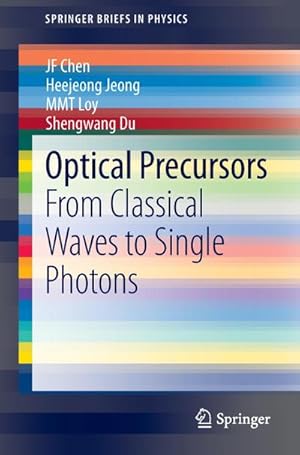
Optical Precursors
Libro 25 di 151: SpringerBriefs in PhysicsLingua: Inglese
Editore: Springer Nature Singapore Jul 2013, 2013
ISBN 10: 9814451932 ISBN 13: 9789814451932
Da: BuchWeltWeit Ludwig Meier e.K., Bergisch Gladbach, Germania
Valutazione del venditore 5 su 5 stelle
EUR 53,49
Spedizione EUR 23,00
Spedito da Germania a U.S.A.Quantità: 2 disponibili
Aggiungi al carrelloTaschenbuch. Condizione: Neu. This item is printed on demand - it takes 3-4 days longer - Neuware -Ever since Einstein's special relativity in 1905, the principle of invariant light speed in vacuum has been attracting attention from a wide range of disciplines. How to interpret the principle of light speed Is light referred to continuous light, or light pulse with definite boundaries Recent discovery of superluminal medium triggered vigorous discussion within the Physics community. Can communication via such 'superluminal channel' break the speed limit and thus violate causality principle Or, will a single photon, which is not governed by classical laws of Physics, tend to break the speed limit To solve these problems, this Brief brings in Optical Precursors, the theoretical works for which started as early as 1914. This is a typical optical phenomenon combining wave propagation theory and light-wave interaction. Both theory and experimental works are covered in this Brief. The study of precursor verifies that the effective information carried by light pulses can never exceed the speed of light in vacuum- c. Further, through observation from nonclassical single photon source, the precursor rules out the probability of a single photon traveling with the speed, breaking the classical limit. 88 pp. Englisch.
-

EUR 48,37
Spedizione EUR 48,99
Spedito da Germania a U.S.A.Quantità: Più di 20 disponibili
Aggiungi al carrelloCondizione: New. Dieser Artikel ist ein Print on Demand Artikel und wird nach Ihrer Bestellung fuer Sie gedruckt. Professor Michael Loy earned both his BSc (1966) and PhD (1971) degrees at the University of California at Berkeley. He joined HKUST in 1993 as Professor of Physics and served as Dean of Science from 1998 to 2004. Before coming to HKUST, Professor Loy wo.
-

Optical Precursors
Libro 25 di 151: SpringerBriefs in PhysicsLingua: Inglese
Editore: Springer, Springer Jul 2013, 2013
ISBN 10: 9814451932 ISBN 13: 9789814451932
Da: buchversandmimpf2000, Emtmannsberg, BAYE, Germania
Valutazione del venditore 5 su 5 stelle
EUR 53,49
Spedizione EUR 60,00
Spedito da Germania a U.S.A.Quantità: 1 disponibili
Aggiungi al carrelloTaschenbuch. Condizione: Neu. This item is printed on demand - Print on Demand Titel. Neuware -Ever since Einstein¿s special relativity in 1905, the principle of invariant light speed in vacuum has been attracting attention from a wide range of disciplines. How to interpret the principle of light speed Is light referred to continuous light, or light pulse with definite boundaries Recent discovery of superluminal medium triggered vigorous discussion within the Physics community. Can communication via such ¿superluminal channel¿ break the speed limit and thus violate causality principle Or, will a single photon, which is not governed by classical laws of Physics, tend to break the speed limit To solve these problems, this Brief brings in Optical Precursors, the theoretical works for which started as early as 1914. This is a typical optical phenomenon combining wave propagation theory and light-wave interaction. Both theory and experimental works are covered in this Brief. The study of precursor verifies that the effective information carried by light pulses can never exceed the speed of light in vacuum- c. Further, through observation from nonclassical single photon source, the precursor rules out the probability of a single photon traveling with the speed, breaking the classical limit.Springer-Verlag GmbH, Tiergartenstr. 17, 69121 Heidelberg 88 pp. Englisch.


