

Importo totale (1 articolo articoli):
Destinazione ordine:

johnson isabel bishop (6 risultati)
Vai alla pagina principale dei risultati di ricerca
Filtri di ricerca
Tipo di articolo
- Tutti i tipi di prodotto
- Libri (6)
- Riviste e Giornali (Nessun altro risultato corrispondente a questo perfezionamento)
- Fumetti (Nessun altro risultato corrispondente a questo perfezionamento)
- Spartiti (Nessun altro risultato corrispondente a questo perfezionamento)
- Arte, Stampe e Poster (Nessun altro risultato corrispondente a questo perfezionamento)
- Fotografie (Nessun altro risultato corrispondente a questo perfezionamento)
- Mappe (Nessun altro risultato corrispondente a questo perfezionamento)
- Manoscritti e Collezionismo cartaceo (Nessun altro risultato corrispondente a questo perfezionamento)
Condizioni Maggiori informazioni
- Nuovo (Nessun altro risultato corrispondente a questo perfezionamento)
- Come nuovo, Ottimo o Quasi ottimo (Nessun altro risultato corrispondente a questo perfezionamento)
- Molto buono o Buono (3)
- Discreto o Mediocre (Nessun altro risultato corrispondente a questo perfezionamento)
- Come descritto (3)
Legatura
Ulteriori caratteristiche
Lingua (2)
Spedizione gratuita
- Spedizione gratuita in U.S.A. (Nessun altro risultato corrispondente a questo perfezionamento)
Paese del venditore
Valutazione venditore
-

Isabel Bishop: Prints and Drawings 1925-1964
Lingua: Inglese
Editore: The Brooklyn Museum, 1964
Da: LBH Books, Los Angeles, CA, U.S.A.
Valutazione del venditore 5 su 5 stelle

Prima edizione Copia autografata
Hardcover. Condizione: Very Good. 1st Edition. 64 pages. Hardcover, no jacket (as issued) in very good condition for age other than previous owner's name written inside front cover. Signed by Isabel Bishop on title page. Signed by Author(s).
-

Isabel Bishop: Prints and Drawings 1925-1964
Editore: Brooklyn Museum, Brooklyn, New York, 1964
Da: Mainly Books, Silverdale, PA, U.S.A.
Valutazione del venditore 5 su 5 stelle
Prima edizione
Hardcover. Condizione: Very Good. 1st Edition; 1st Printing. Hardcover, no dustjacket, pictorial cloth, illustrated throughout, including a wonderful frontis photo of the artist, the cover has some tan discoloration on the top and bottom edge and there is a small surface-bruise on the rear cover, the binding is tight and clean and the contents are fine; 62 pages.
-
Isabel Bishop Prints and Drawings 1925-1964
Editore: shorewood new york [1964], 1964
Da: Hard to Find Books NZ (Internet) Ltd., Dunedin, OTAGO, Nuova Zelanda
Membro dell'associazione: IOBA
Valutazione del venditore 5 su 5 stelle
Prima edizione
EUR 8,80
Spedizione EUR 17,44
Spedito da Nuova Zelanda a U.S.A.Quantità: 1 disponibili
Aggiungi al carrellofirst edition inscribed by author [johnson] 63pp ills.[b/w] VG (cream ill.paper boards,rubbed and soiled w.surface losses due to insects,mod.wear to extrems.,eps and content edges sl.foxed,inscr.by una johnson on copyright page dated 1973).
-
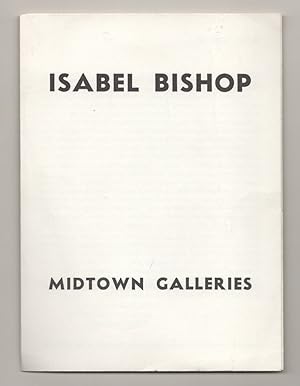
Isabel Bishop
Editore: Midtown Galleries, New York, 1967
Da: Jeff Hirsch Books, ABAA, Wadsworth, IL, U.S.A.
Membro dell'associazione: ABAA ILAB MWABA
Valutazione del venditore 5 su 5 stelle
Prima edizione
First Edition. First edition. Exhibition brochure for a show that ran April 4-29, 1967. Single sheet folded twice to create 6 pages. Features text by Una E. Johnson. Includes 1 black and white illustration, a checklist, and other biographical information. A clean very near fine copy. Scarce ephemera.
-
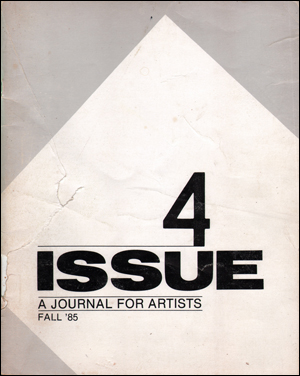
Issue : A Journal for Artists, No. 4 (Fall 1985)
Editore: Reflex Horizons, Ltd. New York, NY, 1985
Da: Specific Object / David Platzker, New York, NY, U.S.A.
Valutazione del venditore 5 su 5 stelle
54 pp.; 25.4 x 20.2 cm.; staple bound; black-and-white; edition size unknown; unsigned and unnumbered; offset-printed; Issue 4 of "Issue, A Journal for Artists," edited by Judith Wilson. Contents include: "Milton Resnick," edited by Lily Wei; "Isabel Bishop," interviewed by Donna Nelson & John Mendelsohn; "Elmer Bishop," interviewed by Susan Klein; "Enrico Donati," interviewed by William Jeffett; "Bill Rivers," interviewed by Donna Nelson and John Mendelsohn; "James Brooks," interviewed by Ann Gibson; "Richard Bellamy," interviewed by Judith Wilson; "Vincent Smith," interviewed by Donna Nelson and John Mendelsohn; "Stephen Greene," edited by Ann Tempkin; "Frank Lobdell," edited by Ann Gibson; "Blanche Grambs," interviewed by Susan Dorais; "George McNeil," interviewed by Ann Tempkin; "Estaban Vicente," interviewed by Susan Klein; "Lester Johnson," by Jim Weiss; "The Club," by L. Alcopely; "Ed Clark," interviewed by Judith Wilson; "Leon Polk Smith," interviewed by William Jeffett and "Rudy Burkhardt." Poor / Good. 13.6 cm. tear to recto with additional creasing across covers. Yellow soiling to contents page. 13.5 cm. significant stain to page 9 with adjacent staining. 5.6 cm. staining to last page and inside of verso. Original 1.8 cm. MoMA pricing sticker on verso.
-
Isabel Bishop Prints and Drawings 1925-1964
Editore: The Brooklyn Museum, Brooklyn, NY, 1964
Da: Ground Zero Books, Ltd., Silver Spring, MD, U.S.A.
Valutazione del venditore 5 su 5 stelle
Prima edizione Copia autografata
Hardcover. Condizione: Very good. Condizione sovraccoperta: Fair. Michael Rolston (Photograph of Isabel Bishop) (illustratore). Presumed First Edition, First printing. The format is approximately 6.25 inches by 9.25 inches. 63, [1] pages. Illustrated front cover. Illustrations (one in color). Chronology. Awards and Honors. One-Man Exhibitions. Graphic Works in Public Collections. Selected Bibliography. Signed by Isabel Bishop on the second fep. The glacine dust wrapper has a large tear in front. This is Monograph No. 2 in the series American Graphic Artists of the Twentieth Century. Una Johnson (1905 April 28, 1997) was an American curator and art historian. She was the head curator of prints and drawings at the Brooklyn Museum for more than 25 years. In 1936 Johnson became assistant curator of prints and drawings at the Brooklyn Museum. In 1937, she oversaw the purchase of a complete set of Francisco Goya's Caprichos print series. In 1941 she was promoted to the Curator position, which she would hold for the next 28 years. Johnson curated many major exhibitions for the Brooklyn Museum, including the first exhibition of the work of art dealer and publisher Ambroise Vollard, the first exhibition of Edvard Munch prints in the United States, the internationally recognized survey American Woodcuts 1670-1950, and New Expressions in Fine Printmaking. In 1947, she curated the Brooklyn Museum's first National Print Exhibition. During her tenure, the Brooklyn Museum made important acquisitions for its print collection, including Daumier, a collection of Japanese prints, and many contemporary European works. She published numerous books and monographs about printmaking, focusing on artists like Georges Rouault, Isabel Bishop, and Adja Yunkers. Isabel Bishop (March 3, 1902 February 19, 1988) was an American painter and graphic artist. Bishop studied under Kenneth Hayes Miller at the Art Students League of New York, where she would later become an instructor. She was most notable for her scenes of everyday life in Manhattan, as a member of the loosely-defined 'Fourteenth Street School' of artists, grouped in that precinct. Union Square features prominently in her work, which mainly depicts female figures. Bishop's paintings won the American Academy of Arts and Letters Award, among other distinctions. Bishop began her art education at the age of 12 in a Saturday morning life drawing class at the John Wicker Art School in Detroit. In 1918, at the age of 15, Bishop graduated high school and began art studies at John Wicker's art school in Detroit, Michigan. She later moved to New York City to study illustration at the New York School of Applied Design for Women. After two years there she shifted from illustration to painting, and attended the Art Students League for four years until 1924. It was there that she studied with Guy Pène du Bois and with Kenneth Hayes Miller, from whom she adapted a technique which owed much to baroque Flemish painting. In addition, she learned from other early modernists including Max Weber and Robert Henri. During the early 1920s she also studied and painted in Woodstock, New York. In 1963, she went to Yale University School of Fine Arts, New Haven. For the first time that she taught at The Art Students League in New York, she was the only full time woman teacher in that school. Throughout the 1920s and 1930s she developed a realist style of painting, primarily depicting women in their daily routine on the streets of Manhattan. Her work was greatly influenced by Peter Paul Rubens and other Dutch and Flemish painters that she had discovered during trips to Europe. In 1932, Bishop began showing her work frequently at the newly opened Midtown Galleries, where her work would be represented throughout her career. Bishop takes inspiration from Rubens by adding a light ochre-ish tone to all her works, allowing for the painting to be rendered in any way. In 1934, Bishop married Dr. Harold G. Wolff, a neurologist, and moved to Riverdale New York. However, she continued to work in a loft studio near Union Square at 9 West Fourteenth St, which she continued to use until 1984. She became interested in the interaction of form and ground and the mobility of everyday life, what she called "unfixity", life and movement captured on canvas. Her style is noted for its sensitive modeling of form and "a submarine pearliness and density of atmosphere". During this time, Bishop began working in various printing techniques, most notably aquatint. Her work was included in the first three iterations of the Whitney Biennial in 1932, 1934, and 1936, as well as ten subsequent annual exhibitions at the Whitney Museum of American Art. In 1940, Bishop was elected into the National Academy of Design as an associate member, and became a full member in 1941. Her work was also part of the painting event in the art competition at the 1932 Summer Olympics. She was also a member of and frequently shown her work in the Society of American Graphic Artists exhibitions. Bishop's mature works mainly depict the inhabitants of New York's Union Square area. Her portraits are often studies of individual heads; the emphasis securely on the subject's expression or of solitary nudes. Bishop also painted multiple-figure compositions, often containing two females engaged in various workday interactions. In the post-war years, Bishop's interest turned to more abstracted scenes of New Yorkers walking and traveling, in the streets or on the subways. The first retrospective exhibition of Bishop's work was held during her lifetime at the University of Arizona Museum of Art in 1974.

