

Importo totale (1 articolo articoli):
Destinazione ordine:

joseph hirschfelder editor (4 risultati)
Vai alla pagina principale dei risultati di ricerca
Filtri di ricerca
Tipo di articolo
- Tutti i tipi di prodotto
- Libri (4)
- Riviste e Giornali (Nessun altro risultato corrispondente a questo perfezionamento)
- Fumetti (Nessun altro risultato corrispondente a questo perfezionamento)
- Spartiti (Nessun altro risultato corrispondente a questo perfezionamento)
- Arte, Stampe e Poster (Nessun altro risultato corrispondente a questo perfezionamento)
- Fotografie (Nessun altro risultato corrispondente a questo perfezionamento)
- Mappe (Nessun altro risultato corrispondente a questo perfezionamento)
- Manoscritti e Collezionismo cartaceo (Nessun altro risultato corrispondente a questo perfezionamento)
Condizioni Maggiori informazioni
- Nuovo (Nessun altro risultato corrispondente a questo perfezionamento)
- Come nuovo, Ottimo o Quasi ottimo (1)
- Molto buono o Buono (2)
- Discreto o Mediocre (Nessun altro risultato corrispondente a questo perfezionamento)
- Come descritto (1)
Legatura
Ulteriori caratteristiche
- Prima ed. (1)
- Copia autograf. (Nessun altro risultato corrispondente a questo perfezionamento)
- Sovracoperta (2)
- Con foto (1)
- Non Print on Demand (4)
Lingua (2)
Prezzo
- Qualsiasi prezzo
- Inferiore a EUR 20 (Nessun altro risultato corrispondente a questo perfezionamento)
- EUR 20 a EUR 45
- Superiore a EUR 45
Spedizione gratuita
- Spedizione gratuita in U.S.A. (Nessun altro risultato corrispondente a questo perfezionamento)
Paese del venditore
Valutazione venditore
-
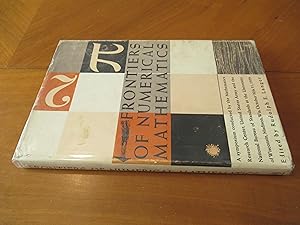
Frontiers Of Numerical Mathematics (A Symposium)
Lingua: Inglese
Editore: University Of Wisconsin Press, Madison, 1960
Da: Arroyo Seco Books, Pasadena, Member IOBA, Pasadena, CA, U.S.A.
Membro dell'associazione: IOBA
Valutazione del venditore 4 su 5 stelle

Prima edizione
Hardcover. Condizione: Very Good. Condizione sovraccoperta: Very Good. 1st Edition. Xi, 132 Pp, Brown Cloth, Gilt. First Printing. Very Good In Very Good Price-Clipped Dust Jacket, No Marks.
-

Intermolecular Forces (Advances in Chemical Physics, Volume 12)
Editore: Wiley Interscience Publishers, 1967
Da: Charles Berry, Bookseller, Lakeport, CA, U.S.A.
Valutazione del venditore 5 su 5 stelle

Hardcover. Condizione: Near Fine. Condizione sovraccoperta: Good. Hardcover in excellent, unmarked, near-pristine condition (slight handling evident), with good dust jacket (slight wear, small tear along upper edge). The DJ is protected by a new, clear, removeable cover. 643 pages, with advanced equations throughout. [2.4 lbs]. Book.
-
The Effects of Atomic Weapons: Prepared for the U.S. Department of Defense and the U.S. Atomic Energy Commission Under the Direction of the Los Alamos Scientific Laboratory
Editore: U. S. Government Printing Office, Washington DC, 1950
Da: Ground Zero Books, Ltd., Silver Spring, MD, U.S.A.
Valutazione del venditore 5 su 5 stelle
Wraps. Condizione: as is. Revised Edition. x, 456 pages. Illustration. Charts. Appendices. Index. Ex-library with usual library markings. Front and back covers separated but reattached with tape. Bottom edge has become wet and damp stains go from the bottom up about one inch. Some pages were stuck together at the bottom small tears on some pages when separated. Occasional small loss of text. Some pages may still be slightly stuck together. In 1948 the Weapons Effects Classification Board, a committee of military and civilian scientists serving as advisers to the Atomic Energy Commission recommended that a handbook on the effects of atomic weapons be prepared. This volume is the result. This presents a technical summary of the results to be expected from the detonation of atomic weapons (other than information that was kept secret at that time). The energy released from a nuclear weapon detonated in the troposphere can be divided into four basic categories: Blast-40-50% of total energy ; Thermal radiation-30-50% of total energy; Ionizing radiation-5% of total energy (more in a neutron bomb); Residual radiation-5-10% of total energy with the mass of the explosion. Depending on the design of the weapon and the environment in which it is detonated the energy distributed to these categories can be increased or decreased. The blast effect is created by the coupling of immense amounts of energy, spanning the electromagnetic spectrum, with the surroundings. Locations such as submarine, ground burst, air burst, or exo-atmospheric determine how much energy is produced as blast and how much as radiation. In general, denser media around the bomb, like water, absorb more energy, and create more powerful shockwaves while at the same time limiting the area of its effect. When an air burst occurs, lethal blast and thermal effects proportionally scale much more rapidly than lethal radiation effects, as higher and higher yield nuclear weapons are used. The physical-damage mechanisms of a nuclear explosive is millions of times more powerful than conventional explosives.
-
The Effects of Atomic Weapons: Prepared for the U.S. Department of Defense and the U.S. Atomic Energy Commission Under the Direction of the Los Alamos Scientific Laboratory
Editore: U. S. Government Printing Office, Washington DC, 1950
Da: Ground Zero Books, Ltd., Silver Spring, MD, U.S.A.
Valutazione del venditore 5 su 5 stelle
Wraps. Condizione: Good. Revised Edition [stated]. x, 456 pages. Footnotes. Illustrations. Charts. Appendices. Index. In 1948 the Weapons Effects Classification Board, a committee of military and civilian scientists serving as advisers to the Atomic Energy Commission recommended that a handbook on the effects of atomic weapons be prepared. This volume is the result. This presents a technical summary of the results to be expected from the detonation of atomic weapons (other than information that was kept secret at that time). Contributors supported the topics of Shock Waves and Blast Damage, Thermal Radiation and Incendiary Effects, Nuclear Radiation and Instrumentation, Effects on Personnel, Protection of Personnel, and miscellaneous material. Reviewers included Luis Alvarez, Hans Bethe, E. O. Lawrence and Edward Teller. Arnold Kramish was on the Board of Editors. The energy released from a nuclear weapon detonated in the troposphere can be divided into four basic categories: Blast4050% of total energy ; Thermal radiation3050% of total energy; ionizing radiation5% of total energy (more in a neutron bomb); Residual radiation510% of total energy with the mass of the explosion. Depending on the design of the weapon and the environment in which it is detonated the energy distributed to these categories can be increased or decreased. The blast effect is created by the coupling of immense amounts of energy, spanning the electromagnetic spectrum, with the surroundings. Locations such as submarine, ground burst, air burst, or exo-atmospheric determine how much energy is produced as blast and how much as radiation. In general, denser media around the bomb, like water, absorb more energy, and create more powerful shockwaves while at the same time limiting the area of its effect. When an air burst occurs, lethal blast and thermal effects proportionally scale much more rapidly than lethal radiation effects, as higher and higher yield nuclear weapons are used. The physical-damage mechanisms of a nuclear explosive is millions of times more powerful than conventional explosives.


