

Importo totale (1 articolo articoli):
Destinazione ordine:

keyfitz nathan hal caswell (19 risultati)
Vai alla pagina principale dei risultati di ricerca
Filtri di ricerca
Tipo di articolo
- Tutti i tipi di prodotto
- Libri (19)
- Riviste e Giornali (Nessun altro risultato corrispondente a questo perfezionamento)
- Fumetti (Nessun altro risultato corrispondente a questo perfezionamento)
- Spartiti (Nessun altro risultato corrispondente a questo perfezionamento)
- Arte, Stampe e Poster (Nessun altro risultato corrispondente a questo perfezionamento)
- Fotografie (Nessun altro risultato corrispondente a questo perfezionamento)
- Mappe (Nessun altro risultato corrispondente a questo perfezionamento)
- Manoscritti e Collezionismo cartaceo (Nessun altro risultato corrispondente a questo perfezionamento)
Condizioni Maggiori informazioni
- Nuovo (14)
- Come nuovo, Ottimo o Quasi ottimo (3)
- Molto buono o Buono (1)
- Discreto o Mediocre (1)
- Come descritto (Nessun altro risultato corrispondente a questo perfezionamento)
Legatura
Ulteriori caratteristiche
- Prima ed. (Nessun altro risultato corrispondente a questo perfezionamento)
- Copia autograf. (Nessun altro risultato corrispondente a questo perfezionamento)
- Sovracoperta (Nessun altro risultato corrispondente a questo perfezionamento)
- Con foto (7)
- Non Print on Demand (16)
Lingua (1)
Prezzo
- Qualsiasi prezzo
- Inferiore a EUR 20 (Nessun altro risultato corrispondente a questo perfezionamento)
- EUR 20 a EUR 45
- Superiore a EUR 45
Spedizione gratuita
Paese del venditore
Valutazione venditore
-

Applied Mathematical Demography (Statistics for Biology and Health)
Libro 16 di 69: Statistics for Biology and HealthDa: BooksRun, Philadelphia, PA, U.S.A.
Valutazione del venditore 5 su 5 stelle

Hardcover. Condizione: Fair. 3rd. The item might be beaten up but readable. May contain markings or highlighting, as well as stains, bent corners, or any other major defect, but the text is not obscured in any way.
-

Applied Mathematical Demography Statistics for Biology and Health
Libro 16 di 69: Statistics for Biology and HealthDa: books4less (Versandantiquariat Petra Gros GmbH & Co. KG), Welling, Germania
Valutazione del venditore 5 su 5 stelle
EUR 36,95
Spedizione EUR 19,95
Spedito da Germania a U.S.A.Quantità: 2 disponibili
Aggiungi al carrellogebundene Ausgabe. Condizione: Gut. 3rd ed. 555 Seiten Der Erhaltungszustand des hier angebotenen Werks ist trotz seiner Bibliotheksnutzung sehr sauber. Es befindet sich neben dem Rückenschild lediglich ein Bibliotheksstempel im Buch; ordnungsgemäß entwidmet. In ENGLISCHER Sprache. Sprache: Englisch Gewicht in Gramm: 950.
-
Applied Mathematical Demography : with 74 illustrations
Libro 16 di 69: Statistics for Biology and HealthDa: GreatBookPrices, Columbia, MD, U.S.A.
Valutazione del venditore 5 su 5 stelle
Condizione: New.
-
Applied Mathematical Demography : with 74 illustrations
Libro 16 di 69: Statistics for Biology and HealthDa: GreatBookPricesUK, Woodford Green, Regno Unito
Valutazione del venditore 5 su 5 stelle
EUR 122,00
Spedizione EUR 17,36
Spedito da Regno Unito a U.S.A.Quantità: 1 disponibili
Aggiungi al carrelloCondizione: New.
-
Applied Mathematical Demography : with 74 illustrations
Libro 16 di 69: Statistics for Biology and HealthDa: GreatBookPrices, Columbia, MD, U.S.A.
Valutazione del venditore 5 su 5 stelle
Condizione: As New. Unread book in perfect condition.
-
Applied Mathematical Demography (Statistics for Biology and Health)
Libro 16 di 69: Statistics for Biology and HealthDa: Chiron Media, Wallingford, Regno Unito
Valutazione del venditore 5 su 5 stelle
EUR 131,32
Spedizione EUR 17,93
Spedito da Regno Unito a U.S.A.Quantità: 1 disponibili
Aggiungi al carrelloHardcover. Condizione: New.
-
Applied Mathematical Demography (Statistics for Biology and Health)
Libro 16 di 69: Statistics for Biology and HealthDa: Ria Christie Collections, Uxbridge, Regno Unito
Valutazione del venditore 5 su 5 stelle
EUR 137,49
Spedizione EUR 13,87
Spedito da Regno Unito a U.S.A.Quantità: Più di 20 disponibili
Aggiungi al carrelloCondizione: New. In.
-

Applied Mathematical Demography (Statistics for Biology and Health)
Libro 16 di 69: Statistics for Biology and HealthDa: Ria Christie Collections, Uxbridge, Regno Unito
Valutazione del venditore 5 su 5 stelle
EUR 139,93
Spedizione EUR 13,87
Spedito da Regno Unito a U.S.A.Quantità: Più di 20 disponibili
Aggiungi al carrelloCondizione: New. In.
-
Applied Mathematical Demography : with 74 illustrations
Libro 16 di 69: Statistics for Biology and HealthDa: GreatBookPricesUK, Woodford Green, Regno Unito
Valutazione del venditore 5 su 5 stelle
EUR 142,57
Spedizione EUR 17,36
Spedito da Regno Unito a U.S.A.Quantità: 1 disponibili
Aggiungi al carrelloCondizione: As New. Unread book in perfect condition.
-

Applied Mathematical Demography
Libro 16 di 69: Statistics for Biology and HealthLingua: Inglese
Editore: Springer-Verlag New York Inc., US, 2010
ISBN 10: 1441919775 ISBN 13: 9781441919779
Da: Rarewaves.com USA, London, LONDO, Regno Unito
Valutazione del venditore 5 su 5 stelle
EUR 181,23
Spedizione gratuita
Spedito da Regno Unito a U.S.A.Quantità: Più di 20 disponibili
Aggiungi al carrelloPaperback. Condizione: New. Third Edition 2005. The third edition of this classic text maintains its focus on applications of demographic models, while extending its scope to matrix models for stage-classified populations. The authors first introduce the life table to describe age-specific mortality, and then use it to develop theory for stable populations and the rate of population increase. This theory is then revisited in the context of matrix models, for stage-classified as well as age-classified populations. Reproductive value and the stable equivalent population are introduced in both contexts, and Markov chain methods are presented to describe the movement of individuals through the life cycle. Applications of mathematical demography to population projection and forecasting, kinship, microdemography, heterogeneity, and multi-state models are considered. The new edition maintains and extends the book's focus on the consequences of changes in the vital rates. Methods are presented for calculating the sensitivity and elasticity of population growth rate, life expectancy, stable stage distribution, and reproductive value, and for applying those results in comparative studies.Stage-classified models are important in both human demography and population ecology, and this edition features examples from both human and non-human populations. In short, this third edition enlarges considerably the scope and power of demography. It will be an essential resource for students and researchers in demography and in animal and plant population ecology. Nathan Keyfitz is Professor Emeritus of Sociology at Harvard University. After holding positions at Canada's Dominion Bureau of Statistics, the University of Chicago, and the University of California at Berkeley, he became Andelot Professor of Sociology and Demography at Harvard in 1972. After retiring from Harvard, he became Director of the Population Program at the International Institute for Applied Systems Analysis (IIASA) in Vienna from 1983 to 1993. Keyfitz is a member of the U.S. National Academy of Sciences and the Royal Society of Canada, and a Fellow of the American Academy of Arts and Sciences.He has received the Mindel Sheps Award of the Population Association of America and the Lazarsfeld Award of the American Sociological Association, and was the 1997 Laureate of the International Union for the Scientific Study of Population. He has written 12 books, including Introduction to the Mathematics of Population (1968) and, with Fr. Wilhelm Flieger, SVD, World Population Growth and Aging: Demographic Trends in the Late Twentieth Century (1990). Hal Caswell is a Senior Scientist in the Biology Department of the Woods Hole Oceanographic Institution, where he holds the Robert W. Morse Chair for Excellence in Oceanography. He is a Fellow of the American Academy of Arts and Sciences. He has held a Maclaurin Fellowship from the New Zealand Institute of Mathematics and its Applications and a John Simon Guggenheim Memorial Fellowship. His research focuses o.
-

Applied Mathematical Demography
Libro 16 di 69: Statistics for Biology and HealthLingua: Inglese
Editore: Springer-Verlag New York Inc., US, 2005
ISBN 10: 0387225374 ISBN 13: 9780387225371
Da: Rarewaves.com USA, London, LONDO, Regno Unito
Valutazione del venditore 5 su 5 stelle
EUR 181,57
Spedizione gratuita
Spedito da Regno Unito a U.S.A.Quantità: 1 disponibili
Aggiungi al carrelloHardback. Condizione: New. Third Edition 2005. The third edition of this classic text maintains its focus on applications of demographic models, while extending its scope to matrix models for stage-classified populations. The authors first introduce the life table to describe age-specific mortality, and then use it to develop theory for stable populations and the rate of population increase. This theory is then revisited in the context of matrix models, for stage-classified as well as age-classified populations. Reproductive value and the stable equivalent population are introduced in both contexts, and Markov chain methods are presented to describe the movement of individuals through the life cycle. Applications of mathematical demography to population projection and forecasting, kinship, microdemography, heterogeneity, and multi-state models are considered.The new edition maintains and extends the book's focus on the consequences of changes in the vital rates. Methods are presented for calculating the sensitivity and elasticity of population growth rate, life expectancy, stable stage distribution, and reproductive value, and for applying those results in comparative studies.Stage-classified models are important in both human demography and population ecology, and this edition features examples from both human and non-human populations. In short, this third edition enlarges considerably the scope and power of demography. It will be an essential resource for students and researchers in demography and in animal and plant population ecology. Nathan Keyfitz is Professor Emeritus of Sociology at Harvard University. After holding positions at Canada's Dominion Bureau of Statistics, the University of Chicago, and the University of California at Berkeley, he became Andelot Professor of Sociology and Demography at Harvard in 1972. After retiring from Harvard, he became Director of the Population Program at the International Institute for Applied Systems Analysis (IIASA) in Vienna from 1983 to 1993. Keyfitz is a member of the U.S. National Academy of Sciences and the Royal Society of Canada, and a Fellow of the American Academy of Arts and Sciences.He has received the Mindel Sheps Award of the Population Association of America and the Lazarsfeld Award of the American Sociological Association, and was the 1997 Laureate of the International Union for the Scientific Study of Population. He has written 12 books, including Introduction to the Mathematics of Population (1968) and, with Fr. Wilhelm Flieger, SVD, World Population Growth and Aging: Demographic Trends in the Late Twentieth Century (1990). Hal Caswell is a Senior Scientist in the Biology Department of the Woods Hole Oceanographic Institution, where he holds the Robert W. Morse Chair for Excellence in Oceanography. He is a Fellow of the American Academy of Arts and Sciences. He has held a Maclaurin Fellowship from the New Zealand Institute of Mathematics and its Applications and a John Simon Guggenheim Memorial Fellowship. His research focuses on.
-
Applied Mathematical Demography
Libro 16 di 69: Statistics for Biology and HealthDa: Books Puddle, New York, NY, U.S.A.
Valutazione del venditore 4 su 5 stelle

Condizione: New. pp. 584 3rd Edition.
-
EUR 143,21
Spedizione EUR 48,99
Spedito da Germania a U.S.A.Quantità: 1 disponibili
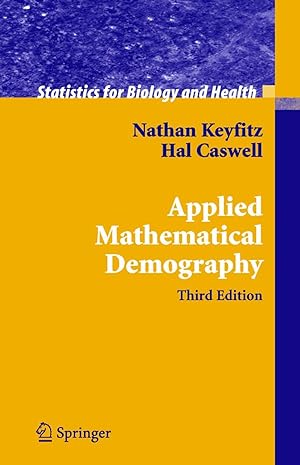
Aggiungi al carrelloCondizione: New. Third edtion of a very popular bookThis third edtion contains new chapters on Matrix Population Models.Introduction: Population Without Age.- The Life Table.- The Matrix Model Framework.- Mortality Comparisons The Male-Female Ratio.- Fixed Regime o.
-
Applied Mathematical Demography (Statistics for Biology and Health)
Libro 16 di 69: Statistics for Biology and HealthDa: Mispah books, Redhill, SURRE, Regno Unito
Valutazione del venditore 4 su 5 stelle
EUR 187,20
Spedizione EUR 28,94
Spedito da Regno Unito a U.S.A.Quantità: 1 disponibili
Aggiungi al carrelloPaperback. Condizione: Like New. LIKE NEW. SHIPS FROM MULTIPLE LOCATIONS. book.
-

Applied Mathematical Demography
Libro 16 di 69: Statistics for Biology and HealthLingua: Inglese
Editore: Springer-Verlag New York Inc., US, 2010
ISBN 10: 1441919775 ISBN 13: 9781441919779
Da: Rarewaves.com UK, London, Regno Unito
Valutazione del venditore 5 su 5 stelle
EUR 170,52
Spedizione EUR 75,25
Spedito da Regno Unito a U.S.A.Quantità: Più di 20 disponibili
Aggiungi al carrelloPaperback. Condizione: New. Third Edition 2005. The third edition of this classic text maintains its focus on applications of demographic models, while extending its scope to matrix models for stage-classified populations. The authors first introduce the life table to describe age-specific mortality, and then use it to develop theory for stable populations and the rate of population increase. This theory is then revisited in the context of matrix models, for stage-classified as well as age-classified populations. Reproductive value and the stable equivalent population are introduced in both contexts, and Markov chain methods are presented to describe the movement of individuals through the life cycle. Applications of mathematical demography to population projection and forecasting, kinship, microdemography, heterogeneity, and multi-state models are considered. The new edition maintains and extends the book's focus on the consequences of changes in the vital rates. Methods are presented for calculating the sensitivity and elasticity of population growth rate, life expectancy, stable stage distribution, and reproductive value, and for applying those results in comparative studies.Stage-classified models are important in both human demography and population ecology, and this edition features examples from both human and non-human populations. In short, this third edition enlarges considerably the scope and power of demography. It will be an essential resource for students and researchers in demography and in animal and plant population ecology. Nathan Keyfitz is Professor Emeritus of Sociology at Harvard University. After holding positions at Canada's Dominion Bureau of Statistics, the University of Chicago, and the University of California at Berkeley, he became Andelot Professor of Sociology and Demography at Harvard in 1972. After retiring from Harvard, he became Director of the Population Program at the International Institute for Applied Systems Analysis (IIASA) in Vienna from 1983 to 1993. Keyfitz is a member of the U.S. National Academy of Sciences and the Royal Society of Canada, and a Fellow of the American Academy of Arts and Sciences.He has received the Mindel Sheps Award of the Population Association of America and the Lazarsfeld Award of the American Sociological Association, and was the 1997 Laureate of the International Union for the Scientific Study of Population. He has written 12 books, including Introduction to the Mathematics of Population (1968) and, with Fr. Wilhelm Flieger, SVD, World Population Growth and Aging: Demographic Trends in the Late Twentieth Century (1990). Hal Caswell is a Senior Scientist in the Biology Department of the Woods Hole Oceanographic Institution, where he holds the Robert W. Morse Chair for Excellence in Oceanography. He is a Fellow of the American Academy of Arts and Sciences. He has held a Maclaurin Fellowship from the New Zealand Institute of Mathematics and its Applications and a John Simon Guggenheim Memorial Fellowship. His research focuses o.
-

Applied Mathematical Demography
Libro 16 di 69: Statistics for Biology and HealthLingua: Inglese
Editore: Springer-Verlag New York Inc., US, 2005
ISBN 10: 0387225374 ISBN 13: 9780387225371
Da: Rarewaves.com UK, London, Regno Unito
Valutazione del venditore 5 su 5 stelle
EUR 170,83
Spedizione EUR 75,25
Spedito da Regno Unito a U.S.A.Quantità: 1 disponibili
Aggiungi al carrelloHardback. Condizione: New. Third Edition 2005. The third edition of this classic text maintains its focus on applications of demographic models, while extending its scope to matrix models for stage-classified populations. The authors first introduce the life table to describe age-specific mortality, and then use it to develop theory for stable populations and the rate of population increase. This theory is then revisited in the context of matrix models, for stage-classified as well as age-classified populations. Reproductive value and the stable equivalent population are introduced in both contexts, and Markov chain methods are presented to describe the movement of individuals through the life cycle. Applications of mathematical demography to population projection and forecasting, kinship, microdemography, heterogeneity, and multi-state models are considered.The new edition maintains and extends the book's focus on the consequences of changes in the vital rates. Methods are presented for calculating the sensitivity and elasticity of population growth rate, life expectancy, stable stage distribution, and reproductive value, and for applying those results in comparative studies.Stage-classified models are important in both human demography and population ecology, and this edition features examples from both human and non-human populations. In short, this third edition enlarges considerably the scope and power of demography. It will be an essential resource for students and researchers in demography and in animal and plant population ecology. Nathan Keyfitz is Professor Emeritus of Sociology at Harvard University. After holding positions at Canada's Dominion Bureau of Statistics, the University of Chicago, and the University of California at Berkeley, he became Andelot Professor of Sociology and Demography at Harvard in 1972. After retiring from Harvard, he became Director of the Population Program at the International Institute for Applied Systems Analysis (IIASA) in Vienna from 1983 to 1993. Keyfitz is a member of the U.S. National Academy of Sciences and the Royal Society of Canada, and a Fellow of the American Academy of Arts and Sciences.He has received the Mindel Sheps Award of the Population Association of America and the Lazarsfeld Award of the American Sociological Association, and was the 1997 Laureate of the International Union for the Scientific Study of Population. He has written 12 books, including Introduction to the Mathematics of Population (1968) and, with Fr. Wilhelm Flieger, SVD, World Population Growth and Aging: Demographic Trends in the Late Twentieth Century (1990). Hal Caswell is a Senior Scientist in the Biology Department of the Woods Hole Oceanographic Institution, where he holds the Robert W. Morse Chair for Excellence in Oceanography. He is a Fellow of the American Academy of Arts and Sciences. He has held a Maclaurin Fellowship from the New Zealand Institute of Mathematics and its Applications and a John Simon Guggenheim Memorial Fellowship. His research focuses on.
-
EUR 127,40
Spedizione EUR 48,99
Spedito da Germania a U.S.A.Quantità: Più di 20 disponibili
Aggiungi al carrelloCondizione: New. Dieser Artikel ist ein Print on Demand Artikel und wird nach Ihrer Bestellung fuer Sie gedruckt. Third edtion of a very popular bookThis third edtion contains new chapters on Matrix Population Models.Introduction: Population Without Age.- The Life Table.- The Matrix Model Framework.- Mortality Comparisons The Male-Female Ratio.- Fixed Regime o.
-
Applied Mathematical Demography
Libro 16 di 69: Statistics for Biology and HealthDa: Majestic Books, Hounslow, Regno Unito
Valutazione del venditore 4 su 5 stelle
EUR 211,09
Spedizione EUR 7,52
Spedito da Regno Unito a U.S.A.Quantità: 4 disponibili
Aggiungi al carrelloCondizione: New. Print on Demand pp. 584 74 Illus.
-
Applied Mathematical Demography
Libro 16 di 69: Statistics for Biology and HealthDa: Biblios, Frankfurt am main, HESSE, Germania
Valutazione del venditore 4 su 5 stelle
EUR 209,56
Spedizione EUR 9,95
Spedito da Germania a U.S.A.Quantità: 4 disponibili
Aggiungi al carrelloCondizione: New. PRINT ON DEMAND pp. 584.

