
Lauri tenhunen (9 risultati)

- Brossura
Da: My Dead Aunt's Books, Hyattsville, MD, U.S.A.My Dead Aunt's Books
Contatta il venditoreVenditore con 5 stelleCondizione: Usato - Molto buono
EUR 27,46
EUR 4,89 spedizioneSpedito in U.S.A.Quantità: 1 disponibile
paperback. Condizione: Very Good. 1990 edition, published by University of Tampere. Paperback, 98 pages plus references.
Lingua: Inglese
Editore: VDM Verlag Dr. Mueller Aktiengesellschaft & Co. KG, 2013
- Brossura
Da: Books Puddle, Woodside, NY, U.S.A.Books Puddle
Contatta il venditoreVenditore con 4 stelleCondizione: Nuovo
EUR 93,12
EUR 3,55 spedizioneSpedito in U.S.A.Quantità: 4 disponibili
Condizione: New. pp. 124.

- Brossura
Da: preigu, Osnabrück, Germaniapreigu
Contatta il venditoreVenditore con 5 stelleCondizione: Nuovo
EUR 47,95
EUR 70,00 spedizioneSpedito da Germania a U.S.A.Quantità: 5 disponibili
Taschenbuch. Condizione: Neu. The CES and Par Production Functions and Income Distribution | Lauri Tenhunen | Taschenbuch | 124 S. | Englisch | 2014 | LAP LAMBERT Academic Publishing | EAN 9783659507441 | Verantwortliche Person für die EU: BoD - Books on Demand, In de Tarpen 42, 22848 Norderstedt, info[at]bod[dot]de | Anbieter: preigu. …

- Brossura
- Print on Demand
Da: BuchWeltWeit Ludwig Meier e.K., Bergisch Gladbach, GermaniaBuchWeltWeit Ludwig Meier e.K.
Contatta il venditoreVenditore con 5 stelleCondizione: Nuovo
EUR 49,90
EUR 23,00 spedizioneSpedito da Germania a U.S.A.Quantità: 2 disponibili
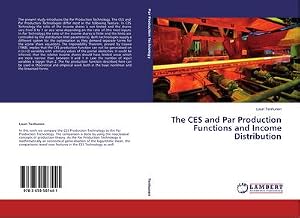
Taschenbuch. Condizione: Neu. This item is printed on demand - it takes 3-4 days longer - Neuware -The present study introduces the Par Production Technology. The CES and Par Production Technologies differ most in the following feature. In CES Technology the ratio of the income shares is not limited and the shares vary from 0 to 1 or vice versa depending on the ratio of (the two) inputs. In Par Technology the ratio of the income shares is finite and the limits are controlled by the distribution limit parameter(s). Both technologies supply a different system for the optimisation as they demand separate forms for the icome share equations. The Impossibility Theorem, proved by Uzawa (1968), implies that the CES production function can not be generalised on n (n2) variables with arbitrary values of the partial elasticities. It could be inferred, that the relative income shares should have limited areas which are more narrow than between 0 and 1 in case the number of input variables is bigger than 2. The Par production function described here can be used in theoretical and empirical work both in the basic nonlinear and the linearised forms. 124 pp. Englisch.…
- Brossura
- Print on Demand
Da: AHA-BUCH GmbH, Einbeck, GermaniaAHA-BUCH GmbH
Contatta il venditoreVenditore con 5 stelleCondizione: Nuovo
EUR 55,56
EUR 35,00 spedizioneSpedito da Germania a U.S.A.Quantità: 1 disponibile
Taschenbuch. Condizione: Neu. nach der Bestellung gedruckt Neuware - Printed after ordering - The present study introduces the Par Production Technology. The CES and Par Production Technologies differ most in the following feature. In CES Technology the ratio of the income shares is not limited and the shares vary from 0 to 1 or vice versa depending on the ratio of (the two) inputs. In Par Technology the ratio of the income shares is finite and the limits are controlled by the distribution limit parameter(s). Both technologies supply a different system for the optimisation as they demand separate forms for the icome share equations. The Impossibility Theorem, proved by Uzawa (1968), implies that the CES production function can not be generalised on n (n2) variables with arbitrary values of the partial elasticities. It could be inferred, that the relative income shares should have limited areas which are more narrow than between 0 and 1 in case the number of input variables is bigger than 2. The Par production function described here can be used in theoretical and empirical work both in the basic nonlinear and the linearised forms.…

- Brossura
- Print on Demand
Da: moluna, Greven, Germaniamoluna
Contatta il venditoreVenditore con 5 stelleCondizione: Nuovo
EUR 45,45
EUR 48,99 spedizioneSpedito da Germania a U.S.A.Quantità: Più di 20 disponibili
Condizione: New. Dieser Artikel ist ein Print on Demand Artikel und wird nach Ihrer Bestellung fuer Sie gedruckt. Autor/Autorin: Tenhunen LauriIn this work we compare the CES Production Technology to the Par Production Technology. The comparison is done by using the neoclassical concepts of production theory. As the Par Production Technology is mathematically .…
Lingua: Inglese
Editore: VDM Verlag Dr. Mueller Aktiengesellschaft & Co. KG, 2013
- Brossura
- Print on Demand
Da: Majestic Books, Hounslow, Regno UnitoMajestic Books
Contatta il venditoreVenditore con 4 stelleCondizione: Nuovo
EUR 94,08
EUR 7,65 spedizioneSpedito da Regno Unito a U.S.A.Quantità: 4 disponibili
Condizione: New. Print on Demand pp. 124 2:B&W 6 x 9 in or 229 x 152 mm Perfect Bound on Creme w/Gloss Lam.
Lingua: Inglese
Editore: VDM Verlag Dr. Mueller Aktiengesellschaft & Co. KG, 2013
- Brossura
- Print on Demand
Da: Biblios, frankfurt am main, HESSE, GermaniaBiblios
Contatta il venditoreVenditore con 4 stelleCondizione: Nuovo
EUR 93,70
EUR 9,95 spedizioneSpedito da Germania a U.S.A.Quantità: 4 disponibili
Condizione: New. PRINT ON DEMAND pp. 124.

- Brossura
- Print on Demand
Da: buchversandmimpf2000, Emtmannsberg, BAYE, Germaniabuchversandmimpf2000
Contatta il venditoreVenditore con 5 stelleCondizione: Nuovo
EUR 54,90
EUR 60,00 spedizioneSpedito da Germania a U.S.A.Quantità: 1 disponibile
Taschenbuch. Condizione: Neu. This item is printed on demand - Print on Demand Titel. Neuware -The present study introduces the Par Production Technology. The CES and Par Production Technologies differ most in the following feature. In CES Technology the ratio of the income shares is not limited and the shares vary from 0 to 1 or vice versa depending on the ratio of (the two) inputs. In Par Technology the ratio of the income shares is finite and the limits are controlled by the distribution limit parameter(s). Both technologies supply a different system for the optimisation as they demand separate forms for the icome share equations. The Impossibility Theorem, proved by Uzawa (1968), implies that the CES production function can not be generalised on n (n>2) variables with arbitrary values of the partial elasticities. It could be inferred, that the relative income shares should have limited areas which are more narrow than between 0 and 1 in case the number of input variables is bigger than 2. The Par production function described here can be used in theoretical and empirical work both in the basic nonlinear and the linearised forms.VDM Verlag, Dudweiler Landstraße 99, 66123 Saarbrücken 124 pp. Englisch.…


