
Importo totale (1 articolo articoli):
Destinazione ordine:

levaniouk olga (58 risultati)
Vai alla pagina principale dei risultati di ricerca
Filtri di ricerca
Tipo di articolo
- Tutti i tipi di prodotto
- Libri (58)
- Riviste e Giornali (Nessun altro risultato corrispondente a questo perfezionamento)
- Fumetti (Nessun altro risultato corrispondente a questo perfezionamento)
- Spartiti (Nessun altro risultato corrispondente a questo perfezionamento)
- Arte, Stampe e Poster (Nessun altro risultato corrispondente a questo perfezionamento)
- Fotografie (Nessun altro risultato corrispondente a questo perfezionamento)
- Mappe (Nessun altro risultato corrispondente a questo perfezionamento)
- Manoscritti e Collezionismo cartaceo (Nessun altro risultato corrispondente a questo perfezionamento)
Condizioni Maggiori informazioni
- Nuovo (45)
- Come nuovo, Ottimo o Quasi ottimo (6)
- Molto buono o Buono (6)
- Discreto o Mediocre (Nessun altro risultato corrispondente a questo perfezionamento)
- Come descritto (1)
Legatura
Ulteriori caratteristiche
- Prima ed. (1)
- Copia autograf. (Nessun altro risultato corrispondente a questo perfezionamento)
- Sovracoperta (1)
- Con foto (23)
- Non Print on Demand (43)
Lingua (2)
Spedizione gratuita
Paese del venditore
Valutazione venditore
-

Eve of the Festival : Making Myth in Odyssey 19
Lingua: Inglese
Editore: Center for Hellenic Studies, 2011
ISBN 10: 0674053354 ISBN 13: 9780674053359
Da: GreatBookPrices, Columbia, MD, U.S.A.
Valutazione del venditore 5 su 5 stelle

Condizione: As New. Unread book in perfect condition.
-

Eve of the Festival : Making Myth in Odyssey 19
Lingua: Inglese
Editore: Center for Hellenic Studies, 2011
ISBN 10: 0674053354 ISBN 13: 9780674053359
Da: GreatBookPrices, Columbia, MD, U.S.A.
Valutazione del venditore 5 su 5 stelle
Condizione: New.
-

Eve of the Festival
Da: PBShop.store US, Wood Dale, IL, U.S.A.
Valutazione del venditore 5 su 5 stelle
PAP. Condizione: New. New Book. Shipped from UK. Established seller since 2000.
-

Eve of the Festival: Making Myth in Odyssey 19 (Paperback or Softback)
Lingua: Inglese
Editore: Harvard University Press 8/1/2011, 2011
ISBN 10: 0674053354 ISBN 13: 9780674053359
Da: BargainBookStores, Grand Rapids, MI, U.S.A.
Valutazione del venditore 5 su 5 stelle
Paperback or Softback. Condizione: New. Eve of the Festival: Making Myth in Odyssey 19. Book.
-

Eve of the Festival
Lingua: Inglese
Editore: Harvard University, Center for Hellenic Studies, US, 2011
ISBN 10: 0674053354 ISBN 13: 9780674053359
Da: Rarewaves.com USA, London, LONDO, Regno Unito
Valutazione del venditore 5 su 5 stelle
EUR 25,23
Spedizione gratuita
Spedito da Regno Unito a U.S.A.Quantità: Più di 20 disponibili
Aggiungi al carrelloPaperback. Condizione: New. Eve of the Festival is a study of Homeric myth-making in the first and longest dialogue of Penelope and Odysseus (Odyssey 19). This study makes a case for seeing virtuoso myth-making as an essential part of this conversation, a register of communication important for the interaction between the two speakers. At the core of the book is a detailed examination of several myths in the dialogue in an attempt to understand what is being said and how. The dialogue as a whole is interpreted as an exchange of performances that have the eve of Apollo's festival as their occasion and that amount to activating, and even enacting, the myth corresponding within the Odyssey to the ritual event of the festival.
-
Eve of the Festival: Making Myth in Odyssey 19 (Hellenic Studies Series)
Lingua: Inglese
Editore: Center for Hellenic Studies, 2011
ISBN 10: 0674053354 ISBN 13: 9780674053359
Da: Lucky's Textbooks, Dallas, TX, U.S.A.
Valutazione del venditore 5 su 5 stelle
Condizione: New.
-
Eve of the Festival
Da: PBShop.store UK, Fairford, GLOS, Regno Unito
Valutazione del venditore 5 su 5 stelle
EUR 22,81
EUR 5,76 shipping
Spedito da Regno Unito a U.S.A.Quantità: 15 disponibili
Aggiungi al carrelloPAP. Condizione: New. New Book. Shipped from UK. Established seller since 2000.
-
Eve of the Festival
Da: Majestic Books, Hounslow, Regno Unito
Valutazione del venditore 4 su 5 stelle

EUR 24,89
EUR 7,46 shipping
Spedito da Regno Unito a U.S.A.Quantità: 3 disponibili
Aggiungi al carrelloCondizione: New. pp. 378.
-
Eve of the Festival: Making Myth in Odyssey 19
Lingua: Inglese
Editore: Harvard University, Center for Hellenic Studies, 2011
ISBN 10: 0674053354 ISBN 13: 9780674053359
Da: Kennys Bookshop and Art Galleries Ltd., Galway, GY, Irlanda
Valutazione del venditore 5 su 5 stelle
EUR 23,62
EUR 10,50 shipping
Spedito da Irlanda a U.S.A.Quantità: Più di 20 disponibili
Aggiungi al carrelloCondizione: New. A study of Homeric myth-making in the first and longest dialogue of Penelope and Odysseus ("Odyssey 19"). It makes a case for seeing virtuoso myth-making as an essential part of this conversation, a register of communication important for the interaction between the two speakers. Series: Hellenic Studies. Num Pages: 200 pages, black & white illustrations. BIC Classification: 2AHA; DSBB; DSC; JFHF. Category: (G) General (US: Trade). Dimension: 229 x 140 x 20. Weight in Grams: 508. . 2011. Paperback. . . . .
-
Eve of the Festival: Making Myth in Odyssey 19
Lingua: Inglese
Editore: Harvard University, Center for Hellenic Studies, 2011
ISBN 10: 0674053354 ISBN 13: 9780674053359
Da: Kennys Bookstore, Olney, MD, U.S.A.
Valutazione del venditore 4 su 5 stelle
Condizione: New. A study of Homeric myth-making in the first and longest dialogue of Penelope and Odysseus ("Odyssey 19"). It makes a case for seeing virtuoso myth-making as an essential part of this conversation, a register of communication important for the interaction between the two speakers. Series: Hellenic Studies. Num Pages: 200 pages, black & white illustrations. BIC Classification: 2AHA; DSBB; DSC; JFHF. Category: (G) General (US: Trade). Dimension: 229 x 140 x 20. Weight in Grams: 508. . 2011. Paperback. . . . . Books ship from the US and Ireland.
-
Eve of the Festival (Hellenic Studies)
Lingua: Inglese
Editore: Harvard University Press 2011-06-03, 2011
ISBN 10: 0674053354 ISBN 13: 9780674053359
Da: Chiron Media, Wallingford, Regno Unito
Valutazione del venditore 4 su 5 stelle
EUR 21,69
EUR 17,78 shipping
Spedito da Regno Unito a U.S.A.Quantità: Più di 20 disponibili
Aggiungi al carrelloPaperback. Condizione: New.
-
Condizione: New. pp. 378.
-

Nine Essays on Homer
Lingua: Inglese
Editore: Rowman & Littlefield, Lanham, MD, 1999
ISBN 10: 0847694232 ISBN 13: 9780847694235
Da: Smith Family Bookstore Downtown, Eugene, OR, U.S.A.
Valutazione del venditore 4 su 5 stelle
Hardcover. Condizione: Very Good. Inscribed by authors on half-title page. Gift inscription with signatures of other authors included in the on half-title page. Text clean and unmarked. Binding tight. Boards have light wear. Edges of pages have light wear. No dust jacket.
-
Eve of the Festival: Making Myth in Odyssey 19
Lingua: Inglese
Editore: Harvard University, Center for Hellenic Studies, 2011
ISBN 10: 0674053354 ISBN 13: 9780674053359
Da: THE SAINT BOOKSTORE, Southport, Regno Unito
Valutazione del venditore 5 su 5 stelle
EUR 22,84
EUR 18,51 shipping
Spedito da Regno Unito a U.S.A.Quantità: Più di 20 disponibili
Aggiungi al carrelloPaperback / softback. Condizione: New. New copy - Usually dispatched within 4 working days. 538.
-

Eve of the Festival : Making Myth in Odyssey 19
Lingua: Inglese
Editore: Center for Hellenic Studies, 2011
ISBN 10: 0674053354 ISBN 13: 9780674053359
Da: GreatBookPricesUK, Woodford Green, Regno Unito
Valutazione del venditore 5 su 5 stelle
EUR 23,32
EUR 17,22 shipping
Spedito da Regno Unito a U.S.A.Quantità: Più di 20 disponibili
Aggiungi al carrelloCondizione: As New. Unread book in perfect condition.
-

Eve of the Festival : Making Myth in Odyssey 19
Lingua: Inglese
Editore: Center for Hellenic Studies, 2011
ISBN 10: 0674053354 ISBN 13: 9780674053359
Da: GreatBookPricesUK, Woodford Green, Regno Unito
Valutazione del venditore 5 su 5 stelle
EUR 28,13
EUR 17,22 shipping
Spedito da Regno Unito a U.S.A.Quantità: Più di 20 disponibili
Aggiungi al carrelloCondizione: New.
-
Eve of the Festival Making Myth in Odyssey 19
Lingua: Inglese
Editore: Harvard Univ Center for Hellenic, 2010
ISBN 10: 0674053354 ISBN 13: 9780674053359
Da: Revaluation Books, Exeter, Regno Unito
Valutazione del venditore 5 su 5 stelle
EUR 35,26
EUR 14,35 shipping
Spedito da Regno Unito a U.S.A.Quantità: 2 disponibili
Aggiungi al carrelloPaperback. Condizione: Brand New. 200 pages. 9.02x5.51x0.59 inches. In Stock.
-

Eve of the Festival - Making Myth in Odyssey 19.
Lingua: Inglese
Editore: Massachusetts: Harvard University Press, 2011
ISBN 10: 0674053354 ISBN 13: 9780674053359
Da: Fundus-Online GbR Borkert Schwarz Zerfaß, Berlin, Germania
Membro dell'associazione: BOEV GIAQ
Valutazione del venditore 5 su 5 stelle
EUR 19,00
EUR 40,00 shipping
Spedito da Germania a U.S.A.Quantità: 1 disponibili
Aggiungi al carrelloOriginal brochure. Condizione: Gut. Hellenic Studies 46. 368 p. From the library of Prof. Wolfgang Haase, long-time editor of ANRW and the International Journal of the Classical Tradition (IJCT). - Condition: Slightly gappy binding, otherwise in very good condition. / Zustand: Leicht klaffender Einband, ansonsten im sehr guten Zustand. - Content: This book is about the poetics of myth in a single Homeric conversation, the dialogue between Penelope and Odysseus in Odyssey 19, their first, longest, and most enigmatic exchange of words. My interest in the way myth functions in oral poetry precedes my interest in the dialogue and goes beyond it, but making general theoretical claims on the subject is not the primary goal of the current work. Rather, this is an applied endeavor, an attempt not only to illustrate the workings of myth in Homer, but also to study a particular episode through a mythological lens and to gain interpretive ground in this way. The scene I have chosen for my test case has received its share of scholarly attention and has been viewed as everything from a compositional low point to a masterpiece of indeterminacy. Interpretations have changed dramatically over the last hundred years, and in my opinion much for the better, so that at the moment the treatment of dialogue constitutes a good example of advances in Homeric scholarship. The study of Homeric genres of discourse, voices, conversational patterns, and properties of spoken word has been something of a growth industry in recent decades, with the result that the old subject of "speeches" in Homer has emerged in a completely new light. Questions of disguise, identity, recognition, coded speech, knowledge, and ignorance have also been at the center of Odyssean studies. As one of the longest sustained conversations in Homer, especially interesting for its interlocutors of different genders, the dialogue has become a battleground and a test case for these scholarly trends. More than that, the scene in Book 19 is also arguably the moment of Penelope's most crucial decision in the poem, and accordingly has attracted the attention of scholars interested in questions of agency in general and female agency in particular. Important work on gender and gendered poetics in the Odyssey has also focused on the dialogue, not surprisingly, since this is the scene where Penelope says more about herself than anywhere else. In short, there is no shortage of excellent and compelling scholarship on the very scene I propose to discuss, and I can make no pretences here about correcting past wrongs or restoring an overlooked subject to its proper place under the sun. The dialogue has not, to my knowledge, been analyzed from the particular angle I adopt, but this only partly justifies my decision to focus on this well-studied scene. Primarily I venture to write about it because, for all the unquestionable scholarly advances, the episode remains among the most mysterious in the Odyssey, its mysteries perhaps deepened rather than resolved by recent scholarship. Several factors make the interpretation of the dialogue so complicated. For one thing, Penelope and Odysseus do not speak plainly, but in hints, coded messages, and multi-layered statements, Odysseus' physical disguise as a beggar being only one of many levels of concealment and revelation that come into play as the couple talk. Introducing the stranger, Eumaeus prepares Penelope for someone who speaks like a poet, a master of words, a person whose power of speech is enchanting (Odyssey 17.518-521). For his part, Odysseus observes Penelope with the suitors and concludes that she says one thing but hides another meaning underneath, and that she too has the power to charm with words (Odyssey 18.281-283). When the two meet, they put their impressive powers of verbal art to full use, engaging in an exchange of performances, in fact a dialogue in performances, where each interlocutor is fully able to appreciate the other's skills. Indirect, allusive, enigmatic, powerful, and manipulative discourse is omnipresent in the scene. In my opinion, the dialogue in Odyssey 19 can even be seen as a performative agon, and one of 2 the most sophisticated examples of such agonistic exchanges that have come down to us from antiquity. All of this is what makes the dialogue so interesting but it also makes for a difficult task for a modern, or for that matter ancient, interpreter. No doubt the scene, full of hints and riddles as it is, was meant to entertain by exercising the detective faculties even of the ancient audiences, but modern scholars are at a particular disadvantage, being outsiders who do not speak the language, literally and metaphorically. In the case of Odyssey 19, our plight is aggravated by what has been called "the Penelope question," the question whether or not Penelope recognizes Odysseus at this stage. This has been one of the most debated problems in Odyssean studies, with battle lines firmly drawn and copious argumentation presented on both sides.71 attempt to keep this question somewhat in the background, in the hopes of preventing it from overshadowing the rest of the argument, though I do, of course, make my answer to it clear. My reluctance to engage with the "Penelope question" more fully is motivated by the realization that no argument on this subject is likely to change many minds, a conclusion that can be safely drawn from recent scholarship. There is an inevitable element of subjectivity in each scholar's answer to the question, as all such answers involve some reasoning based on what Penelope is or is not likely to do or say, and on what does and does not make sense. And yet there is in the end no avoiding of the troublesome Penelope question, at least not entirely, since Penelope's utterances and her actions may be taken in widely different ways depending on whether she speaks to a complete stranger or to someone whom she at least suspects of being her husband. When I suggest my own interpretation of the dialogue, therefore, and.
-
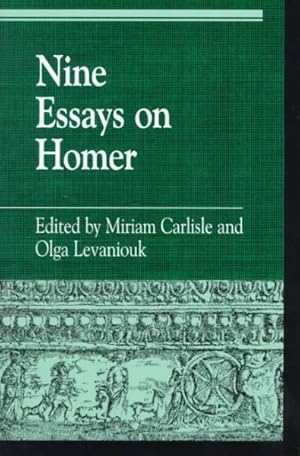
Nine Essays on Homer
Lingua: Inglese
Editore: Rowman & Littlefield Publishers, 1999
ISBN 10: 0847694240 ISBN 13: 9780847694242
Da: GreatBookPrices, Columbia, MD, U.S.A.
Valutazione del venditore 5 su 5 stelle
Condizione: New.
-

Nine Essays on Homer
Lingua: Inglese
Editore: Rowman & Littlefield Publishers, 1999
ISBN 10: 0847694240 ISBN 13: 9780847694242
Da: Lucky's Textbooks, Dallas, TX, U.S.A.
Valutazione del venditore 5 su 5 stelle
Condizione: New.
-
Nine Essays on Homer
Lingua: Inglese
Editore: Rowman & Littlefield Publishers, 1999
ISBN 10: 0847694240 ISBN 13: 9780847694242
Da: California Books, Miami, FL, U.S.A.
Valutazione del venditore 5 su 5 stelle
EUR 67,60
Spedizione gratuita
Spedito in U.S.A.Quantità: Più di 20 disponibili
Aggiungi al carrelloCondizione: New.
-
Nine Essays on Homer
Lingua: Inglese
Editore: Rowman & Littlefield Publishers, 1999
ISBN 10: 0847694240 ISBN 13: 9780847694242
Da: Ria Christie Collections, Uxbridge, Regno Unito
Valutazione del venditore 5 su 5 stelle
EUR 54,75
EUR 13,75 shipping
Spedito da Regno Unito a U.S.A.Quantità: Più di 20 disponibili
Aggiungi al carrelloCondizione: New. In.
-
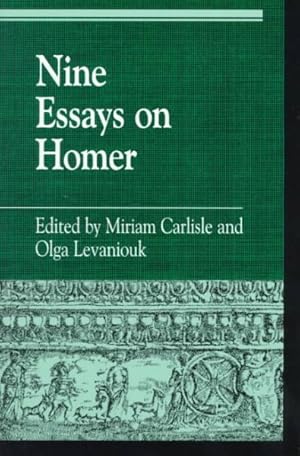
Nine Essays on Homer
Lingua: Inglese
Editore: Rowman & Littlefield Publishers, 1999
ISBN 10: 0847694240 ISBN 13: 9780847694242
Da: GreatBookPrices, Columbia, MD, U.S.A.
Valutazione del venditore 5 su 5 stelle
Condizione: As New. Unread book in perfect condition.
-
Nine Essays on Homer (Paperback)
Lingua: Inglese
Editore: Bloomsbury Publishing Plc, Lanham, MD, 1999
ISBN 10: 0847694240 ISBN 13: 9780847694242
Da: Grand Eagle Retail, Bensenville, IL, U.S.A.
Valutazione del venditore 5 su 5 stelle
Paperback. Condizione: new. Paperback. The essays in this collection addresses questions of intense interest in Homeric studies today: the questions of performance and poet-audience interaction, especially as depicted in idealized performances within the Iliad and the Odyssey; the ways in which epic incorporates material of diverse genres, such as women's laments, blame poetry, or folk tales; how the ideological balance of epic can change and be influenced by "alternative ideologies" introduced through the incorporation of new material; the implications of the continuity of tradition for etymological studies; and how the traditional nature of epic affects textual criticism.The essays differ in focus and method, but all share one fundamental approach to Homer: an understanding of the Homeric tradition as a poetic system that expresses and preserves what is culturally important and a view of the Homeric epics as instances of a cultural tradition which they attempt to explore through the epics themselves and through the comparative, anthropological, and linguistic evidence they bring to bear on these texts.A unique collection that explores Homeric poetry through a variety of tools and approacheslinguistics, philology, cultural anthropology, sociology, textual criticism, and archeologythis volume will be of interest to all scholars and students of oral poetry and Classical literature. The essays in this collection address questions of interest in Homeric studies: the questions of performance and poet-audience interaction, especially as depicted in idealized performances within the "Iliad" and the "Odyssey". Shipping may be from multiple locations in the US or from the UK, depending on stock availability.
-

EUR 23,93
EUR 48,99 shipping
Spedito da Germania a U.S.A.Quantità: Più di 20 disponibili
Aggiungi al carrelloKartoniert / Broschiert. Condizione: New. A study of Homeric myth-making in the first and longest dialogue of Penelope and Odysseus ( Odyssey 19 ). It makes a case for seeing virtuoso myth-making as an essential part of this conversation, a register of communication important for the interaction be.
-

Light and Darkness in Ancient Greek Myth and Religion (Greek Studies: Interdisciplinary Approaches)
Libro 13 di 20: Greek Studies: Interdisciplinary ApproachesDa: William H. Allen Bookseller, Shillington, PA, U.S.A.
Valutazione del venditore 5 su 5 stelle
Hard Cover. Condizione: Very Good. Condizione sovraccoperta: Good. Size: 8vo - otver 7¾" - 9¾" Tall.
-

Nine Essays on Homer
Lingua: Inglese
Editore: Rowman & Littlefield Publishers, 1999, 1999
Da: OPEN DOOR BOOKSHOP, Roma, RM, Italia
Valutazione del venditore 4 su 5 stelle
EUR 40,00
EUR 35,00 shipping
Spedito da Italia a U.S.A.Quantità: 1 disponibili
Aggiungi al carrelloSoft cover. Condizione: As New. Paperback. . xxii, 241pp.
-

Nine Essays on Homer
Lingua: Inglese
Editore: Rowman & Littlefield Publishers, 1999
ISBN 10: 0847694240 ISBN 13: 9780847694242
Da: GreatBookPricesUK, Woodford Green, Regno Unito
Valutazione del venditore 5 su 5 stelle
EUR 63,68
EUR 17,22 shipping
Spedito da Regno Unito a U.S.A.Quantità: 3 disponibili
Aggiungi al carrelloCondizione: New.
-

Nine Essays on Homer
Lingua: Inglese
Editore: Rowman & Littlefield Publishers, 1999
ISBN 10: 0847694240 ISBN 13: 9780847694242
Da: GreatBookPricesUK, Woodford Green, Regno Unito
Valutazione del venditore 5 su 5 stelle
EUR 75,10
EUR 17,22 shipping
Spedito da Regno Unito a U.S.A.Quantità: 3 disponibili
Aggiungi al carrelloCondizione: As New. Unread book in perfect condition.
-

Eve of the Festival : Making Myth in Odyssey 19
Lingua: Inglese
Editore: Harvard University, Center For Hellenic Studies Aug 2011, 2011
ISBN 10: 0674053354 ISBN 13: 9780674053359
EUR 29,85
EUR 63,05 shipping
Spedito da Germania a U.S.A.Quantità: 2 disponibili
Aggiungi al carrelloTaschenbuch. Condizione: Neu. Neuware - 'Eve of the Festival' is a study of Homeric myth-making in the first and longest dialogue of Penelope and Odysseus ('Odyssey '19). This study makes a case for seeing virtuoso myth-making as an essential part of this conversation, a register of communication important for the interaction between the two speakers. At the core of the book is a detailed examination of several myths in the dialogue in an attempt to understand what is being said and how. The dialogue as a whole is interpreted as an exchange of performances that have the eve of Apollo's festival as their occasion and that amount to activating, and even enacting, the myth corresponding within the Odyssey to the ritual event of the festival.

