

Importo totale (1 articolo articoli):
Destinazione ordine:

mastykova (6 risultati)
Vai alla pagina principale dei risultati di ricerca
Filtri di ricerca
Tipo di articolo
- Tutti i tipi di prodotto
- Libri (6)
- Riviste e Giornali (Nessun altro risultato corrispondente a questo perfezionamento)
- Fumetti (Nessun altro risultato corrispondente a questo perfezionamento)
- Spartiti (Nessun altro risultato corrispondente a questo perfezionamento)
- Arte, Stampe e Poster (Nessun altro risultato corrispondente a questo perfezionamento)
- Fotografie (Nessun altro risultato corrispondente a questo perfezionamento)
- Mappe (Nessun altro risultato corrispondente a questo perfezionamento)
- Manoscritti e Collezionismo cartaceo (Nessun altro risultato corrispondente a questo perfezionamento)
Condizioni Maggiori informazioni
- Nuovo (Nessun altro risultato corrispondente a questo perfezionamento)
- Come nuovo, Ottimo o Quasi ottimo (4)
- Molto buono o Buono (2)
- Discreto o Mediocre (Nessun altro risultato corrispondente a questo perfezionamento)
- Come descritto (Nessun altro risultato corrispondente a questo perfezionamento)
Legatura
- Tutte
- Rilegato (Nessun altro risultato corrispondente a questo perfezionamento)
- Brossura (6)
Ulteriori caratteristiche
- Prima ed. (1)
- Copia autograf. (Nessun altro risultato corrispondente a questo perfezionamento)
- Sovracoperta (Nessun altro risultato corrispondente a questo perfezionamento)
- Con foto (2)
- Non Print on Demand (6)
Lingua (2)
Prezzo
- Qualsiasi prezzo
- Inferiore a EUR 20 (Nessun altro risultato corrispondente a questo perfezionamento)
- EUR 20 a EUR 45
- Superiore a EUR 45
Spedizione gratuita
- Spedizione gratuita in U.S.A. (Nessun altro risultato corrispondente a questo perfezionamento)
Paese del venditore
Valutazione venditore
-

EUR 21,23
Spedizione EUR 10,00
Spedito da Germania a U.S.A.Quantità: 1 disponibili
Aggiungi al carrelloCondizione: good. Befriedigend/Good: Durchschnittlich erhaltenes Buch bzw. Schutzumschlag mit Gebrauchsspuren, aber vollständigen Seiten. / Describes the average WORN book or dust jacket that has all the pages present.
-
EUR 21,23
Spedizione EUR 10,00
Spedito da Germania a U.S.A.Quantità: 1 disponibili
Aggiungi al carrelloCondizione: very good. Gut/Very good: Buch bzw. Schutzumschlag mit wenigen Gebrauchsspuren an Einband, Schutzumschlag oder Seiten. / Describes a book or dust jacket that does show some signs of wear on either the binding, dust jacket or pages.
-
Les peuples du Caucase du Nord : le début de l'histoire, Ier-VIIe s. apr. J.-C.
Lingua: Francese
Editore: Errance, coll. « Collection des Hespérides », 2003
ISBN 10: 2877722422 ISBN 13: 9782877722421
Da: Librairie de l'Avenue - Henri Veyrier, Saint-Ouen, FR, Francia
Valutazione del venditore 5 su 5 stelle

EUR 21,00
Spedizione EUR 35,00
Spedito da Francia a U.S.A.Quantità: 1 disponibili
Aggiungi al carrelloCouverture souple. Condizione: Bon état. In-4 broché 25 cm sur 18. 214 pages, couverture illustrée. Ouvrage illustré. Bon état d'occasion. Sommaire, glossaire, bibliographie. Quelques soulignements au crayon à papier.
-
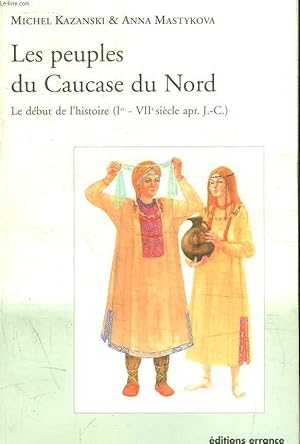
LES PEUPLES DU CAUCASE DU NORD
Da: Le-Livre, SABLONS, Francia
Membro dell'associazione: ILAB
Valutazione del venditore 5 su 5 stelle
EUR 45,80
Spedizione EUR 42,00
Spedito da Francia a U.S.A.Quantità: 1 disponibili
Aggiungi al carrelloCouverture souple. Condizione: bon. R260183443: 2003. In-8. Broché. Bon état, Couv. convenable, Dos satisfaisant, Intérieur frais. 214 pages augmentées de nombreuses illustrations en noir et blanc dans et hors texte. . . . Classification Dewey : 900-GEOGRAPHIE, HISTOIRE, SCIENCES AUXILIAIRES DE L'HISTOIRE.
-
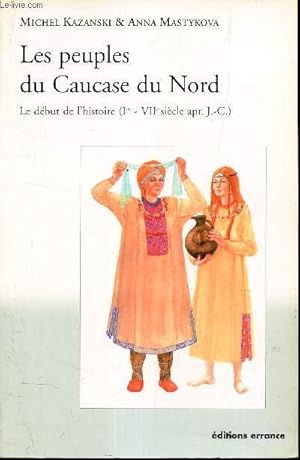
LES PEUPLES DU CAUCASE DU NORD - Le debut de l'histoire (Ier-VIIe siecle apr J.C.).
Da: Le-Livre, SABLONS, Francia
Membro dell'associazione: ILAB
Valutazione del venditore 5 su 5 stelle
EUR 45,80
Spedizione EUR 42,00
Spedito da Francia a U.S.A.Quantità: 1 disponibili
Aggiungi al carrelloCouverture souple. Condizione: bon. R320105807: 2003. In-8. Broché. Bon état, Couv. convenable, Dos satisfaisant, Intérieur frais. 214 pages augmentées de nombreuses photos et dessins en noir et blanc dans et hors texte. . . . Classification Dewey : 930-Histoire générale du monde ancien jusqu'à 499 apr. J.-C.
-

La nécropole gallo-romaine et mérovingienne de Breny (Aisne) d'après les collections et les archives du Musée des Antiquités Nationales
Editore: Monique Mergoil
Da: Okmhistoire, St Rémy-des-Monts, SARTH, Francia
Valutazione del venditore 4 su 5 stelle

Prima edizione
EUR 98,00
Spedizione EUR 33,00
Spedito da Francia a U.S.A.Quantità: 2 disponibili
Aggiungi al carrelloCouverture souple. Condizione: Comme neuf. Edition originale. Montagnac 2002. 1 Volume/1. -- Neu - Broschiert quarto - ( 30 x 21 cm ). -------- 269 seiten , 3 fig , 125 planches ********************* "" La nécropole gallo-romaine et alto-médiévale de Breny, en Picardie, a été fouillée en 1880-81 par Frédéric Moreau : plus de 2200 tombes y ont été mises au jour, selon les méthodes plutôt rudimentaires de l'époque. Malgré ce handicap, l'exploitation des données scientifiques de cette fouille ainsi que du mobilier, conservé au Musée des Antiquités Nationales de Saint-Germain-en-Laye, prend place parmi les dossiers majeurs pour la connaissance de l'occupation du sol et des usages funéraires dans cette région, au même titre que les nécropoles d'Armentières, Caranda, Sablonnière et Arcy-Sainte-Restitue. Comme dans la plupart des sites mentionnés ci-dessus, la nécropole témoigne de la stabilité d'une même communauté du Haut-Empire à la fin de l'époque mérovingienne. Les apports d'objets d'origine étrangère sont classiques pour cette période et ne permettent pas de conclure, par exemple, à une arrivée de population «germanique». Des femmes, notamment, reconnaissables à leurs parures spécifiques, rejoignent la communauté et s'y intègrent rapidement. Une tombe du Bas-Empire (avec épée, hache, lance) et quelques sépultures mérovingiennes (plaques-boucles cloisonnées, important équipement guerrier, monnaie en or) relèvent d'un statut privilégié, mais ces notables sont enterrés auprès des autres défunts. L'étude précise du mobilier (parures, céramiques, verreries, armement), qui dans bien des cas est tout ce qui subsiste des sépultures, permet enfin de replacer Breny dans le contexte des nécropoles gallo-romaines de cette région et de l'évolution locale des populations autochtones sur plus de six siècles. "" ************************************************************ "" Archaeological exploration by Frédéric Moreau in1880-81 in the Gallo-Roman and early medieval cemetery of Breny, Picardy, brought to light more than 2200 graves, which he excavated by the rather rudimentary methods of the time. Despite this handicap, the scientific information recovered from the site, and the grave furnishings, now in the Musée des Antiquités Nationales of Saint-Germain-en-Laye, place it among the most important records of both land-use and funerary ritual in the region, ranking alongside the cemeteries of Armentières, Caranda, Sablonnière and Arcy-Sainte-Restitue. Along with most of those sites, the cemetery testifies to the stability of the High Empire community in the area towards the end of the Merovingian period. The influx of foreign-made objects is standard for the period, and cannot be interpreted as evidence for the arrival of, for example, a large 'Germanic' population. However, a few women of Germanic origin, recognizable by their suites of jewellery, joined the community and were rapidly integrated. A grave of the Low Empire (with sword, axe, and spear) and several Merovingian burials (cloisonné-decorated plate-buckles, high-quality warrior equipment, gold coins.) point to a privileged élite, but these individuals were buried among the rank and file of the population. Careful study of the grave furnishings (suites of jewellery, pottery, glassware, weapons.), which in many cases is all that remains of the graves, allows Breny to be placed once more in the context of the other Gallo-Roman cemeteries in the region and of the local evolution of autochthonous populations over more than six centuries. "" ****************************.


