Importo totale (1 articolo articoli):
Destinazione ordine:

mounier comte (10 risultati)
Vai alla pagina principale dei risultati di ricerca
Filtri di ricerca
Tipo di articolo
- Tutti i tipi di prodotto
- Libri (10)
- Riviste e Giornali (Nessun altro risultato corrispondente a questo perfezionamento)
- Fumetti (Nessun altro risultato corrispondente a questo perfezionamento)
- Spartiti (Nessun altro risultato corrispondente a questo perfezionamento)
- Arte, Stampe e Poster (Nessun altro risultato corrispondente a questo perfezionamento)
- Fotografie (Nessun altro risultato corrispondente a questo perfezionamento)
- Mappe (Nessun altro risultato corrispondente a questo perfezionamento)
- Manoscritti e Collezionismo cartaceo (Nessun altro risultato corrispondente a questo perfezionamento)
Condizioni Maggiori informazioni
- Nuovo (2)
- Come nuovo, Ottimo o Quasi ottimo (6)
- Molto buono o Buono (Nessun altro risultato corrispondente a questo perfezionamento)
- Discreto o Mediocre (1)
- Come descritto (1)
Legatura
Ulteriori caratteristiche
- Prima ed. (5)
- Copia autograf. (1)
- Sovracoperta (Nessun altro risultato corrispondente a questo perfezionamento)
- Con foto (9)
- Non Print on Demand (8)
Lingua (2)
Spedizione gratuita
Paese del venditore
Valutazione venditore
-

Voyage autour du monde Bougainville, Louis-Antoine de
Da: Au bon livre, La Barre en Ouche, Francia
Valutazione del venditore 5 su 5 stelle

EUR 10,00
Spedizione EUR 40,00
Spedito da Francia a U.S.A.Quantità: 1 disponibili
Aggiungi al carrelloJun 10, 1999. Condizione: D'occasion - Bon état. Tirage de 1999, Pocket, coll. Classiques. Texte intégral + Les clés de l'oeuvre par Pierre Mounier. Coins un peu cornés, papier un peu jauni, légères marques d'usage sur le dos, livre en bon état général. Envoi rapide et soigné dans enveloppe à bulles.
-

Suite du Procès-Verbal de l'Assemblée Nationale - N° 30 - Du jeudi 23 Juillet 1789.
Editore: Paris : Baudouin, 1789
Prima edizione
EUR 15,12
Spedizione EUR 32,99
Spedito da Francia a U.S.A.Quantità: 1 disponibili
Aggiungi al carrelloCouverture souple. Condizione: Bon. Edition originale. In-8° broché, 23 pages.
-

Suite du Procès-Verbal de l'Assemblée Nationale. - N° 31 - Du Vendredi 24 Juillet 1789.
Editore: Paris : Baudouin, 1789
Prima edizione
EUR 18,48
Spedizione EUR 32,99
Spedito da Francia a U.S.A.Quantità: 1 disponibili
Aggiungi al carrelloCouverture souple. Condizione: Bon. Edition originale. In-8° broché, 14 pages.
-

Entretiens (1926-1944). Édition établie par Bernard Comte, Yves Roullière et al.
Lingua: Francese
Editore: PUR, 2017
Da: Librairie Pierre Brunet, Paris, Francia
Valutazione del venditore 5 su 5 stelle
EUR 23,00
Spedizione EUR 45,00
Spedito da Francia a U.S.A.Quantità: 1 disponibili
Aggiungi al carrelloCouverture souple. Condizione: Très bon. Rennes, PUR, 2017 ; fort in-8° broché, 979 pp.
-
Souvenirs intimes et notes du Baron Mounier, secrétaire intime de Napoléon Ier, pair de France, directeur général de la police.
Editore: Paris Paul Ollendorff 1896, 1896
Da: Librairie Vignes Online, Paris, Francia
Membro dell'associazione: ILAB
Valutazione del venditore 5 su 5 stelle
EUR 30,00
Spedizione EUR 40,00
Spedito da Francia a U.S.A.Quantità: 1 disponibili
Aggiungi al carrelloCondizione: Acceptable. in-8, bradel demi-percaline verte, VII + 332 pp. Reliure modeste mais solide, intérieur très propre.
-

Suite du procès -Verbal de L'Assemblée Nationale. Du Samedi 18 Juillet 1789. N° 27
Editore: Paris, chez Baudouin, Imprimeur de l'Assemblée Nationale, 1789
Prima edizione
EUR 49,50
Spedizione EUR 32,99
Spedito da Francia a U.S.A.Quantità: 1 disponibili
Aggiungi al carrelloCouverture souple. Condizione: Bon. Edition originale. In-4° broché, exemplaire en feuilles, 7 pages.
-

LE CABINET NOIR Napoléon- Marie-Louise - Louis XVIII. (Les papiers secrets du Comte MOUNIER) Police Secrete NAPOLEON
Editore: Ollendorf, 1887
Prima edizione
EUR 290,00
Spedizione EUR 25,00
Spedito da Francia a U.S.A.Quantità: 1 disponibili
Aggiungi al carrelloCouverture rigide. Condizione: Bon. Edition originale. "LE CABINET NOIR Napoléon- Marie-Louise - Louis XVIII. (Les papiers secrets du Comte MOUNIER) Par le Comte d'HERISSON EDITION PAUL OLLENDORFF, 1887 RELIE, 350 PAGES « Un hasard heureux m'a rendu possesseur d'un nombre considérable de papiers secrets émanant du fameux « cabinet noir », ( dont tous les gouvernements nient l'existence, mais qui sous tous les régimes, a été chargé, dans la plus grande discrétion, du contrôle des correspondances privées par un service particulier et anonyme de l'Administration des postes royales, révolutionnaires ou impériales au profit de la haute police de l'État et de son chef), provenant du portefeuille d'un ancien Secrétaire du Cabinet de NAPOLEON devenu directeur de la police sous la Restauration, le baron MOUNIER. Auditeur au Conseil d'État depuis 1806, puis Maître des Requêtes et Baron de l'Empire, MOUNIER fut pendant cinq ans, à partir de 1809, secrétaire au Cabinet de l'Empereur NAPOLEON Ier, puis intendant des bâtiments de la Couronne. Il se rallia aux Bourbons après l'abdication de Fontainebleau en 1814 et leur fut fidèle aux Cent Jours. Il devint sous la Seconde Restauration, le bras droit du Duc de Richelieu et fut nommé Directeur de la Police départementale en France et Pair de France. Ces papiers qu'il avait conservés avec soin sont constitués de souvenirs écrits de sa main au jour le jour sur son service auprès de l'Empereur sous le Consulat et l'Empire, quelques milliers de rapports de police, autant de lettres interceptées et copiées par le Cabinet Noir de la Police, un grand nombre de lettres originales particulières, dont quelques unes inédites et curieuses, provenant de Sainte Hélène en 1816-1817 et éditées à Londres à cette époque. " Malgré tout ce qui a été écrit sur NAPOLEON, j'ai considéré comme une bonne fortune de pouvoir publier quelques souvenirs et appréciations d'un de ses secrétaires restés inédits jusqu'ici. Ils sont rédigés et formulés avec l'impartialité d'un homme qui joignait à une grande justesse d'esprit une remarquable indépendance de caractère. » Comte D'HERISSON. Cet ouvrage recherché contient de nombreuses révélations tirées des papiers secrets de MOUNIER sur, la Police secrète de l'Empire et de la Restauration, Les premiers BONAPARTE à Florence et en Corse, les murs intimes de NAPOLEON et de ses proches, les Impératrices JOSEPHINE et MARIE-LOUISE, des anecdotes et des précisions inédites sur les grands personnages et les évènements du Consulat et de l'Empire, l'exil de l'Empereur à l'Île d'Elbe, Sainte-Hélène, etc. provenant soit des souvenirs inédits du baron MOUNIER, Secrétaire au Cabinet de NAPOLEON soit des papiers et rapports secrets tirés du viol des correspondances du fameux « Cabinet noir » restés entre les mains du même MOUNIER sous la Restauration alors qu'il était un des chefs de la Police Royale. Belle reliure DOS CUIR a 5 nerfs. Titres et fleurons dorés. BON ETAT POSSIBILITE DE REGLEMENT EN PLUSIEURS FOIS SANS FRAIS : ME CONSULTER" ***** ATTENTION ! ! A PARTIR DU 1er JUILLET, LE TARIF ECONOMIQUE LIVRE ET BROCHURE N'EXISTE PLUS. ENVOI A L'INTERNATIONAL EN TARIF COURRIER OU COLISSIMO, BEAUCOUP PLUS ONEREUX.".
-
![Immagine del venditore per Lettre de M. le marquis d'Autichamp, l'un des de?pute?s de la noblesse de Dauphine?, a? M. le comte de Vienne, pre?sident du Comite? de la noblesse de Bourgogne : Paris, le 15 mars 1789. 1789 [LeatherBound] venduto da True World of Books](https://pictures.abebooks.com/inventory/md/md31532943616.jpg)
Lettre de M. le marquis d'Autichamp, l'un des de?pute?s de la noblesse de Dauphine?, a? M. le comte de Vienne, pre?sident du Comite? de la noblesse de Bourgogne : Paris, le 15 mars 1789. 1789 [LeatherBound]
Data di pubblicazione: 2025
EUR 21,19
Spedizione gratuita
Spedito da India a U.S.A.Quantità: 18 disponibili
Aggiungi al carrelloLeatherBound. Condizione: New. BOOKS ARE EXEMPT FROM IMPORT DUTIES AND TARIFFS; NO EXTRA CHARGES APPLY. Leather Binding on Spine and Corners with Golden leaf printing on spine. Bound in genuine leather with Satin ribbon page markers and Spine with raised gilt bands. A perfect gift for your loved ones. Reprinted from 1789 edition. NO changes have been made to the original text. This is NOT a retyped or an ocr'd reprint. Illustrations, Index, if any, are included in black and white. Each page is checked manually before printing. As this print on demand book is reprinted from a very old book, there could be some missing or flawed pages, but we always try to make the book as complete as possible. Fold-outs, if any, are not part of the book. If the original book was published in multiple volumes then this reprint is of only one volume, not the whole set and contains approximately 10 pages. IF YOU WISH TO ORDER PARTICULAR VOLUME OR ALL THE VOLUMES YOU CAN CONTACT US. Resized as per current standards. Sewing binding for longer life, where the book block is actually sewn (smythe sewn/section sewn) with thread before binding which results in a more durable type of binding. Language: French.
-
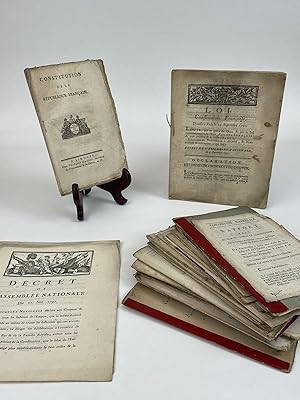
THE RUSSELL COLLECTION: BOOKS, BROADSIDES, AND EPHEMERA OF THE FRENCH REVOLUTION
Editore: 1571 - 1947, 1571
Da: Second Story Books, ABAA, Rockville, MD, U.S.A.
Membro dell'associazione: ABAA ILAB
Valutazione del venditore 4 su 5 stelle

Prima edizione Copia autografata
The Russell Collection contains over 300 books, broadsides, and pieces of ephemera produced between the waning decades of the ancien regime and the fall of Napoleon Bonaparte. The collection was assembled in the early 1950s by William F. Russell (1890 1956), President of Columbia University's Teacher's College from 1949 to 1954. With material spanning the 16th to the early 20th century, the majority of the collection was produced between 1775 and 1800. Highlights include early editions of the 1791 and 1793 French Constitutions, letters written and signed by pioneering economist Anne Robert Jacques Turgot, and official documents signed by Robespierre and other members of the Comite du Salut Public. The Collection is comprised of the following components: 1) The French Monarchy and the Ancien Regime; 2) Ideological Roots of Revolution; 3) The Transition to Republicanism and Collapse of the Monarchy; 4) The National Convention and the Committee for Public Safety; 5) Historical and Contemporary Context; and, 6) Miscellanea (Ephemera, Manuscripts, and Books). Most of the printed material was published by one of the two major publishing houses in Limoges. This concentration of material from a single city offers perspective on the publication and distribution of political and governmental texts in a particular city or departement (one which was especially impacted by the Crown's frequently shifting tax and trade policies). It also provides important insight into the early work and career of Anne Robert Jacques Turgot, who served as intendant of Limoges from 1761 1774. Limoges was home to several printing houses which, at various times during the Monarchy and Revolution, were designated as official printers of government documents for the region. Most notable among these were the Barbou and Dalesmes families. Both families had been established printers for centuries, but the Barbou appear to have been too closely aligned with the ecclesiastical hierarchy after 1791, all of the officially published material printed in Limoges was released by members of chez Dalesme. 1) The French Monarchy and the Ancien Regime A significant portion of the collection is made up of documents from the reign of Louis XVI, issued by the crown, members of the regime, and the Parisian Parlement in the two decades leading up to the Revolution. These items, ranging from royal decrees to trial testimonies, illustrate governmental practice under the monarchy, especially as it relates to trade policy and criminal justice. 2) Ideological Roots of Revolution The Russell Collection includes a number of books and tracts from writers crucial to the development of revolutionary thought and discourse in France during the 18th-century. First or early editions by Mirabeau, Raynal, Mounier, Marat, and Condorcet, written before and during the upheavals of the early 1790s, reveal the increasingly liberal and radical intellectual currents among France's intelligentsia. First or early editions of works by Jacques Necker and Turgot also appear, shedding light on abortive efforts at modernization during the various governments under Louis XVI. 3) The Transition to Republicanism and Dissolution of the Monarchy The full span of the National Assembly, from its foundations during the Brienne and Necker governments to its ceding of legislative authority to the National Convention, is captured through official printed documents (Royal and republican), periodicals, regionally-drafted complaints and instructions, and published addresses. Also included are first or early editions of the French Constitutions of 1791 and 1793, as well as various edicts and documents issued by Louis XVI during l'Assemblee Nationale. The formal inauguration of the National Convention (and the removal of all executive powers from the King) is represented both by an Extrait of the relevant Assembly session, and in an officially published broadside explaining "des motif d'apres lesquels l'Assemblee Nationale a proclame la convocation d'un Convention nationale, et prononce la suspension su Pouvoir executive dans les mains du Roi." 4) The National Convention and the Committee for Public Safety; A substantial component of the Russell Collection is comprised of material created by, or related to, the Convention Nationale and the Comite du Salut Public. Nearly 90 official decrees from the legislative body are present, in addition to numerous printed addresses, departmental complaints, and two officially published broadsides related to the trial of Louis XVI. Other highlights include printed decrees and orders from the Committee for Public Safety, a document issued by the Parisian Communards, and an order signed by seven members of the Committee. 5) Historical and Contemporary Context; A subset of the Collection is made up of books and pamphlets responding to the events of the Revolution, from contemporaneous accounts to late 19th-century histories. The works published during the 1790s and early 1800s, whether biographies of revolutionaries or socio-political commentaries, reveal the mix of horror, regret, enthusiasm and hope stirred up among emigres, international observers, and participants in the revolutionary melee. The texts printed after 1840 reflect the intensive, documentary approach of the French historians in the latter half of the century. 6) Miscellaneous Documents (regional, subject-specific, etc.). Also included are a number of items (ephemera and manuscripts) that are either subject specific and tangentially related to the French Revolution (i.e.; treatises on the French language, moral philosophy deduced from botanical studies, 17th century medicine), or specific to Limoges and the Haute-Vienne. The latter includes several 16th and 17th century manuscripts from Limoges and Orleans. Several 20th century books, inscribed to the collector W.F. Russell, appear in the collection as well. All items are in good or better condition, unless otherwise stated. To view.
-
![Immagine del venditore per Souvenirs intimes et notes du baron Mounier, secretaire de Napoleon Ier, pair de France, directeur general de la police 1896 [LeatherBound] venduto da True World of Books](https://pictures.abebooks.com/inventory/md/md31657393642.jpg)
Souvenirs intimes et notes du baron Mounier, secretaire de Napoleon Ier, pair de France, directeur general de la police 1896 [LeatherBound]
Data di pubblicazione: 2025
EUR 28,26
Spedizione gratuita
Spedito da India a U.S.A.Quantità: 18 disponibili
Aggiungi al carrelloLeatherBound. Condizione: New. BOOKS ARE EXEMPT FROM IMPORT DUTIES AND TARIFFS; NO EXTRA CHARGES APPLY. LeatherBound edition. Condition: New. Reprinted from 1896 edition. Leather Binding on Spine and Corners with Golden leaf printing on spine. Bound in genuine leather with Satin ribbon page markers and Spine with raised gilt bands. A perfect gift for your loved ones. Pages: 352 NO changes have been made to the original text. This is NOT a retyped or an ocr'd reprint. Illustrations, Index, if any, are included in black and white. Each page is checked manually before printing. As this print on demand book is reprinted from a very old book, there could be some missing or flawed pages, but we always try to make the book as complete as possible. Fold-outs, if any, are not part of the book. If the original book was published in multiple volumes then this reprint is of only one volume, not the whole set. Sewing binding for longer life, where the book block is actually sewn (smythe sewn/section sewn) with thread before binding which results in a more durable type of binding. Pages: 352 Mounier, Claude Philippe Édouard, Baron, 1784-1843,Hérisson, comte d' (Maurice d'Irisson), 1839-1898.