
Mueller shing (9 risultati)

Lady With the Phoenix Crown : Tang-Period Grave Goods of the Noblewoman Li Chui 711-736
Filip, Sonja (EDT); Hilgner, Alexandra (EDT); Kroh, Guje (CON); Kupfer, Peter (CON); Mueller, Shing (CON)
- Rilegato
Da: GreatBookPrices, Columbia, MD, U.S.A.GreatBookPrices
Contatta il venditoreVenditore con 5 stelleCondizione: Nuovo
EUR 38,87
EUR 2,33 spedizioneSpedito in U.S.A.Quantità: 9 disponibili
Condizione: New.
Lady With the Phoenix Crown : Tang-Period Grave Goods of the Noblewoman Li Chui 711-736
Filip, Sonja (EDT); Hilgner, Alexandra (EDT); Kroh, Guje (CON); Kupfer, Peter (CON); Mueller, Shing (CON)
- Rilegato
Da: GreatBookPrices, Columbia, MD, U.S.A.GreatBookPrices
Contatta il venditoreVenditore con 5 stelleCondizione: Usato - Come nuovo
EUR 38,88
EUR 2,33 spedizioneSpedito in U.S.A.Quantità: 9 disponibili
Condizione: As New. Unread book in perfect condition.

- Brossura
Da: Revaluation Books, Exeter, Regno UnitoRevaluation Books
Contatta il venditoreVenditore con 5 stelleCondizione: Nuovo
EUR 61,68
EUR 11,59 spedizioneSpedito da Regno Unito a U.S.A.Quantità: 1 disponibili
Paperback. Condizione: Brand New. 190 pages. 6.85x0.47x9.53 inches. In Stock.

- Brossura
Da: AHA-BUCH GmbH, Einbeck, GermaniaAHA-BUCH GmbH
Contatta il venditoreVenditore con 5 stelleCondizione: Nuovo
EUR 48,58
EUR 62,40 spedizioneSpedito da Germania a U.S.A.Quantità: 1 disponibili
Taschenbuch. Condizione: Neu. Neuware - Compared to the later capital of the Northern Wei Dynasty, Luoyang (494-534), Pingcheng on the northern border of the Chinese world has received less scholarly attention despite its far longer capital status (398-494). The main reason is the lack of written sources. In addition, there is t…he derogatory idea that Pingcheng was a latifundium inhabited by 'barbarians,' since the rulers of the Northern Wei were the Tuoba Xianbei from the eastern steppe, who established the first long-term foreign control over northern China. Traditionally, Luoyang is the epitome of the sinicized Tuoba Xianbei, while Pingcheng represents the state of the Tuoba Xianbei who were on the way to 'becoming Chinese.' Excavations show that Pingcheng, which was built on the ruins of a garrison from the Han-Dynasty, arose from nothing and the inhabitants came from outside. Burial finds indicate a steadily growing population, which is said to have reached one million in its prime. At first, tombs were erected to indicate their steppe origins. New rites and artifacts emerged in spurts. This corresponds to written records, according to which the city was mainly populated by steppe warriors, followed by forcibly relocated peoples from all conquered northern Chinese regions. The authors focus on the people(s) in Pingcheng. Zhang's epigraphic study is devoted to a Xianbei family that arose during the Pingcheng period and remained closely intertwined with the imperial court in the following centuries. Using burial finds, Müller explores the diversity and foreignness of funerary customs and artifacts, the ways in which different ethnic groups communicated and interacted, and the emergence of a new collective identity that was anything but Chinese.

- Rilegato
Da: AHA-BUCH GmbH, Einbeck, GermaniaAHA-BUCH GmbH
Contatta il venditoreVenditore con 5 stelleCondizione: Nuovo
EUR 98,00
EUR 66,89 spedizioneSpedito da Germania a U.S.A.Quantità: 1 disponibili
Gebundene Ausgabe. Condizione: Neu. Neu Neuware, auf Lager - The Xianbei from southeast Mongolia were the first foreign sovereignty over North China since the 4th century. During the 200 years of Xianbei rulership, the cultures of old and new inhabitants - the Han-Chinese, the Xianbei and diverse steppe peoples, the Sogdians and… other Central Asians from the west - confronted and competed with one another. This volume is one of the first in Europe that concentrates on the cultural conflicts and the emergence of new traditions in North China during the Early Medieval period. Topics include archaeological evidence of the early Fuyu culture in southern Manchuria and early traces of Sogdians in Qinghai, impacts of Buddhism in the formation of new funerary cults and new city planning, the hybridization of diverse funerary traditions such as the use of head rests and stone beds and house-shaped sarcophagi, the emergence of a multiple identity for denizens as an adaptation to a fast changing world, and the militarization of the northern society as seen in murals and in defense lines. Also included are new insights on the Chinese sabao and Sogdian s'rtp'w titles, and discussions on Sogdian slaves in the Kocho Kingdom as well as on 'multi-culture' in Chinese historiographical works.The papers in Chinese and English have been contributed by renowned archaeologists and historians from China, the USA and Germany.

- Brossura
Da: Books-by-Floh, Paderborn, GermaniaBooks-by-Floh
Contatta il venditoreVenditore con 4 stelleCondizione: Nuovo
EUR 59,57
EUR 105,00 spedizioneSpedito da Germania a U.S.A.Quantità: 1 disponibili
Taschenbuch. Condizione: Neu. Neuware -Compared to the later capital of the Northern Wei Dynasty, Luoyang (494-534), Pingcheng on the northern border of the Chinese world has received less scholarly attention despite its far longer capital status (398-494). The main reason is the lack of written sources. In addition, there is th…e derogatory idea that Pingcheng was a latifundium inhabited by 'barbarians,' since the rulers of the Northern Wei were the Tuoba Xianbei from the eastern steppe, who established the first long-term foreign control over northern China. Traditionally, Luoyang is the epitome of the sinicized Tuoba Xianbei, while Pingcheng represents the state of the Tuoba Xianbei who were on the way to 'becoming Chinese.' Excavations show that Pingcheng, which was built on the ruins of a garrison from the Han-Dynasty, arose from nothing and the inhabitants came from outside. Burial finds indicate a steadily growing population, which is said to have reached one million in its prime. At first, tombs were erected to indicate their steppe origins. New rites and artifacts emerged in spurts. This corresponds to written records, according to which the city was mainly populated by steppe warriors, followed by forcibly relocated peoples from all conquered northern Chinese regions. The authors focus on the people(s) in Pingcheng. Zhang's epigraphic study is devoted to a Xianbei family that arose during the Pingcheng period and remained closely intertwined with the imperial court in the following centuries. Using burial finds, Müller explores the diversity and foreignness of funerary customs and artifacts, the ways in which different ethnic groups communicated and interacted, and the emergence of a new collective identity that was anything but Chinese. Englisch.
- Brossura
Da: BUCHSERVICE / ANTIQUARIAT Lars Lutzer, Wahlstedt, GermaniaBUCHSERVICE / ANTIQUARIAT Lars Lutzer
Contatta il venditoreVenditore con 5 stelleCondizione: Usato - Molto buono
EUR 189,90
EUR 39,95 spedizioneSpedito da Germania a U.S.A.Quantità: 1 disponibili
Softcover. Condizione: gut. 2024. Peoples of Pingcheng (398-494) : Cultural Diversity and Interaction In deutscher Sprache. pages.
Lingua: Tedesco
Editore: Mainz : Verlag des Römisch-Germanischen Zentralmuseums 2022
- Rilegato
Da: Borkert, Schwarz und Zerfaß GbR, Berlin, GermaniaBorkert, Schwarz und Zerfaß GbR
Contatta il venditoreVenditore con 5 stelleCondizione: Usato - Come nuovo
EUR 88,00
EUR 40,00 spedizioneSpedito da Germania a U.S.A.Quantità: 1 disponibili
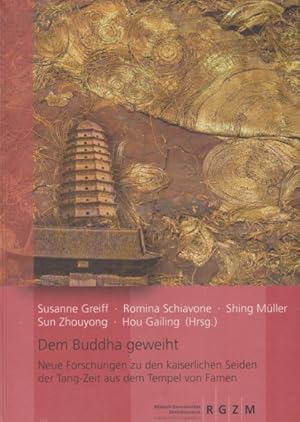
Pp. Condizione: Wie neu. XIX, 651 Seiten : zahlr. Illustrationen. Neuwertiges Exemplar. - Nachdem durch ein Starkregenereignis 1981 die Ming-zeitliche Pagode eingestürzt war, offenbarte sich 1987 bei Freilegungsarbeiten unter dem buddhistischen Tempel von Famen (Provinz Shaanxi?/?VR China) eine Schatzkammer aus der Tang-Zeit. Ei…ne Inschriftentafel am Eingang der vorderen Kammer verriet nicht nur, dass sie 874 n.?Chr. zum letzten Mal verschlossen worden war, sondern listete auch die zahlreichen dort verwahrten Kunst- und Kulturgegenständen auf. Mitglieder der kaiserlichen Familie und hochrangige Mönche hatten diese über 240 Jahre lang zu Ehren einer Fingerreliquie Buddhas dem Tempel geweiht. Neben Objekten aus vergoldetem Silber, seltener Seladonkeramik und aus fernen Ländern importierten Glaswaren traten auch größere Mengen edler Seiden zutage. Die zu großen Ballen geschichteten Textilien befanden sich nach über einem Jahrtausend Lagerung in der feuchten Umgebung in prekärem Erhaltungszustand. / In mehreren vom Bundesministerium für Bildung und Forschung finanzierten Teilprojekten arbeitete ein interdisziplinäres Team deutscher und chinesischer Fachleute aus Mainz, München, Münster und Xian zwischen 2001 und 2014 am Erhalt und der Untersuchung der einzigartigen Funde. Das Buch stellt die Ergebnisse der exemplarischen Arbeiten an den Seidenfunden vor und vermittelt darüber hinaus Einblicke in Tang-zeitliche Bekleidungssitten, die Organisation der Textilproduktion, Farbstofftechnik und Goldfadenherstellung sowie die Rolle von Seide in Religion und Alltag. / Inhaltsverzeichnis: Zhao Rong -- Grußwort -- Susanne Greiff -- Vorwort -- Wang Weilin -- Vorwort -- Han Wei t -- Das deutsch-chinesische Projekt zur Erhaltung von Kulturgütern als Musterbeispiel -- internationaler Zusammenarbeit -- Zhang Jianlin -- Die Wiederentdeckung des buddhistischen Reliquienschatzes im Tempel von Famen -- Reinhard Emmerich -- Reliquien und staatliche Förderung des Buddhismus im China der Dynastien Sui und Tang -- Shing Müller -- Kaiserliche Seide für den Buddha - Eine kulturhistorische Untersuchung der Seidenfunde -- aus dem Famen-Tempel -- Soon-Chim Jung -- Die Produktion von Seidengeweben und ihre Bezeichnungen in der Tang-Zeit -- im Spiegel der Schriftquellen (mit einem Glossar) -- Sandra Austrup -- Alltägliche Wunderwerke - Überlegungen zum Prestige von Seide -- in der Tang-Zeit im Spiegel zweier zeitnaher Handbücher -- Lu Zhiyong Angelika Sliwka -- Zu den Konservierungs- und Restaurierungsarbeiten an den Seidenfunden aus dem Famen-Tempel -- Ines Scholz -- Textiltechnologische Untersuchungen an drei Gewändern aus dem Famen-Tempel (Ballen T68) -- Zhang fing -- Gewebearten der Stoffproben aus den Funden der Krypta des Famen-Tempels Florian Ströbele Markus Boner -- Leichte stabile Isotope als Indikatoren für die Provenienz von Seidenfasern - -- eine Pilotstudie am Beispiel der Textilfunde aus dem Tempel von Famen -- Regina Hofmann-de Keijzer Regina Knaller Maarten R van Bommel -- Ineke Joosten Andreas G Heiss Helga Natschläger Bernhard Pichler -- Rudolf Erlach Luc Megens Matthijs de Keijzer -- Gelbe und pfirsichblütenfarbene Gewänder, verziert mit Gold und Silber- -- naturwissenschaftliche Untersuchungen an Seidengeweben aus dem Famen-Tempel -- Yang Junchang Zhang Jing Jiang Jie -- Zur Herstellungstechnik Tang-zeitlicher Goldlahnfäden aus der Krypta des Famen-Tempels. ISBN 9783884673546 Sprache: Deutsch Gewicht in Gramm: 2000.

Botschaften an die Goetter
Höllmann, Thomas O|Friedrich, Michael|Obi, Lucia|Müller, Shing|Götzfried, Xaver
- Brossura
- Print on Demand
Da: moluna, Greven, Germaniamoluna
Contatta il venditoreVenditore con 5 stelleCondizione: Nuovo
EUR 39,00
EUR 48,99 spedizioneSpedito da Germania a U.S.A.Quantità: Più di 20 disponibili
Kartoniert / Broschiert. Condizione: New. Dieser Artikel ist ein Print on Demand Artikel und wird nach Ihrer Bestellung fuer Sie gedruckt. Der reichlich bebilderte Band erschliesst Daoismus-Forschern, Ethnologen und Sinologen zum ersten Mal liturgische daoistische Texte der in Suedostasien lebenden Yao. Im vorangestellten Textte…il des Katalogs werden die Themen Ethnographie, Religion, Buchherste.


