

Importo totale (1 articolo articoli):
Destinazione ordine:

nelson charles red (3 risultati)
Vai alla pagina principale dei risultati di ricerca
Filtri di ricerca
Tipo di articolo
- Tutti i tipi di prodotto
- Libri (2)
- Riviste e Giornali (Nessun altro risultato corrispondente a questo perfezionamento)
- Fumetti (Nessun altro risultato corrispondente a questo perfezionamento)
- Spartiti (Nessun altro risultato corrispondente a questo perfezionamento)
- Arte, Stampe e Poster (Nessun altro risultato corrispondente a questo perfezionamento)
- Fotografie (1)
- Mappe (Nessun altro risultato corrispondente a questo perfezionamento)
- Manoscritti e Collezionismo cartaceo (Nessun altro risultato corrispondente a questo perfezionamento)
Condizioni Maggiori informazioni
- Nuovo (Nessun altro risultato corrispondente a questo perfezionamento)
- Come nuovo, Ottimo o Quasi ottimo (Nessun altro risultato corrispondente a questo perfezionamento)
- Molto buono o Buono (3)
- Discreto o Mediocre (Nessun altro risultato corrispondente a questo perfezionamento)
- Come descritto (Nessun altro risultato corrispondente a questo perfezionamento)
Legatura
Ulteriori caratteristiche
- Prima ed. (Nessun altro risultato corrispondente a questo perfezionamento)
- Copia autograf. (Nessun altro risultato corrispondente a questo perfezionamento)
- Sovracoperta (Nessun altro risultato corrispondente a questo perfezionamento)
- Con foto (3)
- Non Print on Demand (3)
Lingua (1)
Prezzo
- Qualsiasi prezzo
- Inferiore a EUR 20 (Nessun altro risultato corrispondente a questo perfezionamento)
- EUR 20 a EUR 45 (Nessun altro risultato corrispondente a questo perfezionamento)
- Superiore a EUR 45
Spedizione gratuita
- Spedizione gratuita in U.S.A. (Nessun altro risultato corrispondente a questo perfezionamento)
Paese del venditore
Valutazione venditore
-
I. W. W. Songs: Songs of Life [Title Page]. I. W. W. Songs: To Fan the Flames of Discontent [Front Cover]
Editore: Industrial Workers of the World [I.W.W. / IWW], Chicago, 1922
Da: Ken Sanders Rare Books, ABAA, Salt Lake City, UT, U.S.A.
Membro dell'associazione: ABAA ILAB IOBA RMABA
Valutazione del venditore 5 su 5 stelle

Paperback / Pamphlet. Condizione: Good +. Seventeenth Edition. [17th Edition]. 64 pp. 15 cm. Saddle-stapled in pink (faded from red?) printed wraps. IWW's circular emblem printed on the front. Frontis portrait of Joe Hill on page [2]; this edition features twelve of his songs. Staples (binding) are beginning to rust. Sporadic staining and dust soiling to covers. Minor signs of age-toning, internally clean. The IWW's famous "Little Red Songbook" which was originally published in 1909 and has never gone out of print. Fifty-two songs are printed here (pages 5-64) in this Seventeenth Edition from 1922. Some tune designations are given. Some short lyrical explanations are given. Musical notation is not printed. Includes an index of song titles at the front (pages [3-4]). IWW's "Preamble" is printed on the front inside cover. "We Are Going to Find Out" (six paragraphs of text raising awareness and support for imprisoned Wobblies) by the IWW's General Defense Committee is printed on the rear inside cover. An advertisement for future versions of the songbook, with the promise of printed musical notation to be included, is printed on the rear cover. IWW's address of "1001 W. MADISON ST. CHICAGO, ILL" is printed on the front cover, title page [1], and rear cover, which was the IWW's General Headquarters from July 1917 - March 1925. About The Little Red Songbook, Historian Philip Taft noted. "By far the most popular work produced by the Industrial Workers of the World, the Song Book has gone through many editions. In fact, some of its "Songs," especially one by Joe Hill, are known by many who are scarcely acquainted with the I.W.W. itself. [.] What first attracted me to the I.W.W. was its songs and the gusto with which its members sang them." Contains the following songs (in the order printed): The Rebel Girl; The Internationale; We Will Sing One Song; Workers of the World, Awaken!; One Big Industrial Union; The Red Flag; The Workers of the World Are Now Awaking [sic Awakening]; Harvest War Song; Workers of the World; John Golden and the Lawrence Strike; Scissor Bill; Dump the Bosses off Your Back; All Hell Can't Stop Us!; Up from Your Knees; The Tramp; Whadda Ya Want to Break Your Back for the Boss For?; The White Slave; The Big Question; Solidarity Forever!; The Dollar Alarm Clock; We Have Fed You All for a Thousand Years; I'm Too Old to Be a Scab; Mr. Block; The Industrial Workers of the World; The Workers' Marseillaise; "Remember"; Industrial Unionism Speaks to the Toilers of the Sea; The Preacher and the Slave; "The Popular Wobbly"; "Renunciation"; Don't Take My Papa Away from Me; When You Wear That Button; My Wandering Boy; The Everett County Jail; I Wanna Free Miss Liberty; May Day Song; They'll Soon Ring Out; Onward, "One Big Union"; Count Your WorkersCount Them!; Fifty Thousand Lumberjacks; Tie 'Em Up!; Joe Hill's Last Will; The Mysteries of a Hobo's Life; Workers' Memorial Song; Farewell, Frank!; The Commonwealth of Toil; A Worker's Plea; Organize!; There Is Power in a Union; Harvest Land; Hold the Fort; and Workingmen, Unite!
-
I. W. W. Songs: Songs of Life [Title Page]. I. W. W. Songs: To Fan the Flames of Discontent [Front Cover]
Editore: Industrial Workers of the World [I.W.W. / IWW], Chicago, 1922
Da: Ken Sanders Rare Books, ABAA, Salt Lake City, UT, U.S.A.
Membro dell'associazione: ABAA ILAB IOBA RMABA
Valutazione del venditore 5 su 5 stelle
Paperback / Pamphlet. Condizione: Very Good +. Seventeenth Edition. [17th Edition]. 64 pp. 15 cm. Saddle-stapled in red printed wraps. IWW's circular emblem printed on the front. Frontis portrait of Joe Hill on page [2]; this edition features twelve of his songs. A previous owner's 3" x 5" index/notecard is laid-in with a paragraph of cursive text written in black ink. A nice, clean copy with just a bit of wear to the covers. The IWW's famous "Little Red Songbook" which was originally published in 1909 and has never gone out of print. Fifty-two songs are printed here (pages 5-64) in this Seventeenth Edition from 1922. Some tune designations are given. Some short lyrical explanations are given. Musical notation is not printed. Includes an index of song titles at the front (pages [3-4]). IWW's "Preamble" is printed on the front inside cover. "We Are Going to Find Out" (six paragraphs of text raising awareness and support for imprisoned Wobblies) by the IWW's General Defense Committee is printed on the rear inside cover. An advertisement for future versions of the songbook, with the promise of printed musical notation to be included, is printed on the rear cover. IWW's address of "1001 W. MADISON ST. CHICAGO, ILL" is printed on the front cover, title page [1], and rear cover, which was the IWW's General Headquarters from July 1917 - March 1925. About The Little Red Songbook, Historian Philip Taft noted. "By far the most popular work produced by the Industrial Workers of the World, the Song Book has gone through many editions. In fact, some of its "Songs," especially one by Joe Hill, are known by many who are scarcely acquainted with the I.W.W. itself. [.] What first attracted me to the I.W.W. was its songs and the gusto with which its members sang them." Contains the following songs (in the order printed): The Rebel Girl; The Internationale; We Will Sing One Song; Workers of the World, Awaken!; One Big Industrial Union; The Red Flag; The Workers of the World Are Now Awaking [sic Awakening]; Harvest War Song; Workers of the World; John Golden and the Lawrence Strike; Scissor Bill; Dump the Bosses off Your Back; All Hell Can't Stop Us!; Up from Your Knees; The Tramp; Whadda Ya Want to Break Your Back for the Boss For?; The White Slave; The Big Question; Solidarity Forever!; The Dollar Alarm Clock; We Have Fed You All for a Thousand Years; I'm Too Old to Be a Scab; Mr. Block; The Industrial Workers of the World; The Workers' Marseillaise; "Remember"; Industrial Unionism Speaks to the Toilers of the Sea; The Preacher and the Slave; "The Popular Wobbly"; "Renunciation"; Don't Take My Papa Away from Me; When You Wear That Button; My Wandering Boy; The Everett County Jail; I Wanna Free Miss Liberty; May Day Song; They'll Soon Ring Out; Onward, "One Big Union"; Count Your WorkersCount Them!; Fifty Thousand Lumberjacks; Tie 'Em Up!; Joe Hill's Last Will; The Mysteries of a Hobo's Life; Workers' Memorial Song; Farewell, Frank!; The Commonwealth of Toil; A Worker's Plea; Organize!; There Is Power in a Union; Harvest Land; Hold the Fort; and Workingmen, Unite!
-
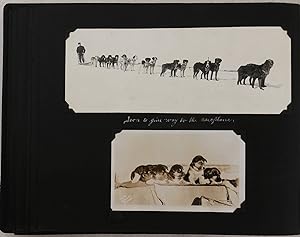
Nelson, Charles "Red" (1900-1982); Bragaw, Robert (1889-1969, fl. ca. 1920s-1930s); Steward, H.W.; Rossman, Earl; Johnson, George L. & others. Album with over 210 Original Gelatin Photographs of Alaska, Showing Central Alaska (Mt. Denali, Mt. Susitna, Knik Arm, Tanana and Susitna Rivers, Cache Creek, Curry - Now a Ghost Town, Mining and Survey Camps), Anchorage Environs, Kenai Peninsula (Lake Kenai, Resurrection River, Bald Mountain, Tustumena glacier, Nuka Bay glacier), Prince William Sound, the Inside Passage, Latouche Village, Portraits of Yupic People, Scenes of Dog Mushing, Hunting, Fishing, and Gold Panning, Alaskan Wildlife, Russel Merril's Plane, &c. Ca. 1920s.
Data di pubblicazione: 1920
Da: Globus Rare Books & Archives, San Francisco, CA, U.S.A.
Membro dell'associazione: ABAA ILAB
Valutazione del venditore 5 su 5 stelle
Fotografia
Hardcover. Condizione: Very Good. Oblong Folio album ca. 26x33 cm (10 ¼ x 13 in). 47 card stock leaves. With over 210 mounted gelatin silver photos, including about six colour tinted images from ca. 20x25 cm (7 ¾ x 10 in) to ca. 15x20 cm (6x8 in) and a panorama ca. 9x24,5 cm (3 ½ x 9 ¾ in). The rest of the photos are from ca. 12,5x17,5 cm (5x7 in) to ca. 4x8 cm (1 ¾ x 3 ¼ in); most photos are ca. 8x14 cm (3 ¼ x 5 ½ in). Over fifty photos are captioned and/or signed in negative (some text faded). With over a hundred period white ink manuscript captions on the mounts, related to individual images or groups of images. Period black patterned sheep album, fastened with a string; front cover with a generic gilt-lettered title "Photographs;" the inner side of the rear cover with an ink stamp "L.C. Rhodes, Genuine Leather Cover." The inner side of the front cover with a period white ink presentation inscription "Anchorage, Alaska, Dec. 20 1929. To Lawrence C. Heath from Lawrence Alfred Stephenson." A few photos mildly faded or with mild silvering, otherwise a very good album of interesting strong photos. Attractive extensive collection of well-annotated original photos of Alaska, from the 1920s. Compiled by Lawrence Alfred Stephenson - most likely, a resident of Anchorage, the album includes unsigned photos (possibly, taken by Stephenson himself), as well as images taken by several noted Alaskan photographers: Charles "Red" Nelson, Robert Bragaw, H.W. Steward, Earl Rossman, George L. Johnson, & others. The album contains six colour-tinted photos by Charles "Red" Nelson. The first photo showing Mt. Denali is supplemented by a piece of birch bark with the handwritten caption about "Mt. McKinley," which erroneously notes that "so far no one has ever been to the top." The album was compiled in the late 1920s (according to the presentation inscription, dated "1929"), but the first successful ascent of the southern peak of Mount Denali took place already in 1913. The other colour-tinted photos show Cook Inlet near Anchorage, Mt. Susitna, Russian Creek near Seward, a winter forest and an Alaskan waterfall. A large panoramic photo depicts a dog musher and his team. The smaller photos include a series of excellent views of central Alaska and the Kenai Peninsula, showing Knik Arm, Lake Spenard, the beach in Anchorage, Mt. Denali, Tanana River, Kantishna district, Cache Creek (with the view of a "placer mining camp"), "Peters Creek mining district," a "camp of survey party," steamer "Betty M." "hauling freight up the Susitna River," Susitna River "just before freezeup," Curry - "division point on Alaska Railroad and tourist camp" (now a ghost town), "500 foot suspension bridge at Curry," "mining camp in Yentna mining district," "Alaska Road Commission camp near Talkeetna," Lake Kenai, Resurrection River, Bald Mountain, Tustumena glacier, Nuka Bay glacier, &c. The other photos show Prince William Sound, the environs of Juneau, Inside Passage, "S.S. Aleutian at Columbia Glacier," &c. Another interesting image shows the harbour of Latouche - a no longer existing mining community on Latouche Island (Prince William Sound). A post office was established here in 1905 and discontinued in 1955. There are also photos of Alaskan settlements in winter, trappers' cabins and survey camps, the loghouse office of the Superintendent of "Mt. McKinley National Park," the gateway to the park, the Alaska Railroad in winter, &c. Several photos portray native Alaskans - "Eskimo" (Yupic) seal hunters, families and children, show the interior of the Orthodox Christian Cathedral in Kodiak and traditional graves on the Eklutna cemetery. Two photos depict famous dog musher Leonhard Seppala (1877-1967) and his dogs, who played the pivotal role in the 1925 serum run to Nome. The compiler's manuscript caption reads: "Seppala and his famous "Relief Team" went to Nome, Alaska, in record time with medical supplies during epidemic." The other images show Alaska Huskies, scenes of dog mushing, hunting and fishing,
![Immagine del venditore per I. W. W. Songs: Songs of Life [Title Page]. I. W. W. Songs: To Fan the Flames of Discontent [Front Cover] venduto da Ken Sanders Rare Books, ABAA](https://pictures.abebooks.com/inventory/md/md32233035427.jpg)

![Immagine del venditore per I. W. W. Songs: Songs of Life [Title Page]. I. W. W. Songs: To Fan the Flames of Discontent [Front Cover] venduto da Ken Sanders Rare Books, ABAA](https://pictures.abebooks.com/inventory/md/md32233039256.jpg)