

Importo totale (1 articolo articoli):
Destinazione ordine:

norman lew (12 risultati)
Vai alla pagina principale dei risultati di ricerca
Filtri di ricerca
Tipo di articolo
- Tutti i tipi di prodotto
- Libri (10)
- Riviste e Giornali (Nessun altro risultato corrispondente a questo perfezionamento)
- Fumetti (Nessun altro risultato corrispondente a questo perfezionamento)
- Spartiti (Nessun altro risultato corrispondente a questo perfezionamento)
- Arte, Stampe e Poster (Nessun altro risultato corrispondente a questo perfezionamento)
- Fotografie (2)
- Mappe (Nessun altro risultato corrispondente a questo perfezionamento)
- Manoscritti e Collezionismo cartaceo (Nessun altro risultato corrispondente a questo perfezionamento)
Condizioni Maggiori informazioni
- Nuovo (1)
- Come nuovo, Ottimo o Quasi ottimo (Nessun altro risultato corrispondente a questo perfezionamento)
- Molto buono o Buono (10)
- Discreto o Mediocre (Nessun altro risultato corrispondente a questo perfezionamento)
- Come descritto (1)
Legatura
- Tutte
- Rilegato (Nessun altro risultato corrispondente a questo perfezionamento)
- Brossura (9)
Ulteriori caratteristiche
- Prima ed. (2)
- Copia autograf. (1)
- Sovracoperta (Nessun altro risultato corrispondente a questo perfezionamento)
- Con foto (7)
- Non Print on Demand (11)
Lingua (2)
Spedizione gratuita
Paese del venditore
Valutazione venditore
-

30 dy mr pow Voc
Da: Better World Books: West, Reno, NV, U.S.A.
Valutazione del venditore 5 su 5 stelle

Condizione: Good. rev Edition. Former library copy. Pages intact with minimal writing/highlighting. The binding may be loose and creased. Dust jackets/supplements are not included. Includes library markings. Stock photo provided. Product includes identifying sticker. Better World Books: Buy Books. Do Good.
-
30 dy mr pow Voc
Da: Better World Books, Mishawaka, IN, U.S.A.
Valutazione del venditore 5 su 5 stelle
Condizione: Good. rev Edition. Former library copy. Pages intact with minimal writing/highlighting. The binding may be loose and creased. Dust jackets/supplements are not included. Includes library markings. Stock photo provided. Product includes identifying sticker. Better World Books: Buy Books. Do Good.
-
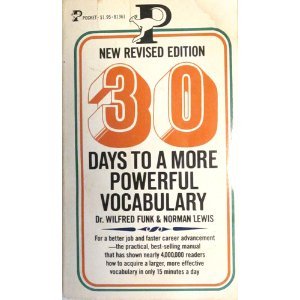
30 dy mr pow Voc
Da: Better World Books, Mishawaka, IN, U.S.A.
Valutazione del venditore 5 su 5 stelle
Condizione: Good. Pages intact with minimal writing/highlighting. The binding may be loose and creased. Dust jackets/supplements are not included. Stock photo provided. Product includes identifying sticker. Better World Books: Buy Books. Do Good.
-
30 dy mr pow Voc
Da: Better World Books Ltd, Dunfermline, Regno Unito
Valutazione del venditore 5 su 5 stelle
EUR 8,43
Spedizione EUR 5,77
Spedito da Regno Unito a U.S.A.Quantità: 1 disponibili
Aggiungi al carrelloCondizione: Good. rev Edition. Pages intact with minimal writing/highlighting. The binding may be loose and creased. Dust jackets/supplements are not included. Stock photo provided. Product includes identifying sticker. Better World Books: Buy Books. Do Good.
-
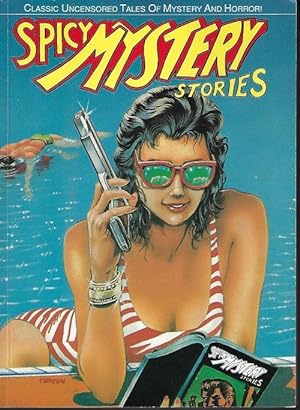
SPICY MYSTERY STORIES
Lingua: Inglese
Editore: Malibu Graphics, Newbury Park, CA, 1990
ISBN 10: 0944735231 ISBN 13: 9780944735237
Da: Books from the Crypt, N. Potomac, MD, U.S.A.
Membro dell'associazione: IOBA
Valutazione del venditore 5 su 5 stelle
Prima edizione
Paperback. Condizione: Very Good+. First Edition. [1st printing] 1990. Reprints stories from the 'Spicy' pulps. Cover art by Madman. Includes "Foreward" by Tom Mason; "Introduction" by John Wooley; "The Dark Tower" by Robert Leslie Bellem; "Werewolf's Bride" by James A. Lawson; "The Stone of Ageless Evil" by Rex Norman; "Medusa's Kiss" by Hamlin Daly; "I Am A Monster" by Robert Leslie Bellem; "Dungeon of the Blind" by Arthur Wallace; "Portrait of Terror" by Jerome Severs Perry; "The Door on the Stairs" by Charles A. Baker, Jr.; "Synthetic Husband" by Lew Merrill; "Princess of Dreams" by Robert Leslie Bellem. Rubbing; corner wear. Book.
-

Book And Magazine Collector November 1984 No.9 / Helen Macleod "Lewis Carroll's Books" / Paul Bishop "Raymond and the Philip Marlowe stories" / Norman wright And David Ashford "The'Thriller' Comics Library" /Lew Thomas "W Somerset Maugham" / Graham Wade "Spanish Travel Books" / D C Hogg "H E Bates"
Editore: Diamond Publishing Group Ltd, 1984
EUR 6,54
Spedizione EUR 12,69
Spedito da Regno Unito a U.S.A.Quantità: 1 disponibili
Aggiungi al carrelloSoft cover. Condizione: Very Good. 116 pages. Illustrated. Helen Macleod "Lewis Carroll's Books" / Paul Bishop "Raymond and the Philip Marlowe stories" / Norman wright And David Ashford "The'Thriller' Comics Library" /Lew Thomas "W Somerset Maugham" / Graham Wade "Spanish Travel Books" / D C Hogg "H E Bates".
-
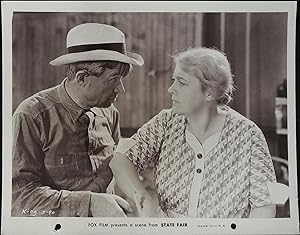
State Fair 8 x 10 Still 1933 Will Rogers, Louise Dresser!
Editore: Fox, 1933
Da: AcornBooksNH, New Harbor, ME, U.S.A.
Valutazione del venditore 5 su 5 stelle
Fotografia
No Binding. Condizione: VG+. King-5-90. A VG or better original 8 x 10 still. Size: 8" x 10". Photographic Image.
-
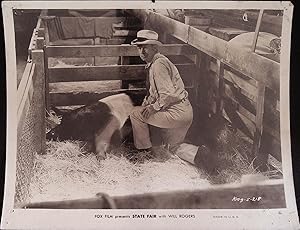
State Fair 8 x 10 Still 1933 Will Rogers with "Blue Boy"!
Editore: Fox, 1933
Da: AcornBooksNH, New Harbor, ME, U.S.A.
Valutazione del venditore 5 su 5 stelle
Fotografia
No Binding. Condizione: VG+. King-5-218. A VG or better original 8 x 10 still. Size: 8" x 10". Photographic Image.
-
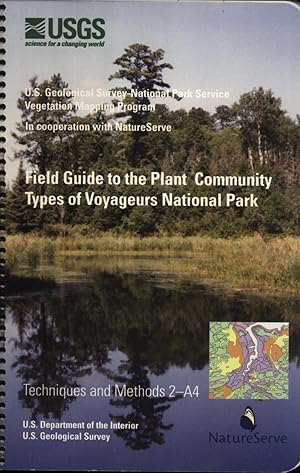
Field Guide to the Plant Community Types of Voyageurs National Park (Techniques and Methods)
Editore: U. S. Geological Survey/NatureServe, 2007
Da: Masalai Press, Oakland, CA, U.S.A.
Valutazione del venditore 5 su 5 stelle
Soft cover. Condizione: Very Good. 156 pp., illustrations, maps, bibliography. The objective of the U.S. Geological Survey-National Park Service Vegetation Mapping Program is to classify, describe, and map vegetation for most of the park units within the National Park Service (NPS). The program was created in response to the NPS Natural Resources Inventory and Monitoring Guidelines issued in 1992. Products for each park include digital files of the vegetation map and field data, keys and descriptions to the plant communities, reports, metadata, map accuracy verification summaries, and aerial photographs. Interagency teams work in each park and, following standardized mapping and field sampling protocols, develop products and vegetation classification standards that document the various vegetation types found in a given park.
-
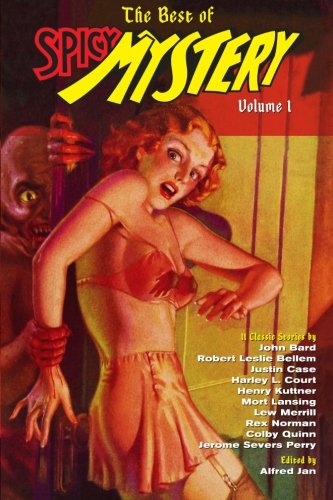
The Best of Spicy Mystery Volume 1
Da: Revaluation Books, Exeter, Regno Unito
Valutazione del venditore 5 su 5 stelle
EUR 22,93
Spedizione EUR 11,54
Spedito da Regno Unito a U.S.A.Quantità: 1 disponibili
Aggiungi al carrelloPaperback. Condizione: Brand New. 202 pages. 9.00x6.00x0.46 inches. This item is printed on demand.
-
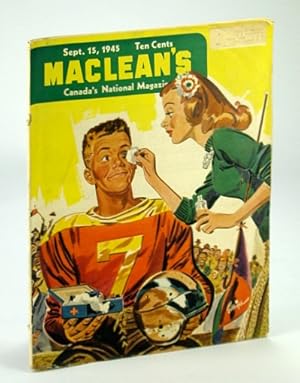
Maclean's, Canada's National Magazine, 15 September (Sept.), 1945: Russian "Wireless" Electric Car! / Gambling in Montreal / General Crerar Comes Home
Editore: Maclean-Hunter, Toronto, 1945
Da: RareNonFiction, IOBA, Ladysmith, BC, Canada
Membro dell'associazione: IOBA
Valutazione del venditore 5 su 5 stelle
Prima edizione
EUR 265,13
Spedizione EUR 17,15
Spedito da Canada a U.S.A.Quantità: 1 disponibili
Aggiungi al carrelloSingle Issue Magazine. Condizione: Good. Alexander, Norman; Eldridge, Harold (cover) (illustratore). First Edition. 72 pages. Features: Gambling in Montreal - "operating wide open and crowded with civilians and servicemen"; A General Comes Home - General H.D.G. Crerar - short article with photo; When Memory Blacks Out - article on amnesia; John Mulloy Comes Home (fiction); Rockets are Coming - Prof. A.M. Low, president of the Interplanetary Society, predicts passenger rockets within twenty years; Manhunter's Moon (fiction); Why Not Pro Football? - by Lew Hayman; Latin America - Whose Customer?; "His Majesty From Sioux City" (fiction); Russian "Wireless" Car at Work - brief article with first photos to reach Canada; One-page Westinghouse ad features fascinating photo and details of a 100-ton cycloton they constructed in 1938; and more. Includes many nice ads in colour and black and white, our favourite being the colour back cover Coke ad which shows servicement engaged in a chess game. Unmarked with average wear. Binding intact. A sound vintage copy.
-
(1) MEITNER & FRISCH, 'Disintegration of Uranium by Neutrons: a New Type of Nuclear Reaction,' pp. 239-240, in Vol. 143, No. 3615, 11 February 1939 [PMM 422b]; (2) FRISCH, 'Physical Evidence for the Division of Heavy Nuclei under Neutron Bombardment,' p. 276, in No. 3616, 18 February [PMM 422c]; (3) BOHR, 'Disintegration of Heavy Nuclei,' p. 330, in No. 3617, 25 February; (4) HALBAN, JOLIOT & KOWARSKI, 'Liberation of Neutrons in the Nuclear Explosion of Uranium,' pp. 470-471 [PMM 422d], with MEITNER & FRISCH, 'Products of the Fission of the Uranium Nucleus,' pp. 471-472, both in No. 3620, 18 March;(5) HALBAN, JOLIOT & KOWARSKI, 'Number of Neutrons Liberated in the Nuclear Fission of Uranium,' p. 680, in No. 3625, 22 April; (6) ADLER & HALBAN, 'Nuclear Physics: Control of the Chain Reaction Involved in Fission of the Uranium Nucleus,' pp. 793-794, in No. 3628, 13 May; (7) FEATHER, 'Fission of Heavy Nuclei: a New Type of Nuclear Disintegration,' pp. 877-879, in No. 3630, 27 May; (8) HALB
Editore: Macmillan, London, 1939
Da: SOPHIA RARE BOOKS, Koebenhavn V, Danimarca
Membro dell'associazione: ABF ILAB
Valutazione del venditore 4 su 5 stelle

Copia autografata
EUR 6.629,36
Spedizione gratuita
Spedito da Danimarca a U.S.A.Quantità: 1 disponibili
Aggiungi al carrelloThe Discovery of Nuclear Fission and of the Chain Reaction. First edition, rare, journal issues in the original printed wrappers, of the complete sequence of papers in Nature by which nuclear fission was reported, theoretically interpreted, experimentally verified, and shown to liberate enough secondary neutrons to sustain a chain reaction-the sequence that, between 11 February and 3 June 1939, took physics from a chemical anomaly observed in Berlin to the certainty of a feasible nuclear bomb. Three of the eight issues offered here contain Printing and the Mind of Man entries (422b, the discovery and naming of fission; 422c, its experimental confirmation; 422d, the demonstration of neutron multiplication); the remaining five are the immediately surrounding papers without which the PMM trio cannot be properly read. Together they constitute the entire foundational literature of nuclear fission, in the form in which it first reached the working physicist on his subscriber's table, and in the four-month window between the Christmas-week calculation of Meitner and Frisch in a Swedish wood and the outbreak of the Second World War in Poland fewer than thirteen weeks after the appearance of the last paper here offered. The story begins in Berlin in December 1938. Otto Hahn and Fritz Strassmann had been bombarding uranium with neutrons since 1934, hoping to produce transuranic elements. Their chemical analyses kept yielding results that made no nuclear-physical sense: among the products, in repeated and unmistakable fashion, was an isotope of barium (Z = 56), an element less than two-thirds the atomic number of uranium (Z = 92). The reigning view of nuclear processes-that a slow neutron could only nudge a heavy nucleus by a unit or two of charge through the emission of ? or ? particles-made any such large change inconceivable. Hahn, an outstanding radiochemist with no theoretical training, wrote to his former collaborator of thirty years, the physicist Lise Meitner, who had fled Berlin five months earlier as the post-Anschluss racial laws closed in on Jewish scientists, and who was now working in straitened circumstances at Manne Siegbahn's institute in Stockholm. Meitner read Hahn's letter on 21 December 1938 and could not at first make sense of the chemistry either, except in the conviction-based on thirty years of joint work-that the chemistry was right. She read the letter again over the Christmas holiday at Kungälv on the west coast of Sweden, where she was the guest of her old friend Eva von Bahr-Bergius and where she was joined by her thirty-four-year-old nephew Otto Robert Frisch, then a junior researcher at Bohr's institute in Copenhagen. The two of them went out for a walk in the snow on the morning of Christmas Day-Frisch on skis, Meitner walking briskly alongside-to talk through what could possibly be wrong with Hahn's analysis, which they were certain was not. They sat down on a tree-trunk in the woods and did the calculation together. Treating the uranium nucleus as a deformable liquid drop, in the model that George Gamow had proposed in 1928 and that Niels Bohr and Carl Friedrich von Weizsäcker had developed through the middle 1930s, they reasoned that the surface tension that ordinarily held the drop spherical would be largely cancelled by the mutual electrostatic repulsion of the 92 protons in a nucleus as heavy as uranium. The drop should be on the verge of instability with respect to even small deformations. A captured neutron might set it oscillating; the oscillation could elongate it into a dumbbell; the electrostatic repulsion could then drive the two halves apart, with the release of about 200 MeV per nucleus. Where, Frisch asked, would the energy come from? Meitner, working from memory of the empirical mass formula, calculated that the daughter nuclei would together be about one-fifth of a proton-mass lighter than the parent, and that this mass deficit, multiplied by c , gave precisely 200 MeV. The mechanism, the magnitude of the energy, and the chemistry all fitted at once. Frisch returned to Copenhagen by ferry on 3 January 1939 and went straight to Bohr, who, on hearing the explanation, slapped his forehead and said something to the effect that they had all been idiots not to have seen it. Bohr immediately recognised that the new picture refined rather than refuted his own compound-nucleus theory, and promised not to publish or speak of the result until Meitner and Frisch had submitted their paper. Frisch, in the days that followed, consulted the American biologist William A. Arnold, then visiting Copenhagen, on the term used in microbiology for the division of a single cell into two. The answer was 'binary fission.' Frisch shortened it to 'fission,' used the noun and the verb throughout his papers and Meitner's, and within a year the term-coined by analogy with the multiplication of an amoeba-had displaced every alternative in every language of physics. Bohr boarded the Drottningholm for New York on 7 January 1939 to attend the fifth Washington Conference on Theoretical Physics. He was accompanied by his collaborator Léon Rosenfeld; he had given Frisch and Meitner his word, but appears not to have impressed on Rosenfeld that the news was confidential. Met at the New York pier on 16 January by Enrico Fermi and John Wheeler, the party went down to Princeton, where the regular Monday-evening Physics Journal Club was meeting. Wheeler asked Rosenfeld for any news from Europe; Rosenfeld delivered a complete account of the Meitner-Frisch interpretation. Within days the result was known across the United States, and a mortified Bohr-who had been counting on a discreet interval until the Meitner-Frisch paper appeared-wrote a hurried note to Nature defending the European priority, which is the third paper here offered ('Disintegration of Heavy Nuclei,' p. 330 in the 25 February issue). Hahn, when he saw the note, was nettled that Bohr had cited only Meitner and Frisch and only m. Signed.

![Immagine del venditore per (1) MEITNER & FRISCH, 'Disintegration of Uranium by Neutrons: a New Type of Nuclear Reaction,' pp. 239-240, in Vol. 143, No. 3615, 11 February 1939 [PMM 422b]; (2) FRISCH, 'Physical Evidence for the Division of Heavy Nuclei under Neutron Bombardment,' p. 276, in No. 3616, 18 February [PMM 422c]; (3) BOHR, 'Disintegration of Heavy Nuclei,' p. 330, in No. 3617, 25 February; (4) HALBAN, JOLIOT & KOWARSKI, 'Liberation of Neutrons in the Nuclear Explosion of Uranium,' pp. 470-471 [PMM 422d], with MEITNER & FRISCH, 'Products of the Fission of the Uranium Nucleus,' pp. 471-472, both in No. 3620, 18 March;(5) HALBAN, JOLIOT & KOWARSKI, 'Number of Neutrons Liberated in the Nuclear Fission of Uranium,' p. 680, in No. 3625, 22 April; (6) ADLER & HALBAN, 'Nuclear Physics: Control of the Chain Reaction Involved in Fission of the Uranium Nucleus,' pp. 793-794, in No. 3628, 13 May; (7) FEATHER, 'Fission of Heavy Nuclei: a New Type of Nuclear Disintegration,' pp. 877-879, in No. 3630, 27 May; (8) HALB venduto da SOPHIA RARE BOOKS](https://pictures.abebooks.com/inventory/md/md32455389996.jpg)
