

Importo totale (1 articolo articoli):
Destinazione ordine:

old¿ich koza (4 risultati)
Vai alla pagina principale dei risultati di ricerca
Filtri di ricerca
Tipo di articolo
- Tutti i tipi di prodotto
- Libri (4)
- Riviste e Giornali (Nessun altro risultato corrispondente a questo perfezionamento)
- Fumetti (Nessun altro risultato corrispondente a questo perfezionamento)
- Spartiti (Nessun altro risultato corrispondente a questo perfezionamento)
- Arte, Stampe e Poster (Nessun altro risultato corrispondente a questo perfezionamento)
- Fotografie (Nessun altro risultato corrispondente a questo perfezionamento)
- Mappe (Nessun altro risultato corrispondente a questo perfezionamento)
- Manoscritti e Collezionismo cartaceo (Nessun altro risultato corrispondente a questo perfezionamento)
Condizioni Maggiori informazioni
- Nuovo (4)
- Come nuovo, Ottimo o Quasi ottimo (Nessun altro risultato corrispondente a questo perfezionamento)
- Molto buono o Buono (Nessun altro risultato corrispondente a questo perfezionamento)
- Discreto o Mediocre (Nessun altro risultato corrispondente a questo perfezionamento)
- Come descritto (Nessun altro risultato corrispondente a questo perfezionamento)
Legatura
- Tutte
- Rilegato (Nessun altro risultato corrispondente a questo perfezionamento)
- Brossura (4)
Ulteriori caratteristiche
- Prima ed. (Nessun altro risultato corrispondente a questo perfezionamento)
- Copia autograf. (Nessun altro risultato corrispondente a questo perfezionamento)
- Sovracoperta (Nessun altro risultato corrispondente a questo perfezionamento)
- Con foto (4)
- Non Print on Demand (1)
Lingua (1)
Prezzo
- Qualsiasi prezzo
- Inferiore a EUR 20 (Nessun altro risultato corrispondente a questo perfezionamento)
- EUR 20 a EUR 45
- Superiore a EUR 45
Spedizione gratuita
- Spedizione gratuita in U.S.A. (Nessun altro risultato corrispondente a questo perfezionamento)
Paese del venditore
Valutazione venditore
-

Behaviour of Stocks on the Prague Stock Exchange | During the Financial Crisis: Evidence from Empirical Research
Lingua: Inglese
Editore: LAP LAMBERT Academic Publishing, 2011
ISBN 10: 3847313177 ISBN 13: 9783847313175
EUR 43,30
Spedizione EUR 70,00
Spedito da Germania a U.S.A.Quantità: 5 disponibili
Aggiungi al carrelloTaschenbuch. Condizione: Neu. Behaviour of Stocks on the Prague Stock Exchange | During the Financial Crisis: Evidence from Empirical Research | Old¿ich Koza | Taschenbuch | 60 S. | Englisch | 2011 | LAP LAMBERT Academic Publishing | EAN 9783847313175 | Verantwortliche Person für die EU: BoD - Books on Demand, In de Tarpen 42, 22848 Norderstedt, info[at]bod[dot]de | Anbieter: preigu.
-
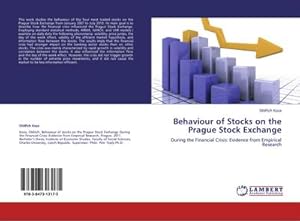
Behaviour of Stocks on the Prague Stock Exchange
Lingua: Inglese
Editore: LAP LAMBERT Academic Publishing Dez 2011, 2011
ISBN 10: 3847313177 ISBN 13: 9783847313175
Da: BuchWeltWeit Ludwig Meier e.K., Bergisch Gladbach, Germania
Valutazione del venditore 5 su 5 stelle

EUR 49,00
Spedizione EUR 23,00
Spedito da Germania a U.S.A.Quantità: 2 disponibili
Aggiungi al carrelloTaschenbuch. Condizione: Neu. This item is printed on demand - it takes 3-4 days longer - Neuware -This work studies the behaviour of the four most traded stocks on the Prague Stock Exchange from January 2007 to July 2010. Its main goal is to describe how the financial crisis influenced the Prague Stock Exchange. Employing standard statistical methods, ARMA, GARCH, and VAR models I examine on daily data the following phenomena: volatility, price jumps, the day of the week effect, validity of the efficient market hypothesis, and information flow between the stocks. The results imply that the financial crisis had stronger impact on the banking sector stocks than on other stocks. The crisis was mainly characterized by rapid growth in volatility and correlation between the stocks. It also influenced the information flow and the day of the week effect. However, the crisis did not trigger growth in the number of extreme price movements, and it did not cause the market to be less information efficient. 60 pp. Englisch.
-

Behaviour of Stocks on the Prague Stock Exchange
Lingua: Inglese
Editore: LAP LAMBERT Academic Publishing Dez 2011, 2011
ISBN 10: 3847313177 ISBN 13: 9783847313175
Da: buchversandmimpf2000, Emtmannsberg, BAYE, Germania
Valutazione del venditore 5 su 5 stelle
EUR 49,00
Spedizione EUR 60,00
Spedito da Germania a U.S.A.Quantità: 1 disponibili
Aggiungi al carrelloTaschenbuch. Condizione: Neu. This item is printed on demand - Print on Demand Titel. Neuware -This work studies the behaviour of the four most traded stocks on the Prague Stock Exchange from January 2007 to July 2010. Its main goal is to describe how the financial crisis influenced the Prague Stock Exchange. Employing standard statistical methods, ARMA, GARCH, and VAR models I examine on daily data the following phenomena: volatility, price jumps, the day of the week effect, validity of the efficient market hypothesis, and information flow between the stocks. The results imply that the financial crisis had stronger impact on the banking sector stocks than on other stocks. The crisis was mainly characterized by rapid growth in volatility and correlation between the stocks. It also influenced the information flow and the day of the week effect. However, the crisis did not trigger growth in the number of extreme price movements, and it did not cause the market to be less information efficient.VDM Verlag, Dudweiler Landstraße 99, 66123 Saarbrücken 60 pp. Englisch.
-
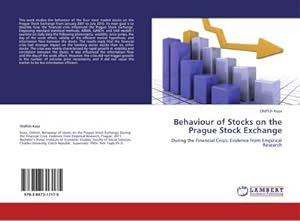
Behaviour of Stocks on the Prague Stock Exchange : During the Financial Crisis: Evidence from Empirical Research
Lingua: Inglese
Editore: LAP LAMBERT Academic Publishing, 2011
ISBN 10: 3847313177 ISBN 13: 9783847313175
EUR 49,00
Spedizione EUR 60,54
Spedito da Germania a U.S.A.Quantità: 1 disponibili
Aggiungi al carrelloTaschenbuch. Condizione: Neu. nach der Bestellung gedruckt Neuware - Printed after ordering - This work studies the behaviour of the four most traded stocks on the Prague Stock Exchange from January 2007 to July 2010. Its main goal is to describe how the financial crisis influenced the Prague Stock Exchange. Employing standard statistical methods, ARMA, GARCH, and VAR models I examine on daily data the following phenomena: volatility, price jumps, the day of the week effect, validity of the efficient market hypothesis, and information flow between the stocks. The results imply that the financial crisis had stronger impact on the banking sector stocks than on other stocks. The crisis was mainly characterized by rapid growth in volatility and correlation between the stocks. It also influenced the information flow and the day of the week effect. However, the crisis did not trigger growth in the number of extreme price movements, and it did not cause the market to be less information efficient.
