

Importo totale (1 articolo articoli):
Destinazione ordine:

pogun sakire (18 risultati)
Vai alla pagina principale dei risultati di ricerca
Filtri di ricerca
Tipo di articolo
- Tutti i tipi di prodotto
- Libri (18)
- Riviste e Giornali (Nessun altro risultato corrispondente a questo perfezionamento)
- Fumetti (Nessun altro risultato corrispondente a questo perfezionamento)
- Spartiti (Nessun altro risultato corrispondente a questo perfezionamento)
- Arte, Stampe e Poster (Nessun altro risultato corrispondente a questo perfezionamento)
- Fotografie (Nessun altro risultato corrispondente a questo perfezionamento)
- Mappe (Nessun altro risultato corrispondente a questo perfezionamento)
- Manoscritti e Collezionismo cartaceo (Nessun altro risultato corrispondente a questo perfezionamento)
Condizioni Maggiori informazioni
- Nuovo (15)
- Come nuovo, Ottimo o Quasi ottimo (2)
- Molto buono o Buono (1)
- Discreto o Mediocre (Nessun altro risultato corrispondente a questo perfezionamento)
- Come descritto (Nessun altro risultato corrispondente a questo perfezionamento)
Legatura
Ulteriori caratteristiche
- Prima ed. (Nessun altro risultato corrispondente a questo perfezionamento)
- Copia autograf. (Nessun altro risultato corrispondente a questo perfezionamento)
- Sovracoperta (Nessun altro risultato corrispondente a questo perfezionamento)
- Con foto (9)
- Non Print on Demand (11)
Lingua (2)
Prezzo
- Qualsiasi prezzo
- Inferiore a EUR 20 (Nessun altro risultato corrispondente a questo perfezionamento)
- EUR 20 a EUR 45 (Nessun altro risultato corrispondente a questo perfezionamento)
- Superiore a EUR 45
Spedizione gratuita
Paese del venditore
Valutazione venditore
-
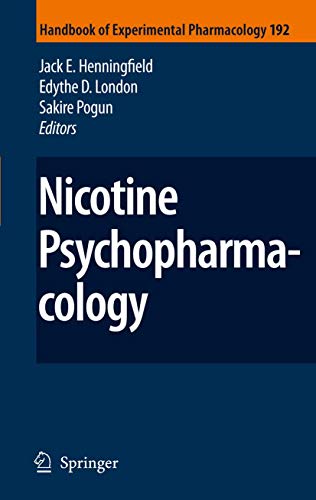
Nicotine Psychopharmacology (Handbook of Experimental Pharmacology, 192)
Da: Ria Christie Collections, Uxbridge, Regno Unito
Valutazione del venditore 5 su 5 stelle

EUR 310,39
Spedizione EUR 13,85
Spedito da Regno Unito a U.S.A.Quantità: Più di 20 disponibili
Aggiungi al carrelloCondizione: New. In.
-
Nicotine Psychopharmacology
Da: GreatBookPricesUK, Woodford Green, Regno Unito
Valutazione del venditore 5 su 5 stelle
EUR 309,77
Spedizione EUR 17,34
Spedito da Regno Unito a U.S.A.Quantità: Più di 20 disponibili
Aggiungi al carrelloCondizione: New.
-
Nicotine Psychopharmacology
Da: GreatBookPrices, Columbia, MD, U.S.A.
Valutazione del venditore 5 su 5 stelle
EUR 334,74
Spedizione EUR 2,29
Spedito in U.S.A.Quantità: Più di 20 disponibili
Aggiungi al carrelloCondizione: New.
-
Nicotine Psychopharmacology (Handbook of Experimental Pharmacology, 192)
Da: California Books, Miami, FL, U.S.A.
Valutazione del venditore 4 su 5 stelle

EUR 347,31
Spedizione gratuita
Spedito in U.S.A.Quantità: Più di 20 disponibili
Aggiungi al carrelloCondizione: New.
-
Nicotine Psychopharmacology
Da: GreatBookPrices, Columbia, MD, U.S.A.
Valutazione del venditore 5 su 5 stelle
EUR 347,94
Spedizione EUR 2,29
Spedito in U.S.A.Quantità: Più di 20 disponibili
Aggiungi al carrelloCondizione: As New. Unread book in perfect condition.
-

EUR 274,55
Spedizione EUR 70,00
Spedito da Germania a U.S.A.Quantità: 5 disponibili
Aggiungi al carrelloTaschenbuch. Condizione: Neu. Nicotine Psychopharmacology | Jack E. Henningfield (u. a.) | Taschenbuch | Handbook of Experimental Pharmacology | xiv | Englisch | 2010 | Springer | EAN 9783642088728 | Verantwortliche Person für die EU: Springer Verlag GmbH, Tiergartenstr. 17, 69121 Heidelberg, juergen[dot]hartmann[at]springer[dot]com | Anbieter: preigu.
-
Nicotine Psychopharmacology
Da: GreatBookPricesUK, Woodford Green, Regno Unito
Valutazione del venditore 5 su 5 stelle
EUR 342,95
Spedizione EUR 17,34
Spedito da Regno Unito a U.S.A.Quantità: Più di 20 disponibili
Aggiungi al carrelloCondizione: As New. Unread book in perfect condition.
-

EUR 320,99
Spedizione EUR 65,51
Spedito da Germania a U.S.A.Quantità: 1 disponibili
Aggiungi al carrelloBuch. Condizione: Neu. Druck auf Anfrage Neuware - Printed after ordering - The fact that tobacco ingestion can affect how people feel and think has been known for millennia, placing the plant among those used spiritually, honori cally, and habitually (Corti 1931; Wilbert 1987). However, the conclusion that nicotine - counted for many of these psychopharmacological effects did not emerge until the nineteenth century (Langley 1905). This was elegantly described by Lewin in 1931 as follows: 'The decisive factor in the effects of tobacco, desired or undesired, is nicotine. . . '(Lewin 1998). The use of nicotine as a pharmacological probe to und- stand physiological functioning at the dawn of the twentieth century was a landmark in the birth of modern neuropharmacology (Limbird 2004; Halliwell 2007), and led the pioneering researcher John Langley to conclude that there must exist some '- ceptive substance' to explain the diverse actions of various substances, including nicotine, when applied to muscle tissue (Langley 1905). Research on tobacco and nicotine progressed throughout the twentieth century, but much of this was from a general pharmacological and toxicological rather than a psychopharmacological perspective (Larson et al. 1961). There was some attention to the effects related to addiction, such as euphoria (Johnston 1941), tolerance (Lewin 1931), and withdrawal (Finnegan et al. 1945), but outside of research supported by the tobacco industry, addiction and psychopharmacology were not major foci for research (Slade et al. 1995; Hurt and Robertson 1998; Henning eld et al. 2006; Henning eld and Hartel 1999; Larson et al. 1961).
-

Nicotine Psychopharmacology
Lingua: Inglese
Editore: Springer Berlin Heidelberg, 2010
ISBN 10: 3642088724 ISBN 13: 9783642088728
EUR 320,99
Spedizione EUR 64,19
Spedito da Germania a U.S.A.Quantità: 1 disponibili
Aggiungi al carrelloTaschenbuch. Condizione: Neu. Druck auf Anfrage Neuware - Printed after ordering - The fact that tobacco ingestion can affect how people feel and think has been known for millennia, placing the plant among those used spiritually, honori cally, and habitually (Corti 1931; Wilbert 1987). However, the conclusion that nicotine - counted for many of these psychopharmacological effects did not emerge until the nineteenth century (Langley 1905). This was elegantly described by Lewin in 1931 as follows: 'The decisive factor in the effects of tobacco, desired or undesired, is nicotine. . . '(Lewin 1998). The use of nicotine as a pharmacological probe to und- stand physiological functioning at the dawn of the twentieth century was a landmark in the birth of modern neuropharmacology (Limbird 2004; Halliwell 2007), and led the pioneering researcher John Langley to conclude that there must exist some '- ceptive substance' to explain the diverse actions of various substances, including nicotine, when applied to muscle tissue (Langley 1905). Research on tobacco and nicotine progressed throughout the twentieth century, but much of this was from a general pharmacological and toxicological rather than a psychopharmacological perspective (Larson et al. 1961). There was some attention to the effects related to addiction, such as euphoria (Johnston 1941), tolerance (Lewin 1931), and withdrawal (Finnegan et al. 1945), but outside of research supported by the tobacco industry, addiction and psychopharmacology were not major foci for research (Slade et al. 1995; Hurt and Robertson 1998; Henning eld et al. 2006; Henning eld and Hartel 1999; Larson et al. 1961).
-
Nicotine Psychopharmacology (Handbook of Experimental Pharmacology) (Volume 192)
Da: Revaluation Books, Exeter, Regno Unito
Valutazione del venditore 5 su 5 stelle
EUR 453,87
Spedizione EUR 14,45
Spedito da Regno Unito a U.S.A.Quantità: 2 disponibili
Aggiungi al carrelloHardcover. Condizione: Brand New. 1st edition. 544 pages. 9.29x6.38x0.94 inches. In Stock.
-

hardcover. Condizione: Good. Ex-Library hardcover book no dust jacket, usual library marks are present. Has some light reader wear.
-

Nicotine Psychopharmacology (eng)
Da: Brook Bookstore On Demand, Napoli, NA, Italia
Valutazione del venditore 3 su 5 stelle

EUR 246,33
Spedizione EUR 8,00
Spedito da Italia a U.S.A.Quantità: Più di 20 disponibili
Aggiungi al carrelloCondizione: new. Questo è un articolo print on demand.
-
Nicotine Psychopharmacology
Lingua: Inglese
Editore: Springer Berlin Heidelberg, 2010
ISBN 10: 3642088724 ISBN 13: 9783642088728
EUR 267,86
Spedizione EUR 48,99
Spedito da Germania a U.S.A.Quantità: Più di 20 disponibili
Aggiungi al carrelloCondizione: New. Dieser Artikel ist ein Print on Demand Artikel und wird nach Ihrer Bestellung fuer Sie gedruckt. With contributions by numerous expertsThe fact that tobacco ingestion can affect how people feel and think has been known for millennia, placing the plant among those used spiritually, honori?cally, and habitually (Corti 1931 Wilbert 1987). However, th.
-

Nicotine Psychopharmacology
Lingua: Inglese
Editore: Springer Berlin Heidelberg, 2009
ISBN 10: 3540692460 ISBN 13: 9783540692461
EUR 267,86
Spedizione EUR 48,99
Spedito da Germania a U.S.A.Quantità: Più di 20 disponibili
Aggiungi al carrelloCondizione: New. Dieser Artikel ist ein Print on Demand Artikel und wird nach Ihrer Bestellung fuer Sie gedruckt. With contributions by numerous expertsThe fact that tobacco ingestion can affect how people feel and think has been known for millennia, placing the plant among those used spiritually, honori?cally, and habitually (Corti 1931 Wilbert 1987). However, th.
-

Nicotine Psychopharmacology
Lingua: Inglese
Editore: Springer Berlin Heidelberg Feb 2009, 2009
ISBN 10: 3540692460 ISBN 13: 9783540692461
Da: BuchWeltWeit Ludwig Meier e.K., Bergisch Gladbach, Germania
Valutazione del venditore 5 su 5 stelle
EUR 320,99
Spedizione EUR 23,00
Spedito da Germania a U.S.A.Quantità: 2 disponibili
Aggiungi al carrelloBuch. Condizione: Neu. This item is printed on demand - it takes 3-4 days longer - Neuware -The fact that tobacco ingestion can affect how people feel and think has been known for millennia, placing the plant among those used spiritually, honori cally, and habitually (Corti 1931; Wilbert 1987). However, the conclusion that nicotine - counted for many of these psychopharmacological effects did not emerge until the nineteenth century (Langley 1905). This was elegantly described by Lewin in 1931 as follows: 'The decisive factor in the effects of tobacco, desired or undesired, is nicotine. . . '(Lewin 1998). The use of nicotine as a pharmacological probe to und- stand physiological functioning at the dawn of the twentieth century was a landmark in the birth of modern neuropharmacology (Limbird 2004; Halliwell 2007), and led the pioneering researcher John Langley to conclude that there must exist some '- ceptive substance' to explain the diverse actions of various substances, including nicotine, when applied to muscle tissue (Langley 1905). Research on tobacco and nicotine progressed throughout the twentieth century, but much of this was from a general pharmacological and toxicological rather than a psychopharmacological perspective (Larson et al. 1961). There was some attention to the effects related to addiction, such as euphoria (Johnston 1941), tolerance (Lewin 1931), and withdrawal (Finnegan et al. 1945), but outside of research supported by the tobacco industry, addiction and psychopharmacology were not major foci for research (Slade et al. 1995; Hurt and Robertson 1998; Henning eld et al. 2006; Henning eld and Hartel 1999; Larson et al. 1961). 560 pp. Englisch.
-

Nicotine Psychopharmacology
Lingua: Inglese
Editore: Springer Berlin Heidelberg Nov 2010, 2010
ISBN 10: 3642088724 ISBN 13: 9783642088728
Da: BuchWeltWeit Ludwig Meier e.K., Bergisch Gladbach, Germania
Valutazione del venditore 5 su 5 stelle
EUR 320,99
Spedizione EUR 23,00
Spedito da Germania a U.S.A.Quantità: 2 disponibili
Aggiungi al carrelloTaschenbuch. Condizione: Neu. This item is printed on demand - it takes 3-4 days longer - Neuware -The fact that tobacco ingestion can affect how people feel and think has been known for millennia, placing the plant among those used spiritually, honori cally, and habitually (Corti 1931; Wilbert 1987). However, the conclusion that nicotine - counted for many of these psychopharmacological effects did not emerge until the nineteenth century (Langley 1905). This was elegantly described by Lewin in 1931 as follows: 'The decisive factor in the effects of tobacco, desired or undesired, is nicotine. . . '(Lewin 1998). The use of nicotine as a pharmacological probe to und- stand physiological functioning at the dawn of the twentieth century was a landmark in the birth of modern neuropharmacology (Limbird 2004; Halliwell 2007), and led the pioneering researcher John Langley to conclude that there must exist some '- ceptive substance' to explain the diverse actions of various substances, including nicotine, when applied to muscle tissue (Langley 1905). Research on tobacco and nicotine progressed throughout the twentieth century, but much of this was from a general pharmacological and toxicological rather than a psychopharmacological perspective (Larson et al. 1961). There was some attention to the effects related to addiction, such as euphoria (Johnston 1941), tolerance (Lewin 1931), and withdrawal (Finnegan et al. 1945), but outside of research supported by the tobacco industry, addiction and psychopharmacology were not major foci for research (Slade et al. 1995; Hurt and Robertson 1998; Henning eld et al. 2006; Henning eld and Hartel 1999; Larson et al. 1961). 560 pp. Englisch.
-

Nicotine Psychopharmacology
Lingua: Inglese
Editore: Springer, Springer Vieweg Nov 2010, 2010
ISBN 10: 3642088724 ISBN 13: 9783642088728
Da: buchversandmimpf2000, Emtmannsberg, BAYE, Germania
Valutazione del venditore 5 su 5 stelle
EUR 320,99
Spedizione EUR 60,00
Spedito da Germania a U.S.A.Quantità: 1 disponibili
Aggiungi al carrelloTaschenbuch. Condizione: Neu. This item is printed on demand - Print on Demand Titel. Neuware -The fact that tobacco ingestion can affect how people feel and think has been known for millennia, placing the plant among those used spiritually, honori cally, and habitually (Corti 1931; Wilbert 1987). However, the conclusion that nicotine - counted for many of these psychopharmacological effects did not emerge until the nineteenth century (Langley 1905). This was elegantly described by Lewin in 1931 as follows: ¿The decisive factor in the effects of tobacco, desired or undesired, is nicotine. . . ¿(Lewin 1998). The use of nicotine as a pharmacological probe to und- stand physiological functioning at the dawn of the twentieth century was a landmark in the birth of modern neuropharmacology (Limbird 2004; Halliwell 2007), and led the pioneering researcher John Langley to conclude that there must exist some ¿- ceptive substance¿ to explain the diverse actions of various substances, including nicotine, when applied to muscle tissue (Langley 1905). Research on tobacco and nicotine progressed throughout the twentieth century, but much of this was from a general pharmacological and toxicological rather than a psychopharmacological perspective (Larson et al. 1961). There was some attention to the effects related to addiction, such as euphoria (Johnston 1941), tolerance (Lewin 1931), and withdrawal (Finnegan et al. 1945), but outside of research supported by the tobacco industry, addiction and psychopharmacology were not major foci for research (Slade et al. 1995; Hurt and Robertson 1998; Henning eld et al. 2006; Henning eld and Hartel 1999; Larson et al. 1961).Springer-Verlag KG, Sachsenplatz 4-6, 1201 Wien 560 pp. Englisch.
-

Nicotine Psychopharmacology
Lingua: Inglese
Editore: Springer, Springer Vieweg Feb 2009, 2009
ISBN 10: 3540692460 ISBN 13: 9783540692461
Da: buchversandmimpf2000, Emtmannsberg, BAYE, Germania
Valutazione del venditore 5 su 5 stelle
EUR 320,99
Spedizione EUR 60,00
Spedito da Germania a U.S.A.Quantità: 1 disponibili
Aggiungi al carrelloBuch. Condizione: Neu. This item is printed on demand - Print on Demand Titel. Neuware -The fact that tobacco ingestion can affect how people feel and think has been known for millennia, placing the plant among those used spiritually, honori cally, and habitually (Corti 1931; Wilbert 1987). However, the conclusion that nicotine - counted for many of these psychopharmacological effects did not emerge until the nineteenth century (Langley 1905). This was elegantly described by Lewin in 1931 as follows: ¿The decisive factor in the effects of tobacco, desired or undesired, is nicotine. . . ¿(Lewin 1998). The use of nicotine as a pharmacological probe to und- stand physiological functioning at the dawn of the twentieth century was a landmark in the birth of modern neuropharmacology (Limbird 2004; Halliwell 2007), and led the pioneering researcher John Langley to conclude that there must exist some ¿- ceptive substance¿ to explain the diverse actions of various substances, including nicotine, when applied to muscle tissue (Langley 1905). Research on tobacco and nicotine progressed throughout the twentieth century, but much of this was from a general pharmacological and toxicological rather than a psychopharmacological perspective (Larson et al. 1961). There was some attention to the effects related to addiction, such as euphoria (Johnston 1941), tolerance (Lewin 1931), and withdrawal (Finnegan et al. 1945), but outside of research supported by the tobacco industry, addiction and psychopharmacology were not major foci for research (Slade et al. 1995; Hurt and Robertson 1998; Henning eld et al. 2006; Henning eld and Hartel 1999; Larson et al. 1961).Springer-Verlag KG, Sachsenplatz 4-6, 1201 Wien 560 pp. Englisch.


