

Importo totale (1 articolo articoli):
Destinazione ordine:

richard pennington redpath (8 risultati)
Vai alla pagina principale dei risultati di ricerca
Filtri di ricerca
Tipo di articolo
- Tutti i tipi di prodotto
- Libri (Nessun altro risultato corrispondente a questo perfezionamento)
- Riviste e Giornali (1)
- Fumetti (Nessun altro risultato corrispondente a questo perfezionamento)
- Spartiti (Nessun altro risultato corrispondente a questo perfezionamento)
- Arte, Stampe e Poster (Nessun altro risultato corrispondente a questo perfezionamento)
- Fotografie (Nessun altro risultato corrispondente a questo perfezionamento)
- Mappe (Nessun altro risultato corrispondente a questo perfezionamento)
- Manoscritti e Collezionismo cartaceo (7)
Condizioni Maggiori informazioni
- Nuovo (Nessun altro risultato corrispondente a questo perfezionamento)
- Come nuovo, Ottimo o Quasi ottimo (Nessun altro risultato corrispondente a questo perfezionamento)
- Molto buono o Buono (8)
- Discreto o Mediocre (Nessun altro risultato corrispondente a questo perfezionamento)
- Come descritto (Nessun altro risultato corrispondente a questo perfezionamento)
Legatura
- Tutte
- Rilegato (Nessun altro risultato corrispondente a questo perfezionamento)
- Brossura (2)
Ulteriori caratteristiche
- Prima ed. (Nessun altro risultato corrispondente a questo perfezionamento)
- Copia autograf. (Nessun altro risultato corrispondente a questo perfezionamento)
- Sovracoperta (Nessun altro risultato corrispondente a questo perfezionamento)
- Con foto (8)
- Non Print on Demand (8)
Lingua (1)
Spedizione gratuita
- Spedizione gratuita in U.S.A. (Nessun altro risultato corrispondente a questo perfezionamento)
Paese del venditore
Valutazione venditore
-
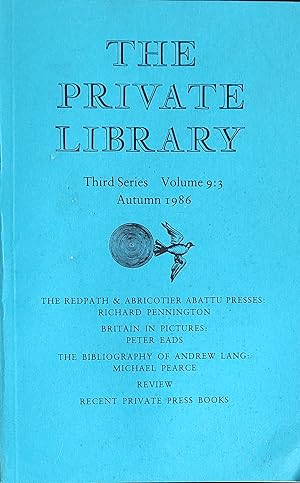
The Private Library Autumn 1986 Third Series Volume 9:3 / Richard Pennington "The Redpath & Abricotter Abattu Presses" / Peter Eads "Britain In Pictures" / Michael Pearce "The Bibliography Of Andrew Lang"
Editore: Private Libraries Association, 1986
Rivista / Giornale
EUR 10,63
Spedizione EUR 12,61
Spedito da Regno Unito a U.S.A.Quantità: 1 disponibili
Aggiungi al carrelloSoft cover. Condizione: Very Good. 48 pages. Richard Pennington "The Redpath & Abricotter Abattu Presses" / Peter Eads "Britain In Pictures" / Michael Pearce "The Bibliography Of Andrew Lang".
-

Exit Mistress Fitton. A Letter To Sidney Fisher from Richard Pennington. One of 50 copies printed.
Editore: Montreal, Canada: Redpath Press., 1973
Da: Wittenborn Art Books, San Francisco, CA, U.S.A.
Valutazione del venditore 5 su 5 stelle

Manoscritto / Collezionismo cartaceo
Condizione: Good. 12mo. String-Bound Chapbook, Marbled Deckled Wraps, Letterpress on Deckled Laid. Printed label pasted down to cover. [9 pp.], Good with marginal tear, minor creasing, & light staining to end papers.
-
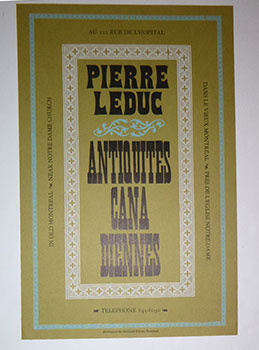
Pierre Luduc. Antiquites Canadiennes in Old Montreal. Dans le vieux Montreal. First edition of the poster.
Editore: Montreal: Pierre Luduc, circa 1960s, 1960
Da: Wittenborn Art Books, San Francisco, CA, U.S.A.
Valutazione del venditore 5 su 5 stelle
Manoscritto / Collezionismo cartaceo
Condizione: Good. Letterpress and silkscreen on green paper. 48.5 x 31.2 cm. Luduc was located at 222 rue de l'hopital dans le vieux Montreal .Richard Pennington established Redpath Press while he was working at McGill University in Montreal. He started the press 'partly for pleasure and partly to demonstrate the practices of hand-printing to students in the school of librarianship where he annually lectured on the history of the book and printing'.(Source: Peter Biskup 'Richard Pennington, University of Queensland's First James Forsyth Librarian, 1939-1946.' Australian Academic and Research Libraries 27.4 December 1996.)Provenance: from the estate of Raymond Gid who died Sunday November 12, 2000 in Paris. Born on November 25, 1905, Raymond Gid became first known through his posters, after having studied at les Beaux-Arts. As a film enthusiast, he designed many movie posters, for example Vampyr de Dreyer (photomontage, 1932), Le Silence de la mer by Melville (1949), Les Diaboliques by Clouzot (1955). But a meeting with Guy Levis Mano (editions GLM), editor and typographer, soon directed Gid towards the book. In 1935, he publishes, together with the photographer Pierre Jahan Devot Christ de Perpignan and Chats, Chiens by Ylla. It is an intensive period of his life period: he meets Dufy, Corbusier, Hake, Lurcat and receives the gold medal for a poster at the International exhibition of Paris (1937). He reacts to the Civil War in Spain with a poster " Help to the civil populations ". Together With Father Carre, « bete-a-bon-Dieu » of the Resistance, Raymond Gid began to design liturgical texts. Apocalypse Six (an extract of the biblical text of Saint John) appeard after the war. It is one of his major works, composed in the Peignot typeface, which was designed by Cassandre in 1937. He designs several post-war period posters, for example Week of absent, a simple Lorraine cross surrounded by barbed wire on a dark background. Right from the beginning of the symposiums in Lure (Provence) in 1954, Raymond Gid participates in discussions on typography, particularly with Maximilen Vox, Charles Peignot, Roger Excoffon. Raymond Gid puts on page and illustrates the Dialogues of the Carmelite nuns by Bernanos (1954), then some pages in Caractere Noel 1955, dedicated to his friend Jan van Krimpen, the creator of dutch type faces. He plays with the breathing of the text, in the manner of Mallarme, as in his Book of hours (1959) or his Apocalypse (1964), adapting medieval text to present day tastes. He also designs posters like those for the Club Mediterranee (1961), Bally (1976) or, heavier fare, like that of Amnesty International (1973). During his whole life, Raymond Gid remained attached to the typographical arts. He liked to try out new characters in his compositions, mixing them with his very free drawings, as for example in Messidor published by the Imprimerie nationale (1989). Jean-Francois Porchez, type designer; translated from french by Babelfish and cleaned up a bit. Links Art and Poster Bally posters Chicago Center for the Print Bally posters Poster Auctions International, New York Catalogue from the personal exhibition at the Bibliotheque Forney, Paris, in 1992.
-
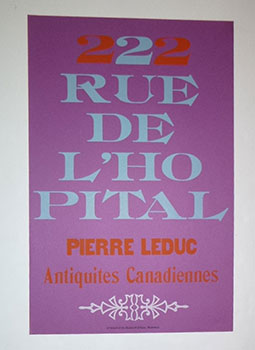
222 Rue de L'Hopital. Pierre Luduc. Antiquites Canadiennes. First edition of the poster.
Editore: Montreal: Pierre Luduc, circa 1960s, 1960
Da: Wittenborn Art Books, San Francisco, CA, U.S.A.
Valutazione del venditore 5 su 5 stelle
Manoscritto / Collezionismo cartaceo
Condizione: Good. Letterpress and silkscreen on mauve paper. 48.5 x 31.2 cm. Luduc was located at 222 rue de l'hopital dans le vieux Montreal .Richard Pennington established Redpath Press while he was working at McGill University in Montreal. He started the press 'partly for pleasure and partly to demonstrate the practices of hand-printing to students in the school of librarianship where he annually lectured on the history of the book and printing'.(Source: Peter Biskup 'Richard Pennington, University of Queensland's First James Forsyth Librarian, 1939-1946.' Australian Academic and Research Libraries 27.4 December 1996.)Provenance: from the estate of Raymond Gid who died Sunday November 12, 2000 in Paris. Born on November 25, 1905, Raymond Gid became first known through his posters, after having studied at les Beaux-Arts. As a film enthusiast, he designed many movie posters, for example Vampyr de Dreyer (photomontage, 1932), Le Silence de la mer by Melville (1949), Les Diaboliques by Clouzot (1955). But a meeting with Guy Levis Mano (editions GLM), editor and typographer, soon directed Gid towards the book. In 1935, he publishes, together with the photographer Pierre Jahan Devot Christ de Perpignan and Chats, Chiens by Ylla. It is an intensive period of his life period: he meets Dufy, Corbusier, Hake, Lurcat and receives the gold medal for a poster at the International exhibition of Paris (1937). He reacts to the Civil War in Spain with a poster " Help to the civil populations ". Together With Father Carre, « bete-a-bon-Dieu » of the Resistance, Raymond Gid began to design liturgical texts. Apocalypse Six (an extract of the biblical text of Saint John) appeard after the war. It is one of his major works, composed in the Peignot typeface, which was designed by Cassandre in 1937. He designs several post-war period posters, for example Week of absent, a simple Lorraine cross surrounded by barbed wire on a dark background. Right from the beginning of the symposiums in Lure (Provence) in 1954, Raymond Gid participates in discussions on typography, particularly with Maximilen Vox, Charles Peignot, Roger Excoffon. Raymond Gid puts on page and illustrates the Dialogues of the Carmelite nuns by Bernanos (1954), then some pages in Caractere Noel 1955, dedicated to his friend Jan van Krimpen, the creator of dutch type faces. He plays with the breathing of the text, in the manner of Mallarme, as in his Book of hours (1959) or his Apocalypse (1964), adapting medieval text to present day tastes. He also designs posters like those for the Club Mediterranee (1961), Bally (1976) or, heavier fare, like that of Amnesty International (1973). During his whole life, Raymond Gid remained attached to the typographical arts. He liked to try out new characters in his compositions, mixing them with his very free drawings, as for example in Messidor published by the Imprimerie nationale (1989). Jean-Francois Porchez, type designer; translated from french by Babelfish and cleaned up a bit. Links Art and Poster Bally posters Chicago Center for the Print Bally posters Poster Auctions International, New York Catalogue from the personal exhibition at the Bibliotheque Forney, Paris, in 1992.
-
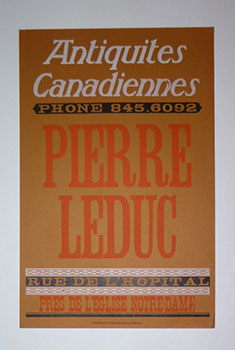
Pierre Luduc. Antiquites Canadiennes. . First edition of the poster.
Editore: Montreal: Pierre Luduc, circa 1960s, 1960
Da: Wittenborn Art Books, San Francisco, CA, U.S.A.
Valutazione del venditore 5 su 5 stelle
Manoscritto / Collezionismo cartaceo
Condizione: Good. Letterpress and silkscreen on pumpkin color paoer., 48.5 x 31.2 cm. Luduc was located at 222 rue de l'hopital dans le vieux Montreal .Richard Pennington established Redpath Press while he was working at McGill University in Montreal. He started the press 'partly for pleasure and partly to demonstrate the practices of hand-printing to students in the school of librarianship where he annually lectured on the history of the book and printing'.(Source: Peter Biskup 'Richard Pennington, University of Queensland's First James Forsyth Librarian, 1939-1946.' Australian Academic and Research Libraries 27.4 December 1996.)Provenance: from the estate of Raymond Gid who died Sunday November 12, 2000 in Paris. Born on November 25, 1905, Raymond Gid became first known through his posters, after having studied at les Beaux-Arts. As a film enthusiast, he designed many movie posters, for example Vampyr de Dreyer (photomontage, 1932), Le Silence de la mer by Melville (1949), Les Diaboliques by Clouzot (1955). But a meeting with Guy Levis Mano (editions GLM), editor and typographer, soon directed Gid towards the book. In 1935, he publishes, together with the photographer Pierre Jahan Devot Christ de Perpignan and Chats, Chiens by Ylla. It is an intensive period of his life period: he meets Dufy, Corbusier, Hake, Lurcat and receives the gold medal for a poster at the International exhibition of Paris (1937). He reacts to the Civil War in Spain with a poster " Help to the civil populations ". Together With Father Carre, « bete-a-bon-Dieu » of the Resistance, Raymond Gid began to design liturgical texts. Apocalypse Six (an extract of the biblical text of Saint John) appeard after the war. It is one of his major works, composed in the Peignot typeface, which was designed by Cassandre in 1937. He designs several post-war period posters, for example Week of absent, a simple Lorraine cross surrounded by barbed wire on a dark background. Right from the beginning of the symposiums in Lure (Provence) in 1954, Raymond Gid participates in discussions on typography, particularly with Maximilen Vox, Charles Peignot, Roger Excoffon. Raymond Gid puts on page and illustrates the Dialogues of the Carmelite nuns by Bernanos (1954), then some pages in Caractere Noel 1955, dedicated to his friend Jan van Krimpen, the creator of dutch type faces. He plays with the breathing of the text, in the manner of Mallarme, as in his Book of hours (1959) or his Apocalypse (1964), adapting medieval text to present day tastes. He also designs posters like those for the Club Mediterranee (1961), Bally (1976) or, heavier fare, like that of Amnesty International (1973). During his whole life, Raymond Gid remained attached to the typographical arts. He liked to try out new characters in his compositions, mixing them with his very free drawings, as for example in Messidor published by the Imprimerie nationale (1989). Jean-Francois Porchez, type designer; translated from french by Babelfish and cleaned up a bit. Links Art and Poster Bally posters Chicago Center for the Print Bally posters Poster Auctions International, New York Catalogue from the personal exhibition at the Bibliotheque Forney, Paris, in 1992.
-

Pierre Luduc., Pres de l'Eglise Notre Dame. Antiquites Canadiennes. First edition of the poster.
Editore: Montreal: Pierre Luduc, circa 1960s, 1960
Da: Wittenborn Art Books, San Francisco, CA, U.S.A.
Valutazione del venditore 5 su 5 stelle
Manoscritto / Collezionismo cartaceo
Condizione: Good. Letterpress and silkscreen on green-blue paper. 48.5 x 31.2 cm. Luduc was located at 222 rue de l'hopital dans le vieux Montreal .Richard Pennington established Redpath Press while he was working at McGill University in Montreal. He started the press 'partly for pleasure and partly to demonstrate the practices of hand-printing to students in the school of librarianship where he annually lectured on the history of the book and printing'.(Source: Peter Biskup 'Richard Pennington, University of Queensland's First James Forsyth Librarian, 1939-1946.' Australian Academic and Research Libraries 27.4 December 1996.)Provenance: from the estate of Raymond Gid who died Sunday November 12, 2000 in Paris. Born on November 25, 1905, Raymond Gid became first known through his posters, after having studied at les Beaux-Arts. As a film enthusiast, he designed many movie posters, for example Vampyr de Dreyer (photomontage, 1932), Le Silence de la mer by Melville (1949), Les Diaboliques by Clouzot (1955). But a meeting with Guy Levis Mano (editions GLM), editor and typographer, soon directed Gid towards the book. In 1935, he publishes, together with the photographer Pierre Jahan Devot Christ de Perpignan and Chats, Chiens by Ylla. It is an intensive period of his life period: he meets Dufy, Corbusier, Hake, Lurcat and receives the gold medal for a poster at the International exhibition of Paris (1937). He reacts to the Civil War in Spain with a poster " Help to the civil populations ". Together With Father Carre, « bete-a-bon-Dieu » of the Resistance, Raymond Gid began to design liturgical texts. Apocalypse Six (an extract of the biblical text of Saint John) appeard after the war. It is one of his major works, composed in the Peignot typeface, which was designed by Cassandre in 1937. He designs several post-war period posters, for example Week of absent, a simple Lorraine cross surrounded by barbed wire on a dark background. Right from the beginning of the symposiums in Lure (Provence) in 1954, Raymond Gid participates in discussions on typography, particularly with Maximilen Vox, Charles Peignot, Roger Excoffon. Raymond Gid puts on page and illustrates the Dialogues of the Carmelite nuns by Bernanos (1954), then some pages in Caractere Noel 1955, dedicated to his friend Jan van Krimpen, the creator of dutch type faces. He plays with the breathing of the text, in the manner of Mallarme, as in his Book of hours (1959) or his Apocalypse (1964), adapting medieval text to present day tastes. He also designs posters like those for the Club Mediterranee (1961), Bally (1976) or, heavier fare, like that of Amnesty International (1973). During his whole life, Raymond Gid remained attached to the typographical arts. He liked to try out new characters in his compositions, mixing them with his very free drawings, as for example in Messidor published by the Imprimerie nationale (1989). Jean-Francois Porchez, type designer; translated from french by Babelfish and cleaned up a bit. Links Art and Poster Bally posters Chicago Center for the Print Bally posters Poster Auctions International, New York Catalogue from the personal exhibition at the Bibliotheque Forney, Paris, in 1992.
-
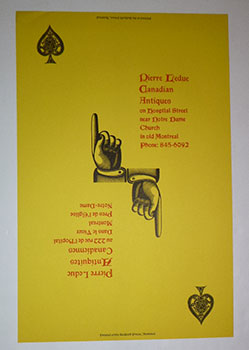
Pierre Luduc Antiquites Canadiennes au 222 rue de l'hopital. Pres de l'Eglise Notre Dame.First edition of the poster.
Editore: Montreal: Pierre Luduc, circa 1960s, 1960
Da: Wittenborn Art Books, San Francisco, CA, U.S.A.
Valutazione del venditore 5 su 5 stelle
Manoscritto / Collezionismo cartaceo
Condizione: Good. Letterpress and silkscreen on yellow paper. 48.5 x 31.2 cm. Luduc was located at 222 rue de l'hopital dans le vieux Montreal .Richard Pennington established Redpath Press while he was working at McGill University in Montreal. He started the press 'partly for pleasure and partly to demonstrate the practices of hand-printing to students in the school of librarianship where he annually lectured on the history of the book and printing'.(Source: Peter Biskup 'Richard Pennington, University of Queensland's First James Forsyth Librarian, 1939-1946.' Australian Academic and Research Libraries 27.4 December 1996.)Provenance: from the estate of Raymond Gid who died Sunday November 12, 2000 in Paris. Born on November 25, 1905, Raymond Gid became first known through his posters, after having studied at les Beaux-Arts. As a film enthusiast, he designed many movie posters, for example Vampyr de Dreyer (photomontage, 1932), Le Silence de la mer by Melville (1949), Les Diaboliques by Clouzot (1955). But a meeting with Guy Levis Mano (editions GLM), editor and typographer, soon directed Gid towards the book. In 1935, he publishes, together with the photographer Pierre Jahan Devot Christ de Perpignan and Chats, Chiens by Ylla. It is an intensive period of his life period: he meets Dufy, Corbusier, Hake, Lurcat and receives the gold medal for a poster at the International exhibition of Paris (1937). He reacts to the Civil War in Spain with a poster " Help to the civil populations ". Together With Father Carre, « bete-a-bon-Dieu » of the Resistance, Raymond Gid began to design liturgical texts. Apocalypse Six (an extract of the biblical text of Saint John) appeard after the war. It is one of his major works, composed in the Peignot typeface, which was designed by Cassandre in 1937. He designs several post-war period posters, for example Week of absent, a simple Lorraine cross surrounded by barbed wire on a dark background. Right from the beginning of the symposiums in Lure (Provence) in 1954, Raymond Gid participates in discussions on typography, particularly with Maximilen Vox, Charles Peignot, Roger Excoffon. Raymond Gid puts on page and illustrates the Dialogues of the Carmelite nuns by Bernanos (1954), then some pages in Caractere Noel 1955, dedicated to his friend Jan van Krimpen, the creator of dutch type faces. He plays with the breathing of the text, in the manner of Mallarme, as in his Book of hours (1959) or his Apocalypse (1964), adapting medieval text to present day tastes. He also designs posters like those for the Club Mediterranee (1961), Bally (1976) or, heavier fare, like that of Amnesty International (1973). During his whole life, Raymond Gid remained attached to the typographical arts. He liked to try out new characters in his compositions, mixing them with his very free drawings, as for example in Messidor published by the Imprimerie nationale (1989). Jean-Francois Porchez, type designer; translated from french by Babelfish and cleaned up a bit. Links Art and Poster Bally posters Chicago Center for the Print Bally posters Poster Auctions International, New York Catalogue from the personal exhibition at the Bibliotheque Forney, Paris, in 1992.
-
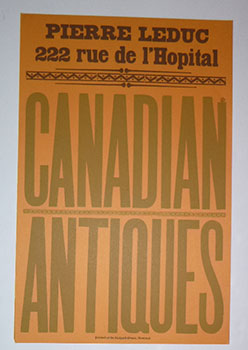
Pierre Luduc. Canadian Antiques.First edition of the poster.
Editore: Montreal: Pierre Luduc, circa 1960s, 1960
Da: Wittenborn Art Books, San Francisco, CA, U.S.A.
Valutazione del venditore 5 su 5 stelle
Manoscritto / Collezionismo cartaceo
Condizione: Good. Letterpress and silkscreen on orange paper. 48.5 x 31.2 cm. Luduc was located at 222 rue de l'hopital dans le vieux Montreal .Richard Pennington established Redpath Press while he was working at McGill University in Montreal. He started the press 'partly for pleasure and partly to demonstrate the practices of hand-printing to students in the school of librarianship where he annually lectured on the history of the book and printing'.(Source: Peter Biskup 'Richard Pennington, University of Queensland's First James Forsyth Librarian, 1939-1946.' Australian Academic and Research Libraries 27.4 December 1996.)Provenance: from the estate of Raymond Gid who died Sunday November 12, 2000 in Paris. Born on November 25, 1905, Raymond Gid became first known through his posters, after having studied at les Beaux-Arts. As a film enthusiast, he designed many movie posters, for example Vampyr de Dreyer (photomontage, 1932), Le Silence de la mer by Melville (1949), Les Diaboliques by Clouzot (1955). But a meeting with Guy Levis Mano (editions GLM), editor and typographer, soon directed Gid towards the book. In 1935, he publishes, together with the photographer Pierre Jahan Devot Christ de Perpignan and Chats, Chiens by Ylla. It is an intensive period of his life period: he meets Dufy, Corbusier, Hake, Lurcat and receives the gold medal for a poster at the International exhibition of Paris (1937). He reacts to the Civil War in Spain with a poster " Help to the civil populations ". Together With Father Carre, « bete-a-bon-Dieu » of the Resistance, Raymond Gid began to design liturgical texts. Apocalypse Six (an extract of the biblical text of Saint John) appeard after the war. It is one of his major works, composed in the Peignot typeface, which was designed by Cassandre in 1937. He designs several post-war period posters, for example Week of absent, a simple Lorraine cross surrounded by barbed wire on a dark background. Right from the beginning of the symposiums in Lure (Provence) in 1954, Raymond Gid participates in discussions on typography, particularly with Maximilen Vox, Charles Peignot, Roger Excoffon. Raymond Gid puts on page and illustrates the Dialogues of the Carmelite nuns by Bernanos (1954), then some pages in Caractere Noel 1955, dedicated to his friend Jan van Krimpen, the creator of dutch type faces. He plays with the breathing of the text, in the manner of Mallarme, as in his Book of hours (1959) or his Apocalypse (1964), adapting medieval text to present day tastes. He also designs posters like those for the Club Mediterranee (1961), Bally (1976) or, heavier fare, like that of Amnesty International (1973). During his whole life, Raymond Gid remained attached to the typographical arts. He liked to try out new characters in his compositions, mixing them with his very free drawings, as for example in Messidor published by the Imprimerie nationale (1989). Jean-Francois Porchez, type designer; translated from french by Babelfish and cleaned up a bit. Links Art and Poster Bally posters Chicago Center for the Print Bally posters Poster Auctions International, New York Catalogue from the personal exhibition at the Bibliotheque Forney, Paris, in 1992.
