
Robert dammy (32 risultati)

Editore: Paris, 1912
- Brossura
- Stampa artistica
Da: Trillium Antique Prints & Rare Books, Franklin, TN, U.S.A.Trillium Antique Prints & Rare Books
Contatta il venditoreVenditore con 3 stelleCondizione: Usato - Ottimo
EUR 67,53
EUR 8,74 spedizioneSpedito in U.S.A.Quantità: 1 disponibili
Condizione: Fine. The Gazette du Bon Ton featured some of the most desirable pochoir, fashion lithographs. The fashion periodical ran from 1912 to 1925, and greatly influenced the style of the time. Great artists from the day, such as George Barbier and Andre Marty, contributed beautiful plates to the work. Gazette du Bon Ton wa…s published by Lucien Vogel in Paris.The work was meant to appeal to the upper echelon of Parisian society. The fashion prints beauty and quality of the publication has taken on great appeal through the time. The prints feature dramatic pochoir coloring, which is created when single layers of color are added by hand to a lithograph using a stencil.Many prominent artists contributed the magazine including Barbier, Marty, Brissaud, Worth, Monvel, Lepape, Pacquin, & Poiret. George Barbier's contributions to this work are particularly desirable. He contributed greatly to design in this era and also had work featured in Vogue. Lucien Vogel, fashion publisher, (pictured above), was the brilliant creator of this famous Art Deco fashion magazine. He was well-known and well-connected paving the way for the Gazette's success. --- The work is in very good to excellent condition overall. There may be a few light marks, toned spots or imperfections to be expected with age. There are occasional pencil marks on some of the plates. Please review the image carefully for condition and contact us with any questions. --- Paper Size ~ 7 1/2" by 9 3/4". H. Robert Dammy (illustratore).

Editore: Paris, 1912
- Brossura
- Stampa artistica
Da: Trillium Antique Prints & Rare Books, Franklin, TN, U.S.A.Trillium Antique Prints & Rare Books
Contatta il venditoreVenditore con 3 stelleCondizione: Usato - Ottimo
EUR 67,53
EUR 8,74 spedizioneSpedito in U.S.A.Quantità: 1 disponibili
Condizione: Fine. The Gazette du Bon Ton featured some of the most desirable pochoir, fashion lithographs. The fashion periodical ran from 1912 to 1925, and greatly influenced the style of the time. Great artists from the day, such as George Barbier and Andre Marty, contributed beautiful plates to the work. Gazette du Bon Ton wa…s published by Lucien Vogel in Paris.The work was meant to appeal to the upper echelon of Parisian society. The fashion prints beauty and quality of the publication has taken on great appeal through the time. The prints feature dramatic pochoir coloring, which is created when single layers of color are added by hand to a lithograph using a stencil.Many prominent artists contributed the magazine including Barbier, Marty, Brissaud, Worth, Monvel, Lepape, Pacquin, & Poiret. George Barbier's contributions to this work are particularly desirable. He contributed greatly to design in this era and also had work featured in Vogue. Lucien Vogel, fashion publisher, (pictured above), was the brilliant creator of this famous Art Deco fashion magazine. He was well-known and well-connected paving the way for the Gazette's success. --- The work is in very good to excellent condition overall. There may be a few light marks, toned spots or imperfections to be expected with age. There are occasional pencil marks on some of the plates. Please review the image carefully for condition and contact us with any questions. --- Paper Size ~ 7 1/2" by 9 3/4". H. Robert Dammy (illustratore).

Editore: Paris, 1912
- Brossura
- Stampa artistica
Da: Trillium Antique Prints & Rare Books, Franklin, TN, U.S.A.Trillium Antique Prints & Rare Books
Contatta il venditoreVenditore con 3 stelleCondizione: Usato - Ottimo
EUR 67,53
EUR 8,74 spedizioneSpedito in U.S.A.Quantità: 1 disponibili
Soft cover. Condizione: Fine. The Gazette du Bon Ton featured some of the most desirable pochoir, fashion lithographs. The fashion periodical ran from 1912 to 1925, and greatly influenced the style of the time. Great artists from the day, such as George Barbier and Andre Marty, contributed beautiful plates to the work. Gazette d…u Bon Ton was published by Lucien Vogel in Paris.The work was meant to appeal to the upper echelon of Parisian society. The fashion prints beauty and quality of the publication has taken on great appeal through the time. The prints feature dramatic pochoir coloring, which is created when single layers of color are added by hand to a lithograph using a stencil.Many prominent artists contributed the magazine including Barbier, Marty, Brissaud, Worth, Monvel, Lepape, Pacquin, & Poiret. George Barbier's contributions to this work are particularly desirable. He contributed greatly to design in this era and also had work featured in Vogue. Lucien Vogel, fashion publisher, (pictured above), was the brilliant creator of this famous Art Deco fashion magazine. He was well-known and well-connected paving the way for the Gazette's success. --- The work is in good to excellent condition. There may be a few light marks, toned spots or imperfections to be expected with age. Please review the image carefully for condition and contact us with any questions. --- Paper Size ~ 7" by 9 1/2". H. Robert Dammy (illustratore).

Editore: Paris, 1912
- Brossura
- Stampa artistica
Da: Trillium Antique Prints & Rare Books, Franklin, TN, U.S.A.Trillium Antique Prints & Rare Books
Contatta il venditoreVenditore con 3 stelleCondizione: Usato - Ottimo
EUR 72,03
EUR 8,74 spedizioneSpedito in U.S.A.Quantità: 1 disponibili
Condizione: Fine. The Gazette du Bon Ton featured some of the most desirable pochoir, fashion lithographs. The fashion periodical ran from 1912 to 1925, and greatly influenced the style of the time. Great artists from the day, such as George Barbier and Andre Marty, contributed beautiful plates to the work. Gazette du Bon Ton wa…s published by Lucien Vogel in Paris.The work was meant to appeal to the upper echelon of Parisian society. The fashion prints beauty and quality of the publication has taken on great appeal through the time. The prints feature dramatic pochoir coloring, which is created when single layers of color are added by hand to a lithograph using a stencil.Many prominent artists contributed the magazine including Barbier, Marty, Brissaud, Worth, Monvel, Lepape, Pacquin, & Poiret. George Barbier's contributions to this work are particularly desirable. He contributed greatly to design in this era and also had work featured in Vogue. Lucien Vogel, fashion publisher, (pictured above), was the brilliant creator of this famous Art Deco fashion magazine. He was well-known and well-connected paving the way for the Gazette's success. --- The work is in very good to excellent condition overall. There may be a few light marks, toned spots or imperfections to be expected with age. There are occasional pencil marks on some of the plates. Please review the image carefully for condition and contact us with any questions. --- Paper Size ~ 7 1/2" by 9 3/4". H. Robert Dammy (illustratore).

Editore: Paris, 1912
- Brossura
- Stampa artistica
Da: Trillium Antique Prints & Rare Books, Franklin, TN, U.S.A.Trillium Antique Prints & Rare Books
Contatta il venditoreVenditore con 3 stelleCondizione: Usato - Ottimo
EUR 76,53
EUR 8,74 spedizioneSpedito in U.S.A.Quantità: 1 disponibili
Condizione: Fine. The Gazette du Bon Ton featured some of the most desirable pochoir, fashion lithographs. The fashion periodical ran from 1912 to 1925, and greatly influenced the style of the time. Great artists from the day, such as George Barbier and Andre Marty, contributed beautiful plates to the work. Gazette du Bon Ton wa…s published by Lucien Vogel in Paris.The work was meant to appeal to the upper echelon of Parisian society. The fashion prints beauty and quality of the publication has taken on great appeal through the time. The prints feature dramatic pochoir coloring, which is created when single layers of color are added by hand to a lithograph using a stencil.Many prominent artists contributed the magazine including Barbier, Marty, Brissaud, Worth, Monvel, Lepape, Pacquin, & Poiret. George Barbier's contributions to this work are particularly desirable. He contributed greatly to design in this era and also had work featured in Vogue. Lucien Vogel, fashion publisher, (pictured above), was the brilliant creator of this famous Art Deco fashion magazine. He was well-known and well-connected paving the way for the Gazette's success. --- The work is in very good to excellent condition overall. There may be a few light marks, toned spots or imperfections to be expected with age. There are occasional pencil marks on some of the plates. Please review the image carefully for condition and contact us with any questions. --- Paper Size ~ 7 1/2" by 9 3/4". H. Robert Dammy (illustratore).

Editore: Paris, 1912
- Brossura
- Stampa artistica
Da: Trillium Antique Prints & Rare Books, Franklin, TN, U.S.A.Trillium Antique Prints & Rare Books
Contatta il venditoreVenditore con 3 stelleCondizione: Usato - Ottimo
EUR 76,53
EUR 8,74 spedizioneSpedito in U.S.A.Quantità: 1 disponibili
Soft cover. Condizione: Fine. The Gazette du Bon Ton featured some of the most desirable pochoir, fashion lithographs. The fashion periodical ran from 1912 to 1925, and greatly influenced the style of the time. Great artists from the day, such as George Barbier and Andre Marty, contributed beautiful plates to the work. Gazette d…u Bon Ton was published by Lucien Vogel in Paris.The work was meant to appeal to the upper echelon of Parisian society. The fashion prints beauty and quality of the publication has taken on great appeal through the time. The prints feature dramatic pochoir coloring, which is created when single layers of color are added by hand to a lithograph using a stencil.Many prominent artists contributed the magazine including Barbier, Marty, Brissaud, Worth, Monvel, Lepape, Pacquin, & Poiret. George Barbier's contributions to this work are particularly desirable. He contributed greatly to design in this era and also had work featured in Vogue. Lucien Vogel, fashion publisher, (pictured above), was the brilliant creator of this famous Art Deco fashion magazine. He was well-known and well-connected paving the way for the Gazette's success. --- The work is in good to excellent condition. There may be a few light marks, toned spots or imperfections to be expected with age. Please review the image carefully for condition and contact us with any questions. --- Paper Size ~ 7" by 9 1/2". H. Robert Dammy (illustratore).

Editore: Paris, 1912
- Brossura
- Stampa artistica
Da: Trillium Antique Prints & Rare Books, Franklin, TN, U.S.A.Trillium Antique Prints & Rare Books
Contatta il venditoreVenditore con 3 stelleCondizione: Usato - Ottimo
EUR 94,54
EUR 8,74 spedizioneSpedito in U.S.A.Quantità: 1 disponibili
Condizione: Fine. The Gazette du Bon Ton featured some of the most desirable pochoir, fashion lithographs. The fashion periodical ran from 1912 to 1925, and greatly influenced the style of the time. Great artists from the day, such as George Barbier and Andre Marty, contributed beautiful plates to the work. Gazette du Bon Ton wa…s published by Lucien Vogel in Paris.The work was meant to appeal to the upper echelon of Parisian society. The fashion prints beauty and quality of the publication has taken on great appeal through the time. The prints feature dramatic pochoir coloring, which is created when single layers of color are added by hand to a lithograph using a stencil.Many prominent artists contributed the magazine including Barbier, Marty, Brissaud, Worth, Monvel, Lepape, Pacquin, & Poiret. George Barbier's contributions to this work are particularly desirable. He contributed greatly to design in this era and also had work featured in Vogue. Lucien Vogel, fashion publisher, (pictured above), was the brilliant creator of this famous Art Deco fashion magazine. He was well-known and well-connected paving the way for the Gazette's success. --- The work is in very good to excellent condition overall. There may be a few light marks, toned spots or imperfections to be expected with age. There are occasional pencil marks on some of the plates. Please review the image carefully for condition and contact us with any questions. --- Paper Size ~ 7 1/2" by 9 3/4". H. Robert Dammy (illustratore).

Editore: Paris, 1912
- Brossura
- Stampa artistica
Da: Trillium Antique Prints & Rare Books, Franklin, TN, U.S.A.Trillium Antique Prints & Rare Books
Contatta il venditoreVenditore con 3 stelleCondizione: Usato - Ottimo
EUR 94,54
EUR 8,74 spedizioneSpedito in U.S.A.Quantità: 1 disponibili
Soft cover. Condizione: Fine. The Gazette du Bon Ton featured some of the most desirable pochoir, fashion lithographs. The fashion periodical ran from 1912 to 1925, and greatly influenced the style of the time. Great artists from the day, such as George Barbier and Andre Marty, contributed beautiful plates to the work. Gazette d…u Bon Ton was published by Lucien Vogel in Paris.The work was meant to appeal to the upper echelon of Parisian society. The fashion prints beauty and quality of the publication has taken on great appeal through the time. The prints feature dramatic pochoir coloring, which is created when single layers of color are added by hand to a lithograph using a stencil.Many prominent artists contributed the magazine including Barbier, Marty, Brissaud, Worth, Monvel, Lepape, Pacquin, & Poiret. George Barbier's contributions to this work are particularly desirable. He contributed greatly to design in this era and also had work featured in Vogue. Lucien Vogel, fashion publisher, (pictured above), was the brilliant creator of this famous Art Deco fashion magazine. He was well-known and well-connected paving the way for the Gazette's success. --- The work is in good to excellent condition. There may be a few light marks, toned spots or imperfections to be expected with age. Please review the image carefully for condition and contact us with any questions. --- Paper Size ~ 7" by 9 1/2". H. Robert Dammy (illustratore).

Editore: Paris, 1912
- Brossura
- Stampa artistica
Da: Trillium Antique Prints & Rare Books, Franklin, TN, U.S.A.Trillium Antique Prints & Rare Books
Contatta il venditoreVenditore con 3 stelleCondizione: Usato - Ottimo
EUR 103,54
EUR 8,74 spedizioneSpedito in U.S.A.Quantità: 1 disponibili
Condizione: Fine. This remarkable fashion pochoir is from Journal des Dames et des Modes, Costumes Parisiens. The work was published between 1912 and 1914 with only 1,279 copies printed. Leading artists of the time contributed to the Journal including Barbier, Brunelleschii, Bakst, J. van Brock, Wegener, Drian, and many others.…It was edited by Pierre de la Mesangere.Journal des Dames sought to be an expression of French elegance. It showed the fashion and also the culture of the early 20th century. Each illustration was printed on high quality paper using excellent pochoir coloring. Pochoir is created when single layers of color are added by hand to a lithograph using a stencil.George Barbier's contributions to this work are particularly desirable. He contributed greatly to design in this era and also had work featured in Vogue. --- The work is in very good to excellent condition overall. There may be a few minor imperfections or faint marks to be expected with age. Please review the image carefully for condition and contact us with any questions. --- Paper Size ~ 5 1/4 - 1/2" by 8 1/2 - 5/8". H. Robert Dammy (illustratore).

Editore: Paris, 1912
- Brossura
- Stampa artistica
Da: Trillium Antique Prints & Rare Books, Franklin, TN, U.S.A.Trillium Antique Prints & Rare Books
Contatta il venditoreVenditore con 3 stelleCondizione: Usato - Ottimo
EUR 103,54
EUR 8,74 spedizioneSpedito in U.S.A.Quantità: 1 disponibili
Condizione: Fine. This remarkable fashion pochoir is from Journal des Dames et des Modes, Costumes Parisiens. The work was published between 1912 and 1914 with only 1,279 copies printed. Leading artists of the time contributed to the Journal including Barbier, Brunelleschii, Bakst, J. van Brock, Wegener, Drian, and many others.…It was edited by Pierre de la Mesangere.Journal des Dames sought to be an expression of French elegance. It showed the fashion and also the culture of the early 20th century. Each illustration was printed on high quality paper using excellent pochoir coloring. Pochoir is created when single layers of color are added by hand to a lithograph using a stencil.George Barbier's contributions to this work are particularly desirable. He contributed greatly to design in this era and also had work featured in Vogue. --- The work is in very good to excellent condition overall. There may be a few minor imperfections or faint marks to be expected with age. Please review the image carefully for condition and contact us with any questions. --- Paper Size ~ 5 1/4 - 1/2" by 8 1/2 - 5/8". H. Robert Dammy (illustratore).

Editore: Paris, 1912
- Brossura
- Stampa artistica
Da: Trillium Antique Prints & Rare Books, Franklin, TN, U.S.A.Trillium Antique Prints & Rare Books
Contatta il venditoreVenditore con 3 stelleCondizione: Usato - Ottimo
EUR 103,54
EUR 8,74 spedizioneSpedito in U.S.A.Quantità: 1 disponibili
Condizione: Fine. This remarkable fashion pochoir is from Journal des Dames et des Modes, Costumes Parisiens. The work was published between 1912 and 1914 with only 1,279 copies printed. Leading artists of the time contributed to the Journal including Barbier, Brunelleschii, Bakst, J. van Brock, Wegener, Drian, and many others.…It was edited by Pierre de la Mesangere.Journal des Dames sought to be an expression of French elegance. It showed the fashion and also the culture of the early 20th century. Each illustration was printed on high quality paper using excellent pochoir coloring. Pochoir is created when single layers of color are added by hand to a lithograph using a stencil.George Barbier's contributions to this work are particularly desirable. He contributed greatly to design in this era and also had work featured in Vogue. --- The work is in very good to excellent condition overall. There may be a few minor imperfections or faint marks to be expected with age. Please review the image carefully for condition and contact us with any questions. --- Paper Size ~ 5 1/4 - 1/2" by 8 1/2 - 5/8". H. Robert Dammy (illustratore).

Editore: Paris, 1912
- Brossura
- Stampa artistica
Da: Trillium Antique Prints & Rare Books, Franklin, TN, U.S.A.Trillium Antique Prints & Rare Books
Contatta il venditoreVenditore con 3 stelleCondizione: Usato - Ottimo
EUR 103,54
EUR 8,74 spedizioneSpedito in U.S.A.Quantità: 1 disponibili
Condizione: Fine. This remarkable fashion pochoir is from Journal des Dames et des Modes, Costumes Parisiens. The work was published between 1912 and 1914 with only 1,279 copies printed. Leading artists of the time contributed to the Journal including Barbier, Brunelleschii, Bakst, J. van Brock, Wegener, Drian, and many others.…It was edited by Pierre de la Mesangere.Journal des Dames sought to be an expression of French elegance. It showed the fashion and also the culture of the early 20th century. Each illustration was printed on high quality paper using excellent pochoir coloring. Pochoir is created when single layers of color are added by hand to a lithograph using a stencil.George Barbier's contributions to this work are particularly desirable. He contributed greatly to design in this era and also had work featured in Vogue. --- The work is in very good to excellent condition overall. There may be a few minor imperfections or faint marks to be expected with age. Please review the image carefully for condition and contact us with any questions. --- Paper Size ~ 5 1/4 - 1/2" by 8 1/2 - 5/8". H. Robert Dammy (illustratore).

Editore: Paris, 1912
- Brossura
- Stampa artistica
Da: Trillium Antique Prints & Rare Books, Franklin, TN, U.S.A.Trillium Antique Prints & Rare Books
Contatta il venditoreVenditore con 3 stelleCondizione: Usato - Ottimo
EUR 103,54
EUR 8,74 spedizioneSpedito in U.S.A.Quantità: 1 disponibili
Condizione: Fine. This remarkable fashion pochoir is from Journal des Dames et des Modes, Costumes Parisiens. The work was published between 1912 and 1914 with only 1,279 copies printed. Leading artists of the time contributed to the Journal including Barbier, Brunelleschii, Bakst, J. van Brock, Wegener, Drian, and many others.…It was edited by Pierre de la Mesangere.Journal des Dames sought to be an expression of French elegance. It showed the fashion and also the culture of the early 20th century. Each illustration was printed on high quality paper using excellent pochoir coloring. Pochoir is created when single layers of color are added by hand to a lithograph using a stencil.George Barbier's contributions to this work are particularly desirable. He contributed greatly to design in this era and also had work featured in Vogue. --- The work is in very good to excellent condition overall. There may be a few minor imperfections or faint marks to be expected with age. Please review the image carefully for condition and contact us with any questions. --- Paper Size ~ 5 1/4 - 1/2" by 8 1/2 - 5/8". H. Robert Dammy (illustratore).

Editore: Paris, 1912
- Brossura
- Stampa artistica
Da: Trillium Antique Prints & Rare Books, Franklin, TN, U.S.A.Trillium Antique Prints & Rare Books
Contatta il venditoreVenditore con 3 stelleCondizione: Usato - Ottimo
EUR 103,54
EUR 8,74 spedizioneSpedito in U.S.A.Quantità: 1 disponibili
Condizione: Fine. This remarkable fashion pochoir is from Journal des Dames et des Modes, Costumes Parisiens. The work was published between 1912 and 1914 with only 1,279 copies printed. Leading artists of the time contributed to the Journal including Barbier, Brunelleschii, Bakst, J. van Brock, Wegener, Drian, and many others.…It was edited by Pierre de la Mesangere.Journal des Dames sought to be an expression of French elegance. It showed the fashion and also the culture of the early 20th century. Each illustration was printed on high quality paper using excellent pochoir coloring. Pochoir is created when single layers of color are added by hand to a lithograph using a stencil.George Barbier's contributions to this work are particularly desirable. He contributed greatly to design in this era and also had work featured in Vogue. --- The work is in very good to excellent condition overall. There may be a few minor imperfections or faint marks to be expected with age. Please review the image carefully for condition and contact us with any questions. --- Paper Size ~ 5 1/4 - 1/2" by 8 1/2 - 5/8". H. Robert Dammy (illustratore).

Editore: Paris, 1912
- Brossura
- Stampa artistica
Da: Trillium Antique Prints & Rare Books, Franklin, TN, U.S.A.Trillium Antique Prints & Rare Books
Contatta il venditoreVenditore con 3 stelleCondizione: Usato - Ottimo
EUR 103,54
EUR 8,74 spedizioneSpedito in U.S.A.Quantità: 1 disponibili
Soft cover. Condizione: Fine. This remarkable fashion pochoir is from "Journal des Dames et des Modes, Costumes Parisiens". The work was published between 1912 and 1914 with only 1,279 copies printed in total of which this is number 924. Leading artists of the time contributed to the "Journal" including Barbier, Brunelleschii, B…akst, J. van Brock, Wegener, Drian, and many others. It was edited by Pierre de la Mesangere. --- "Journal des Dames" sought to be an expression of French elegance. It showed the fashion and also the culture of the early 20th century. Each illustration was printed on high quality paper using excellent pochoir coloring. Pochoir is created when single layers of color are added by hand to a lithograph using a stencil. --- George Barbier's contributions to this work are particularly desirable. He contributed greatly to design in this era and also had work featured in Vogue. --- The work is in very good to excellent condition overall. There may be a few minor imperfections or faint marks to be expected with age. Please review the image carefully for condition and contact us with any questions. --- Paper Size ~ 5 1/2" by 8 3/4". H. Robert Dammy (illustratore).

Editore: Paris, 1912
- Brossura
- Stampa artistica
Da: Trillium Antique Prints & Rare Books, Franklin, TN, U.S.A.Trillium Antique Prints & Rare Books
Contatta il venditoreVenditore con 3 stelleCondizione: Usato - Ottimo
EUR 103,54
EUR 8,74 spedizioneSpedito in U.S.A.Quantità: 1 disponibili
Soft cover. Condizione: Fine. This remarkable fashion pochoir is from "Journal des Dames et des Modes, Costumes Parisiens". The work was published between 1912 and 1914 with only 1,279 copies printed in total of which this is number 924. Leading artists of the time contributed to the "Journal" including Barbier, Brunelleschii, B…akst, J. van Brock, Wegener, Drian, and many others. It was edited by Pierre de la Mesangere. --- "Journal des Dames" sought to be an expression of French elegance. It showed the fashion and also the culture of the early 20th century. Each illustration was printed on high quality paper using excellent pochoir coloring. Pochoir is created when single layers of color are added by hand to a lithograph using a stencil. --- George Barbier's contributions to this work are particularly desirable. He contributed greatly to design in this era and also had work featured in Vogue. --- The work is in very good to excellent condition overall. There may be a few minor imperfections or faint marks to be expected with age. Please review the image carefully for condition and contact us with any questions. --- Paper Size ~ 5 1/2" by 8 3/4". H. Robert Dammy (illustratore).

Editore: Paris, 1912
- Brossura
- Stampa artistica
Da: Trillium Antique Prints & Rare Books, Franklin, TN, U.S.A.Trillium Antique Prints & Rare Books
Contatta il venditoreVenditore con 3 stelleCondizione: Usato - Ottimo
EUR 103,54
EUR 8,74 spedizioneSpedito in U.S.A.Quantità: 1 disponibili
Soft cover. Condizione: Fine. This remarkable fashion pochoir is from "Journal des Dames et des Modes, Costumes Parisiens". The work was published between 1912 and 1914 with only 1,279 copies printed in total of which this is number 924. Leading artists of the time contributed to the "Journal" including Barbier, Brunelleschii, B…akst, J. van Brock, Wegener, Drian, and many others. It was edited by Pierre de la Mesangere. --- "Journal des Dames" sought to be an expression of French elegance. It showed the fashion and also the culture of the early 20th century. Each illustration was printed on high quality paper using excellent pochoir coloring. Pochoir is created when single layers of color are added by hand to a lithograph using a stencil. --- George Barbier's contributions to this work are particularly desirable. He contributed greatly to design in this era and also had work featured in Vogue. --- The work is in very good to excellent condition overall. There may be a few minor imperfections or faint marks to be expected with age. Please review the image carefully for condition and contact us with any questions. --- Paper Size ~ 5 1/2" by 8 3/4". H. Robert Dammy (illustratore).

Editore: Paris, 1912
- Brossura
- Stampa artistica
Da: Trillium Antique Prints & Rare Books, Franklin, TN, U.S.A.Trillium Antique Prints & Rare Books
Contatta il venditoreVenditore con 3 stelleCondizione: Usato - Ottimo
EUR 103,54
EUR 8,74 spedizioneSpedito in U.S.A.Quantità: 1 disponibili
Soft cover. Condizione: Fine. This remarkable fashion pochoir is from "Journal des Dames et des Modes, Costumes Parisiens". The work was published between 1912 and 1914 with only 1,279 copies printed in total of which this is number 924. Leading artists of the time contributed to the "Journal" including Barbier, Brunelleschii, B…akst, J. van Brock, Wegener, Drian, and many others. It was edited by Pierre de la Mesangere. --- "Journal des Dames" sought to be an expression of French elegance. It showed the fashion and also the culture of the early 20th century. Each illustration was printed on high quality paper using excellent pochoir coloring. Pochoir is created when single layers of color are added by hand to a lithograph using a stencil. --- George Barbier's contributions to this work are particularly desirable. He contributed greatly to design in this era and also had work featured in Vogue. --- The work is in very good to excellent condition overall. There may be a few minor imperfections or faint marks to be expected with age. Please review the image carefully for condition and contact us with any questions. --- Paper Size ~ 5 1/2" by 8 3/4". H. Robert Dammy (illustratore).
 Altre immagini
Gazette du Bon Ton. Art - Modes & Frivolités. Mai 1914 - 2e Année - Numéro 5
Collectif ; VOGEL, Lucien ; BARBIER, George ; GOSE, Javier ; PUGET ; BRISSAUD, Pierre ; DAMMY, H. Robert
Lingua: Francese
Editore: Librairie Centrale des Beaux-Arts, 1914
- Brossura
- Prima edizione
- Periodico
Da: Librairie du Cardinal, GRADIGNAN, FranciaLibrairie du Cardinal
Contatta il venditoreVenditore con 5 stelleCondizione: Usato - Molto buono
EUR 490,00
EUR 25,00 spedizioneSpedito da Francia a U.S.A.Quantità: 1 disponibili
souple. Condizione: Assez bon. 1 vol. in-8 en feuillets sous chemise, Librairie Centrale des Beaux-Arts, Paris, s.d. [ 1914 ], VIII. (sommaire et publicités), pp. 145-179 avec 10 planches hors texte en couleurs (dont deux doubles) Cinquième numéro de l'année 1914 de cette très remarquable revue de grand luxe, essentielle pour la… connaissance de la mode, et à laquelle collaborèrent les tous meilleurs artistes de l'époque. Les illustrations en couleurs, dans le texte ou hors-texte, sont toujours magnifiques et d'un coloris très vif, restituant avec éclat les plus belles créations de Cheruit, Poiret, Doucet, Redfern, Worth, Paquin, etc. Etat très satisfaisant (manque 2 ff. - pp. 181-184-, chemise un peu frottée avec petit accroc sans mq., très bon état par ailleurs) pour ce numéro bien complet des 10 superbes planches hors texte, dont une par Georges Barbier, et dont deux doubles. Colas, 1202 Langue: Français.
 Altre immagini
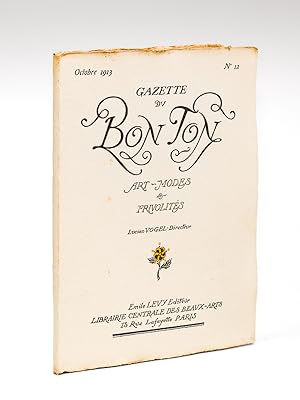
Gazette du Bon Ton. Art - Modes & Frivolités. Octobre 1913 - Numéro 12
Collectif ; VOGEL, Lucien ; LEPAPE, Georges ; BRISSAUD, Pierre ; MARTY, André ; BARBIER, Georges ; GOSE, Javier ; BOULET DE MONVEL, Bernard ; STRIMPL, L. ; TAQUOY, Maurice ; DAMMY, H. Robert
Lingua: Francese
Editore: Librairie Centrale des Beaux-Arts, 1913
- Brossura
- Prima edizione
- Periodico
Da: Librairie du Cardinal, GRADIGNAN, FranciaLibrairie du Cardinal
Contatta il venditoreVenditore con 5 stelleCondizione: Usato - Ottimo
EUR 550,00
EUR 25,00 spedizioneSpedito da Francia a U.S.A.Quantità: 1 disponibili
souple. Condizione: Très bon. 1 vol. in-8 en feuillets sous chemise, Librairie Centrale des Beaux-Arts, Paris, s.d. [ 1913 ], IV pp. (publicités), pp. 353-382, avec 10 planches hors texte en couleurs Douzième numéro de cette très remarquable revue de grand luxe, essentielle pour la connaissance de la mode, et à laquelle collabor…èrent les tous meilleurs artistes de l'époque. Les illustrations en couleurs, dans le texte ou hors-texte, sont toujours magnifiques et d'un coloris très vif, restituant avec éclat les plus belles créations de Cheruit, Poiret, Doucet, Redfern, Worth, Paquin, etc. Bon exemplaire en très bon état de ce numéro bien complet des 10 superbes planches hors texte, dont une par Georges Barbier. Colas, 1202 Langue: Français.
 Altre immagini
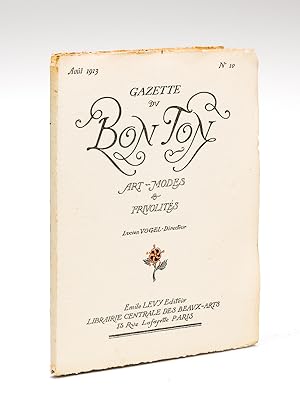
Gazette du Bon Ton. Art - Modes & Frivolités. Août 1913 - Numéro 10
Collectif ; VOGEL, Lucien ; LEPAPE, Georges ; BRISSAUD, Pierre ; MARTY, André ; BARBIER, George ; GOSE, Javier ; STRIMPL, L. ; DAMMY, H. Robert ; TAQUOY
Lingua: Francese
Editore: Librairie Centrale des Beaux-Arts, 1913
- Brossura
- Prima edizione
- Periodico
Da: Librairie du Cardinal, GRADIGNAN, FranciaLibrairie du Cardinal
Contatta il venditoreVenditore con 5 stelleCondizione: Usato - Quasi ottimo
EUR 550,00
EUR 25,00 spedizioneSpedito da Francia a U.S.A.Quantità: 1 disponibili
souple. Condizione: Bon. 1 vol. in-8 en feuillets sous chemise, Librairie Centrale des Beaux-Arts, Paris, s.d. [ 1913 ], IV pp. (publicités), pp. 289-318, avec 10 planches hors texte en couleurs Dixième numéro de cette très remarquable revue de grand luxe, essentielle pour la connaissance de la mode, et à laquelle collaborèrent…les tous meilleurs artistes de l'époque. Les illustrations en couleurs, dans le texte ou hors-texte, sont toujours magnifiques et d'un coloris très vif, restituant avec éclat les plus belles créations de Cheruit, Poiret, Doucet, Redfern, Worth, Paquin, etc. Bon état (petit manque à la chemise en dos, très bon état par ailleurs) pour ce numéro bien complet des 10 superbes planches hors texte, dont une par Georges Barbier. Colas, 1202 Langue: Français.

Editore: Paris, 1912
- Brossura
- Stampa artistica
Da: Trillium Antique Prints & Rare Books, Franklin, TN, U.S.A.Trillium Antique Prints & Rare Books
Contatta il venditoreVenditore con 3 stelleCondizione: Usato - Ottimo
EUR 108,05
EUR 8,74 spedizioneSpedito in U.S.A.Quantità: 1 disponibili
Condizione: Fine. The Gazette du Bon Ton featured some of the most desirable pochoir, fashion lithographs. The fashion periodical ran from 1912 to 1925, and greatly influenced the style of the time. Great artists from the day, such as George Barbier and Andre Marty, contributed beautiful plates to the work. Gazette du Bon Ton wa…s published by Lucien Vogel in Paris.The work was meant to appeal to the upper echelon of Parisian society. The fashion prints beauty and quality of the publication has taken on great appeal through the time. The prints feature dramatic pochoir coloring, which is created when single layers of color are added by hand to a lithograph using a stencil.Many prominent artists contributed the magazine including Barbier, Marty, Brissaud, Worth, Monvel, Lepape, Pacquin, & Poiret. George Barbier's contributions to this work are particularly desirable. He contributed greatly to design in this era and also had work featured in Vogue. Lucien Vogel, fashion publisher, (pictured above), was the brilliant creator of this famous Art Deco fashion magazine. He was well-known and well-connected paving the way for the Gazette's success. --- The work is in very good to excellent condition overall. There may be a few light marks, toned spots or imperfections to be expected with age. There are occasional pencil marks on some of the plates. Please review the image carefully for condition and contact us with any questions. --- Paper Size ~ 7 1/2" by 9 3/4". H. Robert Dammy (illustratore).
 Altre immagini
Editore: Lucien Vogel éditeur, 1913
- Prima edizione
- Stampa artistica
Da: Librairie Le Feu Follet, Paris, FranciaLibrairie Le Feu Follet
Contatta il venditoreVenditore con 5 stelleMembro dell’associazione: ILAB
Condizione: Usato
EUR 92,00
EUR 30,00 spedizioneSpedito da Francia a U.S.A.Quantità: 1 disponibili
Pas de couverture. Lucien Vogel éditeur | Paris Août 1913 | 19 x 24.50 cm | une feuille | Estampe originale en couleur, tirée sur papier vergé, signée en haut à droite dans la planche. Gravure originaleréalisée pour l'illustration deLa gazette du bon ton, l'une des plus belles et des plus influentes revues de mode du XXème siècl…e, célébrant le talent des créateurs et des artistes français en plein essor de l'art déco. * Célèbre revue de mode fondée en 1912 par Lucien Vogel, La Gazette du bon ton a paru jusqu'en 1925 avec une interruption durant la Guerre de 1915 à 1920, pour cause de mobilisation de son rédacteur en chef. Elle se constitue de 69 livraisons tirées à seulement 2000 exemplaires et est illustrée notamment de 573 planches en couleurs et de 148 croquis représentant des modèles de grands couturiers. Dès leur parution, ces luxueuses publications «s'adressent aux bibliophiles et aux mondains esthètes» (Françoise Tétart-Vittu «La Gazette du bon ton» in Dictionnaire de la mode, 2016). Imprimées sur beau papier vergé, elles utilisent une police typographique spécialement créée pour la revue par Georges Peignot, le caractère Cochin, repris en 1946 par Christian Dior. Les estampes sont réalisées grâce à la technique du pochoir métallique, rehaussées en couleurs et pour certaines soulignées à l'or ou au palladium. L'aventure commence en 1912 lorsque Lucien Vogel, homme du monde et de la mode - il a déjà participé à la revue Femina - décide de fonder avec sa femme Cosette de Brunhoff (sur de Jean, le père de Babar) la Gazette du bon ton dont le sous-titre est alors «Art, modes et frivolités». Georges Charensol rapporte les propos du rédacteur en chef: «En 1910, observe-t-il, il n'existait aucun journal de mode véritablement artistique et représentatif de l'esprit de son époque. Je songeais donc à faire un magazine de luxe avec des artistes véritablement modernes [.] J'étais certain du succès car pour la mode aucun pays ne peut rivaliser avec la France.» («Un grand éditeur d'art. Lucien Vogel» in Les Nouvelles littéraires, n°133, mai 1925). Le succès de la revue est immédiat, non seulement en France, mais aussi aux Etats-Unis et en Amérique du Sud. À l'origine, Vogel réunit donc un groupe de sept artistes: André-Édouard Marty et Pierre Brissaud, suivis de Georges Lepape et Dammicourt ; et enfin ses amis de l'École des beaux-arts que sont George Barbier, Bernard Boutet de Monvel, ou Charles Martin. D'autres talents viennent rapidement rejoindre l'équipée: Guy Arnoux, Léon Bakst, Benito, Boutet de Monvel, Umberto Brunelleschi, Chas Laborde, Jean-Gabriel Domergue, Raoul Dufy, Édouard Halouze, Alexandre Iacovleff, Jean Émile Laboureur, Charles Loupot, Charles Martin, Maggie Salcedo. Ces artistes, inconnus pour la plupart lorsque Lucien Vogel fait appel à eux, deviendront par la suite des figures artistiques emblématiques et recherchées. Ce sont ces mêmes illustrateurs qui réalisent les dessins des publicités de la Gazette. Les planches mettent en lumière et subliment les robes de sept créateurs de l'époque : Lanvin, Doeuillet, Paquin, Poiret, Worth, Vionnet et Doucet. Les couturiers fournissent pour chaque numéro des modèles exclusifs. Néanmoins, certaines des illustrations ne figurent aucun modèle réel, mais seulement l'idée que l'illustrateur se fait de la mode du jour. La Gazette du bon ton est une étape décisive dans l'histoire de la mode. Alliant l'exigence esthétique et l'unité plastique, elle réunit pour la première fois les grands talents du monde des arts, des lettres et de la mode et impose, par cette alchimie, une toute nouvelle image de la femme, élancée, indépendante et audacieuse, également portée par la nouvelle génération de couturiers Coco Chanel, Jean Patou, Marcel Rochas. Reprise en 1920 par Condé Montrose Nast, la Gazette du bon ton inspirera largement la nouvelle composition et les choix esthétiques du « petit journal mourant » que Nast avait racheté quelques années auparavant : le magazine Vogue. | [ENGL.
 Altre immagini
Editore: Lucien Vogel éditeur, 1914
- Prima edizione
- Stampa artistica
Da: Librairie Le Feu Follet, Paris, FranciaLibrairie Le Feu Follet
Contatta il venditoreVenditore con 5 stelleMembro dell’associazione: ILAB
Condizione: Usato
EUR 104,00
EUR 30,00 spedizioneSpedito da Francia a U.S.A.Quantità: 1 disponibili
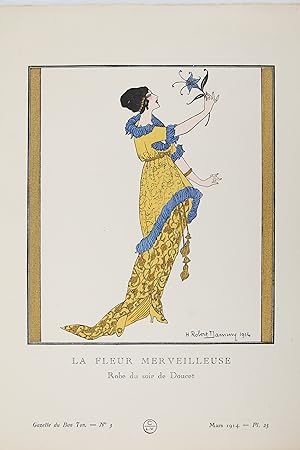
Pas de couverture. Lucien Vogel éditeur | Paris Mars 1914 | 19 x 24.50 cm | une feuille | Estampe originale en couleur rehaussée à l'or, tirée sur papier vergé, signée en bas à droite de la planche. Gravure originaleréalisée pour l'illustration deLa Gazette du bon ton, l'une des plus belles et des plus influentes revues de mode…du XXème siècle, célébrant le talent des créateurs et des artistes français en plein essor de l'art déco. Célèbre revue de mode fondée en 1912 par Lucien Vogel, La Gazette du bon ton a paru jusqu'en 1925 avec une interruption durant la Guerre de 1915 à 1920, pour cause de mobilisation de son rédacteur en chef. Elle se constitue de 69 livraisons tirées à seulement 2000 exemplaires et est illustrée notamment de 573 planches en couleurs et de 148 croquis représentant des modèles de grands couturiers. Dès leur parution, ces luxueuses publications «s'adressent aux bibliophiles et aux mondains esthètes» (Françoise Tétart-Vittu «La Gazette du bon ton» in Dictionnaire de la mode, 2016). Imprimées sur beau papier vergé, elles utilisent une police typographique spécialement créée pour la revue par Georges Peignot, le caractère Cochin, repris en 1946 par Christian Dior. Les estampes sont réalisées grâce à la technique du pochoir métallique, rehaussées en couleurs et pour certaines soulignées à l'or ou au palladium. L'aventure commence en 1912 lorsque Lucien Vogel, homme du monde et de la mode - il a déjà participé à la revue Femina - décide de fonder avec sa femme Cosette de Brunhoff (sur de Jean, le père de Babar) la Gazette du bon ton dont le sous-titre est alors «Art, modes et frivolités». Georges Charensol rapporte les propos du rédacteur en chef: «En 1910, observe-t-il, il n'existait aucun journal de mode véritablement artistique et représentatif de l'esprit de son époque. Je songeais donc à faire un magazine de luxe avec des artistes véritablement modernes [.] J'étais certain du succès car pour la mode aucun pays ne peut rivaliser avec la France.» («Un grand éditeur d'art. Lucien Vogel» in Les Nouvelles littéraires, n°133, mai 1925). Le succès de la revue est immédiat, non seulement en France, mais aussi aux Etats-Unis et en Amérique du Sud. À l'origine, Vogel réunit donc un groupe de sept artistes: André-Édouard Marty et Pierre Brissaud, suivis de Georges Lepape et Dammicourt ; et enfin ses amis de l'École des beaux-arts que sont George Barbier, Bernard Boutet de Monvel, ou Charles Martin. D'autres talents viennent rapidement rejoindre l'équipée: Guy Arnoux, Léon Bakst, Benito, Umberto Brunelleschi, Chas Laborde, Jean-Gabriel Domergue, Raoul Dufy, Édouard Halouze, Alexandre Iacovleff, Jean Émile Laboureur, Charles Loupot, Maggie Salcedo. Ces artistes, inconnus pour la plupart lorsque Lucien Vogel fait appel à eux, deviendront par la suite des figures artistiques emblématiques et recherchées. Ce sont ces mêmes illustrateurs qui réalisent les dessins des publicités de la Gazette. Les planches mettent en lumière et subliment les robes de sept créateurs de l'époque : Lanvin, Doeuillet, Paquin, Poiret, Worth, Vionnet et Doucet. Les couturiers fournissent pour chaque numéro des modèles exclusifs. Néanmoins, certaines des illustrations ne figurent aucun modèle réel, mais seulement l'idée que l'illustrateur se fait de la mode du jour. La Gazette du bon ton est une étape décisive dans l'histoire de la mode. Alliant l'exigence esthétique et l'unité plastique, elle réunit pour la première fois les grands talents du monde des arts, des lettres et de la mode et impose, par cette alchimie, une toute nouvelle image de la femme, élancée, indépendante et audacieuse, également portée par la nouvelle génération de couturiers Coco Chanel, Jean Patou, Marcel Rochas. Reprise en 1920 par Condé Montrose Nast, la Gazette du bon ton inspirera largement la nouvelle composition et les choix esthétiques du « petit journal mourant » que Nast avait racheté quelques années auparavant : le magazine Vogue. | [ENGLISH DESCRIPTION FOLLOWS].

Editore: Paris, France: Gazette du Bon Ton., 1914
- Manoscritto
Da: Wittenborn Art Books, San Francisco, CA, U.S.A.Wittenborn Art Books
Contatta il venditoreVenditore con 5 stelleCondizione: Usato - Buono
EUR 135,06
EUR 8,74 spedizioneSpedito in U.S.A.Quantità: 1 disponibili
Condizione: Good. Pochoir. 24 x 19 cm. Very Good. En Francais.
 Altre immagini
Editore: Lucien Vogel éditeur, 1913
- Prima edizione
- Stampa artistica
Da: Librairie Le Feu Follet, Paris, FranciaLibrairie Le Feu Follet
Contatta il venditoreVenditore con 5 stelleMembro dell’associazione: ILAB
Condizione: Usato
EUR 115,00
EUR 30,00 spedizioneSpedito da Francia a U.S.A.Quantità: 1 disponibili
Pas de couverture. Lucien Vogel éditeur | Paris Octobre 1913 | 19 x 24.50 cm | une feuille | Estampe originale en couleur, tirée sur papier vergé, signée en haut à droite de la planche. Gravure originaleréalisée pour l'illustration deLa Gazette du bon ton, l'une des plus belles et des plus influentes revues de mode du XXème sièc…le, célébrant le talent des créateurs et des artistes français en plein essor de l'art déco. * Célèbre revue de mode fondée en 1912 par Lucien Vogel, La Gazette du bon ton a paru jusqu'en 1925 avec une interruption durant la Guerre de 1915 à 1920, pour cause de mobilisation de son rédacteur en chef. Elle se constitue de 69 livraisons tirées à seulement 2000 exemplaires et est illustrée notamment de 573 planches en couleurs et de 148 croquis représentant des modèles de grands couturiers. Dès leur parution, ces luxueuses publications «s'adressent aux bibliophiles et aux mondains esthètes» (Françoise Tétart-Vittu «La Gazette du bon ton» in Dictionnaire de la mode, 2016). Imprimées sur beau papier vergé, elles utilisent une police typographique spécialement créée pour la revue par Georges Peignot, le caractère Cochin, repris en 1946 par Christian Dior. Les estampes sont réalisées grâce à la technique du pochoir métallique, rehaussées en couleurs et pour certaines soulignées à l'or ou au palladium. L'aventure commence en 1912 lorsque Lucien Vogel, homme du monde et de la mode - il a déjà participé à la revue Femina - décide de fonder avec sa femme Cosette de Brunhoff (sur de Jean, le père de Babar) la Gazette du bon ton dont le sous-titre est alors «Art, modes et frivolités». Georges Charensol rapporte les propos du rédacteur en chef: «En 1910, observe-t-il, il n'existait aucun journal de mode véritablement artistique et représentatif de l'esprit de son époque. Je songeais donc à faire un magazine de luxe avec des artistes véritablement modernes [.] J'étais certain du succès car pour la mode aucun pays ne peut rivaliser avec la France.» («Un grand éditeur d'art. Lucien Vogel» in Les Nouvelles littéraires, n°133, mai 1925). Le succès de la revue est immédiat, non seulement en France, mais aussi aux Etats-Unis et en Amérique du Sud. À l'origine, Vogel réunit donc un groupe de sept artistes: André-Édouard Marty et Pierre Brissaud, suivis de Georges Lepape et Dammicourt ; et enfin ses amis de l'École des beaux-arts que sont George Barbier, Bernard Boutet de Monvel, ou Charles Martin. D'autres talents viennent rapidement rejoindre l'équipée: Guy Arnoux, Léon Bakst, Benito, Boutet de Monvel, Umberto Brunelleschi, Chas Laborde, Jean-Gabriel Domergue, Raoul Dufy, Édouard Halouze, Alexandre Iacovleff, Jean Émile Laboureur, Charles Loupot, Charles Martin, Maggie Salcedo. Ces artistes, inconnus pour la plupart lorsque Lucien Vogel fait appel à eux, deviendront par la suite des figures artistiques emblématiques et recherchées. Ce sont ces mêmes illustrateurs qui réalisent les dessins des publicités de la Gazette. Les planches mettent en lumière et subliment les robes de sept créateurs de l'époque : Lanvin, Doeuillet, Paquin, Poiret, Worth, Vionnet et Doucet. Les couturiers fournissent pour chaque numéro des modèles exclusifs. Néanmoins, certaines des illustrations ne figurent aucun modèle réel, mais seulement l'idée que l'illustrateur se fait de la mode du jour. La Gazette du bon ton est une étape décisive dans l'histoire de la mode. Alliant l'exigence esthétique et l'unité plastique, elle réunit pour la première fois les grands talents du monde des arts, des lettres et de la mode et impose, par cette alchimie, une toute nouvelle image de la femme, élancée, indépendante et audacieuse, également portée par la nouvelle génération de couturiers Coco Chanel, Jean Patou, Marcel Rochas. Reprise en 1920 par Condé Montrose Nast, la Gazette du bon ton inspirera largement la nouvelle composition et les choix esthétiques du « petit journal mourant » que Nast avait racheté quelques années auparavant : le magazine Vogue. | [ENG.
 Altre immagini
Editore: Lucien Vogel éditeur, 1914
- Prima edizione
- Stampa artistica
Da: Librairie Le Feu Follet, Paris, FranciaLibrairie Le Feu Follet
Contatta il venditoreVenditore con 5 stelleMembro dell’associazione: ILAB
Condizione: Usato
EUR 138,00
EUR 30,00 spedizioneSpedito da Francia a U.S.A.Quantità: 1 disponibili
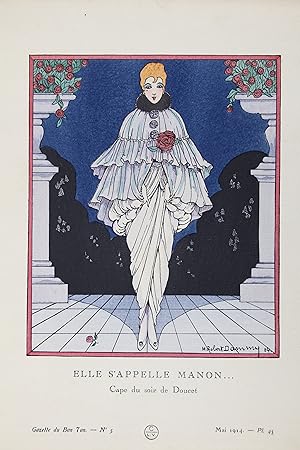
Pas de couverture. Lucien Vogel éditeur | Paris Mai 1914 | 19 x 24.50 cm | une feuille | Estampe originale en couleur, tirée sur papier vergé, signée en bas à droite de la planche. Gravure originaleréalisée pour l'illustration deLa Gazette du bon ton, l'une des plus belles et des plus influentes revues de mode du XXème siècle, c…élébrant le talent des créateurs et des artistes français en plein essor de l'art déco. Célèbre revue de mode fondée en 1912 par Lucien Vogel, La Gazette du bon ton a paru jusqu'en 1925 avec une interruption durant la Guerre de 1915 à 1920, pour cause de mobilisation de son rédacteur en chef. Elle se constitue de 69 livraisons tirées à seulement 2000 exemplaires et est illustrée notamment de 573 planches en couleurs et de 148 croquis représentant des modèles de grands couturiers. Dès leur parution, ces luxueuses publications «s'adressent aux bibliophiles et aux mondains esthètes» (Françoise Tétart-Vittu «La Gazette du bon ton» in Dictionnaire de la mode, 2016). Imprimées sur beau papier vergé, elles utilisent une police typographique spécialement créée pour la revue par Georges Peignot, le caractère Cochin, repris en 1946 par Christian Dior. Les estampes sont réalisées grâce à la technique du pochoir métallique, rehaussées en couleurs et pour certaines soulignées à l'or ou au palladium. L'aventure commence en 1912 lorsque Lucien Vogel, homme du monde et de la mode - il a déjà participé à la revue Femina - décide de fonder avec sa femme Cosette de Brunhoff (sur de Jean, le père de Babar) la Gazette du bon ton dont le sous-titre est alors «Art, modes et frivolités». Georges Charensol rapporte les propos du rédacteur en chef: «En 1910, observe-t-il, il n'existait aucun journal de mode véritablement artistique et représentatif de l'esprit de son époque. Je songeais donc à faire un magazine de luxe avec des artistes véritablement modernes [.] J'étais certain du succès car pour la mode aucun pays ne peut rivaliser avec la France.» («Un grand éditeur d'art. Lucien Vogel» in Les Nouvelles littéraires, n°133, mai 1925). Le succès de la revue est immédiat, non seulement en France, mais aussi aux Etats-Unis et en Amérique du Sud. À l'origine, Vogel réunit donc un groupe de sept artistes: André-Édouard Marty et Pierre Brissaud, suivis de Georges Lepape et Dammicourt ; et enfin ses amis de l'École des beaux-arts que sont George Barbier, Bernard Boutet de Monvel, ou Charles Martin. D'autres talents viennent rapidement rejoindre l'équipée: Guy Arnoux, Léon Bakst, Benito, Umberto Brunelleschi, Chas Laborde, Jean-Gabriel Domergue, Raoul Dufy, Édouard Halouze, Alexandre Iacovleff, Jean Émile Laboureur, Charles Loupot, Maggie Salcedo. Ces artistes, inconnus pour la plupart lorsque Lucien Vogel fait appel à eux, deviendront par la suite des figures artistiques emblématiques et recherchées. Ce sont ces mêmes illustrateurs qui réalisent les dessins des publicités de la Gazette. Les planches mettent en lumière et subliment les robes de sept créateurs de l'époque : Lanvin, Doeuillet, Paquin, Poiret, Worth, Vionnet et Doucet. Les couturiers fournissent pour chaque numéro des modèles exclusifs. Néanmoins, certaines des illustrations ne figurent aucun modèle réel, mais seulement l'idée que l'illustrateur se fait de la mode du jour. La Gazette du bon ton est une étape décisive dans l'histoire de la mode. Alliant l'exigence esthétique et l'unité plastique, elle réunit pour la première fois les grands talents du monde des arts, des lettres et de la mode et impose, par cette alchimie, une toute nouvelle image de la femme, élancée, indépendante et audacieuse, également portée par la nouvelle génération de couturiers Coco Chanel, Jean Patou, Marcel Rochas. Reprise en 1920 par Condé Montrose Nast, la Gazette du bon ton inspirera largement la nouvelle composition et les choix esthétiques du « petit journal mourant » que Nast avait racheté quelques années auparavant : le magazine Vogue. | [ENGLISH DESCRIPTION FOLLOWS] Original color pri.
 Altre immagini
- Prima edizione
- Stampa artistica
Da: Librairie Le Feu Follet, Paris, FranciaLibrairie Le Feu Follet
Contatta il venditoreVenditore con 5 stelleMembro dell’associazione: ILAB
Condizione: Usato
EUR 104,00
EUR 30,00 spedizioneSpedito da Francia a U.S.A.Quantità: 1 disponibili
Pas de couverture. Paris 1912-1913 | 19 x 24.50 cm | une feuille | Estampe originale en couleur tirée sur papier vergé et signée en bas à droite dans la planche. Gravure originaleréalisée pour l'illustration deLa Gazette du bon ton, l'une des plus belles et des plus influentes revues de mode du XXème siècle, célébrant le talent…des créateurs et des artistes français en plein essor de l'art déco. * Célèbre revue de mode fondée en 1912 par Lucien Vogel, La Gazette du bon ton a paru jusqu'en 1925 avec une interruption durant la Guerre de 1915 à 1920, pour cause de mobilisation de son rédacteur en chef. Elle se constitue de 69 livraisons tirées à seulement 2000 exemplaires et est illustrée notamment de 573 planches en couleurs et de 148 croquis représentant des modèles de grands couturiers. Dès leur parution, ces luxueuses publications «s'adressent aux bibliophiles et aux mondains esthètes» (Françoise Tétart-Vittu «La Gazette du bon ton» in Dictionnaire de la mode, 2016). Imprimées sur beau papier vergé, elles utilisent une police typographique spécialement créée pour la revue par Georges Peignot, le caractère Cochin, repris en 1946 par Christian Dior. Les estampes sont réalisées grâce à la technique du pochoir métallique, rehaussées en couleurs et pour certaines soulignées à l'or ou au palladium. L'aventure commence en 1912 lorsque Lucien Vogel, homme du monde et de la mode - il a déjà participé à la revue Femina - décide de fonder avec sa femme Cosette de Brunhoff (sur de Jean, le père de Babar) La Gazette du bon ton dont le sous-titre est alors «Art, modes et frivolités». Georges Charensol rapporte les propos du rédacteur en chef: « En 1910, observe-t-il, il n'existait aucun journal de mode véritablement artistique et représentatif de l'esprit de son époque. Je songeais donc à faire un magazine de luxe avec des artistes véritablement modernes [.] J'étais certain du succès car pour la mode aucun pays ne peut rivaliser avec la France. » («Un grand éditeur d'art. Lucien Vogel» in Les Nouvelles littéraires, n°133, mai 1925). Le succès de la revue est immédiat, non seulement en France, mais aussi aux Etats-Unis et en Amérique du Sud. À l'origine, Vogel réunit donc un groupe de sept artistes: André-Édouard Marty et Pierre Brissaud, suivis de Georges Lepape et Dammicourt ; et enfin ses amis de l'École des beaux-arts que sont George Barbier, Bernard Boutet de Monvel, ou Charles Martin. D'autres talents viennent rapidement rejoindre l'équipée: Guy Arnoux, Léon Bakst, Benito, Boutet de Monvel, Umberto Brunelleschi, Chas Laborde, Jean-Gabriel Domergue, Raoul Dufy, Édouard Halouze, Alexandre Iacovleff, Jean Émile Laboureur, Charles Loupot, Charles Martin, Maggie Salcedo. Ces artistes, inconnus pour la plupart lorsque Lucien Vogel fait appel à eux, deviendront par la suite des figures artistiques emblématiques et recherchées. Ce sont ces mêmes illustrateurs qui réalisent les dessins des publicités de la Gazette. Les planches mettent en lumière et subliment les robes de sept créateurs de l'époque : Lanvin, Doeuillet, Paquin, Poiret, Worth, Vionnet et Doucet. Les couturiers fournissent pour chaque numéro des modèles exclusifs. Néanmoins, certaines des illustrations ne figurent aucun modèle réel, mais seulement l'idée que l'illustrateur se fait de la mode du jour. La Gazette du bon ton est une étape décisive dans l'histoire de la mode. Alliant l'exigence esthétique et l'unité plastique, elle réunit pour la première fois les grands talents du monde des arts, des lettres et de la mode et impose, par cette alchimie, une toute nouvelle image de la femme, élancée, indépendante et audacieuse, également portée par la nouvelle génération de couturiers Coco Chanel, Jean Patou, Marcel Rochas. Reprise en 1920 par Condé Montrose Nast, La Gazette du bon ton inspirera largement la nouvelle composition et les choix esthétiques du « petit journal mourant » que Nast avait racheté quelques années auparavant : le magazine Vogue. | [ENGLISH DESCRIPTION FOLLOWS.

- Stampa artistica
Da: Galerie Joseph Fach GmbH, Oberursel im Taunus, GermaniaGalerie Joseph Fach GmbH
Contatta il venditoreVenditore con 5 stelleCondizione: Usato - Ottimo
EUR 100,00
EUR 45,00 spedizioneSpedito da Germania a U.S.A.Quantità: 1 disponibili
Condizione: sehr guter Zustand. Pochoir, auf Bütten mit Wasserzeichen: Journal des Dames. 17,8:11 cm. Aus Journal des Dames et des Modes", Costumes Parisien, 1914, 142. Mit Manon" ist die weibliche Hauptrolle in einer der bekanntesten Opern der Belle Epoque von Jules Massenet gemeint, die 1884 uraufgeführt wurde.- This is a plat…e-signed hand-coloured pochoir illustration from the 1914 Journal des Dames et des Modes - a Parisian haute couture journal containing these(unbound) artworks published by Tom Antongini from June 1912 until August 1914.

- Stampa artistica
Da: Galerie Joseph Fach GmbH, Oberursel im Taunus, GermaniaGalerie Joseph Fach GmbH
Contatta il venditoreVenditore con 5 stelleCondizione: Usato - Ottimo
EUR 100,00
EUR 45,00 spedizioneSpedito da Germania a U.S.A.Quantità: 1 disponibili
Condizione: sehr guter Zustand. Pochoir, auf Bütten mit Wasserzeichen: Journal des Dames. 17,8:11 cm. Aus Journal des Dames et des Modes", Costumes Parisien, 1914, 142. Mit Manon" ist die weibliche Hauptrolle in einer der bekanntesten Opern der Belle Epoque von Jules Massenet gemeint, die 1884 uraufgeführt wurde.- This is a plat…e-signed hand-coloured pochoir illustration from the 1914 Journal des Dames et des Modes - a Parisian haute couture journal containing these(unbound) artworks published by Tom Antongini from June 1912 until August 1914.


