

Importo totale (1 articolo articoli):
Destinazione ordine:

sandra gilgen (10 risultati)
Vai alla pagina principale dei risultati di ricerca
Filtri di ricerca
Tipo di articolo
- Tutti i tipi di prodotto
- Libri (10)
- Riviste e Giornali (Nessun altro risultato corrispondente a questo perfezionamento)
- Fumetti (Nessun altro risultato corrispondente a questo perfezionamento)
- Spartiti (Nessun altro risultato corrispondente a questo perfezionamento)
- Arte, Stampe e Poster (Nessun altro risultato corrispondente a questo perfezionamento)
- Fotografie (Nessun altro risultato corrispondente a questo perfezionamento)
- Mappe (Nessun altro risultato corrispondente a questo perfezionamento)
- Manoscritti e Collezionismo cartaceo (Nessun altro risultato corrispondente a questo perfezionamento)
Condizioni Maggiori informazioni
- Nuovo (9)
- Come nuovo, Ottimo o Quasi ottimo (1)
- Molto buono o Buono (Nessun altro risultato corrispondente a questo perfezionamento)
- Discreto o Mediocre (Nessun altro risultato corrispondente a questo perfezionamento)
- Come descritto (Nessun altro risultato corrispondente a questo perfezionamento)
Legatura
- Tutte
- Rilegato (Nessun altro risultato corrispondente a questo perfezionamento)
- Brossura (10)
Ulteriori caratteristiche
- Prima ed. (1)
- Copia autograf. (Nessun altro risultato corrispondente a questo perfezionamento)
- Sovracoperta (Nessun altro risultato corrispondente a questo perfezionamento)
- Con foto (3)
- Non Print on Demand (8)
Lingua (1)
Spedizione gratuita
Paese del venditore
Valutazione venditore
-

Disentangling Justice
Prima edizione
paperback. Condizione: New. 1st.
-
Disentangling Justice
Lingua: Inglese
Editore: Nomos Verlagsgesellschaft Mbh & Co, 2022
ISBN 10: 3848783053 ISBN 13: 9783848783052
Da: GreatBookPrices, Columbia, MD, U.S.A.
Valutazione del venditore 5 su 5 stelle

Condizione: As New. Unread book in perfect condition.
-
Disentangling Justice
Lingua: Inglese
Editore: Nomos Verlagsgesellschaft Mbh & Co, 2022
ISBN 10: 3848783053 ISBN 13: 9783848783052
Da: GreatBookPrices, Columbia, MD, U.S.A.
Valutazione del venditore 5 su 5 stelle
Condizione: New.
-
Disentangling Justice (Paperback)
Da: Grand Eagle Retail, Bensenville, IL, U.S.A.
Valutazione del venditore 5 su 5 stelle
Paperback. Condizione: new. Paperback. What is fair? The choice of an allocation norm, whether it be need, merit or equality, can either foster cooperation or conflict. Because of the general irreconcilability of these principles of justice, people are forced to make complex trade-offs when allocating resources. The resulting decisions are shaped by individual factors and context, but also the situation in which an allocation problem arises. Addressing these three levels simultaneously and taking the inherent interdependency of outcomes into consideration, this book adheres to a mechanism-based approach. Its findings support a functionalist perspective on distributive justice, highlighting the inherent relevance of the relational structure for the choice of allocation norms. Shipping may be from multiple locations in the US or from the UK, depending on stock availability.
-
Disentangling Justice
Da: Kennys Bookshop and Art Galleries Ltd., Galway, GY, Irlanda
Valutazione del venditore 5 su 5 stelle
EUR 29,39
Spedizione EUR 10,50
Spedito da Irlanda a U.S.A.Quantità: 2 disponibili
Aggiungi al carrelloCondizione: New. 2022. Paperback. . . . . .
-
Disentangling Justice
Da: Kennys Bookstore, Olney, MD, U.S.A.
Valutazione del venditore 5 su 5 stelle
Condizione: New. 2022. Paperback. . . . . . Books ship from the US and Ireland.
-
EUR 39,00
Spedizione EUR 70,00
Spedito da Germania a U.S.A.Quantità: 5 disponibili
Aggiungi al carrelloTaschenbuch. Condizione: Neu. Disentangling Justice | Needs, Equality or Merit? On the Situation-Dependency of Distributive Justice | Sandra Gilgen | Taschenbuch | 174 S. | Englisch | 2022 | Nomos | EAN 9783848783052 | Verantwortliche Person für die EU: Nomos Verlagsgesellschaft mbH & Co. KG, Waldseestr. 3-5, 76530 Baden-Baden, nomos[at]nomos[dot]de | Anbieter: preigu.
-
Disentangling Justice (Paperback)
Da: AussieBookSeller, Truganina, VIC, Australia
Valutazione del venditore 5 su 5 stelle
EUR 120,55
Spedizione EUR 31,87
Spedito da Australia a U.S.A.Quantità: 1 disponibili
Aggiungi al carrelloPaperback. Condizione: new. Paperback. What is fair? The choice of an allocation norm, whether it be need, merit or equality, can either foster cooperation or conflict. Because of the general irreconcilability of these principles of justice, people are forced to make complex trade-offs when allocating resources. The resulting decisions are shaped by individual factors and context, but also the situation in which an allocation problem arises. Addressing these three levels simultaneously and taking the inherent interdependency of outcomes into consideration, this book adheres to a mechanism-based approach. Its findings support a functionalist perspective on distributive justice, highlighting the inherent relevance of the relational structure for the choice of allocation norms. Shipping may be from our Sydney, NSW warehouse or from our UK or US warehouse, depending on stock availability.
-
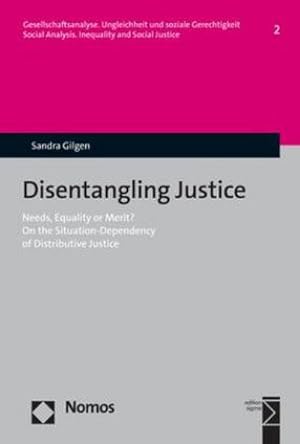
Disentangling Justice
Da: BuchWeltWeit Ludwig Meier e.K., Bergisch Gladbach, Germania
Valutazione del venditore 5 su 5 stelle
EUR 39,00
Spedizione EUR 23,00
Spedito da Germania a U.S.A.Quantità: 1 disponibili
Aggiungi al carrelloTaschenbuch. Condizione: Neu. This item is printed on demand - it takes 3-4 days longer - Neuware -What is fair The choice of an allocation norm, whether it be need, merit or equality, can either foster cooperation or conflict. Because of the general irreconcilability of these principles of justice, people are forced to make complex trade-offs when allocating resources. The resulting decisions are shaped by individual factors and context, but also the situation in which an allocation problem arises. Addressing these three levels simultaneously and taking the inherent interdependency of outcomes into consideration, this book adheres to a mechanism-based approach. Its findings support a functionalist perspective on distributive justice, highlighting the inherent relevance of the relational structure for the choice of allocation norms. 174 pp. Englisch.
-
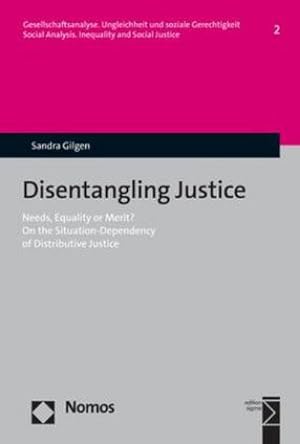
EUR 39,00
Spedizione EUR 61,60
Spedito da Germania a U.S.A.Quantità: 1 disponibili
Aggiungi al carrelloTaschenbuch. Condizione: Neu. nach der Bestellung gedruckt Neuware - Printed after ordering - What is fair The choice of an allocation norm, whether it be need, merit or equality, can either foster cooperation or conflict. Because of the general irreconcilability of these principles of justice, people are forced to make complex trade-offs when allocating resources. The resulting decisions are shaped by individual factors and context, but also the situation in which an allocation problem arises. Addressing these three levels simultaneously and taking the inherent interdependency of outcomes into consideration, this book adheres to a mechanism-based approach. Its findings support a functionalist perspective on distributive justice, highlighting the inherent relevance of the relational structure for the choice of allocation norms.

