

Importo totale (1 articolo articoli):
Destinazione ordine:

sandra mariët beckerman (9 risultati)
Vai alla pagina principale dei risultati di ricerca
Filtri di ricerca
Tipo di articolo
- Tutti i tipi di prodotto
- Libri (9)
- Riviste e Giornali (Nessun altro risultato corrispondente a questo perfezionamento)
- Fumetti (Nessun altro risultato corrispondente a questo perfezionamento)
- Spartiti (Nessun altro risultato corrispondente a questo perfezionamento)
- Arte, Stampe e Poster (Nessun altro risultato corrispondente a questo perfezionamento)
- Fotografie (Nessun altro risultato corrispondente a questo perfezionamento)
- Mappe (Nessun altro risultato corrispondente a questo perfezionamento)
- Manoscritti e Collezionismo cartaceo (Nessun altro risultato corrispondente a questo perfezionamento)
Condizioni Maggiori informazioni
- Nuovo (9)
- Come nuovo, Ottimo o Quasi ottimo (Nessun altro risultato corrispondente a questo perfezionamento)
- Molto buono o Buono (Nessun altro risultato corrispondente a questo perfezionamento)
- Discreto o Mediocre (Nessun altro risultato corrispondente a questo perfezionamento)
- Come descritto (Nessun altro risultato corrispondente a questo perfezionamento)
Legatura
Ulteriori caratteristiche
- Prima ed. (Nessun altro risultato corrispondente a questo perfezionamento)
- Copia autograf. (Nessun altro risultato corrispondente a questo perfezionamento)
- Sovracoperta (Nessun altro risultato corrispondente a questo perfezionamento)
- Con foto (8)
- Non Print on Demand (2)
Lingua (1)
Prezzo
- Qualsiasi prezzo
- Inferiore a EUR 20 (Nessun altro risultato corrispondente a questo perfezionamento)
- EUR 20 a EUR 45
- Superiore a EUR 45
Spedizione gratuita
- Spedizione gratuita in U.S.A. (Nessun altro risultato corrispondente a questo perfezionamento)
Paese del venditore
Valutazione venditore
-

Corded Ware Coastal Communities
Lingua: Inglese
Editore: Sidestone Press Dissertations Jun 2015, 2015
ISBN 10: 9088903182 ISBN 13: 9789088903182
EUR 47,19
Spedizione EUR 64,56
Spedito da Germania a U.S.A.Quantità: 1 disponibili
Aggiungi al carrelloTaschenbuch. Condizione: Neu. Neuware - The Corded Ware Culture (c. 2900-2300 BC) is found in a large area, from Russia to the Netherlands and from Scandinavia to Switzerland. Supra-regional elements include beakers decorated with cord and/or spatula imprints, battle-axes, and a funerary customs involving crouched inhumations under barrows with gender-specific placement of the body gender-specific funerary gifts. Analysis of ceramics from well-preserved settlements from the Dutch coastal zone have provided very valuable new information on the Corded Ware chronology, social organisation, ideology, subsistence, and use of material culture. A critical review of the commonly applied chronological models shows that many of the underlying premises cannot be supported due to problems with (broad calibration and sample reliability of) 14C dates. This study shows that in the Neolithic Dutch coastal zone, the thin-walled ceramics reflect supra-regional (Corded Ware ) affiliations, whereas the medium-thick-walled and thick-walled ceramics reflect persistent regional (Vlaardingen) traditions. The beakers decorated with cord and spatula impressions were used primarily for cooking; indications for the often proposed use of alcohol (and associated rise of individualisation and elites) were not found. It is argued in this study that the Corded Ware Culture represents an economic alliance, a dynamic totality as well as a network linking regional groups - each with a distinct economic base, material culture and ideology. These communities all participated in a vast supra-regional network that was a platform for inter-community exchanges of goods, skills, ideas and possibly people. Affiliation to this supra-regional network was a vital aspect for all regional groups involved, and membership to it was expressed by using a set of common traits. Decorated thin-walled beakers act as symbols of these supra-regional networks and thus embody both functional and ideological roles.
-

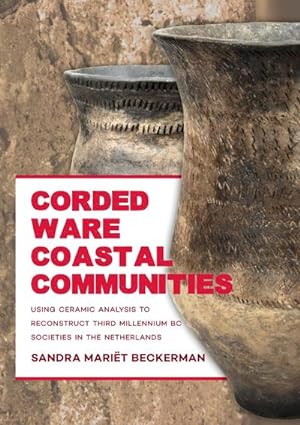
Corded Ware Coastal Communities: Using ceramic analysis to reconstruct third millennium BC societies in the Netherlands
Da: Mispah books, Redhill, SURRE, Regno Unito
Valutazione del venditore 4 su 5 stelle

EUR 284,05
Spedizione EUR 28,85
Spedito da Regno Unito a U.S.A.Quantità: 1 disponibili
Aggiungi al carrellopaperback. Condizione: New. NEW. SHIPS FROM MULTIPLE LOCATIONS. book.
-
Corded Ware Coastal Communities
Lingua: Inglese
Editore: Sidestone Press Dissertations Jun 2015, 2015
ISBN 10: 9088903182 ISBN 13: 9789088903182
Da: BuchWeltWeit Ludwig Meier e.K., Bergisch Gladbach, Germania
Valutazione del venditore 5 su 5 stelle

EUR 45,00
Spedizione EUR 23,00
Spedito da Germania a U.S.A.Quantità: 2 disponibili
Aggiungi al carrelloTaschenbuch. Condizione: Neu. This item is printed on demand - it takes 3-4 days longer - Neuware -The Corded Ware Culture (c. 2900-2300 BC) is found in a large area, from Russia to the Netherlands and from Scandinavia to Switzerland. Supra-regional elements include beakers decorated with cord and/or spatula imprints, battle-axes, and a funerary customs involving crouched inhumations under barrows with gender-specific placement of the body gender-specific funerary gifts. Analysis of ceramics from well-preserved settlements from the Dutch coastal zone have provided very valuable new information on the Corded Ware chronology, social organisation, ideology, subsistence, and use of material culture. A critical review of the commonly applied chronological models shows that many of the underlying premises cannot be supported due to problems with (broad calibration and sample reliability of) 14C dates. This study shows that in the Neolithic Dutch coastal zone, the thin-walled ceramics reflect supra-regional (Corded Ware ) affiliations, whereas the medium-thick-walled and thick-walled ceramics reflect persistent regional (Vlaardingen) traditions. The beakers decorated with cord and spatula impressions were used primarily for cooking; indications for the often proposed use of alcohol (and associated rise of individualisation and elites) were not found. It is argued in this study that the Corded Ware Culture represents an economic alliance, a dynamic totality as well as a network linking regional groups - each with a distinct economic base, material culture and ideology. These communities all participated in a vast supra-regional network that was a platform for inter-community exchanges of goods, skills, ideas and possibly people. Affiliation to this supra-regional network was a vital aspect for all regional groups involved, and membership to it was expressed by using a set of common traits. Decorated thin-walled beakers act as symbols of these supra-regional networks and thus embody both functional and ideological roles. 312 pp. Englisch.
-

Corded Ware Coastal Communities
Lingua: Inglese
Editore: Sidestone Press Dissertations Jun 2015, 2015
ISBN 10: 9088903182 ISBN 13: 9789088903182
Da: buchversandmimpf2000, Emtmannsberg, BAYE, Germania
Valutazione del venditore 5 su 5 stelle
EUR 45,00
Spedizione EUR 60,00
Spedito da Germania a U.S.A.Quantità: 1 disponibili
Aggiungi al carrelloTaschenbuch. Condizione: Neu. This item is printed on demand - Print on Demand Titel. Neuware -The Corded Ware Culture (c. 2900¿2300 BC) is found in a large area, from Russia to the Netherlands and from Scandinavia to Switzerland. Supra-regional elements include beakers decorated with cord and/or spatula imprints, battle-axes, and a funerary customs involving crouched inhumations under barrows with gender-specific placement of the body gender-specific funerary gifts. Analysis of ceramics from well-preserved settlements from the Dutch coastal zone have provided very valuable new information on the Corded Ware chronology, social organisation, ideology, subsistence, and use of material culture. A critical review of the commonly applied chronological models shows that many of the underlying premises cannot be supported due to problems with (broad calibration and sample reliability of) 14C dates. This study shows that in the Neolithic Dutch coastal zone, the thin-walled ceramics reflect supra-regional (Corded Ware ) affiliations, whereas the medium-thick-walled and thick-walled ceramics reflect persistent regional (Vlaardingen) traditions. The beakers decorated with cord and spatula impressions were used primarily for cooking; indications for the often proposed use of alcohol (and associated rise of individualisation and elites) were not found. It is argued in this study that the Corded Ware Culture represents an economic alliance, a dynamic totality as well as a network linking regional groups ¿ each with a distinct economic base, material culture and ideology. These communities all participated in a vast supra-regional network that was a platform for inter-community exchanges of goods, skills, ideas and possibly people. Affiliation to this supra-regional network was a vital aspect for all regional groups involved, and membership to it was expressed by using a set of common traits. Decorated thin-walled beakers act as symbols of these supra-regional networks and thus embody both functional and ideological roles.Books on Demand GmbH, Überseering 33, 22297 Hamburg 312 pp. Englisch.
-
Corded Ware Coastal Communities
Lingua: Inglese
Editore: Sidestone Press Dissertations, 2015
ISBN 10: 9088903182 ISBN 13: 9789088903182
EUR 39,55
Spedizione EUR 70,00
Spedito da Germania a U.S.A.Quantità: 5 disponibili
Aggiungi al carrelloTaschenbuch. Condizione: Neu. Corded Ware Coastal Communities | Sandra Mariët Beckerman | Taschenbuch | Englisch | 2015 | Sidestone Press Dissertations | EAN 9789088903182 | Verantwortliche Person für die EU: preigu GmbH & Co. KG, Lengericher Landstr. 19, 49078 Osnabrück, mail[at]preigu[dot]de | Anbieter: preigu Print on Demand.
-

Corded Ware Coastal Communities
Lingua: Inglese
Editore: Sidestone Press Dissertations Jan 2017, 2017
ISBN 10: 908890328X ISBN 13: 9789088903281
Da: BuchWeltWeit Ludwig Meier e.K., Bergisch Gladbach, Germania
Valutazione del venditore 5 su 5 stelle
EUR 135,00
Spedizione EUR 23,00
Spedito da Germania a U.S.A.Quantità: 1 disponibili
Aggiungi al carrelloBuch. Condizione: Neu. This item is printed on demand - it takes 3-4 days longer - Neuware -The Corded Ware Culture (c. 2900-2300 BC) is found in a large area, from Russia to the Netherlands and from Scandinavia to Switzerland. Supra-regional elements include beakers decorated with cord and/or spatula imprints, battle-axes, and a funerary customs involving crouched inhumations under barrows with gender-specific placement of the body gender-specific funerary gifts.Analysis of ceramics from well-preserved settlements from the Dutch coastal zone have provided very valuable new information on the Corded Ware chronology, social organisation, ideology, subsistence, and use of material culture. A critical review of the commonly applied chronological models shows that many of the underlying premises cannot be supported due to problems with (broad calibration and sample reliability of) 14C dates. This study shows that in the Neolithic Dutch coastal zone, the thin-walled ceramics reflect supra-regional (Corded Ware ) affiliations, whereas the medium-thick-walled and thick-walled ceramics reflect persistent regional (Vlaardingen) traditions. The beakers decorated with cord and spatula impressions were used primarily for cooking; indications for the often proposed use of alcohol (and associated rise of individualisation and elites) were not found.It is argued in this study that the Corded Ware Culture represents an economic alliance, a dynamic totality as well as a network linking regional groups - each with a distinct economic base, material culture and ideology. These communities all participated in a vast supra-regional network that was a platform for inter-community exchanges of goods, skills, ideas and possibly people. Affiliation to this supra-regional network was a vital aspect for all regional groups involved, and membership to it was expressed by using a set of common traits. Decorated thin-walled beakers act as symbols of these supra-regional networks and thus embody both functional and ideological roles. 312 pp. Englisch.
-

Corded Ware Coastal Communities
Lingua: Inglese
Editore: Sidestone Press Dissertations, 2017
ISBN 10: 908890328X ISBN 13: 9789088903281
EUR 109,10
Spedizione EUR 70,00
Spedito da Germania a U.S.A.Quantità: 5 disponibili
Aggiungi al carrelloBuch. Condizione: Neu. Corded Ware Coastal Communities | Sandra Mariët Beckerman | Buch | 312 S. | Englisch | 2017 | Sidestone Press Dissertations | EAN 9789088903281 | Verantwortliche Person für die EU: BoD - Books on Demand, In de Tarpen 42, 22848 Norderstedt, info[at]bod[dot]de | Anbieter: preigu Print on Demand.
-

Corded Ware Coastal Communities
Lingua: Inglese
Editore: Sidestone Press Dissertations Jan 2017, 2017
ISBN 10: 908890328X ISBN 13: 9789088903281
Da: buchversandmimpf2000, Emtmannsberg, BAYE, Germania
Valutazione del venditore 5 su 5 stelle
EUR 135,00
Spedizione EUR 60,00
Spedito da Germania a U.S.A.Quantità: 1 disponibili
Aggiungi al carrelloBuch. Condizione: Neu. This item is printed on demand - Print on Demand Titel. Neuware -The Corded Ware Culture (c. 2900¿2300 BC) is found in a large area, from Russia to the Netherlands and from Scandinavia to Switzerland. Supra-regional elements include beakers decorated with cord and/or spatula imprints, battle-axes, and a funerary customs involving crouched inhumations under barrows with gender-specific placement of the body gender-specific funerary gifts.Analysis of ceramics from well-preserved settlements from the Dutch coastal zone have provided very valuable new information on the Corded Ware chronology, social organisation, ideology, subsistence, and use of material culture. A critical review of the commonly applied chronological models shows that many of the underlying premises cannot be supported due to problems with (broad calibration and sample reliability of) 14C dates. This study shows that in the Neolithic Dutch coastal zone, the thin-walled ceramics reflect supra-regional (Corded Ware ) affiliations, whereas the medium-thick-walled and thick-walled ceramics reflect persistent regional (Vlaardingen) traditions. The beakers decorated with cord and spatula impressions were used primarily for cooking; indications for the often proposed use of alcohol (and associated rise of individualisation and elites) were not found.It is argued in this study that the Corded Ware Culture represents an economic alliance, a dynamic totality as well as a network linking regional groups ¿ each with a distinct economic base, material culture and ideology. These communities all participated in a vast supra-regional network that was a platform for inter-community exchanges of goods, skills, ideas and possibly people. Affiliation to this supra-regional network was a vital aspect for all regional groups involved, and membership to it was expressed by using a set of common traits. Decorated thin-walled beakers act as symbols of these supra-regional networks and thus embody both functional and ideological roles.Books on Demand GmbH, Überseering 33, 22297 Hamburg 312 pp. Englisch.
-

Corded Ware Coastal Communities
Lingua: Inglese
Editore: Sidestone Press Dissertations, 2017
ISBN 10: 908890328X ISBN 13: 9789088903281
EUR 136,62
Spedizione EUR 65,91
Spedito da Germania a U.S.A.Quantità: 1 disponibili
Aggiungi al carrelloBuch. Condizione: Neu. nach der Bestellung gedruckt Neuware - Printed after ordering - The Corded Ware Culture (c. 2900-2300 BC) is found in a large area, from Russia to the Netherlands and from Scandinavia to Switzerland. Supra-regional elements include beakers decorated with cord and/or spatula imprints, battle-axes, and a funerary customs involving crouched inhumations under barrows with gender-specific placement of the body gender-specific funerary gifts.Analysis of ceramics from well-preserved settlements from the Dutch coastal zone have provided very valuable new information on the Corded Ware chronology, social organisation, ideology, subsistence, and use of material culture. A critical review of the commonly applied chronological models shows that many of the underlying premises cannot be supported due to problems with (broad calibration and sample reliability of) 14C dates. This study shows that in the Neolithic Dutch coastal zone, the thin-walled ceramics reflect supra-regional (Corded Ware ) affiliations, whereas the medium-thick-walled and thick-walled ceramics reflect persistent regional (Vlaardingen) traditions. The beakers decorated with cord and spatula impressions were used primarily for cooking; indications for the often proposed use of alcohol (and associated rise of individualisation and elites) were not found.It is argued in this study that the Corded Ware Culture represents an economic alliance, a dynamic totality as well as a network linking regional groups - each with a distinct economic base, material culture and ideology. These communities all participated in a vast supra-regional network that was a platform for inter-community exchanges of goods, skills, ideas and possibly people. Affiliation to this supra-regional network was a vital aspect for all regional groups involved, and membership to it was expressed by using a set of common traits. Decorated thin-walled beakers act as symbols of these supra-regional networks and thus embody both functional and ideological roles.


