
Importo totale (1 articolo articoli):
Destinazione ordine:

sandra rossie (7 risultati)
Vai alla pagina principale dei risultati di ricerca
Filtri di ricerca
Tipo di articolo
- Tutti i tipi di prodotto
- Libri (7)
- Riviste e Giornali (Nessun altro risultato corrispondente a questo perfezionamento)
- Fumetti (Nessun altro risultato corrispondente a questo perfezionamento)
- Spartiti (Nessun altro risultato corrispondente a questo perfezionamento)
- Arte, Stampe e Poster (Nessun altro risultato corrispondente a questo perfezionamento)
- Fotografie (Nessun altro risultato corrispondente a questo perfezionamento)
- Mappe (Nessun altro risultato corrispondente a questo perfezionamento)
- Manoscritti e Collezionismo cartaceo (Nessun altro risultato corrispondente a questo perfezionamento)
Condizioni Maggiori informazioni
- Nuovo (Nessun altro risultato corrispondente a questo perfezionamento)
- Come nuovo, Ottimo o Quasi ottimo (3)
- Molto buono o Buono (4)
- Discreto o Mediocre (Nessun altro risultato corrispondente a questo perfezionamento)
- Come descritto (Nessun altro risultato corrispondente a questo perfezionamento)
Legatura
- Tutte
- Rilegato (6)
- Brossura (Nessun altro risultato corrispondente a questo perfezionamento)
Ulteriori caratteristiche
- Prima ed. (Nessun altro risultato corrispondente a questo perfezionamento)
- Copia autograf. (Nessun altro risultato corrispondente a questo perfezionamento)
- Sovracoperta (Nessun altro risultato corrispondente a questo perfezionamento)
- Con foto (1)
- Non Print on Demand (7)
Lingua (2)
Spedizione gratuita
- Spedizione gratuita in U.S.A. (Nessun altro risultato corrispondente a questo perfezionamento)
Paese del venditore
Valutazione venditore
-

EUR 11,52
Spedizione EUR 15,47
Spedito da Regno Unito a U.S.A.Quantità: 1 disponibili
Aggiungi al carrelloCondizione: Good. Volume 33. This is an ex-library book and may have the usual library/used-book markings inside.This book has hardback covers. In good all round condition. No dust jacket. Please note the Image in this listing is a stock photo and may not match the covers of the actual item,700grams, ISBN:9780120361335.
-
Advances in Second Messenger and Phosphoprotein Research, Volume 33 : Ion Channel Regulation
Da: The Book Exchange, Macclesfield, CHESH, Regno Unito
Valutazione del venditore 4 su 5 stelle

EUR 7,07
Spedizione EUR 23,09
Spedito da Regno Unito a U.S.A.Quantità: 1 disponibili
Aggiungi al carrelloHardcover. Condizione: Very Good. 0120361337. Pictorial Board Hardcover, from closed pharmaceutical company library, light scuff on back cover. Appears unread, colour fade on spine. 334 pages, index, illustrated with charts, tables and diagrams. Volume 33: Reviews ion channel regulation by signal transduction pathways. Ion channels are no longer viewed simply as the voltage-gated resistors of biophysicists or the ligand-gated receptors of biochemists. They have been transformed during the past 20 years into signaling proteins that regulate every aspect of cell physiology. In addition to the voltage-gated channels, which provide the ionic currents to generate and spread neuronal activity, and the calcium ions to trigger synaptic transmission, hormonal secretion, and muscle contraction, new gene families of ion channel proteins regulate cell migration, cell cycle progression, apoptosis, and gene transcription, as well as electrical excitability. Even the genome of the lowly roundworm Caenorhabditis elegans encodes almost 100 distinct genes for potassium-selective channels alone. Most of these new channel proteins are insensitive to membrane potential, yet in humans, mutations in these genes disrupt development and increase individual susceptibility to debilitating and lethal diseases. How do cells regulate the activity of these channels? How might we restore their normal function? In "Ion Channel Regulation", many of the experts who pioneered these discoveries provide detailed summaries of our current understanding of the molecular mechanisms that control ion channel activity. Among its key features, it reviews brain function at the fundamental, molecular level; describes key systems that control signaling between and within cells; and explains how channels are used to stimulate growth and changes to activity of the nucleus and genome. Contents clean, tight and bright. Book.
-
Advances in Second Messenger and Phosphoprotein Research, Volume 33 : Ion Channel Regulation
Da: The Book Exchange, Macclesfield, CHESH, Regno Unito
Valutazione del venditore 4 su 5 stelle
EUR 10,11
Spedizione EUR 23,09
Spedito da Regno Unito a U.S.A.Quantità: 1 disponibili
Aggiungi al carrelloHardcover. Condizione: Near Fine. 0120361337. Pictorial Board Hardcover, from closed pharmaceutical company library, felt tip mark on page edges. Appears unread, colour fade on spine. 334 pages, index, illustrated with charts, tables and diagrams. Volume 33: Reviews ion channel regulation by signal transduction pathways. Ion channels are no longer viewed simply as the voltage-gated resistors of biophysicists or the ligand-gated receptors of biochemists. They have been transformed during the past 20 years into signaling proteins that regulate every aspect of cell physiology. In addition to the voltage-gated channels, which provide the ionic currents to generate and spread neuronal activity, and the calcium ions to trigger synaptic transmission, hormonal secretion, and muscle contraction, new gene families of ion channel proteins regulate cell migration, cell cycle progression, apoptosis, and gene transcription, as well as electrical excitability. Even the genome of the lowly roundworm Caenorhabditis elegans encodes almost 100 distinct genes for potassium-selective channels alone. Most of these new channel proteins are insensitive to membrane potential, yet in humans, mutations in these genes disrupt development and increase individual susceptibility to debilitating and lethal diseases. How do cells regulate the activity of these channels? How might we restore their normal function? In "Ion Channel Regulation", many of the experts who pioneered these discoveries provide detailed summaries of our current understanding of the molecular mechanisms that control ion channel activity. Among its key features, it reviews brain function at the fundamental, molecular level; describes key systems that control signaling between and within cells; and explains how channels are used to stimulate growth and changes to activity of the nucleus and genome. Contents clean, tight and bright. Book.
-
EUR 15,99
Spedizione EUR 20,50
Spedito da Francia a U.S.A.Quantità: 1 disponibili
Aggiungi al carrelloHardcover. Condizione: Bon. Ancien livre de bibliothèque. Edition 1999. Tome 33. Ammareal reverse jusqu'à 15% du prix net de cet article à des organisations caritatives. ENGLISH DESCRIPTION Book Condition: Used, Good. Former library book. Edition 1999. Volume 33. Ammareal gives back up to 15% of this item's net price to charity organizations.
-

Ion Channel Regulation. (= Advances in Second Messenger and Phosphoprotein Research, Vol. 33).
Lingua: Inglese
Editore: San Diego etc.: Academic Press, 1999
Da: Antiquariat Thomas Haker GmbH & Co. KG, Berlin, Germania
Membro dell'associazione: GIAQ
Valutazione del venditore 5 su 5 stelle

EUR 7,50
Spedizione EUR 25,00
Spedito da Germania a U.S.A.Quantità: 1 disponibili
Aggiungi al carrelloHardcover/Pappeinband. Condizione: Gut. 318 pages. Good. Ex-library with usual library markings. Clean pages without underlinings or remarks. Sprache: Englisch Gewicht in Gramm: 710.
-
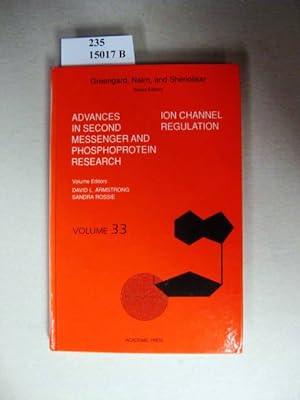
Ion Channel Regulation.
Lingua: Tedesco
Editore: Academic Press. San Diego & London., 1999
ISBN 10: 0120361337 ISBN 13: 9780120361335
Da: avelibro OHG, Dinkelscherben, Germania
Membro dell'associazione: BOEV
Valutazione del venditore 5 su 5 stelle
EUR 17,00
Spedizione EUR 10,00
Spedito da Germania a U.S.A.Quantità: 1 disponibili
Aggiungi al carrelloCondizione: Gut. XX, 318 P. Inside with the usual library stamps and inscriptions, partially crossed out, otherwise in very clean condition. English Language. Advances in Second Messenger and Phosphoprotein Research. Volume 33. Part I: Protein Phosphorylation./ Part II: Closely Associated Proteins./ Part III: Second Messengers.; - With Illustr. deu B12-01-02C|235|15017BB Sprache: Deutsch Gewicht in Gramm: 444 23,5 x 15,5 cm. Original Hardboard. Good condition.
-
Ion Channel Regulation, Volume 33 (Advances in Second Messenger and Phosphoprotein Research)
Da: Mispah books, Redhill, SURRE, Regno Unito
Valutazione del venditore 4 su 5 stelle
EUR 192,65
Spedizione EUR 28,86
Spedito da Regno Unito a U.S.A.Quantità: 1 disponibili
Aggiungi al carrelloHardcover. Condizione: Like New. LIKE NEW. SHIPS FROM MULTIPLE LOCATIONS. book.


