

Importo totale (1 articolo articoli):
Destinazione ordine:

scotese christopher (20 risultati)
Vai alla pagina principale dei risultati di ricerca
Filtri di ricerca
Tipo di articolo
- Tutti i tipi di prodotto
- Libri (19)
- Riviste e Giornali (1)
- Fumetti (Nessun altro risultato corrispondente a questo perfezionamento)
- Spartiti (Nessun altro risultato corrispondente a questo perfezionamento)
- Arte, Stampe e Poster (Nessun altro risultato corrispondente a questo perfezionamento)
- Fotografie (Nessun altro risultato corrispondente a questo perfezionamento)
- Mappe (Nessun altro risultato corrispondente a questo perfezionamento)
- Manoscritti e Collezionismo cartaceo (Nessun altro risultato corrispondente a questo perfezionamento)
Condizioni Maggiori informazioni
- Nuovo (16)
- Come nuovo, Ottimo o Quasi ottimo (3)
- Molto buono o Buono (Nessun altro risultato corrispondente a questo perfezionamento)
- Discreto o Mediocre (Nessun altro risultato corrispondente a questo perfezionamento)
- Come descritto (1)
Legatura
Ulteriori caratteristiche
- Prima ed. (Nessun altro risultato corrispondente a questo perfezionamento)
- Copia autograf. (Nessun altro risultato corrispondente a questo perfezionamento)
- Sovracoperta (1)
- Con foto (11)
- Non Print on Demand (14)
Lingua (2)
Prezzo
- Qualsiasi prezzo
- Inferiore a EUR 20 (Nessun altro risultato corrispondente a questo perfezionamento)
- EUR 20 a EUR 45
- Superiore a EUR 45
Spedizione gratuita
Paese del venditore
Valutazione venditore
-

Metallogenesis and Tectonics of the Russian Far East, Alaska, and the Canadian Cordillera Professional Paper 1697
Editore: USGS, 2005
ISBN 10: 0607984074 ISBN 13: 9780607984071
Da: Crossroads Books, Reno, NV, U.S.A.
Membro dell'associazione: IOBA
Valutazione del venditore 5 su 5 stelle

Condizione: new. "The Proterozoic and Phanerozoic metallogenic and tectonic evolution of the Russian Far East, Alaska, and the Canadian Cordillera is recorded in the cratons, craton margins, and orogenic collages of the Circum-North Pacific mountain belts that separate the North Pacific from the eastern North Asian and western North American Cratons. The collages consist of tectonostratigraphic terranes and contained metallogenic belts, which are composed of fragments of igneous arcs, accretionary-wedge and subduction-zone complexes, passive continental margins, and cratons. The terranes are overlapped by continental-margin-arc and sedimentary-basin assemblages and contained metallogenic belts. The metallogenic and geologic history of terranes, overlap assemblages, cratons, and craton margins has been complicated by postaccretion dismemberment and translation during strike-slip faulting that occurred subparallel to continental margins. Seven processes overlapping in time were responsible for most of metallogenic and geologic complexities of the region (1) In the Early and Middle Proterozoic, marine sedimentary basins developed on major cratons and were the loci for ironstone (Superior Fe) deposits and sediment-hosted Cu deposits that occur along both the North Asia Craton and North American Craton Margin. (2) In the Late Proterozoic, Late Devonian, and Early Carboniferous, major periods of rifting occurred along the ancestral margins of present-day Northeast Asia and northwestern North America. The rifting resulted in fragmentation of each continent, and formation of cratonal and passive continental-margin terranes that eventually migrated and accreted to other sites along the evolving margins of the original or adjacent continents. The rifting also resulted in formation of various massive-sulfide metallogenic belts. (3) From about the late Paleozoic through the mid-Cretaceous, a succession of island arcs and contained igneous-arc-related metallogenic belts and tectonically paired subduction zones formed near continental margins. (4) From about mainly the mid-Cretaceous through the present, a succession of continental-margin igneous arcs (some extending offshore into island arcs) and contained metallogenic belts, and tectonically paired subduction zones formed along the continental margins. (5) From about the Jurassic to the present, oblique convergence and rotations caused orogen-parallel sinistral, and then dextral displacements within the plate margins of the Northeast Asian and North American Cratons. The oblique convergences and rotations resulted in the fragmentation, displacement, and duplication of formerly more continuous arcs, subduction zones, passive continental margins, and contained metallogenic belts. These fragments were subsequently accreted along the margins of the expanding continental margins. (6) From the Early Jurassic through Tertiary, movement of the upper continental plates toward subduction zones resulted in strong plate coupling and accretion of the former island arcs, subduction zones, and contained metallogenic belts to continental margins. In this region, the multiple arc accretions were accompanied and followed by crustal thickening, anatexis, metamorphism, formation of collision-related metallogenic belts, and uplift; this resulted in the substantial growth of the North Asian and North American continents. (7) In the middle and late Cenozoic, oblique to orthogonal convergence of the Pacific Plate with present-day Alaska and Northeast Asia resulted in formation of the present ring of volcanoes and contained metallogenic belts around the Circum-North Pacific. Oblique convergence between the Pacific Plate and Alaska also resulted in major dextral-slip faulting in interior and southern Alaska and along the western part of the Aleutian- Wrangell arc. Associated with dextral-slip faulting was crustal extrusion of terranes from western Alaska into the Bering Sea. " DV2. softcover, wrapped in shrink wrap, tight, crisp, 429 pages.
-

Metallogenesis and Tectonics of the Russian Far East, Alaska, and the Canadian Cordillera Professional Paper 1697
Editore: USGS, 2005
ISBN 10: 0607984074 ISBN 13: 9780607984071
Da: Crossroads Books, Reno, NV, U.S.A.
Membro dell'associazione: IOBA
Valutazione del venditore 5 su 5 stelle
Condizione: new. "The Proterozoic and Phanerozoic metallogenic and tectonic evolution of the Russian Far East, Alaska, and the Canadian Cordillera is recorded in the cratons, craton margins, and orogenic collages of the Circum-North Pacific mountain belts that separate the North Pacific from the eastern North Asian and western North American Cratons. The collages consist of tectonostratigraphic terranes and contained metallogenic belts, which are composed of fragments of igneous arcs, accretionary-wedge and subduction-zone complexes, passive continental margins, and cratons. The terranes are overlapped by continental-margin-arc and sedimentary-basin assemblages and contained metallogenic belts. The metallogenic and geologic history of terranes, overlap assemblages, cratons, and craton margins has been complicated by postaccretion dismemberment and translation during strike-slip faulting that occurred subparallel to continental margins. Seven processes overlapping in time were responsible for most of metallogenic and geologic complexities of the region (1) In the Early and Middle Proterozoic, marine sedimentary basins developed on major cratons and were the loci for ironstone (Superior Fe) deposits and sediment-hosted Cu deposits that occur along both the North Asia Craton and North American Craton Margin. (2) In the Late Proterozoic, Late Devonian, and Early Carboniferous, major periods of rifting occurred along the ancestral margins of present-day Northeast Asia and northwestern North America. The rifting resulted in fragmentation of each continent, and formation of cratonal and passive continental-margin terranes that eventually migrated and accreted to other sites along the evolving margins of the original or adjacent continents. The rifting also resulted in formation of various massive-sulfide metallogenic belts. (3) From about the late Paleozoic through the mid-Cretaceous, a succession of island arcs and contained igneous-arc-related metallogenic belts and tectonically paired subduction zones formed near continental margins. (4) From about mainly the mid-Cretaceous through the present, a succession of continental-margin igneous arcs (some extending offshore into island arcs) and contained metallogenic belts, and tectonically paired subduction zones formed along the continental margins. (5) From about the Jurassic to the present, oblique convergence and rotations caused orogen-parallel sinistral, and then dextral displacements within the plate margins of the Northeast Asian and North American Cratons. The oblique convergences and rotations resulted in the fragmentation, displacement, and duplication of formerly more continuous arcs, subduction zones, passive continental margins, and contained metallogenic belts. These fragments were subsequently accreted along the margins of the expanding continental margins. (6) From the Early Jurassic through Tertiary, movement of the upper continental plates toward subduction zones resulted in strong plate coupling and accretion of the former island arcs, subduction zones, and contained metallogenic belts to continental margins. In this region, the multiple arc accretions were accompanied and followed by crustal thickening, anatexis, metamorphism, formation of collision-related metallogenic belts, and uplift; this resulted in the substantial growth of the North Asian and North American continents. (7) In the middle and late Cenozoic, oblique to orthogonal convergence of the Pacific Plate with present-day Alaska and Northeast Asia resulted in formation of the present ring of volcanoes and contained metallogenic belts around the Circum-North Pacific. Oblique convergence between the Pacific Plate and Alaska also resulted in major dextral-slip faulting in interior and southern Alaska and along the western part of the Aleutian- Wrangell arc. Associated with dextral-slip faulting was crustal extrusion of terranes from western Alaska into the Bering Sea. " DV1. softcover, wrapped in shrink wrap, tight, crisp, 429 pages.
-

Metallogenesis and Tectonics of the Russian Far East, Alaska, and the Canadian Cordillera Professional Paper 1697
Editore: USGS, 2005
ISBN 10: 0607984074 ISBN 13: 9780607984071
Da: Crossroads Books, Reno, NV, U.S.A.
Membro dell'associazione: IOBA
Valutazione del venditore 5 su 5 stelle
Condizione: new. "The Proterozoic and Phanerozoic metallogenic and tectonic evolution of the Russian Far East, Alaska, and the Canadian Cordillera is recorded in the cratons, craton margins, and orogenic collages of the Circum-North Pacific mountain belts that separate the North Pacific from the eastern North Asian and western North American Cratons. The collages consist of tectonostratigraphic terranes and contained metallogenic belts, which are composed of fragments of igneous arcs, accretionary-wedge and subduction-zone complexes, passive continental margins, and cratons. The terranes are overlapped by continental-margin-arc and sedimentary-basin assemblages and contained metallogenic belts. The metallogenic and geologic history of terranes, overlap assemblages, cratons, and craton margins has been complicated by postaccretion dismemberment and translation during strike-slip faulting that occurred subparallel to continental margins. Seven processes overlapping in time were responsible for most of metallogenic and geologic complexities of the region (1) In the Early and Middle Proterozoic, marine sedimentary basins developed on major cratons and were the loci for ironstone (Superior Fe) deposits and sediment-hosted Cu deposits that occur along both the North Asia Craton and North American Craton Margin. (2) In the Late Proterozoic, Late Devonian, and Early Carboniferous, major periods of rifting occurred along the ancestral margins of present-day Northeast Asia and northwestern North America. The rifting resulted in fragmentation of each continent, and formation of cratonal and passive continental-margin terranes that eventually migrated and accreted to other sites along the evolving margins of the original or adjacent continents. The rifting also resulted in formation of various massive-sulfide metallogenic belts. (3) From about the late Paleozoic through the mid-Cretaceous, a succession of island arcs and contained igneous-arc-related metallogenic belts and tectonically paired subduction zones formed near continental margins. (4) From about mainly the mid-Cretaceous through the present, a succession of continental-margin igneous arcs (some extending offshore into island arcs) and contained metallogenic belts, and tectonically paired subduction zones formed along the continental margins. (5) From about the Jurassic to the present, oblique convergence and rotations caused orogen-parallel sinistral, and then dextral displacements within the plate margins of the Northeast Asian and North American Cratons. The oblique convergences and rotations resulted in the fragmentation, displacement, and duplication of formerly more continuous arcs, subduction zones, passive continental margins, and contained metallogenic belts. These fragments were subsequently accreted along the margins of the expanding continental margins. (6) From the Early Jurassic through Tertiary, movement of the upper continental plates toward subduction zones resulted in strong plate coupling and accretion of the former island arcs, subduction zones, and contained metallogenic belts to continental margins. In this region, the multiple arc accretions were accompanied and followed by crustal thickening, anatexis, metamorphism, formation of collision-related metallogenic belts, and uplift; this resulted in the substantial growth of the North Asian and North American continents. (7) In the middle and late Cenozoic, oblique to orthogonal convergence of the Pacific Plate with present-day Alaska and Northeast Asia resulted in formation of the present ring of volcanoes and contained metallogenic belts around the Circum-North Pacific. Oblique convergence between the Pacific Plate and Alaska also resulted in major dextral-slip faulting in interior and southern Alaska and along the western part of the Aleutian- Wrangell arc. Associated with dextral-slip faulting was crustal extrusion of terranes from western Alaska into the Bering Sea." DV4. softcover, wrapped in shrink wrap, tight, crisp, 429 pages.
-

Metallogenesis and Tectonics of the Russian Far East, Alaska, and the Canadian Cordillera Professional Paper 1697
Editore: USGS, 2005
ISBN 10: 0607984074 ISBN 13: 9780607984071
Da: Crossroads Books, Reno, NV, U.S.A.
Membro dell'associazione: IOBA
Valutazione del venditore 5 su 5 stelle
Condizione: new. The Proterozoic and Phanerozoic metallogenic and tectonic evolution of the Russian Far East, Alaska, and the Canadian Cordillera is recorded in the cratons, craton margins, and orogenic collages of the Circum-North Pacific mountain belts that separate the North Pacific from the eastern North Asian and western North American Cratons. The collages consist of tectonostratigraphic terranes and contained metallogenic belts, which are composed of fragments of igneous arcs, accretionary-wedge and subduction-zone complexes, passive continental margins, and cratons. The terranes are overlapped by continental-margin-arc and sedimentary-basin assemblages and contained metallogenic belts. The metallogenic and geologic history of terranes, overlap assemblages, cratons, and craton margins has been complicated by postaccretion dismemberment and translation during strike-slip faulting that occurred subparallel to continental margins. Seven processes overlapping in time were responsible for most of metallogenic and geologic complexities of the region (1) In the Early and Middle Proterozoic, marine sedimentary basins developed on major cratons and were the loci for ironstone (Superior Fe) deposits and sediment-hosted Cu deposits that occur along both the North Asia Craton and North American Craton Margin. (2) In the Late Proterozoic, Late Devonian, and Early Carboniferous, major periods of rifting occurred along the ancestral margins of present-day Northeast Asia and northwestern North America. The rifting resulted in fragmentation of each continent, and formation of cratonal and passive continental-margin terranes that eventually migrated and accreted to other sites along the evolving margins of the original or adjacent continents. The rifting also resulted in formation of various massive-sulfide metallogenic belts. (3) From about the late Paleozoic through the mid-Cretaceous, a succession of island arcs and contained igneous-arc-related metallogenic belts and tectonically paired subduction zones formed near continental margins. (4) From about mainly the mid-Cretaceous through the present, a succession of continental-margin igneous arcs (some extending offshore into island arcs) and contained metallogenic belts, and tectonically paired subduction zones formed along the continental margins. (5) From about the Jurassic to the present, oblique convergence and rotations caused orogen-parallel sinistral, and then dextral displacements within the plate margins of the Northeast Asian and North American Cratons. The oblique convergences and rotations resulted in the fragmentation, displacement, and duplication of formerly more continuous arcs, subduction zones, passive continental margins, and contained metallogenic belts. These fragments were subsequently accreted along the margins of the expanding continental margins. (6) From the Early Jurassic through Tertiary, movement of the upper continental plates toward subduction zones resulted in strong plate coupling and accretion of the former island arcs, subduction zones, and contained metallogenic belts to continental margins. In this region, the multiple arc accretions were accompanied and followed by crustal thickening, anatexis, metamorphism, formation of collision-related metallogenic belts, and uplift; this resulted in the substantial growth of the North Asian and North American continents. (7) In the middle and late Cenozoic, oblique to orthogonal convergence of the Pacific Plate with present-day Alaska and Northeast Asia resulted in formation of the present ring of volcanoes and contained metallogenic belts around the Circum-North Pacific. Oblique convergence between the Pacific Plate and Alaska also resulted in major dextral-slip faulting in interior and southern Alaska and along the western part of the Aleutian- Wrangell arc. Associated with dextral-slip faulting was crustal extrusion of terranes from western Alaska into the Bering Sea. DX1. softcover, wrapped in shrink wrap, tight, crisp, 429 pages.
-
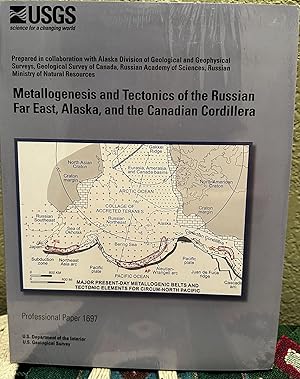
Metallogenesis and Tectonics of the Russian Far East, Alaska, and the Canadian Cordillera Professional Paper 1697
Editore: USGS, 2005
ISBN 10: 0607984074 ISBN 13: 9780607984071
Da: Crossroads Books, Reno, NV, U.S.A.
Membro dell'associazione: IOBA
Valutazione del venditore 5 su 5 stelle
Condizione: new. The Proterozoic and Phanerozoic metallogenic and tectonic evolution of the Russian Far East, Alaska, and the Canadian Cordillera is recorded in the cratons, craton margins, and orogenic collages of the Circum-North Pacific mountain belts that separate the North Pacific from the eastern North Asian and western North American Cratons. The collages consist of tectonostratigraphic terranes and contained metallogenic belts, which are composed of fragments of igneous arcs, accretionary-wedge and subduction-zone complexes, passive continental margins, and cratons. The terranes are overlapped by continental-margin-arc and sedimentary-basin assemblages and contained metallogenic belts. The metallogenic and geologic history of terranes, overlap assemblages, cratons, and craton margins has been complicated by postaccretion dismemberment and translation during strike-slip faulting that occurred subparallel to continental margins. Seven processes overlapping in time were responsible for most of metallogenic and geologic complexities of the region (1) In the Early and Middle Proterozoic, marine sedimentary basins developed on major cratons and were the loci for ironstone (Superior Fe) deposits and sediment-hosted Cu deposits that occur along both the North Asia Craton and North American Craton Margin. (2) In the Late Proterozoic, Late Devonian, and Early Carboniferous, major periods of rifting occurred along the ancestral margins of present-day Northeast Asia and northwestern North America. The rifting resulted in fragmentation of each continent, and formation of cratonal and passive continental-margin terranes that eventually migrated and accreted to other sites along the evolving margins of the original or adjacent continents. The rifting also resulted in formation of various massive-sulfide metallogenic belts. (3) From about the late Paleozoic through the mid-Cretaceous, a succession of island arcs and contained igneous-arc-related metallogenic belts and tectonically paired subduction zones formed near continental margins. (4) From about mainly the mid-Cretaceous through the present, a succession of continental-margin igneous arcs (some extending offshore into island arcs) and contained metallogenic belts, and tectonically paired subduction zones formed along the continental margins. (5) From about the Jurassic to the present, oblique convergence and rotations caused orogen-parallel sinistral, and then dextral displacements within the plate margins of the Northeast Asian and North American Cratons. The oblique convergences and rotations resulted in the fragmentation, displacement, and duplication of formerly more continuous arcs, subduction zones, passive continental margins, and contained metallogenic belts. These fragments were subsequently accreted along the margins of the expanding continental margins. (6) From the Early Jurassic through Tertiary, movement of the upper continental plates toward subduction zones resulted in strong plate coupling and accretion of the former island arcs, subduction zones, and contained metallogenic belts to continental margins. In this region, the multiple arc accretions were accompanied and followed by crustal thickening, anatexis, metamorphism, formation of collision-related metallogenic belts, and uplift; this resulted in the substantial growth of the North Asian and North American continents. (7) In the middle and late Cenozoic, oblique to orthogonal convergence of the Pacific Plate with present-day Alaska and Northeast Asia resulted in formation of the present ring of volcanoes and contained metallogenic belts around the Circum-North Pacific. Oblique convergence between the Pacific Plate and Alaska also resulted in major dextral-slip faulting in interior and southern Alaska and along the western part of the Aleutian- Wrangell arc. Associated with dextral-slip faulting was crustal extrusion of terranes from western Alaska into the Bering Sea. softcover, wrapped in shrink wrap, tight, crisp, 429 pages.
-

Pangaea Sister Sites: Jurassic Link to the Modern World
Da: GreatBookPrices, Columbia, MD, U.S.A.
Valutazione del venditore 5 su 5 stelle
EUR 84,59
Spedizione EUR 2,27
Spedito in U.S.A.Quantità: Più di 20 disponibili
Aggiungi al carrelloCondizione: As New. Scotese, Christopher (illustratore). Unread book in perfect condition.
-
Pangaea Sister Sites: Jurassic Link to the Modern World
Da: GreatBookPrices, Columbia, MD, U.S.A.
Valutazione del venditore 5 su 5 stelle
EUR 85,48
Spedizione EUR 2,27
Spedito in U.S.A.Quantità: Più di 20 disponibili
Aggiungi al carrelloCondizione: New. Scotese, Christopher (illustratore).
-
Pangaea Sister Sites: Jurassic Link to the Modern World
Da: Ria Christie Collections, Uxbridge, Regno Unito
Valutazione del venditore 5 su 5 stelle
EUR 74,02
Spedizione EUR 13,73
Spedito da Regno Unito a U.S.A.Quantità: Più di 20 disponibili
Aggiungi al carrelloCondizione: New. Scotese, Christopher (illustratore). In.
-
Pangaea Sister Sites: Jurassic Link to the Modern World
Da: GreatBookPricesUK, Woodford Green, Regno Unito
Valutazione del venditore 5 su 5 stelle
EUR 74,01
Spedizione EUR 17,19
Spedito da Regno Unito a U.S.A.Quantità: Più di 20 disponibili
Aggiungi al carrelloCondizione: New. Scotese, Christopher (illustratore).
-
Pangaea Sister Sites: Jurassic Link to the Modern World
Da: GreatBookPricesUK, Woodford Green, Regno Unito
Valutazione del venditore 5 su 5 stelle
EUR 81,85
Spedizione EUR 17,19
Spedito da Regno Unito a U.S.A.Quantità: Più di 20 disponibili
Aggiungi al carrelloCondizione: As New. Scotese, Christopher (illustratore). Unread book in perfect condition.
-

The restless Indian plate and its epic voyage from Gondwana to Asia : its epic voyage from Gondwana to Asia : its tectonic, paleoclimatic, and paleobiogeographic evolution
Lingua: Inglese
Editore: Boulder, Colorado The Geological Society of America, 2017
ISBN 10: 0813725291 ISBN 13: 9780813725291
Da: Joseph Burridge Books, Dagenham, Regno Unito
Valutazione del venditore 5 su 5 stelle
EUR 106,23
Spedizione EUR 30,94
Spedito da Regno Unito a U.S.A.Quantità: 1 disponibili
Aggiungi al carrelloSoft cover. Condizione: New. iv, 147 pages : illustrations (some color), maps (some colour) ; 28 cm. The fossil history of animal life in India is central to our understanding of the tectonic evolution of Gondwana, dispersal of India, its northward journey, and its collision with Asia. This book provides the only detailed overview of the paleobiogeographic, tectonic, and paleoclimatic evolution of the Indian plate from Gondwana to Asia. This thorough, up-to-date volume is a must-have reference for researchers and students in Indian geology, paleontology, plate tectonics, and collision of continents.
-

Palaeozoic Palaeogeography and Biogeography (Geological Society Memoir Series, 12)
Lingua: Inglese
Editore: Geological Society, London, 1990
ISBN 10: 0903317494 ISBN 13: 9780903317498
Da: Joseph Burridge Books, Dagenham, Regno Unito
Valutazione del venditore 5 su 5 stelle
EUR 283,29
Spedizione EUR 30,94
Spedito da Regno Unito a U.S.A.Quantità: 1 disponibili
Aggiungi al carrello435 pages : illustrations ; 32 cm. Includes the most recent palaeomagnetic and biogeographic data from all major Palaeozoic continents. From this information, a new set of world maps has been produced illustrating successive positions of the continents and oceans throughout the Palaeozoic Era. The relationships between climatic changes, sea level changes, evolutionary radiations and intercontinental migrations are discussed.
-

Paleozoic base maps
Editore: University of Chicago, 1979
Da: Greenwood Road Books, Bridgman, MI, U.S.A.
Valutazione del venditore 2 su 5 stelle

Rivista / Giornale
Soft cover. Condizione: Near Fine. Lead paper in the May 1979 (Volume 87, Number 3) issue of the Journal of Geology, published by the University of Chicago Press. Entire issue offered. The paper appears on pp. 217-277. Library stamp on front cover.
-

Plate Reconstruction from Paleozoic Paleomagnetism : Interim Report of Working Group 2 on Phanerozoic Plate Motions & Orogenesis
Editore: American Geophysical Union, Washington, D.C, 1984
ISBN 10: 0875905129 ISBN 13: 9780875905129
Da: Expatriate Bookshop of Denmark, Svendborg, Danimarca
Valutazione del venditore 5 su 5 stelle
EUR 52,33
Spedizione EUR 129,00
Spedito da Danimarca a U.S.A.Quantità: 1 disponibili
Aggiungi al carrelloorig. cloth. Condizione: Minor wear. VG. Textual graphs & maps. (illustratore). 28x21cm, vii,136 pp., Series: International Lithosphere Program, Publication no. 103 / Geodynamics series, vol. 12. Contents: An introduction to this volume : Paleozoic paleomagnetism and the assembly of Pangea / C.R. Scotese -- A paleomagnetic reevaluation of Pangea reconstructions / R. Van der Voo, J. Peinado, and C.R. Scotese -- The Tethys paradox in plate tectonics / J. Stocklin -- On the tectonic evolution of Mexico : paleomagnetic constraints / J. Urrutia-Fucugauchi -- Paleomagnetism of the middle Mississippian Greenbrier Group in West Virginia, USA / D.-S.L. Chen and V.A. Schmidt -- Paleomagnetic results from the Carboniferous of Nova Scotia / C.R. Scotese [and others] -- Late Paleozoic motions of the Meguma terrane, Nova Scotia : new paleomagnetic evidence / D.J. Spariosu, D.V. Kent, and J.D. Keppie -- Paleomagnetism of Lower-Middle Devonian and Upper Proterozoic-Cambrian rocks from Mejeria ( Mauritania, West Africa) / D.V. Kent, O. Dia, and J.M.A. Sougy -- Mid- Ordovician paleomagnetism and the proto-Atlantic Ocean in Ireland / E.R. Deutsch -- Paleomagnetism of the Cambrian rocks of the great valley of east central Pennsylvania : fold test constraints on the age of magnetization / R.J. Stead and K.P. Kodama -- Was Laurentia part of an Eocambrian supercontinent? / R. Van der Voo, C. McCabe, and C.R. Scotese.
-
Pangaea Sister Sites
Da: PBShop.store UK, Fairford, GLOS, Regno Unito
Valutazione del venditore 5 su 5 stelle
EUR 74,73
Spedizione EUR 10,73
Spedito da Regno Unito a U.S.A.Quantità: Più di 20 disponibili
Aggiungi al carrelloHRD. Condizione: New. Scotese, Christopher (illustratore). New Book. Delivered from our UK warehouse in 4 to 14 business days. THIS BOOK IS PRINTED ON DEMAND. Established seller since 2000.
-
Pangaea Sister Sites
Da: PBShop.store US, Wood Dale, IL, U.S.A.
Valutazione del venditore 5 su 5 stelle
EUR 87,83
Spedizione gratuita
Spedito in U.S.A.Quantità: Più di 20 disponibili
Aggiungi al carrelloHRD. Condizione: New. Scotese, Christopher (illustratore). New Book. Shipped from UK. THIS BOOK IS PRINTED ON DEMAND. Established seller since 2000.
-
Pangaea Sister Sites: Jurassic Link to the Modern World
Da: THE SAINT BOOKSTORE, Southport, Regno Unito
Valutazione del venditore 5 su 5 stelle
EUR 86,68
Spedizione EUR 14,79
Spedito da Regno Unito a U.S.A.Quantità: Più di 20 disponibili
Aggiungi al carrelloHardback. Condizione: New. Scotese, Christopher (illustratore). This item is printed on demand. New copy - Usually dispatched within 5-9 working days.
-

EUR 104,42
Spedizione EUR 70,41
Spedito da Germania a U.S.A.Quantità: 1 disponibili
Aggiungi al carrelloBuch. Condizione: Neu. Scotese, Christopher (illustratore). nach der Bestellung gedruckt Neuware - Printed after ordering - Dinosaurs, maps, travel, geology, history and climate change. Pangaea Sister Sites, the book, has it all.Pangaea gave birth to 7 modern continents and numerous islands. When it broke up, locations along those fault lines moved farther and farther apart. Pangaea Sister Sites give us a look at 71 sets of locations that were divided as much as 180 million years ago, moving from single digit miles to thousands of miles apart.Filled with more than 1,200 illustrations, including Paleomaps by professional geologist, Dr. Christopher Scotese. This book covers not only at the modern cities, towns, scientific research stations and other sites as they exist today, but also gives us a glimpse at what these sites might have been like back in the Jurassic and early Cretaceous periods-when dinosaurs ruled the world.Some of the Pangaea Sister Site pairs include¿ New York City, NY, USA-Dakhla, Western Sahara¿ Boston, MA, USA-Santa Cruz de Tenerife, Canary Islands¿ Vancouver, BC, Canada-Cabo San Lucas, BC, Mexico¿ Miami, FL, USA-Conakry, Guinea¿ Cape Canaveral, FL, USA-Bissau, Guinea-Bissau¿ Virginia Beach, VA, USA-Nouadhibou, Mauritania¿ Fortaleza, Brazil-Lagos, Nigeria¿ São Paulo, Brazil-Lucira, Angola¿ Rio de Janeiro, Brazil-Lobito, Angola¿ Recife, Brazil-Douala, Cameroon¿ Salvador, Brazil-Port-Gentil, Gabon¿ Buenos Aires, Argentina-Bogenfels, Namibia¿ Antalaha, Madagascar-Mumbai, India¿ Kolkata, India-Davis Station, Antarctica¿ Perth, Australia-Mirny Station, Antarctica.Pangaea Sister Sites, the book, exposes very real connections between these modern locations, rekindling forgotten kinships-links to our Jurassic past.
-

EUR 155,02
Spedizione EUR 48,99
Spedito da Germania a U.S.A.Quantità: Più di 20 disponibili
Aggiungi al carrelloCondizione: New. Scotese, Christopher (illustratore). Dieser Artikel ist ein Print on Demand Artikel und wird nach Ihrer Bestellung fuer Sie gedruckt. Über den AutorrnrnRod Martin, Jr. has been a computer scientist and engineer with a degree, summa cum laude, author of #1 weather bestseller, Climate Basics, developer of 3D astronomy software, Stars in the NeighborHood, and a Hollywood a.
-

EUR 160,70
Spedizione EUR 70,00
Spedito da Germania a U.S.A.Quantità: 5 disponibili
Aggiungi al carrelloBuch. Condizione: Neu. Scotese, Christopher (illustratore). Pangaea Sister Sites | Jurassic Link to the Modern World | Jr. Rod Martin | Buch | Gebunden | Englisch | 2021 | [.] | EAN 9781008932289 | Verantwortliche Person für die EU: Libri GmbH, Europaallee 1, 36244 Bad Hersfeld, gpsr[at]libri[dot]de | Anbieter: preigu Print on Demand.


