Importo totale (1 articolo articoli):
Destinazione ordine:

u s colored troops (11 risultati)
Vai alla pagina principale dei risultati di ricerca
Filtri di ricerca
Tipo di articolo
- Tutti i tipi di prodotto
- Libri (5)
- Riviste e Giornali (Nessun altro risultato corrispondente a questo perfezionamento)
- Fumetti (Nessun altro risultato corrispondente a questo perfezionamento)
- Spartiti (Nessun altro risultato corrispondente a questo perfezionamento)
- Arte, Stampe e Poster (Nessun altro risultato corrispondente a questo perfezionamento)
- Fotografie (1)
- Mappe (Nessun altro risultato corrispondente a questo perfezionamento)
- Manoscritti e Collezionismo cartaceo (5)
Condizioni Maggiori informazioni
- Nuovo (Nessun altro risultato corrispondente a questo perfezionamento)
- Come nuovo, Ottimo o Quasi ottimo (Nessun altro risultato corrispondente a questo perfezionamento)
- Molto buono o Buono (2)
- Discreto o Mediocre (Nessun altro risultato corrispondente a questo perfezionamento)
- Come descritto (9)
Legatura
Ulteriori caratteristiche
- Prima ed. (3)
- Copia autograf. (4)
- Sovracoperta (Nessun altro risultato corrispondente a questo perfezionamento)
- Con foto (9)
- Non Print on Demand (11)
Lingua (2)
Spedizione gratuita
- Spedizione gratuita in U.S.A. (Nessun altro risultato corrispondente a questo perfezionamento)
Paese del venditore
Valutazione venditore
-

The Life of Gen. Philip H.Sheridan Its Romance & Reality: How an Humble Lad Reached the Head of an Army. The Career & Achievements of this Masterly Leader of Men in Battle; Realistic Descriptions of the March, Raid & Charge of the Horsemen; & Graphic Sketches of the Other Cavalry Leaders ("Little Phil" and His Troopers)
Lingua: Inglese
Editore: A. & R.A. Reid Publishers, 1888
Prima edizione
Hardcover. Condizione: Very Good. 1st Edition. Original 1888 issue in good used shape as might be expected. Probably grades to very good in antiquarian descriptio.
-
The Life of Gen. Philip H.Sheridan Its Romance & Reality: How an Humble Lad Reached the Head of an Army. The Career & Achievements of this Masterly Leader of Men in Battle; Realistic Descriptions of the March, Raid & Charge of the Horsemen; & Graphic Sketches of the Other Cavalry Leaders
Editore: J. A. and R. A. Reid., 1888
Da: Bailey's Bibliomania, Ellensburg, WA, U.S.A.
Valutazione del venditore 5 su 5 stelle

Prima edizione
Hardcover. Condizione: Good. unstated First Edition. Hi. Welcome to our small, family-owned bookstore. Copyright J. A. and R. A. Reid (Providence)[not the 1889 Hurst edition). Very good condition for its age. Richly illustrated, includes portraits of Sheridan's contemporary officers. Hardcover, brown cloth with black artwork (portrait);gilt lettering (worn--completely gone from the spine). 445 pages, clean (a small number, including the flyleaf have some kind of oil spots) and still bright. One small spot on the fore-edge. Index. Stout, sewn binding. Packaged using bubble wrap and a sturdy cardboard box. Thanks for checking out this book from our small-town brick-and-mortar and supporting small business.
-

US Colored Troops Manumission and Compensation Documents for Formerly Enslaved Union Soldier Minos James Enlisted in the 9th Regiment, Maryland ca. 1865
Data di pubblicazione: 1865
Da: Max Rambod Inc, Woodland Hills, CA, U.S.A.
Membro dell'associazione: ABAA ILAB PADA
Valutazione del venditore 5 su 5 stelle
Manoscritto / Collezionismo cartaceo Copia autografata
[Civil War] [Slavery] Manumission and compensation documents concerning the enlistment of Minos James in the United States Colored Troops, created in Maryland circa 1865 during the final months of the American Civil War when border state slaveholders sought payment for enslaved men who entered Union military service. The documents record the enlistment of Minos James in Company H of the 9th Regiment United States Colored Troops and the subsequent claim by Worcester County slaveholder Elisha P. Parker for state compensation following James's service and manumission. Maryland permitted slaveholders to receive financial payment for enslaved men who enlisted prior to the abolition of slavery within the state, reflecting the complex legal transition from slavery to freedom among Black soldiers in Union border states. The papers document both the process of manumission and the bureaucratic recognition of Black military service during the final phase of the Civil War. Parker, Elisha P. Compensation claim documents regarding Minos James, Company H, 9th Regiment United States Colored Troops. Maryland Board of Claims, Worcester County, Maryland, circa April 1865. Three documents tipped together along the top edge with signatures, revenue stamps, embossed seals, and official docketing. [1] Maryland Board of Claims. Certification regarding "Deed of Manumission and Release of Service of Minos James." This document records the formal acknowledgment that Elisha P. Parker released his claim to the enslaved man Minos James following James's enlistment in the United States military service. [2] Maryland Board of Claims. Service certification confirming that "Minos James of Co. H, 9th Reg't U.S.C.T., was enlisted in the United States service, from the State of Maryland prior to the first day of April, eighteen hundred and sixty four." Attached to the document is a payment order issued by the Treasurer of the State of Maryland authorizing payment of "the sum of One Hundred Dollars, being the sum appropriated for my slave Minos James of Worcester County, Md., enlisted as described in the above Certificate," signed by Elisha P. Parker. [3] Parker, Elisha P. Proof of ownership affidavit attesting to Parker's ownership of Minos James at the time of enlistment, accompanied by witness signatures verifying the claim as required by Maryland's compensation process. During the Civil War, border states that remained in the Union but retained slavery created compensation systems allowing slaveholders to claim payment when enslaved men enlisted in the United States Colored Troops. Maryland slavery formally ended with the adoption of a new state constitution on November 1, 1864, but compensation claims continued to be processed for earlier enlistments. Units of the United States Colored Troops played a significant role in Union military operations during the final campaigns of the war, including service in major engagements such as the Siege of Petersburg and the occupation of Richmond. Despite their military contribution, Black soldiers faced systemic discrimination, unequal pay during much of the war, and segregated command structures led by white officers. The documents demonstrate the bureaucratic intersection of emancipation, military service, and compensation claims in a border state where slavery ended late in the conflict. Minor edge wear and chipping with partial separations along fold lines, writing and official markings remaining clear and legible, good condition. A revealing Civil War era document group illustrating how the enlistment of Black soldiers intersected with the legal dissolution of slavery in Maryland. Signed.
-
Civil War African American Maryland Volunteers Official Roster Including Ninth Regiment United States Colored Troops Published 1898 to 1899
Data di pubblicazione: 1861
Da: Max Rambod Inc, Woodland Hills, CA, U.S.A.
Membro dell'associazione: ABAA ILAB PADA
Valutazione del venditore 5 su 5 stelle
Prima edizione
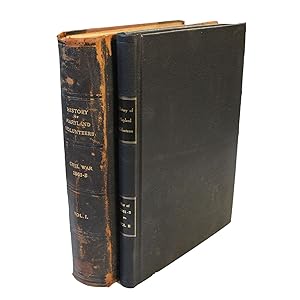
First Edition. Wilmer, L. Allison. History and Roster of Maryland Volunteers, War of 1861-65, published 1898-1899, compiles the official service record of Maryland soldiers, sailors, and marines who served in the Union war effort during the American Civil War, preserving one of the most detailed documentary records of the state's military participation in the conflict. Produced more than three decades after the war, the work records the names and service histories of thousands of Maryland volunteers and includes extensive material on African American troops who entered Union service following the expansion of Black enlistment in 1863. The volumes are particularly significant for their treatment of the Ninth Regiment Infantry, United States Colored Troops, a Maryland regiment organized during the later phase of the war when the Union government formally authorized large scale enlistment of African American soldiers. The publication acknowledges the contributions of these soldiers and records the state's effort to document their service. Wilmer, L. Allison. History and Roster of Maryland Volunteers, War of 1861-65. Baltimore: Press of Guggenheimer, Weil & Co., 1898-1899. First edition. Two volumes. The introductory sections discuss the roles of Maryland soldiers, sailors, and marines during the Civil War. The second volume contains a dedication in the preface to the Colored Troops of the Ninth Regiment Infantry and states: "The Maryland contingent of Colored troops certainly measured up to the expectation of the most sanguine of their friends, and the survivors today fully and gratefully appreciate the just recognition given to them by their native State in this publication, as has been evidenced by expressions to this commission." Volume one records the names of individuals who served in the various branches of the Union military, while volume two presents biographical and service data related to Maryland volunteers serving in the Union Navy. A substantial section of the second volume is devoted to the Ninth Regiment Infantry, United States Colored Troops, Maryland Volunteers, beginning with a regimental history followed by lists of officers and enlisted men that include muster dates, discharges, wounds, and deaths. The Ninth Regiment United States Colored Troops was organized between July 15 and September 1, 1863 and served under Union command during the later campaigns of the Civil War, including service at Fortress Monroe and participation in the Petersburg campaign. The regiment saw sustained military activity following the opening of the siege of Petersburg, one of the decisive campaigns leading to the collapse of Confederate resistance in Virginia. The publication preserves the documentary record of these soldiers' wartime service at a time when official recognition of African American military participation remained incomplete in many public narratives of the war. Two volumes. Volume one 834 pages, volume two 285 pages. Quarto format. Volume one bound in three quarter leather over maroon boards; volume two rebound in modern black cloth. Spine detached on the first volume with edge wear; text pages clean with strong legibility. Second volume well preserved. The set provides a substantial primary reference source for the military history of Maryland volunteers and for the service records of the Ninth Regiment United States Colored Troops.
-

AUTOGRAPH LETTER, SIGNED, BY COLONEL GILES WALDO SHURTLEFF OF THE 5TH U.S. COLORED TROOPS, CAMP DELAWARE, NOVEMBER 10, 1863, TO FRIEND PROFESSOR EDWARD H. MERRELL OF WISCONSIN: "TWO WEEKS AGO TODAY, I STARTED TO OH ON A VISIT, HAD BEEN HOME TWO DAYS RETURN A DISPATCH CAME ORDERING ME IMMEDIATELY BACK TO CAMP. I CAME AND FOUND THAT WE WERE UNDER ORDERS TO REMOVE TO FORT MONROE. BUT AS WE WERE DELAYED SOME DAYS IN CAMP I GOT LEAVE TO GO TO PAINESVILLE. STAID THIRTY HOURS - WHAT HOURS!" "THINGS IN CAMP ARE AS USUAL. MCCOY HAS JUST RECEIVED APPOINTMENT AS COLONEL. THE OFFICERS ALL WANTED ME AND PETITIONED SEC. OF WAR TO THAT EFFECT, BUT THE GOV. WAS BOUND TO APPOINT A PET. HE WAS TERRIBLY WRATHY WHEN HE HEARD OF THAT PETITION THOUGH IT WAS SIGN
Da: David M. Lesser, ABAA, Woodbridge, CT, U.S.A.
Membro dell'associazione: ABAA ESA ILAB SNEAB
Valutazione del venditore 5 su 5 stelle
Two 8" x 10" sheets of unlined paper folded to 5" x 8". [8] pp. Completely in ink manuscript. Includes yellow envelope with canceled 3 cent stamp addressed to "Prof. E.H. Merrell, Ripon, Wisconsin." Minor dustsoiling, old folds, small tear with loss of a few words, a few short closed tears. Very Good. "Camp Delaware remained in use from 1862 to 1864. In 1863, officials expanded the camp, housing white soldiers on the west bank of the Olentangy River and African American troopers on the east bank. The 96th Regiment Ohio Volunteer Infantry, the 121st Regiment Ohio Volunteer Infantry, the 127th Regiment Ohio Volunteer Infantry, the 5th Regiment United States Colored Troops, and the 27th Regiment United States Colored Troops organized at Camp Delaware" [online Ohio Civil War Central]. Giles Waldo Shurtleff [1831-1904] attended Oberlin College before enlisting as a Captain with Company C, Ohio 7th Infantry, on April 22, 1861. He resigned on March 18, 1863, due to illness, and was later commissioned into Field & Staff, U.S. Colored Troops 5th Infantry on July 29, 1863, with a promotion to Colonel. He was breveted Brigadier General on March 13, 1865. After the war, Shurtleff joined Oberlin College as tutor, associate professor and professor of the Latin language and literature from 1865 to 1887. He was a longtime member of the Prudential Committee and later the college treasurer. ["General Giles W. Shurtleff", The Oberlin Review, Volume XXXI, Number 31, May 19, 1904, pp.664-668.] Reverend Professor Edward Huntington Merrell [1835-1910], a graduate of Oberlin College and Oberlin Theological Seminary, was professor and president of Ripon College. He started at Ripon College in 1862, became the principal of the Preparatory Department and Professor of Languages, and later was the college's second president from 1876-1891. Although retired as president, he remained on the faculty until his death. ["Ripon College Presidents", website of Ripon College, accessed December, 2024.].
-
African American Military Organization During the Civil War, Special Order Assigning Sergeant to Colored Detachment, 1863
Data di pubblicazione: 1863
Da: Max Rambod Inc, Woodland Hills, CA, U.S.A.
Membro dell'associazione: ABAA ILAB PADA
Valutazione del venditore 5 su 5 stelle
Manoscritto / Collezionismo cartaceo Copia autografata
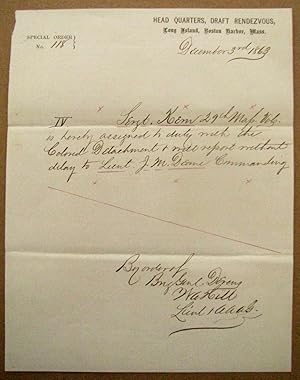
Hill, William Augustus. Special Order No. 118, 3 December 1863, documenting the assignment of a Union Army sergeant to a "Colored Detachment" during the early formation of African American military units following the Emancipation Proclamation. Issued from the Draft Rendezvous at Long Island in Boston Harbor, the order directs Sergeant Kern of the 29th Massachusetts Volunteer Infantry to report immediately to Lieutenant J.M. Deane, indicating the transfer of experienced personnel into newly organized Black units. The document reflects the rapid expansion of United States Colored Troops in 1863, when the Union Army began formally incorporating African American soldiers into its ranks, reshaping military organization and wartime policy. The involvement of the 29th Massachusetts, an established combat regiment, situates the order within broader efforts to support and structure these new formations during a critical phase of the Civil War. Hill, William Augustus. Special Order No. 118. Draft Rendezvous, Long Island, Boston Harbor, Massachusetts, 3 December 1863. Autograph manuscript order on headquarters letterhead, measuring approximately 9.5 x 7.5 inches, signed by Lt. William Augustus Hill of the 19th Massachusetts. The document assigns Sergeant Kern to a Colored Detachment under the command of Lieutenant J.M. Deane and provides direct evidence of administrative processes involved in staffing and organizing African American units. The order originates from the estate of Lieutenant John Milton Deane, the commanding officer referenced in the document. Single manuscript document with minor edge wear; overall very good condition. A primary-source record of Union military reorganization and the integration of African American troops during the Civil War. Signed.
-
Civil War African American Military Service Roll of Honor Volumes Recording the Sacrifice of United States Colored Troops 1866-67
Data di pubblicazione: 1866
Da: Max Rambod Inc, Woodland Hills, CA, U.S.A.
Membro dell'associazione: ABAA ILAB PADA
Valutazione del venditore 5 su 5 stelle
Manoscritto / Collezionismo cartaceo
[US Colored Troops] [Civil War] Roll of Honor government publications issued by the United States Quartermaster General's Office between 1866 and 1867 record the names and burial locations of Union soldiers who died in service during the American Civil War. These volumes document the sacrifice of both white and African American soldiers, including members of the United States Colored Troops whose service played a critical role in Union military operations during the final years of the war. Two original 1866-67 printed Rolls of Honor listing the names of soldiers who died in "Defence of the American Union" evidence of African American military sacrifice during the Civil War, illustrating both the geographical distribution of Black Union soldiers and their contributions to the Union cause . These Union soldiers were interred in various cemeteries across the United States. Roll of Honor "No. VI". Names of Soldiers Who Died in Defence of the American Union, Interred in the Eastern District of Texas; Central District of Texas; Rigo Grande District, Department of Texas; Camp Ford, Tyler, Texas; and Corpus Christi, Texas. Washington: Government Printing Office, 1866. 35 pages. [2] Roll of Honor No. "XII". Names of Soldiers Who Died in Defence of the American Union, Interred in New York, New Jersey, Pennsylvania, Maryland, Virginia, Illinois, Missouri, Iowa, Arkansas, Texas, Utah Territory, and on the Pacific Coast. Washington: Government Printing Office, 1867. 173 pages. These official government publications, issued by the Quartermaster General's Office, document both white and "colored" soldiers who perished in the Civil War. The documents cover burials in states including Texas, Virginia, Pennsylvania, New Jersey, Iowa, Illinois, Missouri, Arkansas, the Utah Territory, and on the Pacific Coast. Texas recorded the highest number of burials for both Black and white soldiers, particularly in Galveston, Corpus Christi, Indianola, Brownsville, and Tyler. Pennsylvania and Virginia also had significant numbers of interments. The records distinguish between white and Black soldiers, noting their ranks, regiments, and places of burial. Notably, it records the sacrifice of several African American soldiers who attained non-commissioned officer ranks, including Sergeant Aaron Hendon of the 115th U.S.C.T. (died Aug. 31, 1865, in Texas), Sergeant Henry F.P. of the 24th U.S.C.T. (died Sept. 1, 1865, in Virginia), Sergeant Charles McFarren of the 115th U.S.C.T. (died Aug. 15, 1865, in Texas), Sergeant Moses Zane of the 118th U.S.C.T. (died Aug. 12, 1865, in Texas), and Sergeant Thomas Wilkinson of the 19th U.S.C.T. (died Aug. 17, 1865, in Texas). Other high-ranking Black soldiers include Drum Corps member George Basset of the 122nd U.S.C.T. and Corporal Wm. Temple of the 45th U.S.C.T., both of whom died in Texas. These entries underscore the leadership roles that African American soldiers held within their units despite the racial discrimination prevalent at the time. These fallen were largely members of the U.S.C.T., an essential force in Union operations, particularly in the South and along frontier outposts. The rolls further document the widespread presence of United States Colored Troops regiments, with numerous privates buried across different states. The 115th, 116th, 122nd, and 19th U.S.C.T. are heavily represented, particularly in Texas cemeteries such as those in Galveston, Corpus Christi, and Indianola. In Pennsylvania, privates from the 24th, 25th, 29th, and 31st U.S.C.T. are recorded, reflecting the state's significant contribution to African American military service. In New Jersey, Alexander Calamine of the 39th U.S.C.T. is listed with a death date of April 24, 1865. Iowa records include Perry Jackson of the 60th Iowa regiment, who died on November 1, 1865. These documents stand as critical records of African American military sacrifice during the Civil War, illustrating both the geographical distribution of Black Union soldiers and their contributions to the Union cause. Their inclusion in the Roll of Honor reflects the broader historical struggle for recognition and equality faced by Black soldiers, many of whom were formerly enslaved and fought for the very freedom they had been denied. These original 19th-century government-printed rolls are in just fair condition, with cracked spines, chipping pages, and a loose binding. A significant and scarce primary source documenting the service and sacrifice of Black Civil War soldiers.
-
African American Military History Private Miles Logan US Colored Troops Pay Voucher 1865 Arkansas Service and Compensation Record
Data di pubblicazione: 1865
Da: Max Rambod Inc, Woodland Hills, CA, U.S.A.
Membro dell'associazione: ABAA ILAB PADA
Valutazione del venditore 5 su 5 stelle
Manoscritto / Collezionismo cartaceo
Logan, Miles. Volunteer Descriptive List and Account of Pay and Clothing, 1865, documents the military service, labor assignment, and compensation of an African American soldier in the 11th Regiment United States Colored Infantry during the Civil War. Enlisted at Fort Smith, Arkansas on 28 December 1863 at approximately eighteen years of age, Logan is recorded as a farmer prior to service, placing him within the cohort of formerly enslaved or newly emancipated men who entered Union ranks following the creation of the Bureau of Colored Troops in 1863. The document traces his presence with the regiment, including assignment as a teamster with a hay train, and confirms his participation during the Battle of Gunther Prairie on 24 August 1864. Notations regarding lost issued equipment and subsequent stoppage of pay provide direct evidence of the disciplinary and logistical systems governing enlisted men, while marginal records of clothing issuance illustrate the material provisioning of Black soldiers in Union service. Volunteer Descriptive List and Account of Pay and Clothing of Private Miles Logan, Company B, 11th Regiment U.S. Colored Troops. United States Army, Little Rock, Arkansas, 1865. Partly printed document completed in manuscript, one page measuring approximately 21 x 10 inches. Record includes enlistment details, service notes, and itemized accounting of clothing and equipment issued through March 25, 1865, totaling $105.72, with additional entries in the margins. Annotations in the paymaster's hand confirm Logan's service status and participation in active operations. The document also reflects the administrative transition of the 11th Regiment into the 113th U.S. Colored Infantry in April 1865, with final muster out in April 1866. During the final year of the Civil War, this document aligns with the large-scale enlistment of African American soldiers who served in Union forces and contributed to military operations across the Confederacy. The detailed accounting of pay, equipment, and service underscores the structured yet unequal conditions under which United States Colored Troops operated, including higher mortality rates and stricter oversight compared to white units. As an individual service record, the document provides granular insight into the lived experience of Black soldiers, linking battlefield participation, labor roles, and federal military administration. Folded with five creases showing wear and reinforcement, with some flaking and age discoloration; overall very good condition.
-
African American Military History United States Colored Troops and Buffalo Soldiers Officer Archive 1874 to 1900 Post Civil War Service and Administration
Data di pubblicazione: 1874
Da: Max Rambod Inc, Woodland Hills, CA, U.S.A.
Membro dell'associazione: ABAA ILAB PADA
Valutazione del venditore 5 su 5 stelle
Copia autografata
Hincks, Edward W.; Pickler, John A.; Hugo, William H. United States Colored Troops and Buffalo Soldiers officer archive, 1874-1900, documents the postwar careers and administrative roles of Union officers associated with Black military service during and after the Civil War. The materials connect directly to the legacy of the United States Colored Troops, established under General Order No. 143 in 1863, through which approximately 178,000 African American soldiers served in Union forces. Edward W. Hincks, a brigadier general who commanded divisions of USCT troops and previously oversaw the Point Lookout prisoner of war camp, appears here in correspondence reflecting his later administrative and personal affairs. John A. Pickler, who commanded a regiment of United States Colored Troops during the war before entering national politics, and William H. Hugo, an officer in the 9th U.S. Cavalry, one of the regiments later known as the Buffalo Soldiers, further extend the archive into the institutional continuity of Black military service in the late nineteenth century. Together, these documents provide evidence of the transition from wartime command to postwar federal service and civil administration among officers linked to African American units. United States, 1874-1900. Archive of four documents totaling six pages, each approximately 8 x 10 inches, consisting of three autograph letters signed and one military pay voucher: [1] Hincks, Edward Winslow. Autograph letter signed. Milwaukee, Wisconsin, 1 June 1874. Two pages. Addressed to George Nichols of Cambridge, Massachusetts, concerning property and potential improvements to a lot. [2] Hincks, Edward Winslow. Autograph letter signed. Headquarters, National Home for Disabled Volunteer Soldiers, Milwaukee, Wisconsin, 5 September 1874. One page, with original mailing envelope. Requests attention to a life insurance premium. [3] Pickler, John A. Autograph letter signed. Faulkton, South Dakota, 20 March 1900. One page on U.S. House of Representatives letterhead. Requests railroad passes for travel, with pencil notations and approval stamp dated 23 March 1900. [4] Hugo, William H. Pay voucher. 9th U.S. Cavalry, 21 January 1875. One page documenting payment to a first lieutenant associated with one of the Army's segregated Black regiments. Produced in the decades following the Civil War, these documents align with the continued service of officers connected to African American military units as the U.S. Army transitioned into its postwar structure, including the establishment of segregated regiments such as the Buffalo Soldiers. The archive reflects both the institutional legacy of the United States Colored Troops and the administrative networks that shaped military and political life during Reconstruction and beyond. As a grouped record, the materials support research into military leadership, African American service history, and the long-term careers of officers associated with Black regiments. Text clear and legible throughout; minor handling wear; overall very good condition. Signed.
-

Black Civil War Soldier Private James Jones' Final Statements, 77th Regiment, United State Colored Troops, Louisiana 1864
Data di pubblicazione: 1864
Da: Max Rambod Inc, Woodland Hills, CA, U.S.A.
Membro dell'associazione: ABAA ILAB PADA
Valutazione del venditore 5 su 5 stelle
Manoscritto / Collezionismo cartaceo Copia autografata
[Civil War][African American Military][USCT] Scarce documentation regarding the "final statements" of Black soldier Private James Jones, Co. C, 77th Regiment, United States Colored Troops, 1864. This document concerns the settlement of accounts for a deceased enlisted man serving in a regiment formed from Louisiana's Corps d'Afrique. The 77th United States Colored Troops, formerly the 85th U.S. Colored Infantry, originated in April 1864 from the 13th Corps d'Afrique Infantry and served within the Department of the Gulf, including at Fort St. Philip in the defenses of New Orleans. The administrative attention to the "final statements" of Private James Jones underscores the formal incorporation of formerly enslaved and free Black men into federal military structures, where pay, service records, and death benefits required standardized documentation. Such records illuminate the intersection of emancipation, military service, and federal accountability at a moment when Black enlistment was reshaping both the war effort and the legal status of African Americans. Taggard, Frank W. 10 June 1864. Bifold, single page. Approximately 5 x 8 inches. Signed ("F.W. Taggard") as Assistant Adjutant General. War Department, Adjutant General's Office, Washington, D.C. Addressed to the Commanding Officer of Company C, 77th U.S. Colored Infantry ("Formerly 85th"), Fort St. Philip, Louisiana. The communication requests that outstanding final statements relating to deceased Private James Jones be forwarded without delay. Service records indicate that a Private James Jones enlisted at New Orleans and mustered into Company C of the 85th U.S. Colored Infantry, which consolidated with the 77th USCT approximately one month after its organization. The regiment remained attached to the Department of the Gulf, serving in the defenses of New Orleans. The document thus represents a direct link between Washington headquarters and Black troops stationed in occupied Louisiana. Light staining and creasing; folds from original bifold format visible but stable. Paper clean and legible with clear signature. Overall condition very good. As a signed War Department communication concerning the death and financial settlement of a soldier in the United States Colored Troops, this document provides concrete evidence of the federal government's management of Black military service and the formal recognition of African American soldiers within Union administrative and legal systems during the Civil War. Signed.
-
African American Military History Civil War United States Colored Troops Petersburg Siege Stereoview 1864
Data di pubblicazione: 1864
Da: Max Rambod Inc, Woodland Hills, CA, U.S.A.
Membro dell'associazione: ABAA ILAB PADA
Valutazione del venditore 5 su 5 stelle
Fotografia
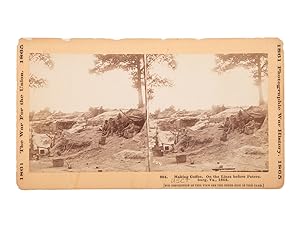
War Photograph & Exposition Company. On the Lines Before Petersburg, Va., 1864, documents the presence and daily conditions of United States Colored Troops during the prolonged siege of Petersburg, one of the final campaigns of the Civil War. The image captures four African American soldiers seated at the entrance of an earthen bombproof shelter while another prepares coffee over an open fire, situating the scene within the entrenched warfare that defined operations outside Petersburg from 1864 to 1865. The photograph places Black soldiers within the logistical and survival routines of siege warfare, providing visual evidence of their role in sustaining Union military operations during a campaign that culminated in the collapse of Confederate defenses and the end of the war. On the Lines Before Petersburg, Va., 1864. Hartford, CT: War Photograph & Exposition Co., circa 1864. Stereoview photograph measuring approximately 6 1/4 x 3 1/8 inches on a cardstock mount, with series imprint, image number, and caption on recto. The image depicts four African American soldiers seated at the mouth of a dugout shelter, with a fifth soldier below tending a large kettle over a fire. Visible objects include tin cups attached to long wooden handles, likely used for heating over flames, along with a pickaxe, wooden barrel, and a washbucket fashioned from a halved barrel. The verso includes a printed description noting that the view "gives a glimpse of the bomb-proofs in which our soldiers tried to live, during the long siege at Petersburg, 1864-1865; the campfire and the coffee-kettle look as familiar as in those days of yore," along with promotional text from the publisher concerning the difficulty of producing such wartime images. By late 1864, African American troops were consolidated into large formations including the XXV Corps of the Army of the James, representing the largest organized body of Black soldiers in the war. Images such as this one provide direct documentation of their presence in front-line siege environments, where extended encampment, engineering labor, and constant exposure to enemy fire defined daily life. The photograph contributes to the visual record of Black military service by focusing on routine activity within fortified positions rather than formal portraiture, offering material for the study of labor, survival, and military organization among United States Colored Troops. Light toning and minor paper loss to mount edges and corners not affecting image or text; overall very good condition.