

Importo totale (1 articolo articoli):
Destinazione ordine:

wolska wanda (5 risultati)
Vai alla pagina principale dei risultati di ricerca
Filtri di ricerca
Tipo di articolo
- Tutti i tipi di prodotto
- Libri (5)
- Riviste e Giornali (Nessun altro risultato corrispondente a questo perfezionamento)
- Fumetti (Nessun altro risultato corrispondente a questo perfezionamento)
- Spartiti (Nessun altro risultato corrispondente a questo perfezionamento)
- Arte, Stampe e Poster (Nessun altro risultato corrispondente a questo perfezionamento)
- Fotografie (Nessun altro risultato corrispondente a questo perfezionamento)
- Mappe (Nessun altro risultato corrispondente a questo perfezionamento)
- Manoscritti e Collezionismo cartaceo (Nessun altro risultato corrispondente a questo perfezionamento)
Condizioni Maggiori informazioni
- Nuovo (Nessun altro risultato corrispondente a questo perfezionamento)
- Come nuovo, Ottimo o Quasi ottimo (1)
- Molto buono o Buono (Nessun altro risultato corrispondente a questo perfezionamento)
- Discreto o Mediocre (Nessun altro risultato corrispondente a questo perfezionamento)
- Come descritto (4)
Legatura
- Tutte
- Rilegato (Nessun altro risultato corrispondente a questo perfezionamento)
- Brossura (3)
Ulteriori caratteristiche
- Prima ed. (1)
- Copia autograf. (Nessun altro risultato corrispondente a questo perfezionamento)
- Sovracoperta (Nessun altro risultato corrispondente a questo perfezionamento)
- Con foto (3)
- Non Print on Demand (5)
Lingua (3)
Spedizione gratuita
- Spedizione gratuita in U.S.A. (Nessun altro risultato corrispondente a questo perfezionamento)
Paese del venditore
Valutazione venditore
-

La Topographie chrétienne de Cosmas Indicopleustès: théologie et science au VIe siècle.
Editore: Paris, PUF 1962.; xv, 329pp; 15 pls, 23 text maps & figs., 1962
Da: Bennett and Kerr Books, ABINGDON, Regno Unito
Membro dell'associazione: ABA ILAB
Valutazione del venditore 5 su 5 stelle

EUR 35,79
Spedizione EUR 18,53
Spedito da Regno Unito a U.S.A.Quantità: 1 disponibili
Aggiungi al carrelloPaperback. Dec wrappers, browned & sl rubbed. Bibl Byzantine Études 3. COSMAS INDICOPLEUSTÈS.
-
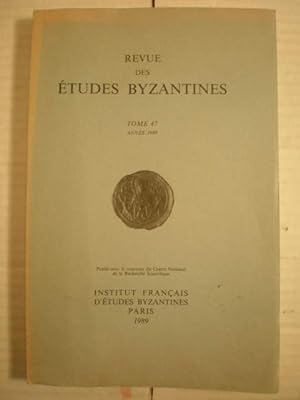
Revue des Etudes Byzantines Tome 47 - Année 1989
Lingua: Spagnolo
Editore: Institut Français d'Etudes Byzantines, París, 1989
Da: Librería Antonio Azorín, San Lorenzo de El Escorial, M, Spagna
Valutazione del venditore 5 su 5 stelle
EUR 20,00
Spedizione EUR 57,00
Spedito da Spagna a U.S.A.Quantità: 1 disponibili
Aggiungi al carrelloEncuadernación de tapa blanda. Condizione: Muy bien. Idioma francés. Ejemplar intonso. Sommaire: Stéphanos d'Athenes et Stéphanos dÁlexandrie. Essai d'identification et de biographie ( Wanda Wolska Conus) - La tradition manuscrite de l'Histoire de Georges Pachymeres ( Livres VII-XIII) ( A. Failler) - The Megala Allagia and the Tzaousios: Aspects of Provincial Military Organization in Late Byzantium ( M. C. Bartusis) - Remarques sur des creations déveches byzantins ( J. Darrouzes) - Le texte de l'Histoire de Nicephore Bryennios a la lumiere dún nouveau fragment ( A. Failler) - The Iconography of the Prophet Habakkuk ( Ch. Walter).
-
LA TOPOGRAPHIE CHRETIENNE
Da: Librairie Laurencier, Bordeaux, AQUIT, Francia
Valutazione del venditore 4 su 5 stelle

EUR 32,00
Spedizione EUR 10,00
Spedito da Francia a U.S.A.Quantità: 1 disponibili
Aggiungi al carrelloPuf.1962.In-8 br.Couv.ill.XV planches.325 p.Etat correct.
-
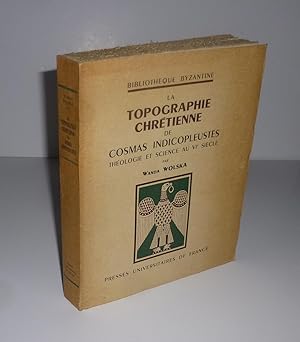
La Topographie chrétienne de Cosmas Indicopleustès, théologie et science au VI° siècle par Wanda Wolska. Paris. PUF, 1962.
Da: Mesnard - Comptoir du Livre Ancien, Ruelle-sur-Touvre, Francia
Valutazione del venditore 4 su 5 stelle
EUR 40,00
Spedizione EUR 30,00
Spedito da Francia a U.S.A.Quantità: 1 disponibili
Aggiungi al carrello1 volume in-8° broché, couverture illustrée, XV + 329 p. - XV planches et figures. Couverture un peu roussie sinon très bon état.
-

Topographie Chrétienne (Chretienne) (complete in 3 volumes). Introduction, texte critique, illustration, traduction et notes par Wanda Wolska-Conus. Tome I (Livres I-IV); Tome II (Livre V); Tome III (Livres VI-XII. Index).
Lingua: Francese
Editore: Paris: Éditions du Cerf 1968, 1970, 1973., 1968
Da: Wissenschaftliches Antiquariat Zorn, Marburg, Germania
Membro dell'associazione: ILAB VDA
Valutazione del venditore 5 su 5 stelle
Prima edizione
EUR 961,00
Spedizione EUR 58,00
Spedito da Germania a U.S.A.Quantità: 1 disponibili
Aggiungi al carrelloPrivate Leinenbände. 569; 373; 486 Seiten mit zahlreichen s/w Abbildungen. Gutes Exemplar mit nur leichten Gebrauchsspuren. Textsauber und aus einem Nichtraucherhaushalt. Sprache: Französisch und Altgriechisch. Dieses Exemplar stammt aus der Bibliothek von Walter W. Müller, Professor für Semitistik an der Philipps-Universität Marburg. Kosmas Indikopleustes war ein spätantiker Schriftsteller und Reisender aus Alexandria und Zeitgenosse Kaiser Justinians. Der wirkliche Name des Autors ist unbekannt; etwa seit dem 9. Jahrhundert nannte man ihn Kosmas Indikopleustes. Der Autor war ein nestorianischer Christ und bereiste als Kaufmann das Schwarze Meer, Arabien und Ostafrika; ob er auch bis nach Sri Lanka und Südindien gelangte, ist in der Forschung umstritten. Um 550 schrieb er im hohen Alter seine Christliche Weltbeschreibung in zwölf Büchern, deren Zweck die Widerlegung der ptolemäischen Auffassung von der Erde als Kugel war. Er bezog wohl auch gegen den christlichen Aristoteliker Johannes Philoponos Stellung. Kosmas entwickelte seine Weltvorstellung aus dem Alten Testament, insbesondere aus Schöpfungserzählung und in Anlehnung an die Stiftshütte. Er stellte sich die Erde als längliche viereckige Fläche vor, über der sich das Universum als zweigeschossiges Gewölbe mit dem oberen Himmel als Dach erhob. In der Mitte erhebt sich der Berg des Nordens, der von der Sonne umkreist wird und dessen Schatten die Nacht verursacht. Südlich davon befindet sich die bekannte Welt, östlich, jenseits des großen Ozeans, das Paradies. Die Engel bewegen die Gestirne und stoßen sie täglich hinter den Berg, wo sie den Blicken der Menschen verborgen sind. Der Wert seines Werks besteht in seinen geographischen, naturwissenschaftlichen und kulturgeschichtlichen Exkursen, in denen der Reisende Kosmas seine Beobachtungen und die Erfahrungen anderer niederlegt. Es beeinflusste einige andere byzantinische Werke und ist außerdem der Versuch, natürliche Ereignisse aus einer vollständig christlichen Sicht zu interpretieren (Wikipedia). // Private hardcovers. Clean books in good condition. Books from a non smoking environment. Language: French and ancient Greek. This copy comes from the library of Walter W. Müller, Professor of Semitic Studies at the Philipps University of Marburg. Cosmas Indicopleustes was a late antique writer and traveler from Alexandria and a contemporary of Emperor Justinian. The author's real name is unknown; from around the 9th century onwards he was called Cosmas Indicopleustes. The author was a Nestorian Christian and travelled as a merchant to the Black Sea, Arabia, and East Africa; whether he also reached Sri Lanka and South India is disputed among scholars. Around 550, in his old age, he wrote his Christian Description of the Universe in twelve books, the purpose of which was to refute the Ptolemaic view of the Earth as a sphere. He probably also took a stand against the Christian Aristotelian John Philoponus. Cosmas developed his worldview from the Old Testament, particularly from the creation narrative and based on the tabernacle. He imagined the Earth as an elongated, rectangular surface above which the universe rose as a two-story vault with the upper heaven as its roof. In the center rises the mountain of the North, orbited by the sun, whose shadow causes night. To the south lies the known world; to the east, beyond the great ocean, lies Paradise. Angels move the stars and daily push them behind the mountain, where they are hidden from human view. The value of his work lies in its geographical, scientific, and cultural-historical excursions, in which the traveler Cosmas records his observations and the experiences of others. It influenced several other Byzantine works and is also an attempt to interpret natural events from a fully Christian perspective (Wikipedia). Sprache: Französisch.


