
After william hodges (4 risultati)
Editore: London : Strahan, 1777
- Prima edizione
- Stampa artistica
Da: Joseph Burridge Books, Dagenham, Regno UnitoJoseph Burridge Books
Contatta il venditoreVenditore con 5 stelleCondizione: Usato - Molto buono
EUR 60,12
EUR 26,85 spedizioneSpedito da Regno Unito a U.S.A.Quantità: 1 disponibili
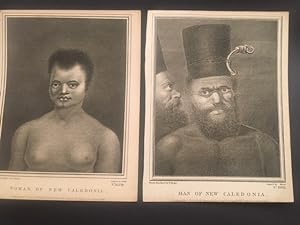
No Binding. Condizione: Very Good. 1st Edition. Man of New Caledonia, Woman of New Caledonia. Two engravings 27 x 21cm, cropped close. After William Hodges, official artist on Captain to Cook's Second Voyage, London published by Strahan 1777.
 Altre immagini
Editore: Hogg, Alexander, London, 1772
Da: Rob Zanger Rare Books LLC, Middletown, NY, U.S.A.Rob Zanger Rare Books LLC
Contatta il venditoreVenditore con 5 stelleCondizione: Usato
EUR 450,19
EUR 17,48 spedizioneSpedito in U.S.A.Quantità: 1 disponibili
Engraving on cream laid paper, 9 1/4 x 15 (235 x 382 mm), evenly trimmed margins, thread to wide. In good condition with uniform toning, and scattered edge wear with a few minor nicks. A rich, well-inked impression. From George William Anderson's work, A New, Authentic, and Complete Account of Voyages Round the World, published…c1784. The location is Resolution Bay (now known as Vaitahu Bay) on the island of Tahuata (historically called Santa Cristina) in the Marquesas Islands. The bay was named after Captain James Cook's ship, the HMS Resolution, which you can see anchored in the distance. In the foreground are traditional Marquesan outrigger canoes with their distinct triangular sails and carved prows. Hodge's composition captures the first European contact with the Marquesas since the Spanish visited almost 200 years prior. Cook arrived there in April 1774 to take on fresh water and food, but stayed only four days. Doomed from the start, The Resolution was almost driven into the rocks during a violent squall as they tried to anchor. Finding that the Marquesans were shrewd traders who knew the value of their food and fresh water, peaceful trading quickly spiraled into tense negotiations that ended in bloodshed. An officer on The Resolution shot and killed a Marquesan man who was accused of stealing a piece of deck hardware, and the incident cast a shadow over Cook's remaining time there. Having loaded the ship with enough water and livestock to continue on, Cook set sail for Tahiti. Five years later Cook was murdered as he attempted to kidnap Kalani??pu?u, the ruling chief (ali?i nui) on the island of Hawaii. Ironically, Cook was stabbed with an iron dagger that the British had traded to the Hawaiians.

Editore: London, 1777
Da: Antipodean Books, Maps & Prints, ABAA, Garrison, NY, U.S.A.Antipodean Books, Maps & Prints, ABAA
Contatta il venditoreVenditore con 4 stelleCondizione: Usato - Molto buono
EUR 742,82
EUR 8,74 spedizioneSpedito in U.S.A.Quantità: 1 disponibili
Condizione: Very good condition. Portrait of Captain Cook as a young man. Engraved by J. Basire 1777. Copper engraving, 8 1/2 x 11 1/4" plus margins, wove paper. Frontispiece to Cook's 2nd Voyage around the World. With the full old border; at some point in the distant past an extra border almost one half inch around has been add…ed. There are no details at the bottom where the publishing details should be. In lovely condition, very nice overall.
Da: Antiquariaat Arine van der Steur / ILAB, Den Haag, Paesi BassiAntiquariaat Arine van der Steur / ILAB
Contatta il venditoreVenditore con 4 stelleCondizione: Usato
EUR 66,55
EUR 30,00 spedizioneSpedito da Paesi Bassi a U.S.A.Quantità: 1 disponibili
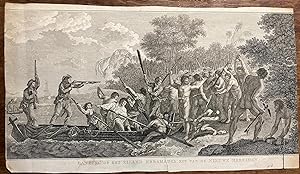
Original engraving on laid paper, 235 x 410 mm. With tears in the plate and narrow margins left and right.Captain James Cook (1728-1779) made three separate voyages to the Pacific (with the ships Endeavour, Resolution, Adventure, and Discovery) and did more than any other voyager to explore the Pacific and Southern Ocean. Cook n…ot only encountered Pacific cultures for the first time, but also assembled the first large-scale collections of Pacific objects to be brought back to Europe. He was killed in Hawaii in 1779.William Hodges (1744 - 1797) joined Cook's second expedition to the South Pacific as a draughtsman 1772-75 and was employed by the Admiralty in finishing his drawings.Cook reached Eromanga on August 4, 1774. As recorded in Hawkesworth's account: "Here Cook met the most unpleasant encounter he had experienced with islanders on the voyage. Hodges made no known portraits of the people of the island, and conditions were such that none were possible; but later, with Cipriani's assistance, he prepared a painting of the encounter for the engraver. The actual arrangement entered into between the two artists is not known, but it was very much in the order of things. Both Hodges and Cipriani are known to have worked in this way with other artists. Cipriani's drawing predictably presents the Melanesians in classical poses but also depicts the tight girdle that the men wore, reported by Cook and others. But it is an ill-coordinated drawing and depicts only a part of the action. Hodges, presumably, was responsible for the figure of Cook (in the action of firing at the 'treacherous' chieftain) and of Cook's companion."This engraving was severly criticized by Georges Forster. Hodges had invented it and it was, he inferred, misleading. William Wales leapt to the artist's defence. He had discussed the criticism with him, and his defence throws an interesting light on Hodges's practice. The artist had copied the account of the affray at Eromanga from Cook's own journal a few days after Cook had written it in order to compose an illustration of the affair. This indicates that both Cook and Hodges had the illustration of significant events of the voyage for the official published account well in mind long before the Resolution returned to England. Since it was not possible at Eromanga to make drawings of the inhabitants, 'the manners and person of the natives were copied chiefly from those at Tanna, as they were exactly alike'. The engraving was not intended, Wales added, ' to identify particular persons, or to give the exact positions of employment of everyone who were present; but it appears very possible, that he might draw a general representation of the action from a description given to him by any person of veracity, equally as well as if he had been on the spot and seen it with his own eyes.' (From: www.rmg.co.uk)[NL] Originele gravure van de landing op eiland Erramanga door Kapitein Cook (Afgebeeld met geweer in de aanslag). Naar de tekening door Hodges. Erramanga, ook wel Erromange is een eiland in Vanuatu, vallend onder provincie Tafea, Grote Oceaan. James Cook was de eerste Europeaan die op 4 augustus 1774 op Erromango landde. Het eerste contact leidde tot een schermutseling waarbij bemanningsleden van Cook gewond raakten en een paar bewoners het leven kostte.


