

Importo totale (1 articolo articoli):
Destinazione ordine:

anthonie dyck (6 risultati)
Vai alla pagina principale dei risultati di ricerca
Filtri di ricerca
Tipo di articolo
- Tutti i tipi di prodotto
- Libri (6)
- Riviste e Giornali (Nessun altro risultato corrispondente a questo perfezionamento)
- Fumetti (Nessun altro risultato corrispondente a questo perfezionamento)
- Spartiti (Nessun altro risultato corrispondente a questo perfezionamento)
- Arte, Stampe e Poster (Nessun altro risultato corrispondente a questo perfezionamento)
- Fotografie (Nessun altro risultato corrispondente a questo perfezionamento)
- Mappe (Nessun altro risultato corrispondente a questo perfezionamento)
- Manoscritti e Collezionismo cartaceo (Nessun altro risultato corrispondente a questo perfezionamento)
Condizioni Maggiori informazioni
- Nuovo (Nessun altro risultato corrispondente a questo perfezionamento)
- Come nuovo, Ottimo o Quasi ottimo (4)
- Molto buono o Buono (1)
- Discreto o Mediocre (Nessun altro risultato corrispondente a questo perfezionamento)
- Come descritto (1)
Legatura
Ulteriori caratteristiche
- Prima ed. (2)
- Copia autograf. (Nessun altro risultato corrispondente a questo perfezionamento)
- Sovracoperta (3)
- Con foto (2)
- Non Print on Demand (6)
Lingua (2)
Prezzo
- Qualsiasi prezzo
- Inferiore a EUR 20 (Nessun altro risultato corrispondente a questo perfezionamento)
- EUR 20 a EUR 45
- Superiore a EUR 45
Spedizione gratuita
Paese del venditore
Valutazione venditore
-

Van Dyck in Sicily 1624-1625 Painting and the Plague
Da: David's Books, Ypsilanti, MI, U.S.A.
Valutazione del venditore 3 su 5 stelle

Paperback. Condizione: As New. New in shrinkwrap ; 4to 11" - 13" tall.
-
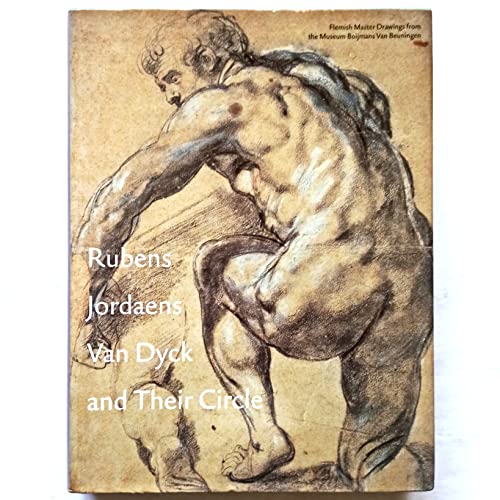
Rubens, Jordaens, Van Dyck and Their Circle: Flemish Master Drawings from the Museum Boijmans Van Beuningen
Lingua: Inglese
Editore: nai010 publishers/Museum Boijmans Van Beuningen, 2001
ISBN 10: 9056622129 ISBN 13: 9789056622121
Da: ThriftBooks-Atlanta, AUSTELL, GA, U.S.A.
Valutazione del venditore 5 su 5 stelle

Hardcover. Condizione: Very Good. No Jacket. May have limited writing in cover pages. Pages are unmarked. ~ ThriftBooks: Read More, Spend Less.
-
Rubens, Jordaens, Van Dyck and Their Circle: Flemish Master Drawings from the Museum Boijmans Van Beuningen
Lingua: Inglese
Editore: nai010 publishers/Museum Boijmans Van Beuningen, Rotterdam, 2001
ISBN 10: 9056622129 ISBN 13: 9789056622121
Prima edizione
EUR 45,92
Spedizione EUR 12,89
Spedito da Canada a U.S.A.Quantità: 1 disponibili
Aggiungi al carrelloHardcover. Condizione: Fine. Condizione sovraccoperta: Near Fine. 1st. (NETH) Presumed 1st edition. No markings, Fine in Near Fine dust jacket with minor faults to dust jacket. Cloth, [384]pp, colour and B&W reproductions of drawings. Among the extensive holdings of Old Master drawings owned by the Boijmans Van Beuningen Museum, the significant collection of drawings by the great Antwerp masters Peter Paul Rubens, Jacob Jordaens, and Anthonie van Dyck stand out as absolute highlights. This generously illustrated publication examines 70 of their important drawings, discussing not only the significance of these works, but also their provenance, attribution, and dating. It also helps to put the work in context by considering the work of a variety of contemporaries on the 17th-century Flemish scene, many of whom were influenced directly by the work of these masters, as well as by including essays on a variety of topics of art and culture in Antwerp. A heavy book. (6.1 JM LVR 206/0 Size: Folio - over 12" - 15" tall.
-
Rubens, Jordaens, Van Dyck and Their Circle: Flemish Master Drawings from the Museum Boijmans Van Beuningen
Lingua: Inglese
Editore: Museum Boijmans Van Beuningen : NAi Publishers, Rotterdam, 2001
ISBN 10: 9056622129 ISBN 13: 9789056622121
Da: Joseph Burridge Books, Dagenham, Regno Unito
Valutazione del venditore 5 su 5 stelle
EUR 60,55
Spedizione EUR 31,75
Spedito da Regno Unito a U.S.A.Quantità: 1 disponibili
Aggiungi al carrelloHardcover. Condizione: Fine. Condizione sovraccoperta: Fine. 381 pages : illustrations, facsimiles (some colour) ; 33 cm. Contents: Indian summer of a golden age. Antwerp after 1585 / Roland Baetens Flemish and Dutch paintings in the seventeenth century : changing views on a diptych / Hans Vlieghe On drawings and Flemish-Venetian relations in the seventeenth century / Bert Meijer Seventeenth-century Flemish painters and their prints / Ger Luijten 'Scrawls' and disegno in seventeenth-century Flemish drawing / Carl Depauw Catalogue. Peter Paul Rubens ; Jacob Jordaens ; Anthony van Dyck ; Other seventeenth-century Flemish artists Notes: "Published for the exhibition 'Rubens, Jordaens, Van Dyck and their Circle: Flemish Master Drawings from the Museum Boijmans Van Beuningen', organized by the Museum . and the American Federation of Arts"--Colophon Includes concordance (p. 380-381) A translation, probably from the Dutch.
-
![Immagine del venditore per Alle tot nu toe bekende schilderijen van Van Dyck. [Werkverzeichnis / catalogue raisonne] venduto da Antiquariat Lenzen](https://pictures.abebooks.com/inventory/md/md32108516253.jpg)
Alle tot nu toe bekende schilderijen van Van Dyck. [Werkverzeichnis / catalogue raisonne]
Editore: Rotterdam, Lekturama, 1979
Da: Antiquariat Lenzen, Düsseldorf, Germania
Membro dell'associazione: GIAQ ILAB VDA
Valutazione del venditore 5 su 5 stelle
Prima edizione
EUR 28,00
Spedizione EUR 45,00
Spedito da Germania a U.S.A.Quantità: 1 disponibili
Aggiungi al carrelloCondizione: Sehr gut. 4°. 31 x 24 cm. 192 Seiten. Gebundener Original-Pappband mit Original-Schutzumschlag. (Meesters der Schilderkunst). 1. Auflage. Niederländischsprachige Ausgabe. Mit zahlreichen Abbildungen. Schutzumschlag minimal berieben. Vorsätze wenig gebräunt. Gutes bis sehr gutes Exemplar. First edition. Dutch edition. With many illustrations. Original hardcover with dust jacket. Dust jacket slightly rubbed. Endpapers slightly darkened. Nearly fine copy.
-
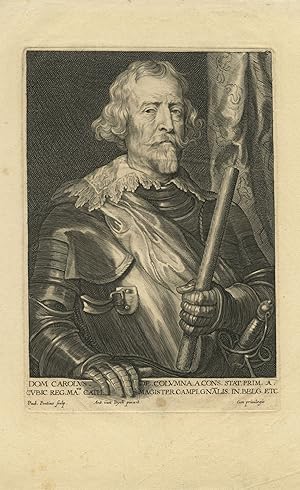
Portrait of Carlos de Columna, Marques de la Espinar
Data di pubblicazione: 1650
Da: Rob Zanger Rare Books LLC, Middletown, NY, U.S.A.
Valutazione del venditore 5 su 5 stelle
Engraving on cream laid paper, 9 1/4 x 6 3/8 inches (234 x 161 mm), full margins. Water stain throughout bottom, diagonal creases in the area of the bottom right corner, paper tape along top edge on recto. A very well inked impression. Flemish painter and engraver Paulus Pontius was born in Antwerp in 1603, and it was in this city that his full life would unfold. At the young age of 13, he was apprenticed to the still life painter Osias Beert, and subsequently to Lucas Vosterman, who was heavily associated with the workshop of Peter Paul Rubens. Vosterman trained Pontius in the skill of engraving, which he took to immediately, finding he had great skill at recreating paintings. Pontius was able to capture the minutiae of light and shadow found on the canvas, and mastered the ability to accurately render the subtleties of brushwork in this alternate media. His success as an engraver cemented his role in the workshop of Rubens, and in 1624, when Vosterman found himself at odds with Rubens, and left Antwerp for England, Pontius assumed his role as foremost engraver in the workshop. It was in this year that Pontius took up lodgings in Rubens's home, and continued to live there until 1631, when courtship and marriage (the first of three) brought him away. After the death of Rubens in 1640, Pontius embarked on a very successful career engraving reproductions of master works by artists including Rubens, Anthony van Dyck, Jacob Jordaens, Pieter van Avont, Abraham van Diepenbeeck, Anselm van Hulle, Frans Luycx, Titian and Velázquez, among others. At the time of his death in 1658, Pontius had been admitted as a Master in the Antwerp Guild of Saint Luke, had engraved 42 plates after Rubens, 32 plates by Van Dyck (including a portrait of himself), and was father to seven children. Many of his portrait engravings were widely published during his lifetime, including in van Dyck's Iconography (Antwerp, c. 1632-44), Johannes Meyssens' Images de divers hommes, and Anselm van Hulle's Icones legatorum (Antwerp, 1648).

