Importo totale (1 articolo articoli):
Destinazione ordine:

bowden b v (12 risultati)
Vai alla pagina principale dei risultati di ricerca
Filtri di ricerca
Tipo di articolo
- Tutti i tipi di prodotto
- Libri (12)
- Riviste e Giornali (Nessun altro risultato corrispondente a questo perfezionamento)
- Fumetti (Nessun altro risultato corrispondente a questo perfezionamento)
- Spartiti (Nessun altro risultato corrispondente a questo perfezionamento)
- Arte, Stampe e Poster (Nessun altro risultato corrispondente a questo perfezionamento)
- Fotografie (Nessun altro risultato corrispondente a questo perfezionamento)
- Mappe (Nessun altro risultato corrispondente a questo perfezionamento)
- Manoscritti e Collezionismo cartaceo (Nessun altro risultato corrispondente a questo perfezionamento)
Condizioni Maggiori informazioni
- Nuovo (1)
- Come nuovo, Ottimo o Quasi ottimo (1)
- Molto buono o Buono (5)
- Discreto o Mediocre (Nessun altro risultato corrispondente a questo perfezionamento)
- Come descritto (5)
Legatura
Ulteriori caratteristiche
- Prima ed. (3)
- Copia autograf. (Nessun altro risultato corrispondente a questo perfezionamento)
- Sovracoperta (3)
- Con foto (9)
- Non Print on Demand (11)
Lingua (2)
Spedizione gratuita
Paese del venditore
Valutazione venditore
-
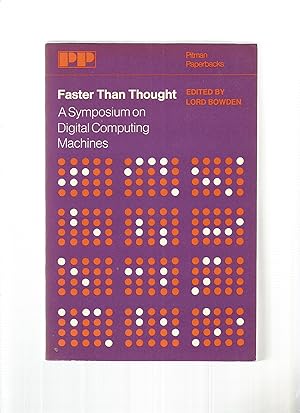
FASTER THAN THOUGHT A Symposium on Digital Computing Machines
Da: Amnesty Bookshop, Malvern, Great Malvern, Regno Unito
Valutazione del venditore 4 su 5 stelle

EUR 27,18
Spedizione EUR 26,09
Spedito da Regno Unito a U.S.A.Quantità: 1 disponibili
Aggiungi al carrelloSoft cover. Condizione: Very Good. First paperback edition of this important book, first published in 1953. 24 experts present an account of digital computing machines, their history, theory and design and their application to industry, commerce and scientific research. Illustrated b/w. Small PO label else clean and sound with no markings or inscription. 15 x 23cms with 416pp. We regret we are no longer able to ship to Denmark. All profits to Amnesty International.
-

IRASCIBLE GENIUS. A LIFE OF CHARLES BABBAGE, INVENTOR
Editore: Hutchinson, London, 1964
Da: Douglas Books, Tunbridge Wells, Regno Unito
Valutazione del venditore 4 su 5 stelle
Prima edizione
EUR 12,08
Spedizione EUR 25,80
Spedito da Regno Unito a U.S.A.Quantità: 1 disponibili
Aggiungi al carrelloBlack Cloth. Condizione: Good-VG. Condizione sovraccoperta: Fair/good. 1st ed. 288 pp., 10 ills on 4 double-sided pp.ex-pagination; two old red & blue biro scribbles top front endpaper, slight odd creasing towards top front gutter on pastedown, covers clean and unworn but surface slightly, but extensively, rubbed appearing greyish; unclipped jacket fairly clean but traingular chunk missing from bottom back and extensive edge-rubbing/chipping/nicking. Handy working/reference copy only. Note: quoted non-UK shipping rates are calculated for 500-700 gram net weight, cost will be modified up or down as appropriate outside this range. Size: 14 Cms x 22 Cms.
-
Universities Quarterly
Lingua: Inglese
Editore: University of London. Athlone Press, London, 1959
Da: The Sanctuary Bookshop., Lyme Regis, Regno Unito
Valutazione del venditore 4 su 5 stelle
EUR 28,99
Spedizione EUR 39,87
Spedito da Regno Unito a U.S.A.Quantità: 1 disponibili
Aggiungi al carrelloSoft cover. Condizione: Very Good. 104 page all original 14 x 22 cm issue for Nov 1959 to January 1960. Vol. 14. No 1. Nine articles, including "What Is Mathematics" by Herbert D. Deas. Images 1 & 2.
-

Faster Than Thought - A Symposium on Digital Computing Machines
Editore: Pitman, 1971
Da: Crappy Old Books, Barry, Regno Unito
Valutazione del venditore 5 su 5 stelle

EUR 52,55
Spedizione EUR 23,51
Spedito da Regno Unito a U.S.A.Quantità: 1 disponibili
Aggiungi al carrelloHardback. Condizione: Good. Faster Than Thought: A Symposium on Digital Computing Machines (1971) edited by B.V. Bowden Pitman ISBN: none (because in 1971 the future didn?t need barcodes) Condition: Good As sold by Crappy Old Books This is the moment the modern world cleared its throat and said, politely but firmly: computers are happening. And not as a hobby, not as a curiosity, but as a serious, world-rearranging idea delivered in the most mid-century way possible ? a symposium , published by Pitman, with the calm confidence of people who have seen the inside of a valve cabinet and are not afraid. Faster Than Thought is a title with swagger. It doesn?t merely suggest speed; it implies that human thinking is now the slow option, like choosing to walk to Glasgow because you enjoy the scenery. In 1955, ?digital computing machines? were still large, warm, expensive, and slightly alarming ? the sort of devices that required rooms, teams, and a respectful attitude. This book captures that era perfectly: when computation was not ?an app,? it was machinery . It?s a collection of essays and contributions from the people who were building the foundations ? engineers, mathematicians, pioneers explaining what these machines were, how they worked, and what they might become. Reading it now is like listening to the early architects of the internet describe a ?new kind of post.? They?re precise, practical, and occasionally seized by flashes of prophecy. And the irony is delicious. The authors are describing machines that, by modern standards, are hilariously underpowered ? yet the conceptual leap they?re making is immense. You can feel the excitement of discovering that information itself can be mechanised: stored, processed, transformed, trusted (or at least tested). The modern world begins in moments like this: when a group of serious people realise they?ve made something that changes the rules. There?s also a particular charm to the language of the time. No ?AI.? No ?cloud.? No ?user journey.? Instead: circuits, storage, programming, numerical control, logical design ? all delivered with the crisp assurance of an era that believed progress could be explained properly if you just drew enough diagrams. As a physical book, it?s wonderfully of its period: solid, purposeful, and designed for the desk of someone who might be consulted about national projects. In Good condition, this copy is clean and usable, with the kind of wear that says it has been handled by curious minds rather than locked away as a museum piece. Perfect for: collectors of early computing history, engineers and programmers who like origin stories with valves and ambition, anyone fascinated by how ?digital? became normal, or readers who enjoy books that feel like the future arriving in measured, formal paragraphs. Buy it because it?s a genuine landmark ? a snapshot of digital computing at the point where it stopped being a wartime experiment and started becoming civilisation?s new nervous system. Buy it because the title still hits: we live in a world built by machines that really are faster than thought ? and this is one of the books where people first sat down and tried to explain what they?d unleashed. In short: a serious, thrilling, slightly uncanny time capsule from the dawn of the computer age ? when the future was big, loud, and full of promise.
-
Faster Than Thought: A Symposium on Digital Computing Machines
Editore: Pitman Publishing Corporation, 1967
Da: Friends of Poughkeepsie Library, Poughkeepsie, NY, U.S.A.
Valutazione del venditore 5 su 5 stelle
Hardcover. Condizione: Good. Reprinted 1967. In certain light conditions, texture variation and color discoloration to boards. Small white flecks to rear board. Creasing to spine head. Edgewear and soft creasing to spine tips. Previous owner's signature to front pastedown. Owner's initial to fore edge text block. Internally very good. Shelf 1a.
-

Faster than Thought: A Symposium on Digital Computing Machines
Editore: Pitman Publishing Corporation, New York, 1968
Da: Twice Sold Tales, Capitol Hill, Seattle, WA, U.S.A.
Valutazione del venditore 5 su 5 stelle
Hardcover, 416 pages. Condizione: Very good+. Condizione sovraccoperta: Very good. 1968 reprint. Light wear to dust jacket, slight rubbing to corners. 1cm closed tear to front panel adjacent to top of spine panel. Minor soiling to rear panel and minor age toning to spine panel. Flap price unclipped. Very slight rubbing to extremities of blue cloth boards, small ding to head of spine. Minor soiling to text block edges, interior clean. A well-preserved copy.
-
Faster than Thought: A Symposium of Digital Computing Machines
Editore: Sir Isaac Pitman and Sons Ltd, Portsmouth, NH, 1968
Da: Minotavros Books, ABAC ILAB, Whitby, ON, Canada
Membro dell'associazione: ABAC ILAB
Valutazione del venditore 5 su 5 stelle
EUR 79,93
Spedizione EUR 14,49
Spedito da Canada a U.S.A.Quantità: 1 disponibili
Aggiungi al carrelloHardcover. Condizione: Near Fine. Condizione sovraccoperta: Near Fine. 8vo (large). 8th Printing. Blue cloth, xix, 416pp.Bookplate on FFeP. Frontispiece of Ada Lovelace, with 15 plates, [including 1 folding]. Light bruise and fading on spine, else near fine in a near fine, clipped d/w that is somewhat soiled with some superficial tears at extremities of jacket. Several essays on the History of Computing and Computing Machines, Digital Computing Machines in Britain and America, and Applications of Digital Computing Machines.
-
Faster Than Thought A Symposium on Digital Computing Machines
Editore: Sir Isaac Pitman & Sons, LTD., London, 1953
EUR 137,54
Spedizione EUR 12,95
Spedito da Israele a U.S.A.Quantità: 1 disponibili
Aggiungi al carrelloHardcover. Condizione: Good to Very Good. Fair-Good covers, Interiors Good-Very Good clean and tight, faint blue stamp on fly leaf, sporadic penned notes in the beginning of the book.
-

Transvaal Philately., The stamps, forgeries, postal history and miscellanea of the Transvaal Territories from inception to Union.
Editore: Reijger Publishers, 1986, 1986
Da: Pennymead Books PBFA, Knaresborough, Regno Unito
Membro dell'associazione: PBFA
Valutazione del venditore 5 su 5 stelle
EUR 67,04
Spedizione EUR 17,59
Spedito da Regno Unito a U.S.A.Quantità: 1 disponibili
Aggiungi al carrello291 large pp. 1st ed., fine in pictorial cloth. 8.5 x 11.5".
-
Faster Than Thought. A Symposium on Digital Computing Machines.
Editore: London: Sir Isaac Pitman & Sons, Ltd, 1953, 1953
Da: Peter Harrington. ABA/ ILAB., London, Regno Unito
Membro dell'associazione: ABA ILAB PBFA
Valutazione del venditore 5 su 5 stelle
Prima edizione
EUR 1.509,88
Spedizione EUR 25,80
Spedito da Regno Unito a U.S.A.Quantità: 1 disponibili
Aggiungi al carrelloFirst edition, in the dust jacket, of "the most widely read early English introduction to electronic computing" (Origins of Cyberspace), a collection of 24 essays by leading experts in the field, including a chapter on computer chess that was one of Alan Turing's final published pieces. From 1950 to 1953 Bertram Vivian Bowden (1910-1989) worked for the Ferranti corporation, a computer company that specialised in machines for defence and electrical systems and which introduced the first commercially available computer, the Ferranti Mark I, in 1951. Bowden "was particularly effective in explaining, with uncanny prescience, the dramatic effect that the digital computer was destined to have" (ODNB). In the preface he describes some of the tasks, such as engineering calculations, that computers will soon take over from humans, and writes, "It seems probable that we shall have a second Industrial Revolution on our hands before long In the next revolution machines may replace mens' brains and relieve them of much of the drudgery and boredom which is now the lot of so many white collar workers". Origins of Cyberspace 504. Octavo. Photographic frontispiece of Ada Lovelace, 13 plates, 2 folding tables, diagrams within text. Original cream cloth, spine and front cover lettered in gilt. With dust jacket. Ownership initials on front free endpaper. Spine lightly sunned, handful of marks to cloth and edges, contents clean; jacket price-clipped, spine toned and soiled, rear flap fold rubbed, a few chips and closed tears to edges, scuff to front panel: a very good copy in like jacket.
-
Faster Than Thought: A Symposium on Digital Computing Machines
Editore: UK Pitman 1953, 1953
Da: John Atkinson Books ABA ILAB PBFA, Harrogate, Regno Unito
Membro dell'associazione: ABA ILAB PBFA
Valutazione del venditore 5 su 5 stelle
Prima edizione
EUR 724,74
Spedizione EUR 25,80
Spedito da Regno Unito a U.S.A.Quantità: 1 disponibili
Aggiungi al carrelloA first edition, first printing published by Pitman in 1953. A very good copy in original cloth - without inscriptions. The book is famous due to the inclusion of Alan Turing's 'Digital Computers Applied to Games' (pp. 286-310) - Hook and Norman 'Origins of Cyberspace', 504.
-
![Immagine del venditore per Faster Than Thought 1953 [LeatherBound] venduto da True World of Books](https://pictures.abebooks.com/inventory/md/md31618322115.jpg)
Faster Than Thought 1953 [LeatherBound]
Data di pubblicazione: 2025
EUR 35,28
Spedizione gratuita
Spedito da India a U.S.A.Quantità: 18 disponibili
Aggiungi al carrelloLeatherBound. Condizione: New. BOOKS ARE EXEMPT FROM IMPORT DUTIES AND TARIFFS; NO EXTRA CHARGES APPLY. LeatherBound edition. Condition: New. Reprinted from 1953 edition. Leather Binding on Spine and Corners with Golden leaf printing on spine. Bound in genuine leather with Satin ribbon page markers and Spine with raised gilt bands. A perfect gift for your loved ones. Pages: 478 NO changes have been made to the original text. This is NOT a retyped or an ocr'd reprint. Illustrations, Index, if any, are included in black and white. Each page is checked manually before printing. As this print on demand book is reprinted from a very old book, there could be some missing or flawed pages, but we always try to make the book as complete as possible. Fold-outs, if any, are not part of the book. If the original book was published in multiple volumes then this reprint is of only one volume, not the whole set. Sewing binding for longer life, where the book block is actually sewn (smythe sewn/section sewn) with thread before binding which results in a more durable type of binding. Pages: 478.