

Importo totale (1 articolo articoli):
Destinazione ordine:

cancelliere antonio (25 risultati)
Vai alla pagina principale dei risultati di ricerca
Filtri di ricerca
Tipo di articolo
- Tutti i tipi di prodotto
- Libri (25)
- Riviste e Giornali (Nessun altro risultato corrispondente a questo perfezionamento)
- Fumetti (Nessun altro risultato corrispondente a questo perfezionamento)
- Spartiti (Nessun altro risultato corrispondente a questo perfezionamento)
- Arte, Stampe e Poster (Nessun altro risultato corrispondente a questo perfezionamento)
- Fotografie (Nessun altro risultato corrispondente a questo perfezionamento)
- Mappe (Nessun altro risultato corrispondente a questo perfezionamento)
- Manoscritti e Collezionismo cartaceo (Nessun altro risultato corrispondente a questo perfezionamento)
Condizioni Maggiori informazioni
- Nuovo (20)
- Come nuovo, Ottimo o Quasi ottimo (3)
- Molto buono o Buono (Nessun altro risultato corrispondente a questo perfezionamento)
- Discreto o Mediocre (Nessun altro risultato corrispondente a questo perfezionamento)
- Come descritto (2)
Legatura
Ulteriori caratteristiche
- Prima ed. (Nessun altro risultato corrispondente a questo perfezionamento)
- Copia autograf. (Nessun altro risultato corrispondente a questo perfezionamento)
- Sovracoperta (Nessun altro risultato corrispondente a questo perfezionamento)
- Con foto (11)
- Non Print on Demand (14)
Lingua (2)
Prezzo
- Qualsiasi prezzo
- Inferiore a EUR 20 (Nessun altro risultato corrispondente a questo perfezionamento)
- EUR 20 a EUR 45 (Nessun altro risultato corrispondente a questo perfezionamento)
- Superiore a EUR 45
Spedizione gratuita
- Spedizione gratuita in U.S.A. (Nessun altro risultato corrispondente a questo perfezionamento)
Paese del venditore
Valutazione venditore
-

Coping With Drought Risk in Agriculture and Water Supply Systems : Drought Management and Policy Development in the Mediterranean
Da: GreatBookPrices, Columbia, MD, U.S.A.
Valutazione del venditore 5 su 5 stelle

Condizione: As New. Unread book in perfect condition.
-

Coping With Drought Risk in Agriculture and Water Supply Systems : Drought Management and Policy Development in the Mediterranean
Da: GreatBookPrices, Columbia, MD, U.S.A.
Valutazione del venditore 5 su 5 stelle
Condizione: As New. Unread book in perfect condition.
-
Coping with Drought Risk in Agriculture and Water Supply Systems: Drought Management and Policy Development in the Mediterranean (Advances in Natural and Technological Hazards Research, 26)
Da: Ria Christie Collections, Uxbridge, Regno Unito
Valutazione del venditore 5 su 5 stelle
EUR 116,81
Spedizione EUR 14,02
Spedito da Regno Unito a U.S.A.Quantità: Più di 20 disponibili
Aggiungi al carrelloCondizione: New. In.
-
Coping with Drought Risk in Agriculture and Water Supply Systems: Drought Management and Policy Development in the Mediterranean (Advances in Natural and Technological Hazards Research)
Da: Ria Christie Collections, Uxbridge, Regno Unito
Valutazione del venditore 5 su 5 stelle
EUR 116,81
Spedizione EUR 14,02
Spedito da Regno Unito a U.S.A.Quantità: Più di 20 disponibili
Aggiungi al carrelloCondizione: New. In.
-
Coping With Drought Risk in Agriculture and Water Supply Systems : Drought Management and Policy Development in the Mediterranean
Da: GreatBookPrices, Columbia, MD, U.S.A.
Valutazione del venditore 5 su 5 stelle
Condizione: New.
-
Coping With Drought Risk in Agriculture and Water Supply Systems : Drought Management and Policy Development in the Mediterranean
Da: GreatBookPrices, Columbia, MD, U.S.A.
Valutazione del venditore 5 su 5 stelle
Condizione: New.
-
Coping with Drought Risk in Agriculture and Water Supply.
Da: Books Puddle, New York, NY, U.S.A.
Valutazione del venditore 4 su 5 stelle

Condizione: New. pp. 320.
-

EUR 95,25
Spedizione EUR 70,00
Spedito da Germania a U.S.A.Quantità: 5 disponibili
Aggiungi al carrelloTaschenbuch. Condizione: Neu. Coping with Drought Risk in Agriculture and Water Supply Systems | Drought Management and Policy Development in the Mediterranean | Ana Iglesias (u. a.) | Taschenbuch | xvii | Englisch | 2014 | Springer | EAN 9789400789524 | Verantwortliche Person für die EU: Springer Verlag GmbH, Tiergartenstr. 17, 69121 Heidelberg, juergen[dot]hartmann[at]springer[dot]com | Anbieter: preigu.
-
Coping With Drought Risk in Agriculture and Water Supply Systems: Drought Management and Policy Development in the Mediterranean
Da: Revaluation Books, Exeter, Regno Unito
Valutazione del venditore 5 su 5 stelle
EUR 157,88
Spedizione EUR 14,63
Spedito da Regno Unito a U.S.A.Quantità: 2 disponibili
Aggiungi al carrelloHardcover. Condizione: Brand New. hardback/cd-rom edition. 320 pages. 9.25x6.25x0.75 inches. In Stock.
-

EUR 114,36
Spedizione EUR 62,59
Spedito da Germania a U.S.A.Quantità: 1 disponibili
Aggiungi al carrelloTaschenbuch. Condizione: Neu. Druck auf Anfrage Neuware - Printed after ordering - Over the last three decades drought episodes have resulted in severe social problems in Mediterranean countries, receiving broad attention from the international scientific and policy communities. The experiences in the development and implementation of drought management plans highlight the success and challenges of coping with drought for societies with different vulnerabilities and emphasize risk-based drought management as a critical approach to mitigate the impacts associated to drought-induced water shortages. Based on these experiences and the current methods for evaluating risk, the book synthesises guidelines for drought management that link science and policy and that can be applied to other regions. The book comprises a collection of papers divided into four sections that appeal to a broad audience. First, the social and hydrological context of Mediterranean countries is presented, discussing the interactions that have resulted in the complex institutional framework, and highlighting the importance of stakeholder involvement and awareness building for successful drought management. This section emphasises the role of organizations, institutions, and civil stakeholders involved in drought preparedness and mitigation and/or on water management for designing effective risk based strategies that mitigate the effects of drought in agriculture and water supply systems. Second, the book presents an academic approach to risk evaluation, including characterization of drought episodes, development of indicators of risk in hydrological and agricultural systems, and analysis of the role of economic instruments and groundwater for risk mitigation. This section finalises with the description of an integrated method for evaluating social vulnerability based on indicators that include the capacity to anticipate, cope, and respond to drought.The third section includes a collection of case studies that include the description of effective measures taken in the past. These case studies provide the context for developing demand driven guidelines that may be applied to other regions. The authors of these chapters can be viewed as stakeholders in drought management, since they represent a broad range of sectors and institutions from Mediterranean European and North African countries. The topics addressed have implications for the international policy community interested in disaster mitigation, agricultural policy, and development. Finally a synthesis of the management actions is presented in four chapters. Monitoring and preparedness planning is the essential first step for moving from disaster to risk management in response to drought. The management actions related to agriculture and water supply systems are presented in two different chapters but with a common conceptual framework based on the use of drought indicators for evaluating the levels of drought risk (pre-alert, alert, and emergency), that allow establishing linkages between science and policy. The final chapter discuses the lessons learned and application to other regions.
-

EUR 114,36
Spedizione EUR 63,69
Spedito da Germania a U.S.A.Quantità: 1 disponibili
Aggiungi al carrelloBuch. Condizione: Neu. Druck auf Anfrage Neuware - Printed after ordering - Over the last three decades drought episodes have resulted in severe social problems in Mediterranean countries, receiving broad attention from the international scientific and policy communities. The experiences in the development and implementation of drought management plans highlight the success and challenges of coping with drought for societies with different vulnerabilities and emphasize risk-based drought management as a critical approach to mitigate the impacts associated to drought-induced water shortages. Based on these experiences and the current methods for evaluating risk, the book synthesises guidelines for drought management that link science and policy and that can be applied to other regions. The book comprises a collection of papers divided into four sections that appeal to a broad audience. First, the social and hydrological context of Mediterranean countries is presented, discussing the interactions that have resulted in the complex institutional framework, and highlighting the importance of stakeholder involvement and awareness building for successful drought management. This section emphasises the role of organizations, institutions, and civil stakeholders involved in drought preparedness and mitigation and/or on water management for designing effective risk based strategies that mitigate the effects of drought in agriculture and water supply systems. Second, the book presents an academic approach to risk evaluation, including characterization of drought episodes, development of indicators of risk in hydrological and agricultural systems, and analysis of the role of economic instruments and groundwater for risk mitigation. This section finalises with the description of an integrated method for evaluating social vulnerability based on indicators that include the capacity to anticipate, cope, and respond to drought.The third section includes a collection of case studies that include the description of effective measures taken in the past. These case studies provide the context for developing demand driven guidelines that may be applied to other regions. The authors of these chapters can be viewed as stakeholders in drought management, since they represent a broad range of sectors and institutions from Mediterranean European and North African countries. The topics addressed have implications for the international policy community interested in disaster mitigation, agricultural policy, and development. Finally a synthesis of the management actions is presented in four chapters. Monitoring and preparedness planning is the essential first step for moving from disaster to risk management in response to drought. The management actions related to agriculture and water supply systems are presented in two different chapters but with a common conceptual framework based on the use of drought indicators for evaluating the levels of drought risk (pre-alert, alert, and emergency), that allow establishing linkages between science and policy. The final chapter discuses the lessons learned and application to other regions.
-
EUR 84,33
Spedizione EUR 105,00
Spedito da Germania a U.S.A.Quantità: 1 disponibili
Aggiungi al carrelloCondizione: Sehr gut. Zustand: Sehr gut | Seiten: 340 | Sprache: Englisch | Produktart: Bücher | Over the last three decades drought episodes have resulted in severe social problems in Mediterranean countries, receiving broad attention from the international scientific and policy communities. The experiences in the development and implementation of drought management plans highlight the success and challenges of coping with drought for societies with different vulnerabilities and emphasize risk-based drought management as a critical approach to mitigate the impacts associated to drought-induced water shortages. Based on these experiences and the current methods for evaluating risk, the book synthesises guidelines for drought management that link science and policy and that can be applied to other regions. The book comprises a collection of papers divided into four sections that appeal to a broad audience. First, the social and hydrological context of Mediterranean countries is presented, discussing the interactions that have resulted in the complex institutional framework, and highlighting the importance of stakeholder involvement and awareness building for successful drought management. This section emphasises the role of organizations, institutions, and civil stakeholders involved in drought preparedness and mitigation and/or on water management for designing effective risk based strategies that mitigate the effects of drought in agriculture and water supply systems. Second, the book presents an academic approach to risk evaluation, including characterization of drought episodes, development of indicators of risk in hydrological and agricultural systems, and analysis of the role of economic instruments and groundwater for risk mitigation. This section finalises with the description of an integrated method for evaluating social vulnerability based on indicators that include the capacity to anticipate, cope, and respond to drought. The third section includes a collection of case studies that include the description of effective measures taken in the past. These case studies provide the context for developing demand driven guidelines that may be applied to other regions. The authors of these chapters can be viewed as stakeholders in drought management, since they represent a broad range of sectors and institutions from Mediterranean European and North African countries. The topics addressed have implications for the international policy community interested in disaster mitigation, agricultural policy, and development. Finally a synthesis of the management actions is presented in four chapters. Monitoring and preparedness planning is the essential first step for moving from disaster to risk management in response to drought. The management actions related to agriculture and water supply systems are presented in two different chapters but with a common conceptual framework based on the use of drought indicators for evaluating the levels of drought risk (pre-alert, alert, and emergency), that allow establishing linkages between science and policy. The final chapter discuses the lessons learned and application to other regions.
-
Gruppo di 4 scritti riguardanti la collezione dannunziana dell'antropologo Nello Puccioni: 1) Lettera dattiloscritta, firmata, stesa su una facciata su carta intestata "Reale Accademia d'Italia", indirizzata a Ugo Ojetti, datata: "Roma, 15 aprile 1937 - XV": "Eccellenza [.] Circa la raccolta Puccioni, chiedo all'E.V. qualche giorno, inevitabile perché si tratta di un apprezzamento finanziario. Farò tutto il possibile perché la collezione possa essere acquistata dal Vittoriale; ma i quattrinelli disponibili sono scarsi [.]". 2) Lettera dattiloscritta, firmata. Stesa su una facciata su carta intestata "Reale Accademia d'Italia", indirizzata a Nello Tarchiani, datata 4 giugno 1937 - XV: "Caro Signore ecco il catalogo, Suppongo che il libraio cui trasmisi il catalogo non abbia rilevato che la copia della Canzoni era una delle poche superstiti alla distruzione. Comunque, se Casella ha offerto 40.000 lire bisogna interessarlo di nuovo e potrei coadiuvarla io che gli sono molto amico. Però su
Da: Libreria Oreste Gozzini snc, Firenze, FI, Italia
Membro dell'associazione: ALAI ILAB
Valutazione del venditore 5 su 5 stelle
EUR 50,00
Spedizione EUR 38,00
Spedito da Italia a U.S.A.Quantità: 1 disponibili
Aggiungi al carrelloOssidazioni dovute a grappette metalliche agli angoli dei fogli delle lettere del Bruers. Puccioni cominciò ad adoperarsi per la vendita della sua collezione di dannunziana alla fine del 1930 chiedendo aiuto a Prezzolini, successivamente tenne trattative con De Marinis (1932, al quale però aveva chiesto un parere già nel 1930), Casella (1934), Mario Guabello (1935-36). Nel 1937 Puccioni morì. Nel 1938 la raccolta fu acquistata dal prof. Prassitele Piccinini e da lui donata all'Accademia d'Italia.
-

Delle prerogative del Cancellierato Maggiore dello Studio Generale di Bologna. Carico depositato nell'Arcidiacono della Metropolitana di essa città, raccolte da
Da: Libreria Antiquaria Tonini, Ravenna, RA, Italia
Membro dell'associazione: ALAI ILAB
Valutazione del venditore 1 su 5 stelle

EUR 70,00
Spedizione EUR 26,00
Spedito da Italia a U.S.A.Quantità: 1 disponibili
Aggiungi al carrelloBologna, Eredi Pisarri, 1692, in 16, SENZA COP.; pp. 106 + 2 (imprimatur e b.). ESEMPL. OTTIMO. Unica edizione, abbastanza rara, di queste Memorie. Libro.
-
Coping with Drought Risk in Agriculture and Water Supply Systems (eng)
Da: Brook Bookstore On Demand, Napoli, NA, Italia
Valutazione del venditore 5 su 5 stelle
EUR 86,24
Spedizione EUR 6,80
Spedito da Italia a U.S.A.Quantità: Più di 20 disponibili
Aggiungi al carrelloCondizione: new. Questo è un articolo print on demand.
-

Coping with Drought Risk in Agriculture and Water Supply Systems
Lingua: Inglese
Editore: Springer Netherlands Nov 2014, 2014
ISBN 10: 9400789521 ISBN 13: 9789400789524
Da: BuchWeltWeit Ludwig Meier e.K., Bergisch Gladbach, Germania
Valutazione del venditore 5 su 5 stelle
EUR 106,99
Spedizione EUR 23,00
Spedito da Germania a U.S.A.Quantità: 2 disponibili
Aggiungi al carrelloTaschenbuch. Condizione: Neu. This item is printed on demand - it takes 3-4 days longer - Neuware -Over the last three decades drought episodes have resulted in severe social problems in Mediterranean countries, receiving broad attention from the international scientific and policy communities. The experiences in the development and implementation of drought management plans highlight the success and challenges of coping with drought for societies with different vulnerabilities and emphasize risk-based drought management as a critical approach to mitigate the impacts associated to drought-induced water shortages. Based on these experiences and the current methods for evaluating risk, the book synthesises guidelines for drought management that link science and policy and that can be applied to other regions. The book comprises a collection of papers divided into four sections that appeal to a broad audience. First, the social and hydrological context of Mediterranean countries is presented, discussing the interactions that have resulted in the complex institutional framework, and highlighting the importance of stakeholder involvement and awareness building for successful drought management. This section emphasises the role of organizations, institutions, and civil stakeholders involved in drought preparedness and mitigation and/or on water management for designing effective risk based strategies that mitigate the effects of drought in agriculture and water supply systems. Second, the book presents an academic approach to risk evaluation, including characterization of drought episodes, development of indicators of risk in hydrological and agricultural systems, and analysis of the role of economic instruments and groundwater for risk mitigation. This section finalises with the description of an integrated method for evaluating social vulnerability based on indicators that include the capacity to anticipate, cope, and respond to drought.The third section includes a collection of case studies that include the description of effective measures taken in the past. These case studies provide the context for developing demand driven guidelines that may be applied to other regions. The authors of these chapters can be viewed as stakeholders in drought management, since they represent a broad range of sectors and institutions from Mediterranean European and North African countries. The topics addressed have implications for the international policy community interested in disaster mitigation, agricultural policy, and development. Finally a synthesis of the management actions is presented in four chapters. Monitoring and preparedness planning is the essential first step for moving from disaster to risk management in response to drought. The management actions related to agriculture and water supply systems are presented in two different chapters but with a common conceptual framework based on the use of drought indicators for evaluating the levels of drought risk (pre-alert, alert, and emergency), that allow establishing linkages between science and policy. The final chapter discuses the lessons learned and application to other regions. 340 pp. Englisch.
-
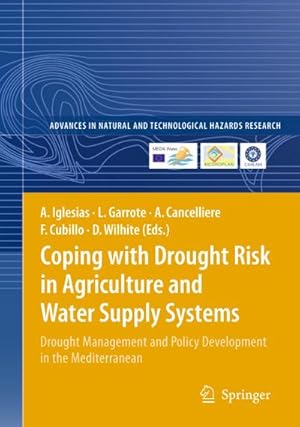
Coping with Drought Risk in Agriculture and Water Supply Systems
Lingua: Inglese
Editore: Springer Netherlands, Springer Netherlands Feb 2009, 2009
ISBN 10: 1402090447 ISBN 13: 9781402090448
Da: BuchWeltWeit Ludwig Meier e.K., Bergisch Gladbach, Germania
Valutazione del venditore 5 su 5 stelle
EUR 106,99
Spedizione EUR 23,00
Spedito da Germania a U.S.A.Quantità: 2 disponibili
Aggiungi al carrelloBuch. Condizione: Neu. This item is printed on demand - it takes 3-4 days longer - Neuware -Over the last three decades drought episodes have resulted in severe social problems in Mediterranean countries, receiving broad attention from the international scientific and policy communities. The experiences in the development and implementation of drought management plans highlight the success and challenges of coping with drought for societies with different vulnerabilities and emphasize risk-based drought management as a critical approach to mitigate the impacts associated to drought-induced water shortages. Based on these experiences and the current methods for evaluating risk, the book synthesises guidelines for drought management that link science and policy and that can be applied to other regions. The book comprises a collection of papers divided into four sections that appeal to a broad audience. First, the social and hydrological context of Mediterranean countries is presented, discussing the interactions that have resulted in the complex institutional framework, and highlighting the importance of stakeholder involvement and awareness building for successful drought management. This section emphasises the role of organizations, institutions, and civil stakeholders involved in drought preparedness and mitigation and/or on water management for designing effective risk based strategies that mitigate the effects of drought in agriculture and water supply systems. Second, the book presents an academic approach to risk evaluation, including characterization of drought episodes, development of indicators of risk in hydrological and agricultural systems, and analysis of the role of economic instruments and groundwater for risk mitigation. This section finalises with the description of an integrated method for evaluating social vulnerability based on indicators that include the capacity to anticipate, cope, and respond to drought.The third section includes a collection of case studies that include the description of effective measures taken in the past. These case studies provide the context for developing demand driven guidelines that may be applied to other regions. The authors of these chapters can be viewed as stakeholders in drought management, since they represent a broad range of sectors and institutions from Mediterranean European and North African countries. The topics addressed have implications for the international policy community interested in disaster mitigation, agricultural policy, and development. Finally a synthesis of the management actions is presented in four chapters. Monitoring and preparedness planning is the essential first step for moving from disaster to risk management in response to drought. The management actions related to agriculture and water supply systems are presented in two different chapters but with a common conceptual framework based on the use of drought indicators for evaluating the levels of drought risk (pre-alert, alert, and emergency), that allow establishing linkages between science and policy. The final chapter discuses the lessons learned and application to other regions. 340 pp. Englisch.
-

EUR 92,27
Spedizione EUR 48,99
Spedito da Germania a U.S.A.Quantità: Più di 20 disponibili
Aggiungi al carrelloCondizione: New. Dieser Artikel ist ein Print on Demand Artikel und wird nach Ihrer Bestellung fuer Sie gedruckt. Addresses the growing issue of drought preparedness planning, monitoring, and mitigation which has worldwide applicationThe methodologies and lessons learned are focused on a specific, drought-prone region so the applications have more significanc.
-

EUR 92,27
Spedizione EUR 48,99
Spedito da Germania a U.S.A.Quantità: Più di 20 disponibili
Aggiungi al carrelloGebunden. Condizione: New. Dieser Artikel ist ein Print on Demand Artikel und wird nach Ihrer Bestellung fuer Sie gedruckt. Addresses the growing issue of drought preparedness planning, monitoring, and mitigation which has worldwide applicationThe methodologies and lessons learned are focused on a specific, drought-prone region so the applications have more significanc.
-
Coping with Drought Risk in Agriculture and Water Supply.
Da: Majestic Books, Hounslow, Regno Unito
Valutazione del venditore 4 su 5 stelle
EUR 141,39
Spedizione EUR 7,61
Spedito da Regno Unito a U.S.A.Quantità: 4 disponibili
Aggiungi al carrelloCondizione: New. Print on Demand pp. 320.
-
Coping with Drought Risk in Agriculture and Water Supply.
Da: Biblios, Frankfurt am main, HESSE, Germania
Valutazione del venditore 4 su 5 stelle
EUR 141,13
Spedizione EUR 9,95
Spedito da Germania a U.S.A.Quantità: 4 disponibili
Aggiungi al carrelloCondizione: New. PRINT ON DEMAND pp. 320.
-
EUR 95,70
Spedizione EUR 70,00
Spedito da Germania a U.S.A.Quantità: 5 disponibili
Aggiungi al carrelloBuch. Condizione: Neu. Coping with Drought Risk in Agriculture and Water Supply Systems | Drought Management and Policy Development in the Mediterranean | Ana Iglesias (u. a.) | Buch | xvii | Englisch | 2009 | Springer | EAN 9781402090448 | Verantwortliche Person für die EU: Springer Verlag GmbH, Tiergartenstr. 17, 69121 Heidelberg, juergen[dot]hartmann[at]springer[dot]com | Anbieter: preigu Print on Demand.
-

Coping with Drought Risk in Agriculture and Water Supply Systems
Lingua: Inglese
Editore: Springer, Springer Nov 2014, 2014
ISBN 10: 9400789521 ISBN 13: 9789400789524
Da: buchversandmimpf2000, Emtmannsberg, BAYE, Germania
Valutazione del venditore 5 su 5 stelle
EUR 106,99
Spedizione EUR 60,00
Spedito da Germania a U.S.A.Quantità: 1 disponibili
Aggiungi al carrelloTaschenbuch. Condizione: Neu. This item is printed on demand - Print on Demand Titel. Neuware -Over the last three decades drought episodes have resulted in severe social problems in Mediterranean countries, receiving broad attention from the international scientific and policy communities. The experiences in the development and implementation of drought management plans highlight the success and challenges of coping with drought for societies with different vulnerabilities and emphasize risk-based drought management as a critical approach to mitigate the impacts associated to drought-induced water shortages. Based on these experiences and the current methods for evaluating risk, the book synthesises guidelines for drought management that link science and policy and that can be applied to other regions.The book comprises a collection of papers divided into four sections that appeal to a broad audience. First, the social and hydrological context of Mediterranean countries is presented, discussing the interactions that have resulted in the complex institutional framework, and highlighting the importance of stakeholder involvement and awareness building for successful drought management. This section emphasises the role of organizations, institutions, and civil stakeholders involved in drought preparedness and mitigation and/or on water management for designing effective risk based strategies that mitigate the effects of drought in agriculture and water supply systems.Second, the book presents an academic approach to risk evaluation, including characterization of drought episodes, development of indicators of risk in hydrological and agricultural systems, and analysis of the role of economic instruments and groundwater for risk mitigation. This section finalises with the description of an integrated method for evaluating social vulnerability based on indicators that include the capacity to anticipate, cope, and respond to drought.The third section includes a collection of case studies that include the description of effective measures taken in the past. These case studies provide the context for developing demand driven guidelines that may be applied to other regions. The authors of these chapters can be viewed as stakeholders in drought management, since they represent a broad range of sectors and institutions from Mediterranean European and North African countries. The topics addressed have implications for the international policy community interested in disaster mitigation, agricultural policy, and development.Finally a synthesis of the management actions is presented in four chapters. Monitoring and preparedness planning is the essential first step for moving from disaster to risk management in response to drought. The management actions related to agriculture and water supply systems are presented in two different chapters but with a common conceptual framework based on the use of drought indicators for evaluating the levels of drought risk (pre-alert, alert, and emergency), that allow establishing linkages between science and policy. The final chapter discuses the lessons learned and application to other regions.Springer-Verlag KG, Sachsenplatz 4-6, 1201 Wien 340 pp. Englisch.
-

Coping with Drought Risk in Agriculture and Water Supply Systems
Lingua: Inglese
Editore: Springer, Springer Feb 2009, 2009
ISBN 10: 1402090447 ISBN 13: 9781402090448
Da: buchversandmimpf2000, Emtmannsberg, BAYE, Germania
Valutazione del venditore 5 su 5 stelle
EUR 106,99
Spedizione EUR 60,00
Spedito da Germania a U.S.A.Quantità: 1 disponibili
Aggiungi al carrelloBuch. Condizione: Neu. This item is printed on demand - Print on Demand Titel. Neuware -Over the last three decades drought episodes have resulted in severe social problems in Mediterranean countries, receiving broad attention from the international scientific and policy communities. The experiences in the development and implementation of drought management plans highlight the success and challenges of coping with drought for societies with different vulnerabilities and emphasize risk-based drought management as a critical approach to mitigate the impacts associated to drought-induced water shortages. Based on these experiences and the current methods for evaluating risk, the book synthesises guidelines for drought management that link science and policy and that can be applied to other regions.The book comprises a collection of papers divided into four sections that appeal to a broad audience. First, the social and hydrological context of Mediterranean countries is presented, discussing the interactions that have resulted in the complex institutional framework, and highlighting the importance of stakeholder involvement and awareness building for successful drought management. This section emphasises the role of organizations, institutions, and civil stakeholders involved in drought preparedness and mitigation and/or on water management for designing effective risk based strategies that mitigate the effects of drought in agriculture and water supply systems.Second, the book presents an academic approach to risk evaluation, including characterization of drought episodes, development of indicators of risk in hydrological and agricultural systems, and analysis of the role of economic instruments and groundwater for risk mitigation. This section finalises with the description of an integrated method for evaluating social vulnerability based on indicators that include the capacity to anticipate, cope, and respond to drought.The third section includes a collection of case studies that include the description of effective measures taken in the past. These case studies provide the context for developing demand driven guidelines that may be applied to other regions. The authors of these chapters can be viewed as stakeholders in drought management, since they represent a broad range of sectors and institutions from Mediterranean European and North African countries. The topics addressed have implications for the international policy community interested in disaster mitigation, agricultural policy, and development.Finally a synthesis of the management actions is presented in four chapters. Monitoring and preparedness planning is the essential first step for moving from disaster to risk management in response to drought. The management actions related to agriculture and water supply systems are presented in two different chapters but with a common conceptual framework based on the use of drought indicators for evaluating the levels of drought risk (pre-alert, alert, and emergency), that allow establishing linkages between science and policy. The final chapter discuses the lessons learned and application to other regions.Springer-Verlag KG, Sachsenplatz 4-6, 1201 Wien 340 pp. Englisch.
-
Coping with Drought Risk in Agriculture and Water Supply Systems
Da: Biblios, Frankfurt am main, HESSE, Germania
Valutazione del venditore 4 su 5 stelle
EUR 272,88
Spedizione EUR 9,95
Spedito da Germania a U.S.A.Quantità: 4 disponibili
Aggiungi al carrelloCondizione: New. PRINT ON DEMAND pp. 340.


![Immagine del venditore per Gruppo di 4 scritti riguardanti la collezione dannunziana dell'antropologo Nello Puccioni: 1) Lettera dattiloscritta, firmata, stesa su una facciata su carta intestata "Reale Accademia d'Italia", indirizzata a Ugo Ojetti, datata: "Roma, 15 aprile 1937 - XV": "Eccellenza [.] Circa la raccolta Puccioni, chiedo all'E.V. qualche giorno, inevitabile perché si tratta di un apprezzamento finanziario. Farò tutto il possibile perché la collezione possa essere acquistata dal Vittoriale; ma i quattrinelli disponibili sono scarsi [.]". 2) Lettera dattiloscritta, firmata. Stesa su una facciata su carta intestata "Reale Accademia d'Italia", indirizzata a Nello Tarchiani, datata 4 giugno 1937 - XV: "Caro Signore ecco il catalogo, Suppongo che il libraio cui trasmisi il catalogo non abbia rilevato che la copia della Canzoni era una delle poche superstiti alla distruzione. Comunque, se Casella ha offerto 40.000 lire bisogna interessarlo di nuovo e potrei coadiuvarla io che gli sono molto amico. Però su venduto da Libreria Oreste Gozzini snc](https://pictures.abebooks.com/inventory/md/md31730011386.jpg)


