
Erasmus desiderius 1466 (27 risultati)

- Brossura
Da: La Librería, Iberoamerikan. Buchhandlung, Bonn, NRW, GermaniaLa Librería, Iberoamerikan. Buchhandlung
Contatta il venditoreVenditore con 4 stelleCondizione: Nuovo
EUR 8,10
EUR 39,50 spedizioneSpedito da Germania a U.S.A.Quantità: 1 disponibili
Softcover. Condizione: New. 1a.ed. en esta colección. 19x12 cm. Selección Clásicos Universales. 155 p., Rústica. Sprache: Spanisch, NUEVO / NEU / NEW. Enmascarado con un manto de ironía, Erasmo de Rotterdam construye una obra magistral que sigue iluminando a millones de lectores bastantes siglos después de su primera publicación…. Bajo la apariencia de un juego satírico, se esconde una crítica velada donde no escapan monarcas, papas, la sociedad plebeya o los aristócratas. Con un modo discursivo, donde la propia estulticia es la que habla, se presenta a la locura y a la necedad como las fuentes de todo el bien del hombre, pues serían las que provocarían la felicidad, la bondad y el deleite. De forma sarcástica se nos dice que la razón no es quien dirige nuestras vidas, lo cual no deja de ser una burla más al ser humano y al uso que este hace de su inteligencia, así como una reprimenda directa a los últimos coletazos de las costumbres culturales del medievo más oscuro. Erasmo defendió los valores progresistas hasta sus últimos días. Humanista de corazón, fue uno de los más grandes intérpretes de las corrientes intelectuales del Renacimiento. [Texto editorial] [Erasmo+Erasmus+Erasmo de Rotterdam+filosofía+humanismo]. ** 10% DESCUENTO/RABATT/DISCOUNT PRIMAVERA * excl. New German Books * * * * 8,10 (original price 9,00) **.

Erasmus , Desiderius - Dutch Humanist - Wearing Fur Trimmed Robe - Finely Engraved - An Engraved Portrait
ERASMUS, DESIDERIUS (1466-1536) - an Antique Original Engraved Portrait
Lingua: Inglese
Editore: Blackie, 1860
Da: K Books Ltd ABA ILAB, York, YORKS, Regno UnitoK Books Ltd ABA ILAB
Contatta il venditoreVenditore con 5 stelleCondizione: Usato - Molto buono
EUR 30,30
EUR 22,94 spedizioneSpedito da Regno Unito a U.S.A.Quantità: 1 disponibili
Aggiungi al carrelloNo Binding. Condizione: Very Good. A splendid original antique engraved portrait . Mounted (matted) and ready to frame . Very good condition. Attrractive and decorative. Printed circa 1860.
Engraved Portrait of Erasmus. Half Length, in cap, after Penn by E. Scriven.
DESIDERIUS ERASMUS [1466-1536] Religious Thinker and Reformer.
Editore: 5in x 4in
Da: R.G. Watkins Books and Prints, Ilminster, SOMER, Regno UnitoR.G. Watkins Books and Prints
Contatta il venditoreVenditore con 5 stelleCondizione: Usato
EUR 12,12
EUR 32,94 spedizioneSpedito da Regno Unito a U.S.A.Quantità: 1 disponibili
Aggiungi al carrelloStipple Engraving, C. Knight, 1833, a little spotting on surround.
Erasmus - Dutch Humanist - Original Antique engraved Portrait
ERASMUS, DESIDERIUS (1466-1536) - an Original Antique Engraved Portrait
Lingua: Inglese
Da: K Books Ltd ABA ILAB, York, YORKS, Regno UnitoK Books Ltd ABA ILAB
Contatta il venditoreVenditore con 5 stelleCondizione: Usato - Molto buono
EUR 30,30
EUR 22,94 spedizioneSpedito da Regno Unito a U.S.A.Quantità: 1 disponibili
Aggiungi al carrelloNo Binding. Condizione: Very Good. A fine engraved portrait. Mounted/matted and ready to frame. Attractive, decorative and unusual. C. 1800.
Erasmus, Desiderius - Dutch Humanist - An Original Engraved Antique Portrait
ERASMUS, DESIDERIUS (1466-1536) - An Antique Original Engraved Portrait
Lingua: Inglese
Da: K Books Ltd ABA ILAB, York, YORKS, Regno UnitoK Books Ltd ABA ILAB
Contatta il venditoreVenditore con 5 stelleCondizione: Usato - Molto buono
EUR 42,41
EUR 22,94 spedizioneSpedito da Regno Unito a U.S.A.Quantità: 1 disponibili
Aggiungi al carrelloNo Binding. Condizione: Very Good. A fine original engraving. Mounted and ready to frame, this is a wonderful opportunity to purchase this splendid portrait. Decorative and attractive. Bataigne (illustratore).
 Altre immagini
Proverbes or Adagies [with newe addicions gathered out of the Chiliades of Erasmus by Richard Taverner]. London 1539.
ERASMUS, Desiderius (1466?-1536); TAVERNER, Richard (c. 1505-1575):
Editore: Amsterdam & New York: Da Capo Press, Theatrum Orbis Terrarum, 1969., 1969
- Rilegato
- Prima edizione
Da: Ted Kottler, Bookseller, Redondo Beach, CA, U.S.A.Ted Kottler, Bookseller
Contatta il venditoreVenditore con 4 stelleCondizione: Usato - Molto buono
EUR 112,67
EUR 11,11 spedizioneSpedito in U.S.A.Quantità: 1 disponibili
Aggiungi al carrelloHardcover. Condizione: Very Good. No Jacket. 1st Edition. Original 1539 edition reprinted in facsimile. Original cloth. An ex-library copy with the usual markings, else Very Good+. The English Experience Number 124.
- Brossura
Da: PORCHEROT Gilles -SP.Rance, BREST, FR, FranciaPORCHEROT Gilles -SP.Rance
Contatta il venditoreVenditore con 2 stelleCondizione: Usato
EUR 55,00
EUR 30,00 spedizioneSpedito da Francia a U.S.A.Quantità: 1 disponibili
Aggiungi al carrelloParis, à l'enseigne du pot cassé - 1933/1934 - In-8 - broché - Couverture illustrée en couleusr Exemplaire numéroté sur bornéo - I) XXXIII-204pages - II) 284 - III) 286 pages - Dans chaque, illustrations en texte -Bel ensemble Il reste essentiellement connu aujourd'hui pour sa declamation satirique Éloge de la Folie (1511) et, d…ans une moindre mesure, pour ses Adages (1500), anthologie de plus de quatre mille citations grecques et latines, et pour ses Colloques (1522), recueil d'essais didactiques aux thèmes variés, bien que son uvre, autrement plus vaste et complexe, comprenne des essais et des traités sur un très grand nombre de sujets, sur les problèmes de son temps comme sur l'art, l'éducation, la religion, la guerre ou la philosophie, éclectisme propre aux préoccupations d'un auteur humaniste. Livres 114516989941).
 Altre immagini
Desid. Erasmi Roterodami Colloquia familiaria : notis novis illustrata. Ad usum juventutis politioris humanitatis studiis imbuend? . Editio nitidissima, emendatissima, auctiorque pr?cedentibus
Roterodami, Desiderius Erasmi (Desiderius Erasmus Roterodamus, 1466-1536
Editore: Typis Aaronis Rhami, impensis Joannis Churchill Londinensis, & Eliphalis Dobson Dubliniensis bibliopolarum, Dublinii, 1712
- Rilegato
Da: Minotavros Books, ABAC ILAB, Whitby, ON, CanadaMinotavros Books, ABAC ILAB
Contatta il venditoreVenditore con 5 stelleCondizione: Usato - Molto buono
EUR 337,52
EUR 14,44 spedizioneSpedito da Canada a U.S.A.Quantità: 1 disponibili
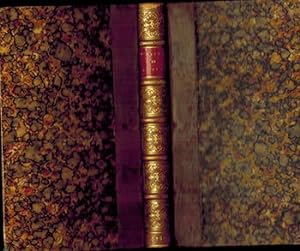
Aggiungi al carrelloHardcover. Condizione: Very Good. No Jacket. 12mo (3" x 4.5"). Editio nova. Contemporary calf boards. Recently professionally rebacked, new leather spine with raised bands, title label, gilt and blind stamping and gilt date stamp. Speckled edges. [42], 663, [17] pp. Engraved title. Wear and scuffing to original boards. Ownership… inscription to front pastedown, "Thomas Brougham's Book," dated 29th January, 1730. Staining to rear pastedown.Cropped copy. A few folded corners. One small hole to lower right corner of first leaf after title, minor loss to catchword. Small chip to foot of pp. 285-286, some loss to footnotes. Light browning and a few ink stains commensurate with age, else very clean internally. Overall a very good copy of a classic by Erasmus, a Dutch Renaissance humanist, Catholic priest, and a theologian.
 Altre immagini
L'éloge de la Folie. Traduction nouvelle du latin par M. Barrett. Orné de douze figures.
Erasmus, Desiderius (1466-1536); Jean-Jacques de Barrett, translator (1717-1792)
Editore: Paris: Defer de Maisonneuve, 1789., 1789
- Rilegato
Da: Wittenborn Art Books, San Francisco, CA, U.S.A.Wittenborn Art Books
Contatta il venditoreVenditore con 5 stelleCondizione: Usato - Buono
EUR 360,54
EUR 8,75 spedizioneSpedito in U.S.A.Quantità: 1 disponibili
Aggiungi al carrelloCondizione: Good. 12 mo. Contemporary calf with raised bands.260pp. 10 x 16.5 cm.Collational formula:a6 A-K12 L4Book label of Petitpas, Nantes. 12 engraved plates in the style of Eisen. ERASME L'éloge de la Folie, orné de 12 gravures dont le frontispice.Traduction du latin par Barrett. 1 vol. in-12 relié 1/2 veau blond glacé,dos… à nerfs à caissons ornés, pièce de titre rouge, tranches jaspées. Bel ex.Réf : Brunet II - 1038 -Cohen 350 - Quérard III - 27 « La meilleure traduction française de cet ouvrage », Expertise by Yves Salmon, 56760 Pénestin, France.
 Altre immagini
C. Suetonij Tranquilli XII Caesares: item I.O. Baptistae Egnatii Veneti De Romanis principibus libri III. Eiusdem Annotationes in Suetonium. Annotata in eundem, & loca aliquot restituta per D. Erasmum Roter.
SUETONIUS TRANQUILLUS, Caius (69-approximately 122); Desiderius Erasmus (1466/7-1536).
Editore: Seb. Gryphium, 1556., Lugduni [Lyon]:, 1556
- Rilegato
- Prima edizione
Da: Jeff Weber Rare Books, Neuchatel, NEUCH, SvizzeraJeff Weber Rare Books
Contatta il venditoreVenditore con 5 stelleCondizione: Usato
EUR 540,82
EUR 25,00 spedizioneSpedito da Svizzera a U.S.A.Quantità: 1 disponibili
Aggiungi al carrelloSmall 8vo. Pagination: 473, [23] pp. Signatures: a-z8, A-H8. Printer's device on the title page, woodcut initials, printed marginalia; editor's name on title and p. 2 are lined out in ink, three small worm holes from title-page. Nineteenth century quarter gilt-ruled calf, red paper board boards. Early ink name on title of "Carol…us . . ." and occasional marginalia (pp. 58, 61, 62, 80-83 [heavy notes] - in the same hand. Very good. Beautifully printed early pocket edition printed by Sebastianus Gryphius (1493-1556), of Suetonius' most famous work and one of the few of his texts that survive, with excellent annotations by Desiderius Erasmus of Rotterdam. Commonly known as The Twelve Caesars, the work contains a set of twelve biographies of Julius Caesar and the first eleven emperors of the Roman Empire [Augustus, Tiberius, Caligula, Claudius, Nero, Galba, Otho, Vitellius, Vespasian, Titus, Domitian]. It is a primary source for the study of Roman history. The first edition of Suetonius with Erasmus' annotation was issued in 1533. Baudrier, Henri L., Bibliographie lyonnaise, VIII, p. 284; Gultlingen V, p. 215: I369; French Books III & IV: Books published in France before 1601 . . . edited by Andrew Pettegree, Malcolm Walsby, Leiden: Brill, 2012, 87100. Locations: BYU (lacks everything after p. 340 and title is damaged); NYPL.
 Altre immagini
Editore: Johann Schöffer, February, Mainz, 1522
- Rilegato
Da: Liber Antiquus Early Books & Manuscripts, Chevy Chase, MD, U.S.A.Liber Antiquus Early Books & Manuscripts
Contatta il venditoreVenditore con 5 stelleCondizione: Usato - Ottimo
EUR 5227,88
EUR 2,63 spedizioneSpedito in U.S.A.Quantità: 1 disponibili
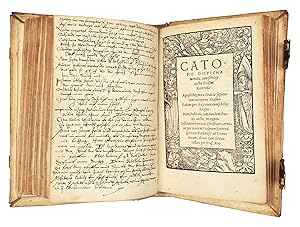
Aggiungi al carrelloHardcover. Condizione: Fine. [Bound with:] Erasmus, Desiderius (1466-1536); Cato, Dionysius (ca. 3rd c.); Colet, John (1467-1519), et al. Catonis disticha moralia cum scholiis auctis Erasmi Roterodam. Isocratis paraenesis ad Demonicum. dennuo cum Graecis collata per Eras[mum] Strasbourg: Johann Knobloch, 1523 Octavo: 15.5 x 10.1… cm. I. (Adagia): [8] lvs, 234 pp., [15] lvs. Collation: A-R8, S4 (with final blank leaf present). II. (Disticha): [56] lvs. Collation: A-G8 [Bound with:] Erasmus, Desiderius (1466-1536); Cato, Dionysius (ca. 3rd c.); Colet, John (1467-1519), et al. Catonis disticha moralia cum scholiis auctis Erasmi Roterodam. Isocratis paraenesis ad Demonicum. dennuo cum Graecis collata per Eras[mum] Strasbourg: Johann Knobloch, 1523 Octavo: 15.5 x 10.1 cm. I. (Adagia): [8] lvs, 234 pp., [15] lvs. Collation: A-R8, S4 (with final blank leaf present). II. (Disticha): [56] lvs. Collation: A-G8 Bound in contemporary blind-stamped pigskin with a very early paper label to the spine. In fine condition. The text bound a bit tight. Minor soiling and a few marginal tears or worming. First t.p. working loose at foot. With fine woodcut borders to the title pages of both works, woodcut initials. Knobloch's device on the final leaf of the second work. The leaf between the two volumes has handwritten German translations (or German equivalents) of certain adages. There are about 25 other translations in the course of the text. See below. This rare edition of the Erasmus' "Adagiorum Collectanea"(Collection of Adages) was printed by Johann Schöffer, grandson of Gutenberg's backer Johann Fust and son of Fust's partner, Peter Schöffer. The fine woodcut border on the title page incorporates Schöffer's arms. The book is bound with Erasmus' edition of the "Distichs of Cato", the "Apothegms of the Greek Sages" and other moralizing texts for use in schools. An unidentified 16th c. reader has provided German renderings for approximately 65 adages, some within the text but the majority written -densely- on both sides of a blank leaf. These are not literal translations but idiomatic equivalents - German sayings and turns of phrase that the reader judged to carry the same sense as the Latin, in the way a modern annotator might pair "actions speak louder than words" with "facta, non verba" (lit. deeds not words) rather than translate it word for word. Here are five examples: 1. Ultra septa transilire is glossed in German as "das heist zu vil machen" "To leap over the fences," i.e. to overshoot the bounds. 2. Oculatus testis unus pluris est quam decem auriti is glossed in German as "von hörensagen leugt man gern" "One eyewitness is worth more than ten ear-witnesses". 3. Genu sura propius is glossed in German as "ich schau auff mein spill" "The knee is nearer than the shin," i.e. one's own concerns come first - "I mind my own game." 4. Arcus non semper feriet quod minabitur is glossed in German as "alle tag ist jagtag, aber nit fangtag" Adapted from Horace, Ars poetica ("nec semper feriet quodcumque minabitur arcus"). Not everything one undertakes comes off - "every day is hunting day, but not catching day." 5. The Latin lemma In lapidicinas / ad corvos is glossed in German as "zum galgen mit dir" Both classical imprecations ("to the quarries!" / "to the crows!", i.e. "go hang"), rendered literally in the German as "to the gallows with you." 6. Haec Helena est - "das ist die praut darumb man dantzt" ("this is the bride around whom the dance goes"). 7. Homo effreni oris - "sein zung schneidt wie ein messer" ("his tongue cuts like a knife"). There is also a long marginal note explaining the adage "Cave Thoracem" ("Beware of the Thorax") - Erasmus, Adagia 2.4.52. It refers to Mount Thorax near Magnesia-on-the-Maeander, where the grammarian Daphitas is said to have been crucified after mocking the Attalid kings in a scurrilous couplet (this exact episode is told by Strabo, Geography 14.1.39, and an oracle had reportedly warned Daphitas to "beware of the Thorax" - a pun, since thorax also means "breastplate" in Greek). THE ADAGES: The "Adagia", one of Erasmus' greatest achievements, is a collection of proverbs taken from both Latin and Greek authors. The work was already conceived during his first stay in England and was first printed at Paris in 1500. The present edition is a reprint of the 1506 edition (which had been expanded by 18 adages). It retains, however, the dedication letter to William Blount Lord Mountjoy (Allen 126) from the first edition. Although it was eclipsed by the massively expanded Aldine edition that was to follow in 1508, the "Adagiorum Chiliades" ("Thousands of Adages"), to which Erasmus would add up until his death in 1536, the much shorter "Collectanea Adagiorum" would continue to be printed as well. "Erasmus' 'Adagiorum Collectanea' is a collection of about eight hundred proverbial sayings drawn from the Latin authors of antiquity and elucidated for the use of those who aspired to write an elegant Latin style. In the dedication Erasmus pointed out the profit an author may derive, both in ornamenting his style and in strengthening his argumentation, from having at his disposal a good supply of sentences hallowed by their antiquity. He proposes to offer such a help to his readers. What he actually gave was much more. He familiarized a much wider circle than the earlier humanists had reached with the spirit of antiquity. "Until this time the humanists had, to some extent, monopolized the treasures of classic culture, in order to parade their knowledge of which the multitude remained destitute, and so to become strange prodigies of learning and elegance. With his irresistible need of teaching and his sincere love for humanity and its general culture, Erasmus introduced the classic spirit, in so far as it could be reflected in the soul of a sixteenth-century Christian, among the people. Not he alone; but none more extensively and more effectively. Not among all the people, it is true, for by writing in Latin he limited hi.
 Altre immagini
Editore: Johann Froben, August 21 1521 - January, Basel, 1522
- Rilegato
- Prima edizione
Da: Liber Antiquus Early Books & Manuscripts, Chevy Chase, MD, U.S.A.Liber Antiquus Early Books & Manuscripts
Contatta il venditoreVenditore con 5 stelleCondizione: Usato - Ottimo
EUR 14.872,42
EUR 2,63 spedizioneSpedito in U.S.A.Quantità: 1 disponibili
Aggiungi al carrelloHardcover. Condizione: Fine. FIRST EDITION. A superb copy bound in contemporary alum-tawed pigskin over beveled wooden boards, ruled and tooled in blind , with the original clasps, catches, and straps preserved. Binding mildly soiled, a few scrapes, mild surface wear. Internally crisp and bright, with just a few lightly toned le…aves and a few trivial stains. With 16th c. manuscript annotations scattered throughout and a 16th c. ownership inscription on the paste-down. The errata lvs. have been tipped in, possibly indicating early issue. Excellent. Title page with the fine ?Triumph of Humanitas? historiated woodcut border by Urs Graf (Lüthi 50a and Hieronymus, Oberrheinische Buchillustration 172) enclosing Froben?s printer?s device; two preliminary pages with fine four- and five-piece woodcut borders by Ambrosius Holbein; white-on-black woodcut headpiece, two 10-line woodcut initials and numerous smaller ones, verso of final leaf with large printer?s device enclosed in five-piece woodcut border; some Greek printing. First edition of this collection of 671 letters, of which 171 are newly printed. The majority of the new letters are from 1519-1521, but some are earlier, the first dated 11 July 1513. The collection is far larger than its predecessors: the ?Epistolae aliquot? of January 1518 (52 letters), the ?Auctarium? of October 1518 (63 letters), and the ?Farrago? of Nov 1519 (333 letters). Erasmus provides a preface to his correspondence for the first time in this edition. The letter to his editor Beatus Rhenanus (Ep 1206) tells of his dislike of two earlier collections edited by him (Beatus) and published by Froben, the ?Auctarium? of October 1518 and the ?Farrago? of Nov 1519, and implies that they were published surreptitiously without his consent. After the present edition no further collections were printed until the ?Opus epistolarum? of 1529. The introduction in the Collected Works to Erasmus? prefatory letter to Beatus Rhenanus illustrates his personal involvement in the production of this collection: "Even as the Farrago was being printed Erasmus spoke of another edition with new letters added and others revised. The last thing he desired was a straight reprint either by Froben or another publisher. So in the summer of 1520 he was going through all his letters and in November the review of the ?Farrago? was apparently completed. Before the middle of January 1521 the revised copy together with a substantial number of new letters had reached Basel. When he sent the first part of the revised New Testament shortly afterwards he apparently asked to have all letters, old and new, back for another review, but was sent none and told instead that a volume of 41 quires (pages 1-490) was set in type, lacking only a preface and an epilogue. So he wrote this preface as well as dispatching more letters to Basel. ?Froben next prepared a preliminary quire containing the title-page (dated 31 August), Epp 1206, 1225, and, to fill some space left over on the last page, Ep. 1239. All was printed and ready to be launched at the Frankfurt autumn fair, but with the certain prospect of Erasmus? return to Basel a delay was indicated. As Froben now preferred his volume not to reach the public and his rivals until the time of the spring fair of 1522, Erasmus could add more letters including the last in time dated from Basle 22 November 1521, which appears on page 639 but is followed by thirty more pages of letters. Presumably as a result of Erasmus? review of the printed volume, over three pages of corrigenda were added at the end" (Collected Works , vol. 8, pp. 215/7). The correspondents for the newly printed letters include Johann Reuchlin, Justus Jonas, Guillaume Bude, Petrus Mosellanus, Polydore Vergil, Pope Leo X, Cardinal Albert of Brandenburg, Thomas More, William Warham, Thomas Wolsey and John Fisher. Many of the letters reflect Erasmus? changing stance regarding Luther but, at the same time, continue his attacks on the friars and Louvain theologians. Bietenholz singles out a lon.
 Altre immagini
Editore: Basel, Bartholomaeus Westheimer, Basel, 1538
- Rilegato
Da: Govi Rare Books LLC, Woodside, New York City, NY, U.S.A.Govi Rare Books LLC
Contatta il venditoreVenditore con 4 stelleCondizione: Usato
EUR 1800,00
EUR 13,13 spedizioneSpedito in U.S.A.Quantità: 1 disponibili
Aggiungi al carrelloCondizione: Buono (Good). 8vo. (16), 477 [i.e. 479], (1) pp. ?8, a-z8, A-G8. With the printer's device on the verso of the last leaf. Contemporary blindstamped pigskin over wooden boards, one clasp.Index Aureliensis, 162.936; VD 16, E-2955; I. Bezzel, Erasmusdrucke des 16 Jahrhunderts in Bayerischen Bibliotheken, (Stuttgart, 197…9), 1037; F. van der Haegen, Bibliotheca Erasmiana, I, (Gand, 1893), p. 101. FIRST EDITION of this selection of Erasmus' letters made from his Opus epistolarum of the same year. The whole volume was intended for school boys as a manual of model letters. The volume opens with the announcement of Erasmus' death and a short biography of the latter by Beatus Rhenanus, and also contains some laudatory verses on Erasmus by Henricus Glareanus and Johannes Sapidus, and an epitaphium by Andrea Alciati. Westheimer reprinted the volume in 1551. The present edition was possibly, although there is no direct evidence, also edited by Johannes Gast (d. 1552), who in 1546 published Desiderii Erasmi Roterodami epistolae familiares in tres centurias divisae.?Il a une haute idée de la lettre considerée comme un genre littéraire qui ?peint les moeurs, le destin, les sentiments, les conditions de la vie publique et de la vie privée' tout en maintenenant le ton de la conversation: colloquium inter absentes. Ses préférences vont à la simplicité, au style naturel et familier, à tout ce qui s'écarte résolument des expressions conventionelles, artificielles et impersonnelles. Sans doute, Erasme lui-même n'a-t-il pas toujours suivis ces sages recommandations? Il n'en reste pas moins qu'il n'aurait pu écrire un tel traité épistolaire s'il n'avait été d'abord un gran épistolier. Ajoutons pour mémoire, qu'Erasme n'a pas publié lui-même un recueil de ses plus belles lettres familières. Le volume intitulé Desiderii Erasmi Roterdami epistolae familiares est une édition posthume, chez B. Westhemerus à Bâle en 1538? (L.-E. Halkin, Erasmus ex Erasmo. Erasme éditeur de sa correspondence, Aubel, 1983, pp. 127-128).Bartholomaeus Westheimer (1499-1567/68) was born at Pforzheim and educated in the Latin school of Johann Sapidus at Schlettstadt. Around 1525 he lived in Rastatt and came into contact with the circle of Reformed theologians like Johannes Brenz and Dietrich von Gemmingen. A year later he settled in Basle as a proofreader, became a citizen and married a former nun. In Basel he issued his first theological works being printed by Thomas Wolff, whose printing shop he eventually took over in 1536. During some of his business trips, he met in Strasbourg the theologian Konrad Hubert with whom he remained in correspondence over a longer period. In 1546 he ceased his activities as a printer and became pastor of Therwil (near Basel) and in 1547 of Mulhouse. In 1551 he returned to Basel and his name is found in the university register. In 1553 he was called as a preacher to Horbourg (near Colmar). With a short stay in Montbéliard (Burgundy) he returned permanently to Horbough.As a printer he published over one hundred works: classical authors, theological and philological treatises as well as medical tracts, mostly in Latin. As theologian (he had converted from Calvinism to Lutheranism in his later years), he tried to show, combining humanism, biblical studies, and the Church Fathers, that the Reformation is indeed a return to the spirit of the early Church. If he ever had contacts with Erasmus is not known, but it is very probable (cf. H. Rissel, Dem Buch und der Kanzel gedient: Bartholomäus Westheimer aus Pforzheim, 1499?-1567, in: ?Neue Beiträge zur Pforzheimer Stadtgeschichte?, Ch. Groh, ed., Stuttgart, 2006, pp. 13-24). Gerrit Gerritszoon (better known as Desiderius Erasmus) was born at Rotterdam, apparently on October 28, 1466, the illegitimate son of a physician's daughter and a future monk. At Deventer he attended the local school run by the German humanist Alexander Hegius, learning Latin and Greek. On his parents' death he entered the Augustinian C. Book.
 Altre immagini
Editore: Freiburg/Br., Stephan Graf, Freiburg/Br., 1543
- Rilegato
Da: Govi Rare Books LLC, Woodside, New York City, NY, U.S.A.Govi Rare Books LLC
Contatta il venditoreVenditore con 4 stelleCondizione: Usato
EUR 600,00
EUR 13,13 spedizioneSpedito in U.S.A.Quantità: 1 disponibili
Aggiungi al carrelloCondizione: Buono (Good). 8vo. 167, (9, including one blank) leaves. a-y8. Contempory limp vellum.Index Aureliensis, 163.213; VD 16, E-2959; I. Bezzel, Erasmusdrucke des 16 Jahrhunderts in Bayerischen Bibliotheken, (Stuttgart, 1979), 1045; H. Brunner, Dulce bellum inexpertis: Bilder des Krieges in der deutschen Literatur des 15.… und 16. Jahrhunderts, (Wiesbaden, 2002), p. 485; F. van der Haegen, Bibliotheca Erasmiana, I, (Gand, 1893), p. 101. ONLY EDITION of this selection of Erasmian letters published by the poet and historian Johannes Tethinger (fl. 1st half of the 16th century). It was intended for school boys as a manual of model letters. Probably Tethinger had in hands the similar volume published at Basel by Bartholomäus Westheimer in 1538.Both volumes open with Erasmus' letter to the Carthusian Gabriel Ofhusius, dated Anderlecht, October 14, [1520]. Some letters are omitted in one of the works, whereas there are a few additions in the other. Both works also contain answers to letters written by Erasmus. Whereas Westheimer's edition does not contain letters dated after 1529, Tethinger's selection has letters up to 1533 and furthermore some poetry: Hermann von dem Busche's poem In Erasmum Coloniam recens ingressum (1516), Heinrich Glareanus' elegy Ad Erasmum Roterdamum immortale Belgarum decus (1516), and by the same an elegy celebrating his friend Oswald Mykonius (1516).Very little is known about the life of Johann Tethinger. He probably took over the position as a rector of the grammar school in Freiburg a.Br. around 1518. He published some schoolbooks on Latin grammar, but his main work is Silva de quattuor bellis Wirtembergicis (1535), an epic on the wars of Ulrich, Duke of Wurttemberg. An enlarged edition with an added historical prose account was published in 1545 (cf. P.P. Albert, Zur Lebens- und Familiengeschichte des Dichters und Geschichtsschreibers Johann Tethinger Pedius, in: ?Zeitschrift für die Geschichte des Oberrheins?, 54, 1900, pp. 8-14). Gerrit Gerritszoon (better known as Desiderius Erasmus) was born at Rotterdam, apparently on October 28, 1466, the illegitimate son of a physician's daughter and a future monk. At Deventer he attended the local school run by the German humanist Alexander Hegius, learning Latin and Greek. On his parents' death he entered the Augustinian College of Stein near Gouda, where he spent six years. At length the Bishop of Cambrai, Henry of Bergen, made him his private secretary. In order to allow him to accept that post, he was given a temporary dispensation from his monastic vows, dispensation that later was made permanent by Pope Leo X.After taking priest's orders Erasmus went to Paris, where he studied at the Collège Montaigu. He resided there until 1498, gaining a livelihood by teaching. Among his pupils was Lord Mountjoy, on whose invitation probably Erasmus made his first visit to England in 1498. He lived chiefly at Oxford, making the acquaintance of John Colet and Thomas More.In 1500 he was again in France, living for the next six years mainly at Paris. During this period he wrote the Adagia (Paris, 1500) and the Enchiridion Militis Christiani (Antwerp, 1503). After a short visit to England, in 1506 Erasmus carried out a long-desired journey to Italy, staying chiefly at Padua as tutor to Alexander Stewart, Archbishop of St. Andrews, and Venice, collaborating to the publishing house of Aldo Manuzio. His visit closed with a short stay in Rome.In 1509 the accession of Henry VIII and the invitation of Lord Mountjoy induced Erasmus once more to settle in England. In this period he wrote the famous Encomium Moriae (first published at Strasbourg or Paris in 1511) and resided mainly at Cambridge, where he was appointed Margaret professor of Divinity and professor of Greek.After 1514 he lived alternatively in Basel and England, and from 1517 to 1521 at Louvain. In 1516 at Basel appeared the first edition of the Colloquia, usually regarded as his masterpiece, and the first edition of. Book.
 Altre immagini
Editore: Apud Ioan. Froben. Mense Xbri., Basel, 1520
- Rilegato
- Prima edizione
Da: Liber Antiquus Early Books & Manuscripts, Chevy Chase, MD, U.S.A.Liber Antiquus Early Books & Manuscripts
Contatta il venditoreVenditore con 5 stelleCondizione: Usato - Ottimo
EUR 10.816,31
EUR 2,63 spedizioneSpedito in U.S.A.Quantità: 1 disponibili
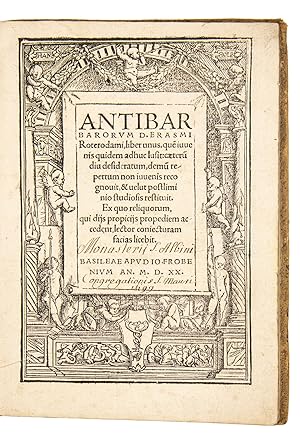
Aggiungi al carrelloHardcover. Condizione: Fine. Bound in contemporary reversed-deerskin (with minor stains and surface wear). A fine, tall, and fresh copy. Woodcut border by Hans Holbein to title page, additional woodcut borders to second leaf and the opening leaf of the text. Woodcut Froben device on verso of final leaf. Neat contemporary annotat…ions in the margins, a few trivial marginal stains, final leaf with light crease, light soiling to t.p. and final leaf. Provenance: 17th c. inscription on t.p. "Monasterii S. Albani Congregationis S. Mauri 1699." 16th c. ownership inscription (struck through) on pastedown. Second Froben edition, printed within 6 months of the first, of a book begun by Erasmus when he was a young humanist monk in his twenties and completed twenty-five years later, by which time he had become a figure of international renown and controversy. As originally conceived in the 1490s, Erasmus' "Antibarbarians" was to be a spirited defense of humanism, in particular the reading and study of classical literature and languages, against charges that such literature and pursuits are fundamentally un-Christian. In its final form, as published in 1520, the book was also a defense of Erasmus' theological positions, his views on church reform, and his application of humanist principles and philological methods to the study of religious texts, in particular Holy Scripture. Erasmus conceived his "Antibarbarians" at about the age of twenty, while living as a monk at the monastery at Steyn. By the time the book was published, Erasmus was under attack from many quarters, especially from the monastic orders, whose members resented Erasmus' criticisms of their abuses and accused Erasmus of heresy and Lutheranism. The threat to humanistic studies that Erasmus had perceived in the 1490s was still alive and well but had taken on new dimensions and implications. The Louvain theological faculty had condemned Erasmus' Greek New Testament, the preeminent expression of Erasmian humanism, and had also attacked Erasmus for his part in the so-called Reuchlin affair, "long regarded as the first formal confrontation of the new scripture-based reform with the scholastic defenders of the theological faculties and the Vulgate."(Levy, p. 177) Forced to defend himself on these fronts and to clarify his positions, Erasmus used the "Antibarbarians" as a vehicle to stage his defense and to launch new attacks on his enemies. The Genesis and Development of the Work: "Erasmus arrived in Paris in 1495 and soon after his arrival submitted the first book of his 'Antibarbari' to the historian Robert Gaguin. In 1499 Erasmus went to England and it was probably then that he showed the drafts of Books I and II to John Colet. During the penurious years in Paris that followed, he apparently went on with it during the time he could spare from his teaching. He took it with him to Italy in 1506, and revised Books I and II at Bologna. But when in 1509 he received an urgent invitation to come to England and share in the golden age that was opening with the reign of Henry VIII, he left Italy in a hurry and consigned his papers to the care of an English friend, Richard Pace, at Ferrara. Soon Pace had to leave too and the papers went to another Englishman, less conscientious, who sold what he could and gave the rest away. "Erasmus asked over and over again for the return of his brainchild. But he never saw most of it again. He got hold of Book I when he was in Louvain many years later, revised it again, and sent it to Froben, who published it in 1520. The reason given for this was that Erasmus had found the manuscript circulating from hand to hand, and he was conscious of its juvenile mistakes; the only way to deal with this was to produce a new and revised edition. A year or two later he had the beginning of Book II sent from England and found the end of the same book at Bruges. But nothing more ever emerged, and he never fulfilled his intention of rewriting it."(Margaret Mann Phillips, 'The Antibarbarians', in.
 Altre immagini
Editore: Jodocus Badius Ascensius, Paris, 1524
- Rilegato
Da: Liber Antiquus Early Books & Manuscripts, Chevy Chase, MD, U.S.A.Liber Antiquus Early Books & Manuscripts
Contatta il venditoreVenditore con 5 stelleCondizione: Usato - Ottimo
EUR 11.266,99
EUR 2,63 spedizioneSpedito in U.S.A.Quantità: 1 disponibili
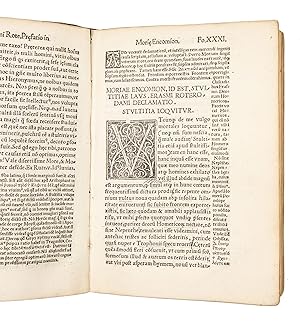
Aggiungi al carrelloHardcover. Condizione: Fine. Bound in contemporary limp vellum, lightly soiled. The contents are in very good condition with a few pencil annotations and light soiling to the title page. With Badius' device of his print shop, the "Praelum Ascensianum" showing printers working a press, on the title page. With large, attractive cr…ible initials, and smaller, charming historiated initials. Passages in Greek. A fine, unsophisticated copy of this rare edition. From the personal library of Bob and Emily De Graaf. The rare 1524 Parisian "Praise of Folly", printed by Erasmus' friend, the scholar-printer Badius Ascensius, who printed the first authorized edition in 1512. This edition contains all of the supplementary texts found in the Froben edition of 1519 (see the note "additional Moria texts" below), including the dedicatory letter to Thomas More and the letter to Martin Dorp in which Erasmus explains his motives for writing the "Moria": "My aim in the 'Folly' was exactly the same as in my other works. Only the presentation was different. In the 'Enchiridion' I simply outlined the pattern of a Christian life. In my little book, the 'Education of a Christian Prince', I offered plain advice on how to instruct a prince. In my 'Panegyric' I did the same under the veil of eulogy as I had done elsewhere explicitly. And in the 'Folly' I expressed the same ideas as in the 'Enchiridion', but in the form of a joke." "The 'Praise of Folly' is Erasmus' most famous and controversial work In Erasmus' lifetime, the 'Moria' was condemned in 1527 by the theologians of Paris for its attacks on faith and morality and again in 1533 by the Franciscans, who found it full of heresies. The officials of the Sorbonne put it on the list of condemned books in 1542 and 1543, a list that was the basis of the Tridentine Index of 1564 "The 'Moria' may start as a learned joke to amuse a fellow humanist [Thomas More] but it moves into sharp criticism of contemporary mores, and ends with a plea for a return to the Christianity of the Gospels Erasmus writes in a Lucianic spirit of irreverent burlesque of the gods of classical mythology and light-hearted amusement at the irrationality of mankind. Folly argues that she is all that is natural, youthful, fecund, and happy, and that life would be intolerable if it were not ruled by civilized conventions, which necessitate a degree of humbug and illusion. By contrast, the Stoic ideal, rational man is a 'kind of marble statue of a man, devoid of sense and any sort of human feeling.' She [then] shifts her viewpoint and lists the people who enjoy her benefits insofar as they try to preserve their illusions or are happy in their ignorance, self-deception, or self-love. She even adds superstitious piety to alchemy, gambling, and the nobility's obsession with hunting and extravagant building "[Next] Erasmus starts to deliver a sharp and often bitter attack on all the victims of blind folly, those who are deaf to the voice of true religion and lacking the gentler Christian virtues, among whom are sycophants, self-seekers, money-makers, pedants, scholastics, lawyers, theologians, superstitious worshippers of images and relics, courtiers and kings, worldly monks, and irreligious pontiffs. This section culminates in a savage thrust at Pope Julius II, the bellicose pope. The keen wit and ingenuity of the satire can be highly entertaining, but there is no note of gaiety now. As Erasmus surveys the gulf between the Church and the 'true philosophy of Christ' he moves into the final section, where the alternative offered to barren scholasticism is the vision of reality taken from Plato, and folly in the sense used by Saint Paul, that of receptivity to the Christian message by the 'fool in Christ.' All irony is dropped, until the final short epilogue when Folly light-heartedly cuts short her 'hotch-potch of words'; this is a direct and simply worded account of Erasmus' personal belief, moving into an exposition of the Neoplatonist concept that the soul's ascent to.
 Altre immagini
Editore: Ex Officina Theodori Maire, Hagae, 1641
- Rilegato
Da: Tavistock Books, ABAA, Reno, NV, U.S.A.Tavistock Books, ABAA
Contatta il venditoreVenditore con 5 stelleCondizione: Usato
EUR 743,62
EUR 6,56 spedizioneSpedito in U.S.A.Quantità: 1 disponibili
Aggiungi al carrello[3] - 22, 1 - 630, [76] pp. Indices at rear, T.p. printer device. Woodcut initial letters. Tailpieces. 12mo. *12 [- *1, *12] A - 2F12 2G6 [last leaf a blank]. 15 cm x 9.5 cm. Overall VG (unobtrusive vellum repair at head of spine). Period vellum with maroon leather spine label Editio Nova, à multis quibus antea scatebat mendis,…diligenter repurgata.
 Altre immagini
Lingua: Latino
Editore: John Hayes, Cambridge.Cantabrigiae, 1685
- Rilegato
Da: Terra Firma Books, San Diego, CA, U.S.A.Terra Firma Books
Contatta il venditoreVenditore con 5 stelleCondizione: Usato - Buono
EUR 179,37
EUR 5,24 spedizioneSpedito in U.S.A.Quantità: 1 disponibili
Aggiungi al carrelloHardcover. Condizione: Good. Very important FIRST PRINTING of 1685 published by John Hayes of Cambridge. Full leather binding; spine chipped; 400pp+index. Measures 3x5"/8x13cm).
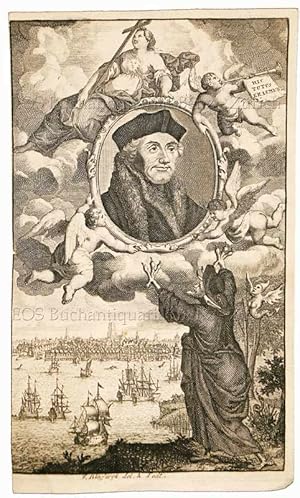
Editore: Um, 1600
- Arte / Stampa / Poster
Da: EOS Buchantiquariat Benz, Zürich, SvizzeraEOS Buchantiquariat Benz
Contatta il venditoreVenditore con 4 stelleCondizione: Usato
EUR 111,48
EUR 25,00 spedizioneSpedito da Svizzera a U.S.A.Quantità: 1 disponibili
Aggiungi al carrelloKupferstich (Brustbild) mit der Ansicht der Stadt Rotterdam von Bleujwyk (?). Blattgrösse: 14 x 8,5 cm. Knapp beschnitten. + Wichtig: Für unsere Kunden in der EU erfolgt der Versand alle 14 Tage verzollt ab Deutschland / Postbank-Konto in Deutschland vorhanden +.
[LEDERAUSGABE] Das Lob der Torheit. Eine Lehrrede. Übersetzung aus dem Lateinischen und Nachwort von Kurt Steinmann. Mit dreißig Zeichnungen von Hans Holbein d. J. 1. Auflage. (= Manesse Bibliothek der Weltliteratur) [Vorzugsausgabe in GANZLEDER]
Erasmus von Rotterdam [Desiderius Erasmus (1466, 1467 oder 1469-1536)]:
- Rilegato
Da: Antiquariat Lorang, Bamberg, BY, GermaniaAntiquariat Lorang
Contatta il venditoreVenditore con 5 stelleCondizione: Usato
EUR 60,00
EUR 105,00 spedizioneSpedito da Germania a U.S.A.Quantità: 1 disponibili
Aggiungi al carrelloManesse Verlag, Zürich, 2002. Grünes Original-Leder mit Rückenvergoldung, 317 Seiten, kl.8° (15,5 cm). Dünndruckpapier. Einband mit angedeuteten Gebrauchsspuren, Papier ohne Bräunungsspuren, Buchblock sauber (also ohne Unterstreichungen & Randglossen). Sehr schönes, ungelesenes Exemplar. Mit Kopfgoldschnitt und Lesebändchen. Zus…tand: wie neu. [STANDORT Manesse-Regal].
 Altre immagini
Editore: Hackius, Leiden and Rotterdam, 1664
Da: Abbey Antiquarian Books, Blockley, GLOS, Regno UnitoAbbey Antiquarian Books
Contatta il venditoreVenditore con 4 stelleCondizione: Usato - Molto buono
EUR 305,39
EUR 30,30 spedizioneSpedito da Regno Unito a U.S.A.Quantità: 1 disponibili
Aggiungi al carrelloCondizione: Very Good. Copperplate illustrated titlepage engraved by P.P. Octavo contemporary full vellum (washed), more recent neat MS spine label, All Edges Rouge. Engraved illustrated TP +[12]pp prelims (dedication by Erasmus to Froben dated Basel 1524, undated autobiographic "Vita Erasmi", and epitaph dated 1536) +784pp +[20…]pp Index. Text in Latin. Titlepage lightly browned at edges, small ink spot and number 49 written at foot, neat underlining in faded brown ink on most pages up to p454, else crisp and clean throughout. *One of 2 editions by Hackius in same year, this notable for last page of "Vita Erasmi" with 27 lines. Referenced by Graesse II.495, Van der Haeghen I, 40. Bibl. Erasmiana, Colloquia, 416. *Collection of dialogues (colloquia) written by Erasmus, edited by Dutchman Cornelis Schrevel (1608-1661) who added footnotes by various authors and the index. 1 volume. Hardcover.
[Moriae encomium] Lob der Narrheit, aus dem Lateinischen des Erasmus von Rotterdam, übersetzt und mit Anmerkungen begleitet von Wilhelm Gottlieb Becker. Mit 83 Holzschnitten, nach Holbeins Figuren neuerdings abgezeichnet. [Erstausgabe]
Erasmus von Rotterdam [Desiderius (1466-1536)] / / Becker, Wilhelm Gottlieb (1753-1813):
- Rilegato
Da: Antiquariat Lorang, Bamberg, BY, GermaniaAntiquariat Lorang
Contatta il venditoreVenditore con 5 stelleCondizione: Usato
EUR 225,00
EUR 105,00 spedizioneSpedito da Germania a U.S.A.Quantità: 1 disponibili
Aggiungi al carrelloBasel gedruckt mit Haasischen Schriften bei Johann Jacob Thurneysen, Jünger. M. DCC. LXXX (MDCCLXXX / 1780). Pappband der Zeit, [13 unpaginierte Blatt], 396 Seiten, 8° (20 cm). EA / erste Ausgabe (1918 erschien bei Georg Müller eine Faksimile-Ausgabe in der berühmten Reihe "Die Bücher der Abtei Thelem"). Frontispiz gestochen von… Samuel Gränicher, die Holzschnitte im Text sind von Heinrich Heitz. Druck in FRAKTUR (gebrochenen Lettern; "altdeutsch") auf Hadernpapier. Zeitgenössischer Einband mit Kleisterpapierbezug und zurückhaltender Rückenornamentierung und gedrucktem Rückenetikett (rot). Einband mit kleinen Gebrauchsspuren und leicht nachgedunkelt, beide Außenfalzen, beide Kapitale sowie die Kanten ein wenig berieben, Ecken leicht verbogen, Papier ohne Bräunungsspuren, Buchblock sauber (also ohne Unterstreichungen & Randglossen). Gleichwohl insgesamt sehr schönes Exemplar. Mit Rundum-Farbschnitt. [SW: Philosophie] [STANDORT Rara].

- Rilegato
- Print on Demand
Da: True World of Books, Delhi, IndiaTrue World of Books
Contatta il venditoreVenditore con 5 stelleCondizione: Nuovo
EUR 27,93
Spedizione gratuitaSpedito da India a U.S.A.Quantità: 18 disponibili
Aggiungi al carrelloLeatherBound. Condizione: New. BOOKS ARE EXEMPT FROM IMPORT DUTIES AND TARIFFS; NO EXTRA CHARGES APPLY. LeatherBound edition. Condition: New. Reprinted from 1641 edition. Leather Binding on Spine and Corners with Golden leaf printing on spine. NO changes have been made to the original text. This is NOT a retyped or an ocr'd repr…int. Illustrations, Index, if any, are included in black and white. Each page is checked manually before printing. Pages: 276 As this print on demand book is reprinted from a very old book, there could be some missing or flawed pages, but we always try to make the book as complete as possible. Fold-outs, if any, are not part of the book. If the original book was published in multiple volumes then this reprint is of only one volume, not the whole set. Sewing binding for longer life, where the book block is actually sewn (smythe sewn/section sewn) with thread before binding which results in a more durable type of binding. Pages: 276 Language: Latin.
De Lof Der Zotheid, Speelensgewys Beschreven Door Erasmus Van Rotterdam. Den Laatsten Druk Vermeerdert Met Het Heekel-Spel Van Den Verrezenen Diogenes. Beide uit 't Latyn vertaalt door F. van Hoogstraten. Verciert met Konstplaaten. (Twee delen in één band).
Erasmus, Desiderius (1466? - 1536), Comenius, J.A. (1592-1670).
Da: Fahrenheit 451 Antiquarian Booksellers, Nieuwerbrug, Paesi BassiFahrenheit 451 Antiquarian Booksellers
Contatta il venditoreVenditore con 4 stelleCondizione: Usato
EUR 300,00
EUR 36,00 spedizioneSpedito da Paesi Bassi a U.S.A.Quantità: 1 disponibili
Aggiungi al carrelloAd I: Amsterdam, Jacobus Verheyde, 1732, (14),160 pag., gegraveerde titel naar F. Lansvelt, 6 platen; Ad II. Amsterdam, Jan van Heekeren, 1719, 96 pag., (afwijkende) gegraveerde titel naar F. Lansvelt, contemporain perkament, klein octavo.
Vande vrye-wil. Tegen D. Martinus Luther. Den Tweeden Druck van veele fauten grootelijcks gesuyvert.
Da: Fahrenheit 451 Antiquarian Booksellers, Nieuwerbrug, Paesi BassiFahrenheit 451 Antiquarian Booksellers
Contatta il venditoreVenditore con 4 stelleCondizione: Usato
EUR 395,00
EUR 36,00 spedizioneSpedito da Paesi Bassi a U.S.A.Quantità: 1 disponibili
Aggiungi al carrelloAlckmaer, for P.P. van der Laen, 1669 (colophon: printed by P. de Wees), 2nd corrected ed., (2),116 pag., woodcut portrait of Erasmus on title-page, contemporary vellum, small octavo. = Upper half of the bookblock waterstained; occas. old underlinings.
Da: Fahrenheit 451 Antiquarian Booksellers, Nieuwerbrug, Paesi BassiFahrenheit 451 Antiquarian Booksellers
Contatta il venditoreVenditore con 4 stelleCondizione: Usato
EUR 550,00
EUR 36,00 spedizioneSpedito da Paesi Bassi a U.S.A.Quantità: 1 disponibili
Aggiungi al carrelloAmsterdam, W, Janssonius, 1621, 508,(4) pag., engraved title with portrait of Erasmus standing, contemporary overlapping vellum with author and title in ink on spine, 24mo= Quite a rare edition, with only 2 copies listed in STCN (Nijmegen and Rotterdam). Coffin, Western Civilizations II, p.463. Erasmus's famous 'Colloquies' is a… collection of humanistic dialogues on a wide variety of subjects, most of which explore man's reactions to other men through conversation. Erasmus, and his pupils, wrote on war, travel, religion, sleep, beggars, funerals, literature, and other topics. (Coffin) This work exposed some of Erasmus's humor through the invention of word games and rhetoric exercises used for education. It did so using everyday Latin dialogues to teach both language and moral values, making humanist ideas accessible to a wide audience. They also played a key role in spreading Renaissance humanism and subtly critiquing social and religious practices of the time. He wanted culture to serve as a model for those living during the Renaissance. Occasional small inkstains (all text well legible).
Erasmuspenning 1969 door Loekie Metz. ERASMUS 1969,
[Erasmus]. Metz, Loekie (1918-2004), Erasmus, Desiderius (1466/ 1467/ 1469-1536).
Da: Fahrenheit 451 Antiquarian Booksellers, Nieuwerbrug, Paesi BassiFahrenheit 451 Antiquarian Booksellers
Contatta il venditoreVenditore con 4 stelleCondizione: Usato
EUR 1250,00
EUR 36,00 spedizioneSpedito da Paesi Bassi a U.S.A.Quantità: 1 disponibili
Aggiungi al carrelloØ 65 mm, zilver, vz. In komvorm portret naar rechts / kz. Nar die de wereldbol omsluit met rondom op brede rand de tekst: Erasmus. = Erasmuspenning 1969, bij de 500e verjaardag van Erasmus, door Loekie (of Loukie) Metz, in de even prachtige als kostbare verzilverd bronzen variant van 65 mm. Hans de Koning, Penningcatalogus Loeki…e Metz, no.49: ERASMUS 1969, 25 en 65 mm, zilver en brons (LM en RKST). vz. In komvorm portret naar rechts / kz. Nar die de wereldbol omsluit met rondom op brede rand de tekst: Erasmus. "In 1969 was het vijfhonderd jaar geleden dat de grote Nederlandse humanist Desiderius Erasmus te Rotterdam werd geboren. Voor een groot publiek bleef hij voortleven door zijn satire op de menselijke dwaasheid: 'Laus Stultitiae' - De Lof der Zotheid -, waarvan al tijdens zijn leven 43 drukken verschenen. Op verschillende wijzen werd Erasmus in 1969 herdacht. In het kader van deze Erasmusherdenkingen verleende de Rotterdamse kunststichting opdracht een Erasmus-penning te ontwerpen aan de bekende beeldhouwster Louki Metz. De voorzijde van de (.) penning geeft, in een naar rechts gewend profiel, Erasmus treffend weer: met skeptisch opgetrokken wenkbrauwen, ingevallen wangen en dunne dichtgeknepen lippen, zoals wij hem kennen van portretten of uit sommige biografieën. De keerzijde heeft betrekking op 'de Lof der Zotheid' en toont, binnen het omschrift Erasmus, een nar, die de wereldbol omsluit." (bron: De Geuzenpenning, jrg. 23, no.1, 1973).Piet Esser - Tegen de golven in - IN: De Beeldenaar (1998, no.3, p.115ff): "Bij haar heb je altijd het gevoel dat zij ongecompliceerd, direct tot de aanval overgaat. Haar werk krijgt daardoor vaak iets overrompelends - en een heftigheid die je verbaast. (.) In haar beste penningen vloeien de erschillende vormdelen in een rijk spel van licht en donker in elkaar over. Ook al omdat ze van het begin af aan in brons denkt. Haar werk heeft dan ook vaak iets 'bloeiends'. (.) Holland is rijk aan goeie medailleurs. Maar haar penningen zitten boordevol met - Loekie Metz - en dat is heel wat! Je kan van haar penningen houden of niet - zelden zijn ze vervelend. Daarvoor zijn ze teveel geladen met spontaneïteit. (.) En nu lees ik op een doosje: Erasmus, 1969. Ja hoor dat is hem, en ik til hem in het licht. Wat een weelde aan hoge glanzen enWat een weelde aan hoge glanzen en fluwelen schaduwen. Alles bloeit aan deze penning als je hem langzaam wentelen laat. Deze is ook weer helemaal vorm geworden zonder enige vaagheid en heeft een fijnzinnige expressie vol levende intelligentie - de achterkant doet goed mee - en wat een plezierig gevoel om in de hand te houden.".


