

Importo totale (1 articolo articoli):
Destinazione ordine:

gill eric mary (9 risultati)
Vai alla pagina principale dei risultati di ricerca
Filtri di ricerca
Tipo di articolo
- Tutti i tipi di prodotto
- Libri (9)
- Riviste e Giornali (Nessun altro risultato corrispondente a questo perfezionamento)
- Fumetti (Nessun altro risultato corrispondente a questo perfezionamento)
- Spartiti (Nessun altro risultato corrispondente a questo perfezionamento)
- Arte, Stampe e Poster (Nessun altro risultato corrispondente a questo perfezionamento)
- Fotografie (Nessun altro risultato corrispondente a questo perfezionamento)
- Mappe (Nessun altro risultato corrispondente a questo perfezionamento)
- Manoscritti e Collezionismo cartaceo (Nessun altro risultato corrispondente a questo perfezionamento)
Condizioni Maggiori informazioni
- Nuovo (Nessun altro risultato corrispondente a questo perfezionamento)
- Come nuovo, Ottimo o Quasi ottimo (Nessun altro risultato corrispondente a questo perfezionamento)
- Molto buono o Buono (5)
- Discreto o Mediocre (Nessun altro risultato corrispondente a questo perfezionamento)
- Come descritto (4)
Legatura
- Tutte
- Rilegato (8)
- Brossura (Nessun altro risultato corrispondente a questo perfezionamento)
Ulteriori caratteristiche
Lingua (2)
Spedizione gratuita
Paese del venditore
Valutazione venditore
-

Eric Gill Last Essays
Lingua: Inglese
Editore: Jonathan Cape, London, 1943
Da: Turtle Creek Books and Sheet Music, Mississauga, ON, Canada
Valutazione del venditore 5 su 5 stelle

EUR 8,86
Spedizione EUR 9,47
Spedito da Canada a U.S.A.Quantità: 1 disponibili
Aggiungi al carrelloHardcover. Condizione: Very Good. Condizione sovraccoperta: Good. Hardcover 1st edition in this format, 4th impression. The book itself, with blue boards and silver titles, is in excellent shape. The dust jacket a little edgeworn and rubbed, and is price clipped. Last Essays was published posthumously by Jonathan Cape in London in 1942, two years after Eric Gill's death in November 1940. It is a slender volume of roughly 93 pages, illustrated with woodcuts and engravings, and carries an introduction by Gill's wife, Mary. The book brings together a collection of pieces written in the final period of Gill's life, some of which had not previously appeared in print. The contents include essays on Art, Work, Private Property, Education for What?, Peace and Poverty, Art in Education, Five Hundred Years of Printing, The Leisure State, and Secular and Sacred in Modern Industry.The essays are characteristic of Gill's broader intellectual project: a sustained attack on industrialism, the dehumanization of labour, and the separation of art from everyday working life. Gill was prophetic in his predictions about industrialism and capitalism, and deeply insightful on the relation of art to work, culture, industry, and God. Running through the collection is the argument that mechanized mass production had reduced the worker to a subhuman condition, stripping labour of its dignity and meaning. Gill believed that a genuine civilization could only be built on the foundation of craftwork, in which the hand and the mind remained united in the making of useful and beautiful things. These were not new ideas for Gill, but the essays in this volume represent his final articulation of them, written as his health was failing and as Europe descended into the Second World War, circumstances that lent his warnings about the consequences of industrial capitalism an additional urgency. The book went through multiple impressions, a measure of its readership during the war years, when questions about the nature of work, the relationship between the individual and the state, and the moral foundations of civilization were very much on people's minds. In 1947, Last Essays was brought together with an earlier collection, In a Strange Land, in a single volume presenting the first complete collection of Gill's essays.Eric Gill was born on February 22, 1882, in Brighton, Sussex, and died on November 17, 1940, in Uxbridge, Middlesex. He was a British sculptor, engraver, typographic designer, and writer, especially known for his elegantly styled lettering and typefaces and the precise linear simplicity of his stone carving.After an inventory following his death, his output was found to include over 750 carved inscriptions, more than 100 stone sculptures and reliefs, 1,000 engravings, several typeface designs, and 300 printed works including books, articles, and pamphlets.Gill was also a deeply controversial figure. In his personal diaries, Gill described his sexual abuse of his adolescent daughters, an incestuous relationship with at least one of his sisters, and bestiality. This aspect of Gill's life was little known beyond his family and friends until the publication of the 1989 biography by Fiona MacCarthy. Since those revelations, his legacy has been fiercely debated. Some institutions have removed or recontextualized his work; others continue to display it while acknowledging his crimes. The tension between the unquestionable significance of his artistic and typographic achievements and the gravity of his personal conduct remains unresolved. Regarding his wife Mary, Her contribution to Last Essays, the brief introduction she wrote for the 1942 volume, represents one of the few occasions on which her own voice entered the public record. As the person closest to Gill throughout his adult life and working career, she was uniquely placed to provide context for these final writings. The introduction allowed her to frame her late husband's last essays for readers who were encountering his ideas in the aftermath of his death, and to.
-

Essays: Last Essays and In a Strange Land
Editore: Jonathan Cape
Da: ThriftBooks-Atlanta, AUSTELL, GA, U.S.A.
Valutazione del venditore 5 su 5 stelle
Hardcover. Condizione: Good. No Jacket. Missing dust jacket; Pages can have notes/highlighting. Spine may show signs of wear. ~ ThriftBooks: Read More, Spend Less.
-
Reprint. Good copy in the original title-blocked cloth. Spine bands and panel edges somewhat dulled and rubbed as with age. Remains quite well-preserved overall. Physical description; 93 pages, 3 unnumbered pages : illustrations ; 19 cm. Subjects; Gill, Eric 1882-1940 ; Essays. Art Philosophy. Art and industry; Moral and ethical aspects. 3 Kg.
-
Essays
Editore: Jonathan Cape 1947, 1947
Da: Hard to Find Books NZ (Internet) Ltd., Dunedin, OTAGO, Nuova Zelanda
Membro dell'associazione: IOBA
Valutazione del venditore 5 su 5 stelle
EUR 12,68
Spedizione EUR 17,84
Spedito da Nuova Zelanda a U.S.A.Quantità: 1 disponibili
Aggiungi al carrelloOctavo hardcover (VG) in VG- d/w; all our specials have minimal description to keep listing them viable. They are at least reading copies, complete and in reasonable condition, but usually secondhand; frequently they are superior examples. Ordering more than one book will reduce your overall postage costs.
-
EUR 18,00
Spedizione EUR 13,95
Spedito da Irlanda a U.S.A.Quantità: 1 disponibili
Aggiungi al carrelloReprint. Good copy in the original title-blocked cloth. Spine bands and panel edges somewhat dulled and rubbed as with age. Remains quite well-preserved overall. Physical description; 93 pages, 3 unnumbered pages : illustrations ; 19 cm. Subjects; Gill, Eric 1882-1940 ; Essays. Art Philosophy. Art and industry; Moral and ethical aspects. 1 Kg.
-
Last Essays
Editore: Jonathan Cape, London, 1942
Da: Kerr & Sons Booksellers ABA, Cartmel, CMA, Regno Unito
Membro dell'associazione: ABA ILAB
Valutazione del venditore 5 su 5 stelle
Prima edizione
EUR 23,82
Spedizione EUR 34,69
Spedito da Regno Unito a U.S.A.Quantità: 1 disponibili
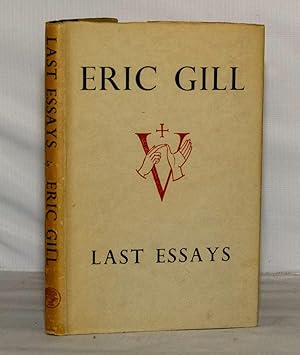
Aggiungi al carrelloHardcover. Condizione: Very Good. Condizione sovraccoperta: Good. 1st Edition. Small thin Octavo. 93pp. Publisher's blue cloth with silver gilt titles. In the white dust wrapper with black titles, some minor edge wear, discolouraton to spine. Wrapper clipped. With illustrations from drawings by Gill. Overall a Good copy.
-
Songs To Our Lady Of Silence
Editore: S. Dominic's Press, Ditchling, Sussex, 1921
Da: Alexander Books (ABAC/ILAB), Ancaster, ON, Canada
Membro dell'associazione: ABAC ILAB
Valutazione del venditore 5 su 5 stelle
EUR 110,90
Spedizione EUR 6,89
Spedito da Canada a U.S.A.Quantità: 1 disponibili
Aggiungi al carrelloHardcover. Condizione: Very Good. Eric Gill (illustratore). 2nd Edition. 55 Pages. Book.
-
Songs to Our Lady of Silence
Editore: S. Dominic's Press, Ditchling, Sussex, 1921
Da: Swan's Fine Books, ABAA, ILAB, IOBA, Walnut Creek, CA, U.S.A.
Membro dell'associazione: ABAA ILAB IOBA
Valutazione del venditore 5 su 5 stelle
Hardcover. Condizione: Very good +. Chute, Desmond (illustratore). Reprint of the 1920 edition, octavo size, 62 pp. The Saint Dominic's Press, founded by Harry (Hilary) Douglas Clarke Pepler, flourished at Ditchling, Sussex, from 1916 to 1936. The first home of the Press was "a disused stable", with a hundred-year-old Stanhope hand-press which supposedly had belonged to William Morris. Pepler endeavored to do everything possible by hand, believing that such would both produce the best results and also be a "more individual or 'humane'.product". He therefore "preferred the handpress to the machine, handmade to machine-made paper, and handset founder's type to the products of typesetting machines." Pepler met Edward Johnston and Eric Gill while living in Hammersmith; Pepler and his family would eventually move to Ditchling to join Gill, who was one of the most important artists to provide illustrations for the St. Dominic's Press. Other artists who provided illustrations included David Jones, Desmond Chute (whose style is very like Gill's), Philip Hagreen, and Mary Dudley Short, among others. While the text was first published by the Saint Dominic's in 1920, this the first printing in this format, "with five wood-engravings by Desmond Chute and press device by Gill." ___DESCRIPTION: Bound in grey textured paper over boards with a linen shelfback, title page with the Eric Gill press device, the five wood-engravings by Desmond Chute throughout; printed on Kelmscott handmade paper, octavo size (8 5/8" x 6"), pagination: [i-iv] 1-55 [1, colophon]. ___CONDITION: Better than very good, with clean boards, slightly bumped corners without rubbing, a strong, square text block with solid hinges, the interior is clean and bright, and entirely free of prior owner markings; the linen shelfback with some sunning (or perhaps offsetting from the glue) and the rear free endpaper has small hole (1/2" by 1/8") an inch from the fore-edge . ___CITATION: Taylor & Sewell no. A73a; Ransom, p. 50 (no. 33); note that the quotes and much of the introductory information from "Three Private Presses" by Brocard Sewell. ___POSTAGE: International customers, please note that additional postage may apply as the standard does not always cover costs; please inquire for details. ___Swan's Fine Books is pleased to be a member of the ABAA, ILAB, and IOBA and we stand behind every book we sell. Please contact us with any questions you may have, we are here to help.
-
From the Jerusalem Diary, dedication copy, and two copies of From the Palestine Diary; together with a collection of correspondence to the dedicatee.
Da: Peter Harrington. ABA/ ILAB., London, Regno Unito
Membro dell'associazione: ABA ILAB PBFA
Valutazione del venditore 5 su 5 stelle
Copia autografata
EUR 2.679,86
Spedizione EUR 25,44
Spedito da Regno Unito a U.S.A.Quantità: 1 disponibili
Aggiungi al carrelloA remarkable collection, including the dedication copy of the From the Jerusalem Diary, inscribed by the editor, Mary Gill, Eric Gill's widow, "To Austen St B. Harrison, with happy memories, from M.E.G.", with the Eric Gill-designed bookplate of Austen St Barbe Harrison to the front pastedown. Harrison, a close personal friend of Gill (1882-1940), was the architect with whom he collaborated on the design for the Rockefeller Museum in Jerusalem. In 1934, Gill was commissioned to carve ten panels for the museum, sculpt the fountain in the Central Court, and carve the English, Arabic, and Hebrew letters of the inscriptions throughout the building. Gill's designs symbolized "the civilizations of that have most affected the history of Palestine, together with the tympanum over the main entrance". The extracts from the diary he kept during his time there were published posthumously by his widow. It was preceded by an earlier version, From the Palestine Diary, printed by the Hague & Gill Press in 1949, of which two copies are here present. The Palestine Diary was subsequently abandoned, and only a small number of copies of the aborted edition now survive. René Hague, Gill's son-in-law, co-founder of the Press, and master printer, initally printed the sheets for the Harvill Press. However, "delays occurred and cancel title pages were printed . . . dated 1951 and 1952 [with the imprint 'High Wycombe | Hague Gill & Davey Ltd]" (Gill, pp. 87-8). These are present here, bound into copy (b). Bookseller G. F. Sims later purchased the surviving sheets and had them bound up by Sangorksi & Sutcliffe. In two letters to Harrison, Gill's other son-in-law and stone-carving assistant, Denis Tegetmeier, discusses the abandonment of the publication. Writing from Pigotts, Gill's home and workshop in High Wycombe, he explains that "there was an edition printed here but never bound or published, and minus the illustrations . . . I think the crisis which finally overtook the Press was responsible for the failure" (2 January 1959). The shortened version of the Palestine Diary, entitled From the Jerusalem Diary, was finally printed in 1953 by Linotype, with illustrations from photos of Gill's carvings. In Tegetmeier's second letter, dated 12 February 1959, he stresses the differences between the two publications: "the edition which was hand-set & printed here has really nothing to do with that printed by Linotype, which was produced privately, chiefly as a display of Eric's type 'Pilgrim' which they had recently acquired. The plan for producing an edition here, which was a much earlier & entirely different venture, proved abortive owing to the breakup of the Press & lack of funds to finance the binding etc. No blocks for the illus. were made & it only got as far as the printing of the letterpress". Accompanying the books are several pieces of correspondence from Mary Gill to Harrison: (i) Christmas card (1955), featuring a photo of Gill's carving of The Good Samaritan (1938) for Coventry Hospital, which was bombed in 1941; (ii) Christmas card (1960), featuring Joseph and the Child, with (iii) an autograph letter signed from Mary Gill, dated 21 December 1960 ("I feel very much immersed in our industrial world - of 1960 - with its noise, commercialism - and dangers . . . I know Eric would have hated it!"); (iv) poignantly, an autograph letter signed from Joanna Hague (Gill's daughter and wife of René Hague), dated 25 July 1961, informing Harrison of her mother's death on 22 March that year: Joanna explains the delay in writing to him ("I couldn't find your address among Mother's papers, but Bernard Wall . . . was able to give it to me . . . I don't think he knew what a close friend you were"). Gill 54a (revised edition); University of Michigan Official Publication, Volume 68, Issue 143, p. 310. Together 4 works, small octavo. Jerusalem Diary: 10 photogravures reproducing carvings by Eric Gill at the Rockefeller Museum courtyard. Two copies of From the Palestine Diary: (a) London: The Harvill Press, 1949. Original orange half morocco by Sangorski & Sutcliffe, orange cloth sides, title to spine gilt, top edge gilt; (b) As previous, wiith two cancel title pages: High Wycombe: Hague Gill & Davey Ltd, dated 1951 and 1952, bound in at rear. Original blue quarter morocco by Sangorski & Sutcliffe, patterned blue and gilt boards, title to spine gilt, fore edge uncut; (c) From the Jerusalem Diary. London: [privately printed,] 1953. Original orange cloth-backed green boards, title to front cover black. First edition, limited issue, number 234 of 300 copies; (d) folder of correspondence from Mary Gill to Austen St Barbe Harrison: two Christmas cards printed on single folded sheets of grey card; two autograph letter, one from Mary Gill and one from Joanna Hague (née Gill). Calligraphic bookplate of David Potter, designed by Reynold Stone, to front free endpapers of Jerusalem Diary and one copy of Palestine Diary. Very minor fading to spines and board edges, a little faint foxing to prelims, neatly repaired tear to p. 35/6 of Palestine Diaries. A very good set.


