

Importo totale (1 articolo articoli):
Destinazione ordine:

john williams anthony pasquin (14 risultati)
Vai alla pagina principale dei risultati di ricerca
Filtri di ricerca
Tipo di articolo
- Tutti i tipi di prodotto
- Libri (14)
- Riviste e Giornali (Nessun altro risultato corrispondente a questo perfezionamento)
- Fumetti (Nessun altro risultato corrispondente a questo perfezionamento)
- Spartiti (Nessun altro risultato corrispondente a questo perfezionamento)
- Arte, Stampe e Poster (Nessun altro risultato corrispondente a questo perfezionamento)
- Fotografie (Nessun altro risultato corrispondente a questo perfezionamento)
- Mappe (Nessun altro risultato corrispondente a questo perfezionamento)
- Manoscritti e Collezionismo cartaceo (Nessun altro risultato corrispondente a questo perfezionamento)
Condizioni Maggiori informazioni
- Nuovo (Nessun altro risultato corrispondente a questo perfezionamento)
- Come nuovo, Ottimo o Quasi ottimo (Nessun altro risultato corrispondente a questo perfezionamento)
- Molto buono o Buono (11)
- Discreto o Mediocre (1)
- Come descritto (2)
Legatura
Ulteriori caratteristiche
- Prima ed. (3)
- Copia autograf. (1)
- Sovracoperta (Nessun altro risultato corrispondente a questo perfezionamento)
- Con foto (9)
- Non Print on Demand (13)
Lingua (2)
Prezzo
- Qualsiasi prezzo
- Inferiore a EUR 20 (Nessun altro risultato corrispondente a questo perfezionamento)
- EUR 20 a EUR 45 (Nessun altro risultato corrispondente a questo perfezionamento)
- Superiore a EUR 45
Spedizione gratuita
- Spedizione gratuita in U.S.A. (Nessun altro risultato corrispondente a questo perfezionamento)
Paese del venditore
Valutazione venditore
-

A liberal critique on the present exhibition of the Royal Academy: being an attempt to correct the national taste; to ascertain the state of the Polite Arts at this Period; and to rescue Merit from Oppression. Nos I-III
Lingua: Inglese
Editore: H D Symonds and J McQueen, London, 1794
Da: Flora Books, Mears Ashby, Regno Unito
Valutazione del venditore 5 su 5 stelle

EUR 173,24
Spedizione EUR 34,33
Spedito da Regno Unito a U.S.A.Quantità: 1 disponibili
Aggiungi al carrelloHardcover. Condizione: Very Good. 148pp, half title, engraved portrait frontispiece and four other portrait plates, half title, modern grey paper covered boards, some light foxing and a few pages browned, small portion torn away from the fore-margin of one leaf (no loss), small hole in H2 with the loss of one letter, 8vo (215x132mm), ESTC T39160, No I was published seperately under the title above and the title page from a reissue of that issue (ESTC T40861) appears to have been used here rather than the title called for by T39160.
-
The Children Of Thespis, A Poem
Editore: Kirby and Co., London, 1792
Da: Willis Monie-Books, ABAA, Cooperstown, NY, U.S.A.
Membro dell'associazione: ABAA ESA ILAB
Valutazione del venditore 5 su 5 stelle
Hardcover. Condizione: Poor. Thirteenth Edition. Front cover and half-title page are detached but present. Rear spine edge is split. Covers have wear to the outer corners and spine ends. Bookplate in front has been removed. ; "With additional characters and emendations." Full leather covers.
-
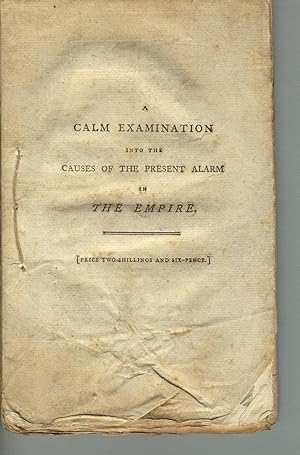
A calm examination into the causes of the present alarm in the empire. By a friend to his king and country
Lingua: Inglese
Data di pubblicazione: 1793
Da: Zamboni & Huntington, Bangor, ME, U.S.A.
Valutazione del venditore 5 su 5 stelle
Sewn. Condizione: Good. London: Printed for J. Bew, 1793. 9 x 5 5/8". 100pp. (including half-title). Sewn. First and last pages soiled, soiling in lower outside corners of first and last few leaves, a few leaves creased. Unopened. Good copy. Collated and complete. This work is attributed to "Anthony Pasquin," the pseudonym of satirist John Williams, on WorldCat, but neither NCBEL nor DNB list this title among Williams' publications.
-

The Children Of Thespis, A Poem
Editore: Kirby and Co., London, 1792
Da: Willis Monie-Books, ABAA, Cooperstown, NY, U.S.A.
Membro dell'associazione: ABAA ESA ILAB
Valutazione del venditore 5 su 5 stelle
Hardcover. Condizione: Good. Thirteenth Edition. Covers have general light wear, a little heavier to the rear outer edge. Spine has very small splits to the upper corners. ; Ownership signature of Ralph Hodgson on the front free endpaper. "With additional characters and emendations." Half leather covers with marbled boards.
-
SATIRES AND BIOGRAPHY.
Editore: London: Lackington & Allen, [1790-1800]., 1800
Da: Steve Finer - Rare Books, Greenfield, MA, U.S.A.
Membro dell'associazione: SNEAB
Valutazione del venditore 4 su 5 stelle

Prima edizione
Hardcover. Condizione: Good. No Jacket. 1st Edition. 8vo, contemporary (possibly original) boards, spine cover eroded off, moderate wear, covers detached, library blind stamp on title page. Containing the following: *THE NEW BRIGHTON GUIDE, 68pp. (1796); A LOOKING-GLASS FOR THE ROYAL FAMILY, engraved frontispiece dated 1797, 36pp. (1797); *SHROVE TUESDAY, 36pp. (1790); A CRYING EPISTLE FROM BRITANNIA TO COLONEL MACK, INCLUDING A NAKED PORTRAIT OF THE KING, QUEEN, AND PRINCE, WITH NOTES, POLITICAL, PHILOSOPHICAL AND PERSONAL. A NEW EDITION. 24pp. (1794); *THE LIFE OF THE LATE EARL OF BARRYMORE. INCLUDING A HISTORY OF THE WARGRAVE THEATRICALS, AND ORIGINAL ANECDOTES OF EMINENT PERSONS. THIRD EDITION. Engraved frontispiece, half-title, 120pp. (1793); *LEGISLATIVE BIOGRAPHY; OR AN ATTEMPT TO ASCERTAIN THE MERITS AND PRINCIPLES OF THE MOST ADMIRED ORATORS OF THE BRITISH SENATE. BEING INTENDED AS A COMPANION TO THE PARLIAMENTARY REPORTS. (London, 1795). Half-title, 64pp. The signature threads have broken, the entire copy thus is in need of being bound up. Pages untrimmed. Despite which, in effect, the production remains pretty much in original state. Williams led a remarkable career in writing and publishing, much of it in a fog of great controversy, starting around 1779, but his profile eventually induced the man, by default, to emigrate to the United States, winding up in Brooklyn, where he died in greatly reduced, abject circumstances.
-
THE NEW BRIGHTON GUIDE, Involving a Complete, Authentic, and Honourable Solution of the Recent Mysteries of Carlton House.
Editore: London: H.D. Symonds; T. Bellamy, 1796., 1796
Da: Minster Gate Bookshop (est. 1970), YORK, Regno Unito
Membro dell'associazione: PBFA
Valutazione del venditore 5 su 5 stelle
EUR 232,97
Spedizione EUR 21,46
Spedito da Regno Unito a U.S.A.Quantità: 1 disponibili
Aggiungi al carrelloCondizione: Very Good. Fourth edition, 8vo., pp.68, quarter leather, gilt, marbled boards, pictorial title; light toning to half title, with two small holes to inner margin, spine neatly repaired with papers, a very good copy.
-
Satires and Biography by Anthony Pasquin Esq.
Editore: London Lackington & Allen and H.D. Symonds ?, 1797
Da: J & S WILBRAHAM, LONDON, Regno Unito
Valutazione del venditore 5 su 5 stelle
EUR 238,95
Spedizione EUR 13,92
Spedito da Regno Unito a U.S.A.Quantità: 1 disponibili
Aggiungi al carrelloHardcover. Condizione: Very Good. 6 separate tracts in in volume with general title page engraved and with vignette by Bartolozzi as above, uncut in later 19th century half maroon morocco, spine gilt ruled with raised bands, marbled sides, main title page lightly waterstained at edge and laid down with a blank corner restored, minor rubbing to binding, a very good copy throughout, FIRST OR EARLY COLLECTED EDITION; there were evidently several such early collective editions of Pasquin's notorious satires, issued by Lackington or Symonds or both, but all collections are very rare. This one corresponds to a Cambridge issue dated to circa 1805, though it is probably earlier judging from the dates of the individual parts which were, of course, all issued separately and in various editions. The collection comprises: 1. The New Brighton Guide, 6th edion, 1796 [with engraved vignette title page]. 2. A Looking-glass for the Royal Family. 1797 [with etched frontispiece, lightly wtarestined to first margins]. 3. Shrove Tuesday, 1790. 4. A Crying Epistle from Brittania to Colonel Mack, ., new edition [1794?]. 5. The Life of the late Earl of Barrymore . 3rd edion, 1793. [with sepia etched portrait] 6. Legislative biography . 1795.
-
Poems: By Anthony Pasquin. In two volumes.
Editore: Printed for J. Strahan, Strand; W. Creech, Edinburgh; J. Exshaw, Dublin; and the Author, No. 125, Strand, London, 1789
Prima edizione
EUR 298,68
Spedizione EUR 30,15
Spedito da Regno Unito a U.S.A.Quantità: 1 disponibili
Aggiungi al carrelloHardcover. Condizione: Good. 1st Edition. Two volumes. London: Printed for J. Strahan, Strand; W. Creech, Edinburgh; J. Exshaw, Dublin; and the Author, No. 125, Strand, no date [1789]. First edition. xxxi,[i]203,[1]; 268pp. §Reached a second edition, same year. Copies in British Isles at BL, Dublin City Libraries, National Library of Scotland, Oxford Christ Church, Sheffield Central, & Brotherton, Leeds. Small paper loss to upper outer corner of E9 & E10, volume I, minor only. One inch closed tear to half-title of volume II; four binder's blank leaves bound after fly-leaf of the same volume. Uniformly bound in contemporary quarter calf, double labels, marbled boards, vellum tips, gilt lettering & decoration. Head of spines rubbed, some external cracking to joints, but sound. Loss to spine of volume I sometime externally repaired with a laid-in strip of leather, reasonably well done, if not beautiful. In all other respects, a very good set.
-
The Children of Thespis. A Poem
Editore: Denew and Grant, London, 1786
Da: Hirschfeld Galleries, Saint Louis, MO, U.S.A.
Valutazione del venditore 2 su 5 stelle

Copia autografata
Hardcover. Condizione: Very Good. John Williams (illustratore). 1st Edition Mixed Issue. The author claims that the editions of the book that appeared earlier under the same title [1786], were Book seller fabrications published in order to destroy the chances of his original work. In the same year that this book was published, Williams sued a London bookdealer for publishing a libel by Gifford which read: "he was so lost to every sense of decency and shame that his acquaintance was infamy and his touch poison." The Judge of the case decided in favor of the bookdealer, declaring ' It appears to me that the author of "The Baviad " has acted a very meritorious part in exposing this man ; and I do most earnestly wish and hope that some method will ere long be fallen upon to prevent all such unprincipled and mercenary wretches from going about unbridled in society to the great annoyance and disquietude of the public '. After the trial Williams emigrated to New York where he edited THE FEDERALIST. He died in poverty and obscurity in Brooklyn in 1818. ESTC T42298. in a 20th century fine 1/4 calf and marbled boards by Alan Grace of Surrey UK, a very good crisp copy in tall 4to. in 3 parts. The poems each feature its own engraved title page, first published 1786 the figure in the center is a demon about to chastize a statue of folly. A Political and literary tour de force on the current state of affairs in 18th century, argument and controversay abounded about the Poems, ending in a trial, which the author lost, upon which he departed for America and become a supporter of the New Nation and its liberties, now free from the corruptions and biases of the old world, however Williams never attained his former fame in his new found home, and died in obscurity and poverty in 1818. John Williams (1761-1818) was an English poet, satirist, journalist and miscellaneous writer, best known by the pseudonym of Anthony Pasquin. He was born in London on 28 April 1761, and was sent in 1771 to Merchant Taylors' School.[1] There he was beaten for an epigram on Mr. Knox, the third master. At the age of seventeen he was placed with a painter, but he gave up art to become an author and translator. When he was about eighteen he wrote a defence of David Garrick against William Kenrick, earning Garrick's friendship. About two years later he went to Ireland, and during his time in Dublin edited several periodical publications. He attacked the government in the Volunteers' Journal during the administration of the Duke of Rutland, a prosecution was started against him in 1784, and he was obliged to decamp, leaving the printers to face the judgment. The same year (1784) he was associated with Henry Bate Dudley in the Morning Herald. A violent quarrel broke out between them, and Williams wrote a satire on his antagonist, for which he was prosecuted, though the action did not proceed. In 1787 Williams accompanied his friend Pilon to France, and on his return he started a paper called The Brighton Guide. He next settled at Bath, Somerset, but again left in a hurry. For some years he contributed influential theatrical criticism to some of the London newspapers. In 1797 he appeared in the Court of King's Bench as plaintiff in an action against Robert Faulder, the bookseller, for a libel contained in William Gifford's poem The Baviad. In one of the notes Gifford, speaking of Williams, observed that 'he was so lost to every sense of decency and shame that his acquaintance was infamy and his touch poison.' In this cause the plaintiff was nonsuited, based the proof that was given of his having himself grossly libelled every respectable character in the kingdom, from the sovereign down to the lowest of his subjects. Lloyd Kenyon, 1st Baron Kenyon, who tried the case, commended Gifford. Williams emigrated to America shortly afterwards, and edited a New York newspaper called The Federalist. He died a poor man of typhus fever in Brooklyn, on 23 November 1818. By the Binder.
-
The Children Of Thespis, A Poem
Editore: Kirby And Co, London, 1792
Da: Harris & Harris Books, Clare, Suffolk, Regno Unito
Valutazione del venditore 5 su 5 stelle
EUR 776,58
Spedizione EUR 36,48
Spedito da Regno Unito a U.S.A.Quantità: 1 disponibili
Aggiungi al carrelloLeather Bound. Condizione: Very Good+. No Jacket. With additional characters and emendations. The thirteenth edition. A poem in three parts, part 1 - first published in 1785, part 2 - first published in 1787, part 3 - first published in 1788. Clean brown calf leather boards with spinal decoration and lettering in gilt to red panel to spine top. A little rubbing to spine tips (see pics). Early bookplate to front pastedown. No further inscriptions, stamps, etc. Half-title and title page present. Internally very clean and tightly bound.
-
Shrove Tuesday: A Satiric Rhapsody
Data di pubblicazione: 1790
Da: Amber Unicorn Books, Las Vegas, NV, U.S.A.
Valutazione del venditore 5 su 5 stelle
Pamphlet. Condizione: Very Good. 1794 Reprint of the 1790 Edition. 36pp. Date on last page, Feb. 15th 1794. Light toning and some foxing. Pain cover around Pamphlet then glued in titled card stock. More like kind British & American titles = abebooks> booksellers> amber unicorn> keyword = brit. Size: 8vo 8-1/4 x 4. Pamphlet.
-

The Eccentricities of John Edwin, Comedian. Collected from his Manuscripts, and enriched with several hundred original Anecdotes
Editore: London, Printed for J. Strahan [1791]., 1791
Da: Bernard Quaritch Ltd ABA ILAB, London, Regno Unito
Membro dell'associazione: ABA ILAB PBFA
Valutazione del venditore 5 su 5 stelle
Prima edizione
EUR 238,95
Spedizione EUR 37,12
Spedito da Regno Unito a U.S.A.Quantità: 1 disponibili
Aggiungi al carrello2 vols., 8vo., pp. viii, 326; iv, 349, [1], plus final advertisement leaf; engraved vignette of the comedic mask to the title; light offsetting throughout, a few blemishes to the titles, else a very good copy in contemporary half calf, lightly rubbed, chips to two corners of the spine label to vol. I without any loss of lettering, headcaps frayed; contemporary ink ownership inscription to titles.First edition of the earliest biography of the actor and singer John Edwin the elder (1749-1790), written by his friend, John Williams, journalist and author of the satirical collection of verse portraits The Children of Thespis (1786). Williams published both works under the pseudonym 'Anthony Pasquin' (Oxford DNB).Although Edwin is primarily remembered for his comic roles Dromio in The Comedy of Errors, Touchstone in As You Like It and the original Silvertongue in The Belle's Stratagem he took several tragic roles with, less celebrated, comedic effect. One such instance is recalled here: 'The next character he assumed was Romeo; but for want of a proper side scene, the lady, who enacted Juliet, was under the irksome necessity of delivering her amorous extacies from a ladder Edwin being then but a sort of novice in making love, and not knowing the delicate customs of Mantua, placed himself too immediately under the fair object of his idolatry, who was obliged in consequence to pay more attention to her petticoats than her author' (vol. I, pp.206-7).Williams had been a pupil under the engraver and caricaturist Matthew Darly, and many of his works are 'illustrated with frontispieces and vignettes drawn and/or engraved by him' (Oxford DNB); the vignette on the title of the present work is probably one such example. Language: English.
-
No. II. A Companion to the Exhibition of the Royal Academy Containing Critical Sketches of the Principal Paintings, with a Key to the Portraits.
Editore: Printed for the Author, 1797., 1797
Da: Michael S. Kemp, Bookseller, Sheerness, KENT, Regno Unito
Membro dell'associazione: PBFA
Valutazione del venditore 5 su 5 stelle
EUR 334,53
Spedizione EUR 46,40
Spedito da Regno Unito a U.S.A.Quantità: 1 disponibili
Aggiungi al carrello8vo. pp. title, iv, 19 - 32. Incomplete, presumed lacking pages 1 [or possibly 5] to 18. Unbound and partially unopened, as issued. Rare. This publication appears to be a companion to, or continuation of: `A companion to the exhibition of the Royal Academy, with a list of the principal portraits, M.DCC.XCVI.' `No. 1' (at head of title page), 2nd edition, (ESTC 479215), the only copy of which listed on ESTC and WorldCat is held at the National Art Library, Victoria & Albert Museum and that too is defective, ending at page 12.
-
A Pin-Basket to the Children of Thespis: part the fourth
Editore: H. D. Symonds and T. Bellamy, London, 1797
Da: Raven & Gryphon Fine Books, Hackett's Cove, NS, Canada
Valutazione del venditore 5 su 5 stelle
EUR 543,06
Spedizione EUR 17,57
Spedito da Canada a U.S.A.Quantità: 1 disponibili
Aggiungi al carrelloHardcover. Condizione: Very Good. A Pin-Basket to the Children of Thespis: part the fourth; Historical, Critical & Biographical; by John Williams, whose public appellation is Anthony Pasquin; London. Printed for H.D. Symonds, Paternoster-Row; and T. Bellamy. King-Street, Covent-Garden, 1797. The first part of this work was published in 1786. John Williams (17611818) was an English poet, satirist, journalist, and miscellaneous writer, best known by the pseudonym of Anthony Pasquin. The Dedication reads to the Noblemen and Gentlemen constituting that very Honorable Society, called The Literary Fund and it goes on for 28 pages. The poem, A Pin-Basket goes from page 29 to the Finis page 232. He was a very controversial person, tarting at a young age and continuing throughout his life. In 1771, he was beaten for an epigram on Mr. Knox, the third master. At the age of seventeen he was placed with a painter, but he gave up art to become an author and translator. When he was about eighteen he wrote a defence of David Garrick against William Kenrick, earning Garrick's friendship. About two years later he went to Ireland, and during his time in Dublin edited several periodical publications. He attacked the government in the Volunteers' Journal during the administration of the Duke of Rutland, a prosecution was started against him in 1784, and he was obliged to decamp, leaving the printers to face the judgment. The same year (1784) he was associated with Henry Bate Dudley in the Morning Herald. A violent quarrel broke out between them, and Williams wrote a satire on his antagonist, for which he was prosecuted, though the action did not proceed. In 1787 Williams accompanied his friend Pilon to France, and on his return he started a paper called The Brighton Guide. He next settled at Bath, Somerset, but again left in a hurry. For some years he contributed influential theatrical criticism to some of the London newspapers. In 1797 he appeared in the Court of King's Bench as plaintiff in an action against Robert Faulder, the bookseller, for a libel contained in William Gifford's poem The Baviad. In one of the notes Gifford, speaking of Williams, observed that 'he was so lost to every sense of decency and shame that his acquaintance was infamy and his touch poison.' In this cause, the plaintiff was nonsuited, based the proof that was given of his having himself grossly libelled every respectable character in the kingdom, from the sovereign down to the lowest of his subjects. Lloyd Kenyon, 1st Baron Kenyon, who tried the case, commended Gifford. Williams emigrated to America shortly afterwards and edited a New York newspaper called The Federalist. He died a poor man of typhus fever in Brooklyn, on 23 November 1818. This small format book, pages measuring 165mm X 100mm, is in very good condition. The full leather binding is a bit scuffed but overall very presentable and the title on the spine is quite readable. The book is very tight and stands on its own very well. The title page is mostly missing. A previous owner has handwritten the title page description on the first free endpaper, and the vignette from the title page has been pasted inside the front cover. The text block is clear with no staining or foxing. There are a few pencil notations. This book is extremely rare, with print-on-demand copies only available on the internet, at the time of this writing.


