Importo totale (1 articolo articoli):
Destinazione ordine:

johnson ben director (18 risultati)
Vai alla pagina principale dei risultati di ricerca
Filtri di ricerca
Tipo di articolo
- Tutti i tipi di prodotto
- Libri (4)
- Riviste e Giornali (Nessun altro risultato corrispondente a questo perfezionamento)
- Fumetti (Nessun altro risultato corrispondente a questo perfezionamento)
- Spartiti (Nessun altro risultato corrispondente a questo perfezionamento)
- Arte, Stampe e Poster (Nessun altro risultato corrispondente a questo perfezionamento)
- Fotografie (11)
- Mappe (Nessun altro risultato corrispondente a questo perfezionamento)
- Manoscritti e Collezionismo cartaceo (3)
Condizioni Maggiori informazioni
- Nuovo (Nessun altro risultato corrispondente a questo perfezionamento)
- Come nuovo, Ottimo o Quasi ottimo (1)
- Molto buono o Buono (1)
- Discreto o Mediocre (1)
- Come descritto (15)
Legatura
Ulteriori caratteristiche
- Prima ed. (Nessun altro risultato corrispondente a questo perfezionamento)
- Copia autograf. (Nessun altro risultato corrispondente a questo perfezionamento)
- Sovracoperta (Nessun altro risultato corrispondente a questo perfezionamento)
- Con foto (15)
- Non Print on Demand (18)
Lingua (2)
Spedizione gratuita
Paese del venditore
Valutazione venditore
-

Art from Ganondagan "The Village of Peace"
Lingua: Inglese
Editore: New York State Office of Parks
Da: Small World Books, Rochester, NY, U.S.A.
Valutazione del venditore 2 su 5 stelle

Soft cover. Condizione: Fine. Illustrated with Photos Ray Gonyea and Tim Johnson (illustratore). No copyright date, presumed 1986. Unmarked, clean, bright and tight copy. Red covers with silver lettering on front cover.
-
Reality of the Holy Spirit A Pentecost Celebration
Editore: The Lay Renewal Foundation, Atlanta, GA, 1968
Da: 4 THE WORLD RESOURCE DISTRIBUTORS, Springfield, MO, U.S.A.
Valutazione del venditore 5 su 5 stelle

Pamphlet. Condizione: Fair. A Personal Response Guide. Pamphlet 19 Pages, Cover Soiled; not marked; oblong; 24mo - over 5" - 5¾" Tall.
-

Hustle (Original still from the 1975 film)
Editore: Cinema International, London, 1976
Da: Royal Books, Inc., ABAA, Baltimore, MD, U.S.A.
Membro dell'associazione: ABAA ILAB
Valutazione del venditore 5 su 5 stelle
Fotografia
Vintage black-and-white still photograph from the 1976 UK release of the 1975 US film. Mimeo tag affixed to the verso, with layout annotations in manuscript pencil, and a UK distributor stamp. Lt. Phil Gaines (Reynolds) is a tough Los Angeles detective investigating the death of a young woman, and having a troubled relationship with a call girl (Deneuve). Features an early role by Robert Englund (Fred "Freddy" Krueger in the "Nightmar on Elm Street" films). An often overlooked entry in the late cycle of film noir. Set in California and shot on location there. 8 x 10 inches. About Near Fine. Grant US. Silver Classic Noir. Spicer US.
-
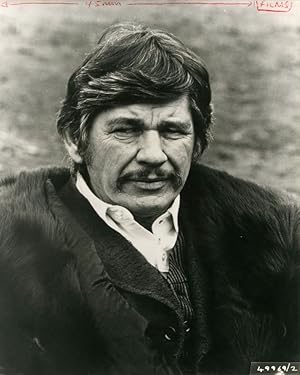
Breakheart Pass (Original photograph from the 1975 film)
Editore: United Artists, Beverly Hills, CA, 1976
Da: Royal Books, Inc., ABAA, Baltimore, MD, U.S.A.
Membro dell'associazione: ABAA ILAB
Valutazione del venditore 5 su 5 stelle
Fotografia
Vintage black-and-white still photograph from the 1976 UK release of the 1975 US film. Mimeograph snipe and layout annotations on the verso, and layout annotations on the recto. Based on Alistair MacLean's 1974 novel, starring Charles Bronson as John Deaken, a prisoner on a train with medical supplies and small US Army unit, heading through Rocky mountains. A story set in the Rocky Mountains, shot on location in Idaho. 8 x 10 inches. Near Fine.
-
Breakheart Pass (Original photograph from the 1975 film)
Editore: United Artists
Da: ThriftBooks-Atlanta, AUSTELL, GA, U.S.A.
Valutazione del venditore 5 su 5 stelle
Hardcover. Condizione: Good. No Jacket. Former library book; Pages can have notes/highlighting. Spine may show signs of wear. ~ ThriftBooks: Read More, Spend Less.
-

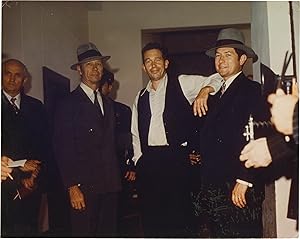
Dillinger (Original photograph from a re-release of the 1973 film)
Editore: American International Pictures [AIP], Los Angeles, 1979
Da: Royal Books, Inc., ABAA, Baltimore, MD, U.S.A.
Membro dell'associazione: ABAA ILAB
Valutazione del venditore 5 su 5 stelle
Fotografia
Vintage studio still photograph from a 1979 re-release of the 1973 film, showing Warren Oates mid-holdup, with a nun looking on with judgment on the left. A dramatization of the crimes of folk hero, midwestern bank robber, and notorious mobster John Dillinger, best known for killing five FBI agents during a shootout in Kansas City. Hot on the heels of Arthur Penn's "Bonnie and Clyde" (1967), a film that reignited the US public's interest in 1930s gangster films. Set and shot on location throughout Arizona and Oklahoma. 10 x 8 inches. Very Good plus, lightly soiled on the bottom margin.
-
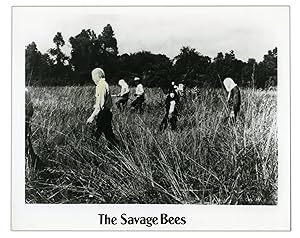
The Savage Bees (Eight photographs from the 1976 film)
Editore: National Broadcasting Company [NBC], London, 1978
Da: Royal Books, Inc., ABAA, Baltimore, MD, U.S.A.
Membro dell'associazione: ABAA ILAB
Valutazione del venditore 5 su 5 stelle
Fotografia
Eight vintage black-and-white still photographs from the 1978 release of the 1976 US television film. Mimeograph snipes affixed to the versos, with distributor rubber-stamps and layout annotations. Mardi Gras is interrupted by African killer bees! Ben Johnson is cast as the local sheriff, and would reprise his tenure with the bees in the 1978 follow-up, "The Swarm." Of the many "killer bee" films, this is regarded as one of the best. 8 x 10 inches. Near Fine.
-
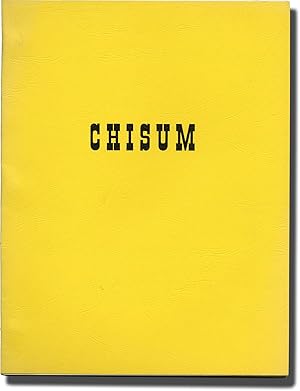
Chisum (Original screenplay for the 1970 film)
Editore: Warner Brothers, Burbank, CA, 1969
Da: Royal Books, Inc., ABAA, Baltimore, MD, U.S.A.
Membro dell'associazione: ABAA ILAB
Valutazione del venditore 5 su 5 stelle
Manoscritto / Collezionismo cartaceo
Draft script for the 1970 film. An older rancher is threatened by bandits stealing his cattle. Together with Pat Garrett and Billy the Kid, he participates in the Lincoln County War, a war against a dry goods monopoly that attempted to control cattle and water supplies as well, which had sprung up in the New Mexico territory and led to great bloodshed. Set in New Mexico territory, shot on location in California, Arizona, and New Mexico, USA. Yellow titled wrappers. Title page present, with credits for screenwriter Andrew J. Fenady. 140 leaves, with last page of text numbered 137. Mechanical duplication, with green, blue, and pink revision pages throughout, dated variously between June 25, 1969 and November 3, 1969. Pages Near Fine, wrapper Near Fine bound internally with three gold brads.
-
![Immagine del venditore per Kid Blue [Dime Box] (Original screenplay for the 1973 film) venduto da Royal Books, Inc., ABAA](https://pictures.abebooks.com/inventory/md/md32191491081.jpg)
Kid Blue [Dime Box] (Original screenplay for the 1973 film)
Editore: Twentieth Century-Fox, Los Angeles, 1973
Da: Royal Books, Inc., ABAA, Baltimore, MD, U.S.A.
Membro dell'associazione: ABAA ILAB
Valutazione del venditore 5 su 5 stelle
Manoscritto / Collezionismo cartaceo
Final shooting script for the 1973 film. Here under the working title "Dime Box," with "Kid Blue" written above that in manuscript ink on the front wrapper. With his cowboy days suddenly behind him, as the American West becomes tame, Kid Blue decides to try his hand at a factory job. He finds the routine workday to be monotonous and soon drifts back to the life he knew. Set in Texas, shot on location in Mexico. Orange titled wrappers. Title page present, dated September 20, 1971, noted as FINAL SHOOTING SCRIPT, with credits for screenwriter Edwin Shrake. 126 leaves, with last page of text numbered 125. Mechanical duplication. Pages Near Fine, wrapper Very Good plus bound internally with three gold brads.
-
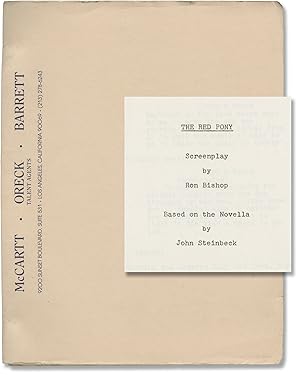
The Red Pony (Original screenplay for the 1973 television movie)
Editore: Omnibus Productions Inc. / National Broadcasting Company [NBC], Los Angeles, 1972
Da: Royal Books, Inc., ABAA, Baltimore, MD, U.S.A.
Membro dell'associazione: ABAA ILAB
Valutazione del venditore 5 su 5 stelle
Manoscritto / Collezionismo cartaceo
Second Draft script for the 1973 television movie, which originally aired on March 18, 1973, on NBC. Working copy belonging to screenwriter Ron Bishop, with an annotation in manuscript pencil on the title page, noting "Bishop only," and 18 manuscript revision pages in Bishop's hand laid in. Based on the 1937 novella by John Steinbeck, filmed once before by Lewis Milestone in 1949. Winner of two Primetime Emmy awards and nominated for seven more. Shot on location in Sonora, California. Beige generic agency wrappers. Title page present, undated, noted as Second Draft, with credits for screenwriter Ron Bishop and novelist John Steinbeck. 126 leaves, with last page of text numbered 124. Xerographic duplication, rectos only, with 18 undated manuscript revision pages laid in. Pages Near Fine, wrapper Near Fine, bound internally with two gold brads.
-
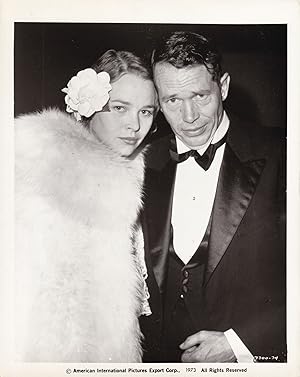
Dillinger (Original photograph from the 1973 film)
Editore: American International Pictures [AIP], Los Angeles, 1973
Da: Royal Books, Inc., ABAA, Baltimore, MD, U.S.A.
Membro dell'associazione: ABAA ILAB
Valutazione del venditore 5 su 5 stelle
Fotografia
Vintage reference photograph from the 1973 film, showing actors Warren Oates and Michelle Phillips. A dramatization of the crimes of folk hero, midwestern bank robber, and notorious mobster John Dillinger, best known for killing five FBI agents during a shootout in Kansas City. Hot on the heels of Arthur Penn's "Bonnie and Clyde" (1967), a movie that reignited the US public's interest in 1930s gangster films. Set and shot on location throughout Arizona and Oklahoma. 8 x 10 inches. Near Fine.
-
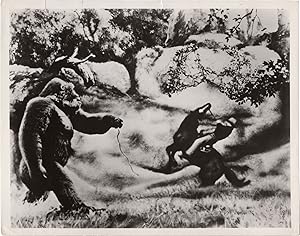
Mighty Joe Young (Original photograph from the 1949 film)
Editore: RKO Radio Pictures, Culver City, CA, 1949
Da: Royal Books, Inc., ABAA, Baltimore, MD, U.S.A.
Membro dell'associazione: ABAA ILAB
Valutazione del venditore 5 su 5 stelle
Fotografia
Vintage reference photograph from the 1949 film, showing the titular gorilla facing off against a man on a rearing horse. Printed mimeo snipe and RKO Radio Pictures stamp on the verso. From the archive of film historian and author Joel Finler. A stop-motion monster fantasy film created in the wake of the massive success of Radio Pictures' "King Kong" (1933), even using the same director-screenwriter-producer team. A young woman heads to Hollywood with her pet gorilla named Joseph, hoping to make enough money to save her ranch home in Africa. When a seedy nightclub entrepreneur proposes the gorilla be used as part of his nightclub's entertainment, it seems like an easy way to make money-but Joe is miserable, as he is mistreated and unhappy in America. Received an Academy Award in 1950 for Best Special Effects. Set in Hollywood. 10 x 8 inches. About Very Good plus, with short closed tears at the edges and creases at the corners.
-
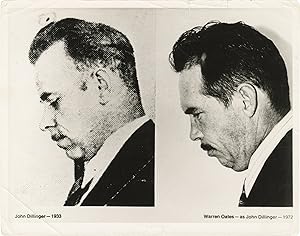
Dillinger (Original photograph from the 1973 film)
Editore: American International Pictures [AIP], Los Angeles, 1973
Da: Royal Books, Inc., ABAA, Baltimore, MD, U.S.A.
Membro dell'associazione: ABAA ILAB
Valutazione del venditore 5 su 5 stelle
Fotografia
Vintage reference photograph from the 1973 film, showing a side-by-side comparison of John Dillinger and actor Warren Oates in costume as Dillinger. With a printed mimeo snipe affixed to the verso. A dramatization of the crimes of folk hero, midwestern bank robber, and notorious mobster John Dillinger, best known for killing five FBI agents during a shootout in Kansas City. Hot on the heels of Arthur Penn's "Bonnie and Clyde" (1967), a movie which reignited the US public's interest in 1930s gangster films. Set and shot on location throughout Arizona and Oklahoma. 10 x 8 inches. Very Good plus, with light creases and curling.
-

The Last Picture Show (Original photograph from the 1971 film, showing Peter Bogdanovich talking with Cybill Shepherd on the set)
Editore: Columbia Pictures, Culver City, CA, 1971
Da: Royal Books, Inc., ABAA, Baltimore, MD, U.S.A.
Membro dell'associazione: ABAA ILAB
Valutazione del venditore 5 su 5 stelle
Fotografia
Vintage studio still photograph from the 1971 film, showing actress Cybill Shepherd talking with director Peter Bogdanovich. Annotations in manuscript ink on the verso. Based on Larry McMurtry's 1966 semi-autobiographical novel, following the everyday lives of three directionless teenagers in a small, lonely Texan town. Peter Bogdanovich's directorial breakthrough, one of the defining films about Texas and the American Southwest, shot in black-and-white on location in Archer City, Texas. Winner of two Academy Awards for actors Ben Johnson and Cloris Leachman, and nominated for another six. 10 x 8 inches. Near Fine, lightly worn at the corners. National Film Registry. Criterion Collection 549. Ebert III.
-

The Getaway (Original photograph of Sam Peckinpah on the set of the 1972 film)
Editore: National General Pictures, New York, 1972
Da: Royal Books, Inc., ABAA, Baltimore, MD, U.S.A.
Membro dell'associazione: ABAA ILAB
Valutazione del venditore 5 su 5 stelle
Fotografia
Vintage double weight matte-finish reference photograph from the set of the 1972 film showing director Sam Peckinpah at work on location. Peckinpah at the peak of his powers, a ballet of violence, and to date easily the finest adaptation of a Jim Thompson novel ever produced. Other grand alliances made this one of the great crime films of New Hollywood Cinema, including a supremely confident Steve McQueen as an anti-hero, and a young Walter Hill-who first encountered McQueen on the set of "Bullitt" 4 years prior-handling the screenplay. Approximately 10 x 8 inches. Near Fine. Lee, The Heist Film. Spicer Neo-Noir US. Silver and Ward Neo-Noir US. Grant US.
-
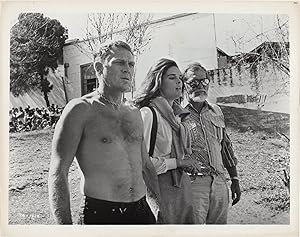
The Getaway (Original photograph of Sam Peckinpah, Steve McQueen, and Ali McGraw on the set of the 1972 film)
Editore: National General Pictures, New York, 1972
Da: Royal Books, Inc., ABAA, Baltimore, MD, U.S.A.
Membro dell'associazione: ABAA ILAB
Valutazione del venditore 5 su 5 stelle
Fotografia
Vintage reference photograph from the set of the 1972 film, showing director Sam Peckinpah with actors Steve McQueen and Ali McGraw. With a mimeo snipe on the verso. Peckinpah at the peak of his powers, a ballet of violence, and to date easily the finest adaptation of a Jim Thompson novel ever produced. Other grand alliances made this one of the great crime films of New Hollywood Cinema, including a supremely confident Steve McQueen as an anti-hero, and a young Walter Hill-who first encountered McQueen on the set of "Bullitt" 4 years prior-handling the screenplay. Approximately 10 x 8 inches. Near Fine. Lee, The Heist Film. Spicer Neo-Noir US. Silver and Ward Neo-Noir US. Grant US.
-
Dillinger (Original oversize photograph from the 1973 film)
Editore: American International Pictures [AIP], Los Angeles, 1973
Da: Royal Books, Inc., ABAA, Baltimore, MD, U.S.A.
Membro dell'associazione: ABAA ILAB
Valutazione del venditore 5 su 5 stelle
Fotografia
Vintage oversize borderless color reference photograph from the 1973 film, showing actor Warren Oates and director John Milius between takes. Stamp of Rossel Films on the verso. A dramatization of the crimes of folk hero, midwestern bank robber, and notorious mobster John Dillinger, best known for killing five FBI agents during a shootout in Kansas City. Hot on the heels of Arthur Penn's "Bonnie and Clyde" (1967), a film that reignited the US public's interest in 1930s gangster films. Set and shot on location throughout Arizona and Oklahoma. 12 x 9.5 inches. Pinholes at the top corners, else about Near Fine.
-
![Immagine del venditore per Wagon Master [Wagonmaster] (Original mini-banner poster for the 1950 film) venduto da Royal Books, Inc., ABAA](https://pictures.abebooks.com/inventory/md/md31747325262.jpg)
Wagon Master [Wagonmaster] (Original mini-banner poster for the 1950 film)
Editore: RKO Radio Pictures, Los Angeles, 1950
Da: Royal Books, Inc., ABAA, Baltimore, MD, U.S.A.
Membro dell'associazione: ABAA ILAB
Valutazione del venditore 5 su 5 stelle
Vintage mini-banner poster for the 1950 Western film. Two cowboys join a wagon train and find themselves forced to defend the group against outlaws, attacking tribes, and foul weather. Basis for the 1957-1965 television series, "Wagon Train," with actor Ward Bond returning to star as the wagon master until his death in 1960. A film which received tepid critical response upon release in 1950, but which was considered by director John Ford to be one of his favorites, and has since been reconsidered as one of Ford's masterpieces. Shot on location in Arizona and Utah. 4.75 x 28 inches. Very Good plus, with light creasing at the extremities. Rosenbaum 1000.