

Importo totale (1 articolo articoli):
Destinazione ordine:

noges peeter (44 risultati)
Vai alla pagina principale dei risultati di ricerca
Filtri di ricerca
Tipo di articolo
- Tutti i tipi di prodotto
- Libri (44)
- Riviste e Giornali (Nessun altro risultato corrispondente a questo perfezionamento)
- Fumetti (Nessun altro risultato corrispondente a questo perfezionamento)
- Spartiti (Nessun altro risultato corrispondente a questo perfezionamento)
- Arte, Stampe e Poster (Nessun altro risultato corrispondente a questo perfezionamento)
- Fotografie (Nessun altro risultato corrispondente a questo perfezionamento)
- Mappe (Nessun altro risultato corrispondente a questo perfezionamento)
- Manoscritti e Collezionismo cartaceo (Nessun altro risultato corrispondente a questo perfezionamento)
Condizioni Maggiori informazioni
- Nuovo (34)
- Come nuovo, Ottimo o Quasi ottimo (7)
- Molto buono o Buono (2)
- Discreto o Mediocre (Nessun altro risultato corrispondente a questo perfezionamento)
- Come descritto (1)
Legatura
Ulteriori caratteristiche
- Prima ed. (Nessun altro risultato corrispondente a questo perfezionamento)
- Copia autograf. (Nessun altro risultato corrispondente a questo perfezionamento)
- Sovracoperta (Nessun altro risultato corrispondente a questo perfezionamento)
- Con foto (20)
- Non Print on Demand (24)
Lingua (1)
Spedizione gratuita
- Spedizione gratuita in U.S.A. (Nessun altro risultato corrispondente a questo perfezionamento)
Paese del venditore
Valutazione venditore
-

European Large Lakes. Ecosystem Changes and Their Ecological and Socioeconomic Impacts
Da: Research Ink, Takoma Park, MD, U.S.A.
Valutazione del venditore 5 su 5 stelle

Hardback. Condizione: Very Good. iii + 276 pp. Developments in Hydrobiology, 199. Rubber-stamped on front free endpaper. book.
-
European Large Lakes: Ecosystem changes and their ecological and socioeconomic impacts. (=Developments in Hydrobiology; Vol.199).
Da: Antiquariat Thomas Haker GmbH & Co. KG, Berlin, Germania
Membro dell'associazione: GIAQ
Valutazione del venditore 5 su 5 stelle
AffareEUR 15,04
Spedizione EUR 30,00
Spedito da Germania a U.S.A.Quantità: 1 disponibili
Aggiungi al carrelloHardcover. Condizione: Wie neu. 283 S. Like new. Shrink wrapped. Sprache: Englisch Gewicht in Gramm: 1005.
-
European Large Lakes: Ecosystem changes and their ecological and socioeconomic impacts (Developments in Hydrobiology, 199)
Da: Ria Christie Collections, Uxbridge, Regno Unito
Valutazione del venditore 5 su 5 stelle
EUR 163,72
Spedizione EUR 13,81
Spedito da Regno Unito a U.S.A.Quantità: Più di 20 disponibili
Aggiungi al carrelloCondizione: New. In.
-
European Large Lakes : Ecosystem Changes and Their Ecological and Socioeconomic Impacts
Da: GreatBookPrices, Columbia, MD, U.S.A.
Valutazione del venditore 5 su 5 stelle
Condizione: New.
-

European Large Lakes : Ecosystem Changes and Their Ecological and Socioeconomic Impacts
Da: GreatBookPrices, Columbia, MD, U.S.A.
Valutazione del venditore 5 su 5 stelle
Condizione: As New. Unread book in perfect condition.
-
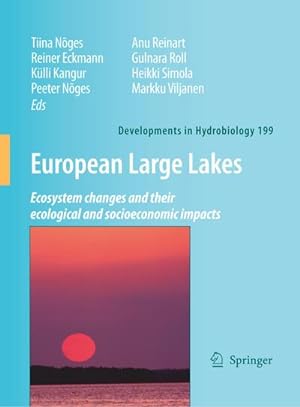
European Large Lakes
Lingua: Inglese
Editore: Springer Netherlands Mrz 2008, 2008
ISBN 10: 1402083785 ISBN 13: 9781402083785
Da: BuchWeltWeit Ludwig Meier e.K., Bergisch Gladbach, Germania
Valutazione del venditore 5 su 5 stelle
EUR 160,49
Spedizione EUR 23,00
Spedito da Germania a U.S.A.Quantità: 2 disponibili
Aggiungi al carrelloBuch. Condizione: Neu. Neuware -Large lakes are important because of their size and ecological distinctiveness as well as their economic and cultural value. Optimal management of them requires a proper understanding of anthropogenic impacts both on the lake ecosystems as such and on the services they provide for society. The specific structural and functional properties of large lakes, e.g. morphology, hydrography, biogeochemical cycles and food-web structure, are all directly related to their size. Although large lakes are among the best-studied ecosystems in the world, the application to them of environmental regulations such as the European Water Framework Directive is a challenging task and requires that several natural and management aspects specific to these water bodies are adequately considered. These vulnerable ecosystems often suffer from accelerated eutrophication, over-fishing, toxic contamination and invasive species. Large lakes offer socio-economic benefits and can be used in many ways, and are often areas in which economic, cultural and political interests overlap. In this book the problems regarding the present status of European large lakes and the directions of change are discussed. Threats caused by direct human impact and by climate change, protection needs and restoration measures are considered. 288 pp. Englisch.
-
European Large Lakes : Ecosystem Changes and Their Ecological and Socioeconomic Impacts
Da: GreatBookPrices, Columbia, MD, U.S.A.
Valutazione del venditore 5 su 5 stelle
Condizione: New.
-

Assessment of the ecological status of European surface waters (Developments in Hydrobiology, 209)
Da: Books Puddle, New York, NY, U.S.A.
Valutazione del venditore 4 su 5 stelle

Condizione: New. pp. 211.
-

EUR 140,00
Spedizione EUR 70,00
Spedito da Germania a U.S.A.Quantità: 5 disponibili
Aggiungi al carrelloTaschenbuch. Condizione: Neu. Assessment of the ecological status of European surface waters | Peeter Nõges (u. a.) | Taschenbuch | vi | Englisch | 2012 | Springer | EAN 9789400731585 | Verantwortliche Person für die EU: Springer Verlag GmbH, Tiergartenstr. 17, 69121 Heidelberg, juergen[dot]hartmann[at]springer[dot]com | Anbieter: preigu.
-
Condizione: New. pp. viii + 276.
-

EUR 115,09
Spedizione EUR 105,00
Spedito da Germania a U.S.A.Quantità: 1 disponibili
Aggiungi al carrelloCondizione: Sehr gut. Zustand: Sehr gut | Sprache: Englisch | Produktart: Bücher | The complex impact that man has on aquatic ecosystems creates a need for assessment systems that are able to adequately appraise and integrate the effects of various pressures. Chemical analysis alone can easily overlook some factors vital for life. With the adoption of the EU Water Framework Directive (WFD) in the year 2000 which defined the ecological status of surface water as ¿¿¿ an expression of the quality of the structure and functioning of aquatic ecosystems associated with surface waters", biological indicators were brought to the forefront for the first time and became drivers to the water management practices.Assessment of ecological status and quantification of its relationships with anthropogenic pressures critically depend on knowledge of relevant biotic and abiotic settings and processes. Needs raised by the implementation of WFD have urged scientific research in many fields in order to find more stable and robust biological metrics and to diminish the uncertainty of assessment results. The number of WFD related scientific publications has increased linearly and exceeded 1500 in the year 2008. This book comprises a small set of this large flow of publications and is mainly focused on the development of biological assessment methods and intercalibration of the assessment results.
-
EUR 118,54
Spedizione EUR 105,00
Spedito da Germania a U.S.A.Quantità: 1 disponibili
Aggiungi al carrelloCondizione: Hervorragend. Zustand: Hervorragend | Sprache: Englisch | Produktart: Bücher | The complex impact that man has on aquatic ecosystems creates a need for assessment systems that are able to adequately appraise and integrate the effects of various pressures. Chemical analysis alone can easily overlook some factors vital for life. With the adoption of the EU Water Framework Directive (WFD) in the year 2000 which defined the ecological status of surface water as ¿¿¿ an expression of the quality of the structure and functioning of aquatic ecosystems associated with surface waters", biological indicators were brought to the forefront for the first time and became drivers to the water management practices.Assessment of ecological status and quantification of its relationships with anthropogenic pressures critically depend on knowledge of relevant biotic and abiotic settings and processes. Needs raised by the implementation of WFD have urged scientific research in many fields in order to find more stable and robust biological metrics and to diminish the uncertainty of assessment results. The number of WFD related scientific publications has increased linearly and exceeded 1500 in the year 2008. This book comprises a small set of this large flow of publications and is mainly focused on the development of biological assessment methods and intercalibration of the assessment results.
-

EUR 168,73
Spedizione EUR 62,35
Spedito da Germania a U.S.A.Quantità: 1 disponibili
Aggiungi al carrelloTaschenbuch. Condizione: Neu. Druck auf Anfrage Neuware - Printed after ordering - The complex impact that man has on aquatic ecosystems creates a need for assessment systems that are able to adequately appraise and integrate the effects of various pressures. Chemical analysis alone can easily overlook some factors vital for life. With the adoption of the EU Water Framework Directive (WFD) in the year 2000 which defined the ecological status of surface water as ''. an expression of the quality of the structure and functioning of aquatic ecosystems associated with surface waters', biological indicators were brought to the forefront for the first time and became drivers to the water management practices.Assessment of ecological status and quantification of its relationships with anthropogenic pressures critically depend on knowledge of relevant biotic and abiotic settings and processes. Needs raised by the implementation of WFD have urged scientific research in many fields in order to find more stable and robust biological metrics and to diminish the uncertainty of assessment results. The number of WFD related scientific publications has increased linearly and exceeded 1500 in the year 2008. This book comprises a small set of this large flow of publications and is mainly focused on the development of biological assessment methods and intercalibration of the assessment results.
-

EUR 168,73
Spedizione EUR 63,51
Spedito da Germania a U.S.A.Quantità: 1 disponibili
Aggiungi al carrelloTaschenbuch. Condizione: Neu. Druck auf Anfrage Neuware - Printed after ordering - Large lakes are important because of their size and ecological distinctiveness as well as their economic and cultural value. Optimal management of them requires a proper understanding of anthropogenic impacts both on the lake ecosystems as such and on the services they provide for society. The specific structural and functional properties of large lakes, e.g. morphology, hydrography, biogeochemical cycles and food-web structure, are all directly related to their size. Although large lakes are among the best-studied ecosystems in the world, the application to them of environmental regulations such as the European Water Framework Directive is a challenging task and requires that several natural and management aspects specific to these water bodies are adequately considered. These vulnerable ecosystems often suffer from accelerated eutrophication, over-fishing, toxic contamination and invasive species. Large lakes offer socio-economic benefits and can be used in many ways, and are often areas in which economic, cultural and political interests overlap. In this book the problems regarding the present status of European large lakes and the directions of change are discussed. Threats caused by direct human impact and by climate change, protection needs and restoration measures are considered.
-

Assessment of the ecological status of European surface waters
Lingua: Inglese
Editore: Springer Netherlands, Springer Netherlands, 2010
ISBN 10: 9048185777 ISBN 13: 9789048185771
EUR 168,73
Spedizione EUR 63,44
Spedito da Germania a U.S.A.Quantità: 1 disponibili
Aggiungi al carrelloBuch. Condizione: Neu. Druck auf Anfrage Neuware - Printed after ordering - The complex impact that man has on aquatic ecosystems creates a need for assessment systems that are able to adequately appraise and integrate the effects of various pressures. Chemical analysis alone can easily overlook some factors vital for life. With the adoption of the EU Water Framework Directive (WFD) in the year 2000 which defined the ecological status of surface water as ''. an expression of the quality of the structure and functioning of aquatic ecosystems associated with surface waters', biological indicators were brought to the forefront for the first time and became drivers to the water management practices.Assessment of ecological status and quantification of its relationships with anthropogenic pressures critically depend on knowledge of relevant biotic and abiotic settings and processes. Needs raised by the implementation of WFD have urged scientific research in many fields in order to find more stable and robust biological metrics and to diminish the uncertainty of assessment results. The number of WFD related scientific publications has increased linearly and exceeded 1500 in the year 2008. This book comprises a small set of this large flow of publications and is mainly focused on the development of biological assessment methods and intercalibration of the assessment results.
-
European Large Lakes: Ecosystem changes and their ecological and socioeconomic impacts (Developments in Hydrobiology, 199)
Da: Ria Christie Collections, Uxbridge, Regno Unito
Valutazione del venditore 5 su 5 stelle
EUR 224,54
Spedizione EUR 13,81
Spedito da Regno Unito a U.S.A.Quantità: Più di 20 disponibili
Aggiungi al carrelloCondizione: New. In.
-

EUR 168,73
Spedizione EUR 64,60
Spedito da Germania a U.S.A.Quantità: 1 disponibili
Aggiungi al carrelloBuch. Condizione: Neu. Druck auf Anfrage Neuware - Printed after ordering - Large lakes are important because of their size and ecological distinctiveness as well as their economic and cultural value. Optimal management of them requires a proper understanding of anthropogenic impacts both on the lake ecosystems as such and on the services they provide for society. The specific structural and functional properties of large lakes, e.g. morphology, hydrography, biogeochemical cycles and food-web structure, are all directly related to their size. Although large lakes are among the best-studied ecosystems in the world, the application to them of environmental regulations such as the European Water Framework Directive is a challenging task and requires that several natural and management aspects specific to these water bodies are adequately considered. These vulnerable ecosystems often suffer from accelerated eutrophication, over-fishing, toxic contamination and invasive species. Large lakes offer socio-economic benefits and can be used in many ways, and are often areas in which economic, cultural and political interests overlap. In this book the problems regarding the present status of European large lakes and the directions of change are discussed. Threats caused by direct human impact and by climate change, protection needs and restoration measures are considered.
-
European Large Lakes: Ecosystem Changes and Their Ecological and Socioeconomic Impacts
Da: Revaluation Books, Exeter, Regno Unito
Valutazione del venditore 5 su 5 stelle
EUR 237,99
Spedizione EUR 14,41
Spedito da Regno Unito a U.S.A.Quantità: 2 disponibili
Aggiungi al carrelloPaperback. Condizione: Brand New. reprint edition. 284 pages. 10.24x7.68x0.64 inches. In Stock.
-
Assessment of the ecological status of European surface waters (Developments in Hydrobiology, 209)
Da: Mispah books, Redhill, SURRE, Regno Unito
Valutazione del venditore 4 su 5 stelle
EUR 228,05
Spedizione EUR 28,83
Spedito da Regno Unito a U.S.A.Quantità: 1 disponibili
Aggiungi al carrelloPaperback. Condizione: Like New. LIKE NEW. SHIPS FROM MULTIPLE LOCATIONS. book.
-
Assessment of the ecological status of European surface waters
Da: Revaluation Books, Exeter, Regno Unito
Valutazione del venditore 5 su 5 stelle
EUR 247,47
Spedizione EUR 11,53
Spedito da Regno Unito a U.S.A.Quantità: 1 disponibili
Aggiungi al carrelloPaperback. Condizione: Brand New. 2010 edition. 212 pages. 10.24x7.60x0.50 inches. In Stock.
-
European Large Lakes: ecosystem changes and their ecological and socioeconomic impacts (Developments in Hydrobiology)
Da: Mispah books, Redhill, SURRE, Regno Unito
Valutazione del venditore 4 su 5 stelle
EUR 271,99
Spedizione EUR 28,83
Spedito da Regno Unito a U.S.A.Quantità: 1 disponibili
Aggiungi al carrelloHardcover. Condizione: Like New. LIKE NEW. SHIPS FROM MULTIPLE LOCATIONS. book.
-
Assessment of the ecological status of European surface waters (Developments in Hydrobiology)
Da: Mispah books, Redhill, SURRE, Regno Unito
Valutazione del venditore 4 su 5 stelle
EUR 271,99
Spedizione EUR 28,83
Spedito da Regno Unito a U.S.A.Quantità: 1 disponibili
Aggiungi al carrelloHardcover. Condizione: Like New. LIKE NEW. SHIPS FROM MULTIPLE LOCATIONS. book.
-
European Large Lakes : Ecosystem Changes and Their Ecological and Socioeconomic Impacts
Da: GreatBookPrices, Columbia, MD, U.S.A.
Valutazione del venditore 5 su 5 stelle
Condizione: As New. Unread book in perfect condition.
-
Assessment of the ecological status of European surface waters
Da: BUCHSERVICE / ANTIQUARIAT Lars Lutzer, Wahlstedt, Germania
Valutazione del venditore 5 su 5 stelle
EUR 349,90
Spedizione EUR 39,95
Spedito da Germania a U.S.A.Quantità: 1 disponibili
Aggiungi al carrelloHardcover. Condizione: gut. 2010. Assessment of the ecological status of European surface waters In deutscher Sprache. pages.
-
Assessment of the ecological status of European surface waters (Developments in Hydrobiology, 209) [Paperback] Nõges, Peeter; Bund, Wouter; Cardoso, Ana Cristina; Solimini, Angelo and Heiskanen, Anna-Stiina (eng)
Da: Brook Bookstore On Demand, Napoli, NA, Italia
Valutazione del venditore 3 su 5 stelle

EUR 126,26
Spedizione EUR 5,50
Spedito da Italia a U.S.A.Quantità: Più di 20 disponibili
Aggiungi al carrelloCondizione: new. Questo è un articolo print on demand.
-
European Large Lakes: Ecosystem changes and their ecological and socioeconomic impacts (Developments in Hydrobiology, 199) [Paperback] Nõges, Tiina; Eckmann, Reiner; Kangur, Külli; Nõges, Peeter; Reinart, Anu; Roll, Gulnara; Simola, Heikki and Viljanen, Markku (eng)
Da: Brook Bookstore On Demand, Napoli, NA, Italia
Valutazione del venditore 3 su 5 stelle
EUR 126,26
Spedizione EUR 6,80
Spedito da Italia a U.S.A.Quantità: Più di 20 disponibili
Aggiungi al carrelloCondizione: new. Questo è un articolo print on demand.
-
Assessment of the ecological status of European surface waters: 209 (Developments in Hydrobiology, 209) (eng)
Da: Brook Bookstore On Demand, Napoli, NA, Italia
Valutazione del venditore 3 su 5 stelle
EUR 126,26
Spedizione EUR 6,80
Spedito da Italia a U.S.A.Quantità: Più di 20 disponibili
Aggiungi al carrelloCondizione: new. Questo è un articolo print on demand.
-

Assessment of the ecological status of European surface waters
Lingua: Inglese
Editore: Springer Netherlands Mai 2012, 2012
ISBN 10: 9400731582 ISBN 13: 9789400731585
Da: BuchWeltWeit Ludwig Meier e.K., Bergisch Gladbach, Germania
Valutazione del venditore 5 su 5 stelle
EUR 160,49
Spedizione EUR 23,00
Spedito da Germania a U.S.A.Quantità: 2 disponibili
Aggiungi al carrelloTaschenbuch. Condizione: Neu. This item is printed on demand - it takes 3-4 days longer - Neuware -The complex impact that man has on aquatic ecosystems creates a need for assessment systems that are able to adequately appraise and integrate the effects of various pressures. Chemical analysis alone can easily overlook some factors vital for life. With the adoption of the EU Water Framework Directive (WFD) in the year 2000 which defined the ecological status of surface water as ''. an expression of the quality of the structure and functioning of aquatic ecosystems associated with surface waters', biological indicators were brought to the forefront for the first time and became drivers to the water management practices.Assessment of ecological status and quantification of its relationships with anthropogenic pressures critically depend on knowledge of relevant biotic and abiotic settings and processes. Needs raised by the implementation of WFD have urged scientific research in many fields in order to find more stable and robust biological metrics and to diminish the uncertainty of assessment results. The number of WFD related scientific publications has increased linearly and exceeded 1500 in the year 2008. This book comprises a small set of this large flow of publications and is mainly focused on the development of biological assessment methods and intercalibration of the assessment results. 220 pp. Englisch.
-

EUR 136,16
Spedizione EUR 48,99
Spedito da Germania a U.S.A.Quantità: Più di 20 disponibili
Aggiungi al carrelloGebunden. Condizione: New. Dieser Artikel ist ein Print on Demand Artikel und wird nach Ihrer Bestellung fuer Sie gedruckt. Discusses the basic principles of setting up biological assessment methodsCovers a large variety of biological indicators from chlorophyll to macroinvertebratesBrings the first results of the intercalibration of national assessment methods.
-
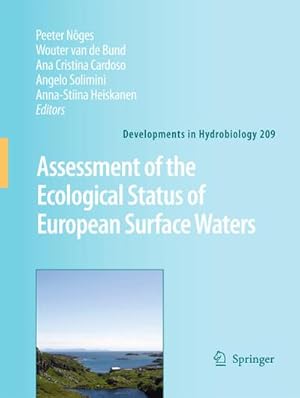
Assessment of the ecological status of European surface waters
Lingua: Inglese
Editore: Springer Netherlands Feb 2010, 2010
ISBN 10: 9048185777 ISBN 13: 9789048185771
Da: BuchWeltWeit Ludwig Meier e.K., Bergisch Gladbach, Germania
Valutazione del venditore 5 su 5 stelle
EUR 160,49
Spedizione EUR 23,00
Spedito da Germania a U.S.A.Quantità: 2 disponibili
Aggiungi al carrelloBuch. Condizione: Neu. This item is printed on demand - it takes 3-4 days longer - Neuware -The complex impact that man has on aquatic ecosystems creates a need for assessment systems that are able to adequately appraise and integrate the effects of various pressures. Chemical analysis alone can easily overlook some factors vital for life. With the adoption of the EU Water Framework Directive (WFD) in the year 2000 which defined the ecological status of surface water as ''. an expression of the quality of the structure and functioning of aquatic ecosystems associated with surface waters', biological indicators were brought to the forefront for the first time and became drivers to the water management practices.Assessment of ecological status and quantification of its relationships with anthropogenic pressures critically depend on knowledge of relevant biotic and abiotic settings and processes. Needs raised by the implementation of WFD have urged scientific research in many fields in order to find more stable and robust biological metrics and to diminish the uncertainty of assessment results. The number of WFD related scientific publications has increased linearly and exceeded 1500 in the year 2008. This book comprises a small set of this large flow of publications and is mainly focused on the development of biological assessment methods and intercalibration of the assessment results. 220 pp. Englisch.


