

Importo totale (1 articolo articoli):
Destinazione ordine:

raphael durbino (27 risultati)
Vai alla pagina principale dei risultati di ricerca
Filtri di ricerca
Tipo di articolo
- Tutti i tipi di prodotto
- Libri (7)
- Riviste e Giornali (Nessun altro risultato corrispondente a questo perfezionamento)
- Fumetti (Nessun altro risultato corrispondente a questo perfezionamento)
- Spartiti (Nessun altro risultato corrispondente a questo perfezionamento)
- Arte, Stampe e Poster (20)
- Fotografie (Nessun altro risultato corrispondente a questo perfezionamento)
- Mappe (Nessun altro risultato corrispondente a questo perfezionamento)
- Manoscritti e Collezionismo cartaceo (Nessun altro risultato corrispondente a questo perfezionamento)
Condizioni Maggiori informazioni
- Nuovo (Nessun altro risultato corrispondente a questo perfezionamento)
- Come nuovo, Ottimo o Quasi ottimo (Nessun altro risultato corrispondente a questo perfezionamento)
- Molto buono o Buono (4)
- Discreto o Mediocre (Nessun altro risultato corrispondente a questo perfezionamento)
- Come descritto (23)
Legatura
- Tutte
- Rilegato (4)
- Brossura (Nessun altro risultato corrispondente a questo perfezionamento)
Ulteriori caratteristiche
- Prima ed. (Nessun altro risultato corrispondente a questo perfezionamento)
- Copia autograf. (Nessun altro risultato corrispondente a questo perfezionamento)
- Sovracoperta (Nessun altro risultato corrispondente a questo perfezionamento)
- Con foto (23)
- Non Print on Demand (27)
Lingua (2)
Prezzo
- Qualsiasi prezzo
- Inferiore a EUR 20 (Nessun altro risultato corrispondente a questo perfezionamento)
- EUR 20 a EUR 45
- Superiore a EUR 45
Spedizione gratuita
- Spedizione gratuita in U.S.A. (Nessun altro risultato corrispondente a questo perfezionamento)
Paese del venditore
Valutazione venditore
-

PORTRAIT OF POPE JULIUS II, By Raphael Sanzio d'Urbino - an Original Antique Engraving
Lingua: Inglese
Data di pubblicazione: 1832
Da: K Books Ltd ABA ILAB, York, YORKS, Regno Unito
Membro dell'associazione: ABA ILAB PBFA
Valutazione del venditore 5 su 5 stelle

EUR 23,82
Spedizione EUR 22,54
Spedito da Regno Unito a U.S.A.Quantità: 1 disponibili
Aggiungi al carrelloNo Binding. Condizione: Very Good. Urbino (illustratore). An original antique print, engraved by R Page from the painting by Raphael Sanzio d'Urbino. Mounted (matted) and ready to frame . Very good condition .
-
EUR 23,82
Spedizione EUR 34,68
Spedito da Regno Unito a U.S.A.Quantità: 1 disponibili
Aggiungi al carrelloHardcover. Condizione: Good. Quarter bound in dark tan leather, some wear but the binding is firm and the there are no splits. Book contains eight engravings by Raphael; Frontispiece is The Transfiguration, followed by 1.The Miraculous Draught of Fishes. 2. Christ's Charge to Peter. 3. The Lame Man Healed. 4. The Death of Ananias. 5. Elymas the Sorcerer struck with Blindness. 6. Paul and Barnabas at Lystra. 7. Paul Preaching at Athens. The Frontispiece has a small patch of tanning in the lower corner. and plates 5, 6, and 7, all have a tanning patch, probably caused by damp, plate 5 in the lower left corner, plate 6 in the upper left corner approx. 1/6th of the picture, and plate 7. in the lower left corner approx 1/4th of the picture.
-
D'urbino, Raphael - An Original Engraved Antique Portrait
Lingua: Inglese
Da: K Books Ltd ABA ILAB, York, YORKS, Regno Unito
Membro dell'associazione: ABA ILAB PBFA
Valutazione del venditore 5 su 5 stelle
EUR 35,72
Spedizione EUR 22,54
Spedito da Regno Unito a U.S.A.Quantità: 1 disponibili
Aggiungi al carrelloNo Binding. Condizione: Very Good. Engraved By J.Pass (illustratore). A fine oval portrait, a stipple engraving on an historiated plinth. Mounted and ready to frame, mount size approx, 14.5 x 11.5 ins, 37 x 29 cms. An excellent opportunity to purchase this delicate stipple engraving. ca 1800. Engraved for the enclyclopaedia Londinensis 1826.
-
ESSAYS AFTER THE CARTOONS OF RAPHAEL at Windsor Drawn by the gracious Permission of His Majesty and by Permission most humbly Inscribed to Her Majesty the Queen of Great Britain By Her Majesty's most Grateful Devoted Servant J. Ruyssen.
Editore: London. Ruyssen. Plates dated 1798-1801., 1798
Da: Charles Russell, ABA, ILAB, est 1978, Cirencester, Regno Unito
Membro dell'associazione: ABA ILAB PBFA
Valutazione del venditore 5 su 5 stelle
EUR 2.977,05
Spedizione EUR 4,74
Spedito da Regno Unito a U.S.A.Quantità: 1 disponibili
Aggiungi al carrelloLARGE FOLIO, paper size approximately 28x22 inches- Extremely rare set of fifteen of sixteen engraved prints in the actual size of the heads in Raphael's cartoons for the Sistine Chapel tapestry series "The Acts of the Apostles". The prints were engraved by Antoine Cardon after drawings made by Nicolas Joseph Ruyssen. Being the calligraphic title page, engraved portrait of Raphael and 14 of 15 large engraved plates from the details of paintings of the Acts of the Apostles, some bound in the original boards and 5 loose- PLUS 11 duplicates. Engravings on wove paper some watermarked 'J Whatman 1794'. Some fraying to the loose plates and occasional spotting. Some of the original flimsies adhering to the versos not affecting the image. A very detailed catalogue description of this scarce work by the rare bookseller Robin Halwas can be found online. His descriptive list of plates is below - plate 10 in the list is missing. List of prints- [1] foreground figure (male), from the Death of Ananias, dated 15 October 1798 (matrice- plate mark 580 × 445 mm) [2] foreground figure (female), from the Death of Ananias, dated 15 October 1798 (matrice 565 × 435 mm) [3] an Apostle, from the Charge to Peter, dated 15 October 1798 (matrice 575 × 445 mm) [4] Peter, from the Miraculous Draught of Fishes, dated 1 January 1800 (matrice 575 × 470 mm) [5] figure (male), from the Death of Ananias, dated October 1801 (matrice 560 × 435 mm) [6] an Athenian, from Paul preaching at Athens, dated 15 October 1798 (matrice 570 × 440 mm) [7] subsidiary head (female), from the Healing of the Lame Man, dated 1 January 1800 (matrice 595 × 485 mm) [8] a child, from the Healing of the Lame Man, dated 1 January 1800 (matrice 600 × 490 mm) [9] John, from The Charge to Peter, dated 1 January 1800 (matrice 575 × 470 mm) [10] two children, from the Sacrifice at Lystra, dated 15 October 1798 (matrice 490 × 590 mm) [11] two Apostles, from the Charge to Peter, dated October 15, 1798 (matrice 510 × 595 mm) [12] two background figures (female and male), from the Healing of the Lame Man, dated 1 January 1800 (matrice 620 × 500 mm) [13] subsidiary figure (female), from the Healing of the Lame Man, dated 1 January 1800 (matrice 620 × 490 mm) [14] two background figures (male), from the Healing of the Lame Man, dated 10 August 1801 (matrice 690 × 515 mm) [15] three background figures, from the Sacrifice at Lystra, dated 10 August 1801 (matrice 530 × 630 mm) A VERY POWERFUL COLLECTION OF ENGRAVINGS AFTER RAPHAEL- 15 plus 11 duplicates.
-
PICTURAE PERISTYLI VATICANI, MANUS RAPHAELI SANCI IN TABULIS AERIALS NOVA CURA EXPRESSAE etc
Editore: Roma. Pietro Paolo Montagnani, 1790, 1790
Da: Charles Russell, ABA, ILAB, est 1978, Cirencester, Regno Unito
Membro dell'associazione: ABA ILAB PBFA
Valutazione del venditore 5 su 5 stelle
EUR 1.488,53
Spedizione EUR 4,74
Spedito da Regno Unito a U.S.A.Quantità: 1 disponibili
Aggiungi al carrelloFolio 20x14 inches, half period calf over boards, spine repaired. Folding engraved double page title page with surrounding cartouches of the Vatican- illustrated with 52 fine copper engraved plates, many with decorative engraved borders. Plates after Raphael engraved by L. Cunego, G. Petrini, G. Carattoni, G. Morghen, A. Mochetti, G. Bossi, F. Cecchini, et al. Some spotting to the title and minor marginal spotting but generally a clean copy, with good impressions, on thick 18th century laid paper. Engravings of Raphael's fabulous Biblical paintings. (Bibliography - Brunet 1110). Armorial bookplate of Thomas Broadwood with this initials and crest at the top of the title. Raffaello Sanzio da Urbino (14831520), known as Raphael, was an Italian painter and architect of the High Renaissance. His work is admired for its clarity of form, ease of composition, and visual achievement of the Neoplatonic ideal of human grandeur. Together with Michelangelo and Leonardo da Vinci, he forms the traditional trinity of great masters of that period. He was known to have been a big influence on the work of WILLIAM BLAKE (1757-1827) - which can be clearly seen in these fine engravings.
-
Psyches et Amoris nuptiae ac fabula a Raphaele Sanctio Urbinate Romae in Farnesinianis hortis transtyberim ad veterum aemulationem ac laudem colorum luminibus expressa a Nicolavo Dorigny ad similitudinem delineata et incisa, et a Joanne Petro Bellorio notis illustrata. [The Story of the Wedding of Cupid and Psyche, Painted by Raphael Sanzio d'Urbino in the Farnesina, Rome?]
Editore: Rome: Dominico de Rossi, Jo. Jacobi (Jo. Jacobi de Rubeis), August 15, 1693
Da: Wittenborn Art Books, San Francisco, CA, U.S.A.
Valutazione del venditore 5 su 5 stelle
Arte / Stampa / Poster
Condizione: Good. Oblong folio. 46.5 x 69 cm. (18.25 x 27.25 inches) page size. Suite of 12 engravings. Housed in a custom portfolio with painted boards, leather spine, large embossed leather label, leather ties and leather corners by the celebrated Russian-American binder Alexandr (Sasha) Mosalov. OCLC Number: 504754030Set of 12 engravings of Raphael's frescoes of scenes from the myth of Cupid (also known as Eros) and Psyche in the Villa Farnesina in Rome. Raphael's paintings illustrate part of the story The Metamorphoses of Lucius Apuleius (the only Latin novel to survive in its entirety). In this work, Venus, jealous of a beautiful mortal girl named Psyche, sends Cupid on an errand to punish the girl. Cupid instead falls in love with Psyche, and after a series of secrets, betrayals, and trials, the lovers are reunited, and Psyche is made immortal.The frescoes are painted on the vaults and ceiling above demilune reserves on the ground floor at the end of the entrance hall, now known as the Loggia of Psyche. Images of leafy garlands of fruit accentuate the arches of the vaults, also framing the classical images. The frescoes were commissioned by the Sienese banker Agostino Chigi, called "magnifico" by his peers for his richly decorated villa and the elegant entertainments he hosted there. The paintings were recently restored and the Villa Farnesina is open to the public as a museum.Some foxing.
-
![Immagine del venditore per [Moses Descends from Mount Sinai] Descendit de Monte Sinai, tenens Tabulas in manibus: Videbantq: Filii Israel cornutam faciem ejus venduto da Donald A. Heald Rare Books (ABAA)](https://pictures.abebooks.com/inventory/md/md31965853430.jpg)
[Moses Descends from Mount Sinai] Descendit de Monte Sinai, tenens Tabulas in manibus: Videbantq: Filii Israel cornutam faciem ejus
Editore: Rome, 1774
Da: Donald A. Heald Rare Books (ABAA), New York, NY, U.S.A.
Membro dell'associazione: ABAA ILAB
Valutazione del venditore 5 su 5 stelle
Arte / Stampa / Poster
Copper engraving, on two joined sheets, by Ottaviani after drawings by Savorelli and Camporesi, printed in light brown coloured ink with contemporary hand-colouring. Neat marginal restoration. A stunning plate from "Logge di Rafaele nel Vaticano": with contemporary colouring of the highest quality from the golden age of the hand-coloured print. The main panel shows Moses coming down from Mount Sinai, holding the tablets bearing the ten words of the Covenant, his face "horned from the conversation of the Lord". Aaron and the children of Israel seeing the face of Moses "horned" are afraid to come near. A very fine image from the second part of a work titled "Loggie di Rafaele nel Vaticano" depicting the decorative work executed by Raphael and his assistants between 1518-1519 in the Vatican. They were drawn by Gaetano Savorelli, a Roman painter and draughtsman best known for his Raphael drawings, and Pietro Camporesi, a Roman architect, who worked for Pope Clemens XIII and Pius VI on rooms for the Vatican Museum. The first to illustrate the famous frescoes, these beautiful plates were probably planned as early as 1760, but were not executed until 1772 to 1776. The plate is remarkable not only as the first important visual record of Raphael's work, but also for the quality of the hand-colouring - the work on this image is, in our opinion, some of the greatest to be produced in Europe during the whole of the eighteenth century: the golden age of the hand-coloured print. They were remarkable not just for their size and magnificent colouring, but also because of the influence they had on contemporary taste. The decision was made to "borrow" elements from Raphael's Vatican tapestries and insert them where the original frescoes were in too poor a state to be legible. The finished plates therefore represented an amalgam of design elements presented with a crisp freshness of colour that held enormous appeal and did much to stimulate the taste for the "grotesque" in the Neo-classical period. A year after the death of his principal patron Julius II, Raphael succeeded Donato Bramante in 1514 as the official Vatican architect. Having previously adorned the "Stanze" or chambers of Julius on the second floor of the papal apartments in the Vatican palace, he was commissioned by Leo X in 1517 to decorate the adjacent Logge. He designed an elaborate cycle of ornamental frescoes for the room's ceiling vaults, doors and auxiliary pillars, which were executed by his assistants Giulio Romano and Giovanni da Udine. Twelve of the quadrilateral ceiling vaults were adorned with murals of familiar Old Testament scenes and one with a scene from the New Testament, while the more decorative frescoes painted on the pilasters by Udine were covered with imaginative compositions of 'grotesque' motifs like foliage, fruit, and chimerical beasts. Cf. Brunet IV, 1110 & 1111; cf. Berlin Katalog 4068 & 4066; "Raphael Invenit: Stampe da Rafaello" (1985) Ottaviano 22; cf. "Raphael: Reproduktions-graphik aus vier Jahrhunderten" (Coburg 1984) 104 & no. 245.
-

Loggie di Rafaele nel Vaticano
Editore: Rome, 1772
Da: Donald A. Heald Rare Books (ABAA), New York, NY, U.S.A.
Membro dell'associazione: ABAA ILAB
Valutazione del venditore 5 su 5 stelle
Arte / Stampa / Poster
Copper engraving with stunning early colour. Printed on laid paper with added wove margins. In excellent condition with the exception of some light foxing in the margins. Image size: 22 7/8 x 15 3/4 inches. This beautiful perspective view of Raphael's Loggia, with contemporary colouring of the highest quality from the golden age of the hand-coloured print, served as the frontispiece to the celebrated text, "Loggie di Rafaele nel Vaticano". This arresting print is a general perspective view of Raphael's design for the Loggia at the Vatican, with a large profile portrait of Raphael in a medallion over the entrance to the corridor. The plate served as the frontispiece to the first part of the "Logge di Rafaele nel Vaticano", which depicted the decorative work executed by Raphael and his assistants between 1518-1519 in the Vatican. The project as a whole was carried out by the painter Gaetano Savorelli, the draughtsman Ludovico Teseo, the architect Pietro Camporesi, and the engravers Giovanni Ottaviani and Giovanni Volpato. The plate is remarkable not only as the first important visual record of Raphael's work, but also for the quality of the hand-colouring - the work on this image is, in our opinion, some of the greatest to be produced in Europe during the whole of the eighteenth century: the golden age of the hand-coloured print. The whole series was remarkable not just for the size and magnificent colouring of the prints, but also because of the influence they had on contemporary taste. The decision was made to "borrow" elements from Raphael's Vatican tapestries and insert them where the original frescoes were in too poor a state to be legible. The finished plates therefore represented an amalgam of design elements presented with a crisp freshness of colour that held enormous appeal and stimulated the taste for the "grotesque" in the neo-classical period. Cf. Brunet IV, 1110; cf. Berlin Katalog 4068; Lambert Pattern and Design (V. & A.: 1983), p. 26; "Raphael Invenit: Stampe da Rafaello" (1985) Volpato 1; Raphael: Reproduktions-graphik aus vier Jahrhunderten (Coburg: 1984), p. 104; G. Marini (editor) Giovanni Volpato 1735-1803 (1988) no. 198.
-
![Immagine del venditore per [Adam, Eve, Cain and Abel] Concepit Heva, et peperit Cain Fratremque ejus Abel venduto da Donald A. Heald Rare Books (ABAA)](https://pictures.abebooks.com/inventory/md/md31965854333.jpg)
[Adam, Eve, Cain and Abel] Concepit Heva, et peperit Cain Fratremque ejus Abel
Editore: Rome, 1774
Da: Donald A. Heald Rare Books (ABAA), New York, NY, U.S.A.
Membro dell'associazione: ABAA ILAB
Valutazione del venditore 5 su 5 stelle
Arte / Stampa / Poster
Copper engraving, on two joined sheets, by Ottaviani after drawings by Savorelli and Camporesi, printed in light brown coloured ink with contemporary hand-colouring. Some marginal restoration at corners and margins. A stunning plate from "Logge di Rafaele nel Vaticano": with contemporary colouring of the highest quality from the golden age of the hand-coloured print. A very fine image from the second part of a work titled "Loggie di Rafaele nel Vaticano" depicting the decorative work executed by Raphael and his assistants between 1518-1519 in the Vatican. They were drawn by Gaetano Savorelli, a Roman painter and draughtsman best known for his Raphael drawings, and Pietro Camporesi, a Roman architect, who worked for Pope Clemens XIII and Pius VI on rooms for the Vatican Museum. The first to illustrate the famous frescoes, these beautiful plates were probably planned as early as 1760, but were not executed until 1772 to 1776. The plate is remarkable not only as the first important visual record of Raphael's work, but also for the quality of the hand-colouring - the work on this image is, in our opinion, some of the greatest to be produced in Europe during the whole of the eighteenth century: the golden age of the hand-coloured print. They were remarkable not just for their size and magnificent colouring, but also because of the influence they had on contemporary taste. The decision was made to "borrow" elements from Raphael's Vatican tapestries and insert them where the original frescoes were in too poor a state to be legible. The finished plates therefore represented an amalgam of design elements presented with a crisp freshness of colour that held enormous appeal and did much to stimulate the taste for the "grotesque" in the Neo-classical period. A year after the death of his principal patron Julius II, Raphael succeeded Donato Bramante in 1514 as the official Vatican architect. Having previously adorned the "Stanze" or chambers of Julius on the second floor of the papal apartments in the Vatican palace, he was commissioned by Leo X in 1517 to decorate the adjacent Logge. He designed an elaborate cycle of ornamental frescoes for the room's ceiling vaults, doors and auxiliary pillars, which were executed by his assistants Giulio Romano and Giovanni da Udine. Twelve of the quadrilateral ceiling vaults were adorned with murals of familiar Old Testament scenes and one with a scene from the New Testament, while the more decorative frescoes painted on the pilasters by Udine were covered with imaginative compositions of 'grotesque' motifs like foliage, fruit, and chimerical beasts. The biblical scene depicted shows the infant brothers Cain and Abel vying for their mother's attention. Adam is sowing nearby. Cf. Brunet IV, 1110 & 1111; cf. Berlin Katalog 4068 & 4066; "Raphael Invenit: Stampe da Rafaello" (1985) Ottaviano 22; cf. "Raphael: Reproduktions-graphik aus vier Jahrhunderten" (Coburg 1984) 104 & no. 245.
-
PSYCHES ET AMORIS NUPTIAE AC FABULA A RAPHAELE SANCTIO URBINATE ROMAE IN FARNESIANIS HORTIS TRANSTYBERIM AD VETERUM AEMULATIONEM AC LAUDEM COLORUM LUMINIBUS EXPRESSA A. DORIGNY. DELINEATA ET INCISA, ET A IOANNE PETRO BELLORIO NOTIS ILLUSTRATA.
Editore: Rome: Typis ac sumptibus Dominici de Rubeis Io. Iacobi filii ac heredis, 1693., 1693
Da: Charles Russell, ABA, ILAB, est 1978, Cirencester, Regno Unito
Membro dell'associazione: ABA ILAB PBFA
Valutazione del venditore 5 su 5 stelle
EUR 1.369,44
Spedizione EUR 4,74
Spedito da Regno Unito a U.S.A.Quantità: 1 disponibili
Aggiungi al carrelloLarge folio 25 x 15 inches from the margins. No binding- loose. Title and 10 PLATES by Dorigny, numbered 1 to 11. Margins of the title frayed, plates trimmed very near to the image - some spotting, plate 4 with a small old damp stain (washable), old central fold where originally bound. It can come with an additional plate 12 of the ceiling fresco in the adjoining Sala di Galatea- not here present. A valuable and very beautiful engraved record of Raphael's Cupid and Psyche frescoes, which he completed between 1516 and 1518 in the Loggia of Psyche of Agostino Chigi's Villa Farnesina in Rome. Sold as a collection of engravings. Bibliography- Berlin Katalog 4066.
-
![Immagine del venditore per [Eve Conceived Cain and his brother Abel] Concepit Heva, et peperit Cain Frantremque ejus Abel venduto da Donald A. Heald Rare Books (ABAA)](https://pictures.abebooks.com/inventory/md/md13562271520.jpg)
[Eve Conceived Cain and his brother Abel] Concepit Heva, et peperit Cain Frantremque ejus Abel
Editore: Rome, 1774
Da: Donald A. Heald Rare Books (ABAA), New York, NY, U.S.A.
Membro dell'associazione: ABAA ILAB
Valutazione del venditore 5 su 5 stelle
Arte / Stampa / Poster
Copper engraving by Ottaviani after drawings by Savorelli and Camporesi, printed in light brown coloured ink with contemporary hand-colouring. Good condition. Shaved within plate mark, expert neat repairs to left margin, one just affecting the image area. A stunning plate from "Logge di Rafaele nel Vaticano": with contemporary colouring of the highest quality from the golden age of the hand-coloured print. A very fine image from the second part of a work titled "Loggie di Rafaele nel Vaticano" depicting the decorative work executed by Raphael and his assistants between 1518-1519 in the Vatican. They were drawn by Gaetano Savorelli, a Roman painter and draughtsman best known for his Raphael drawings, and Pietro Camporesi, a Roman architect, who worked for Pope Clemens XIII and Pius VI on rooms for the Vatican Museum. The first to illustrate the famous frescoes, these beautiful plates were probably planned as early as 1760, but were not executed until 1772 to 1776. The plate is remarkable not only as the first important visual record of Raphael's work, but also for the quality of the hand-colouring - the work on this image is, in our opinion, some of the greatest to be produced in Europe during the whole of the eighteenth century: the golden age of the hand-coloured print. They were remarkable not just for their size and magnificent colouring, but also because of the influence they had on contemporary taste. The decision was made to "borrow" elements from Raphael's Vatican tapestries and insert them where the original frescoes were in too poor a state to be legible. The finished plates therefore represented an amalgam of design elements presented with a crisp freshness of colour that held enormous appeal and did much to stimulate the taste for the "grotesque" in the Neo-classical period. A year after the death of his principal patron Julius II, Raphael succeeded Donato Bramante in 1514 as the official Vatican architect. Having previously adorned the "Stanze" or chambers of Julius on the second floor of the papal apartments in the Vatican palace, he was commissioned by Leo X in 1517 to decorate the adjacent Logge. He designed an elaborate cycle of ornamental frescoes for the room's ceiling vaults, doors and auxiliary pillars, which were executed by his assistants Giulio Romano and Giovanni da Udine. Twelve of the quadrilateral ceiling vaults were adorned with murals of familiar Old Testament scenes and one with a scene from the New Testament, while the more decorative frescoes painted on the pilasters by Udine were covered with imaginative compositions of 'grotesque' motifs like foliage, fruit, and chimerical beasts. The biblical scene depicted shows the infant brothers Cain and Abel vying for their mother's attention. Adam is sowing nearby. Cf. Brunet IV, 1110 & 1111; cf. Berlin Katalog. 4068 & 4066; "Raphael Invenit: Stampe da Rafaello" (1985) Ottaviano 22; cf. "Raphael: Reproduktions-graphik aus vier Jahrhunderten" (Coburg 1984) 104 & no. 245.
-
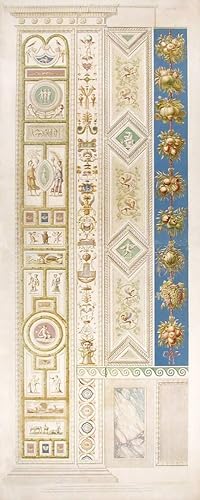
Decorative pilaster with fruit, flowers, and tendrils
Editore: Rome, 1772
Da: Donald A. Heald Rare Books (ABAA), New York, NY, U.S.A.
Membro dell'associazione: ABAA ILAB
Valutazione del venditore 5 su 5 stelle
Arte / Stampa / Poster
Copper engraving by Ottaviani after drawings by Savorelli and Camporesi, printed in light brown coloured ink with contemporary hand-colouring. Good condition. Trimmed to just within plate mark along lower margin, expert repairs to left margin, not affecting image area. A highly decorative print from the famous "Loggie di Rafaele nel Vaticano" series, with contemporary colouring of the highest quality from the golden age of the hand-coloured print. A very fine image from the first part of a work titled "Loggie di Rafaele nel Vaticano" depicting the decorative work executed by Raphael and his assistants between 1518-1519 in the Vatican. This remarkable print, one of the first to be published of the decoration of the Logge on the main storey of the Vatican apartments, was probably planned as early as 1760, but was not executed until between 1772 and 1776. The project as a whole was carried out by the painter Gaetano Savorelli, the draughtsman Ludovico Teseo, the architect Pietro Camporesi, and the engravers Giovanni Ottaviani and Giovanni Volpato. The plate is remarkable not only as the first important visual record of Raphael's work, but also for the quality of the hand-colouring - the work on this image is, in our opinion, some of the greatest to be produced in Europe during the whole of the eighteenth century: the golden age of the hand-coloured print. The whole series was of importance not just for the size and magnificent colouring of the prints, but also because of the influence they had on contemporary taste. The decision was made to "borrow" elements from Raphael's Vatican tapestries and insert them where the original frescoes were in too poor a state to be legible. The finished plates therefore represented an amalgam of design elements presented with a crisp freshness of colour that held enormous appeal and stimulated the taste for the "grotesque" in the neo-classical period. Cf. Brunet IV, 1110; cf. Berlin Katalog 4068; cf. Lambert Pattern and Design (V. & A.: 1983), p. 26; "Raphael Invenit: Stampe da Rafaello" (1985) Ottaviano 4; Raphael: Reproduktions-graphik aus vier Jahrhunderten (Coburg: 1984), p. 104.
-
![Immagine del venditore per [The Lord appears to Issac] Apparvit Isaac Dominus, et ait: ne descendas in Aegyptum, sed quiesce in terra, quam dixero tibi venduto da Donald A. Heald Rare Books (ABAA)](https://pictures.abebooks.com/inventory/md/md1963905145.jpg)
[The Lord appears to Issac] Apparvit Isaac Dominus, et ait: ne descendas in Aegyptum, sed quiesce in terra, quam dixero tibi
Editore: Rome, 1774
Da: Donald A. Heald Rare Books (ABAA), New York, NY, U.S.A.
Membro dell'associazione: ABAA ILAB
Valutazione del venditore 5 su 5 stelle
Arte / Stampa / Poster
Copper engraving, on two joined sheets, by Ottaviani after drawings by Savorelli and Camporesi, printed in light brown coloured ink with contemporary hand-colouring. Neat marginal restoration. A stunning plate from "Logge di Rafaele nel Vaticano": with contemporary colouring of the highest quality from the golden age of the hand-coloured print. In the main panel the Lord appears to Isaac and tells him not to go down into Egypt but to stay in Gerara. A very fine image from the second part of a work titled "Loggie di Rafaele nel Vaticano" depicting the decorative work executed by Raphael and his assistants between 1518-1519 in the Vatican. They were drawn by Gaetano Savorelli, a Roman painter and draughtsman best known for his Raphael drawings, and Pietro Camporesi, a Roman architect, who worked for Pope Clemens XIII and Pius VI on rooms for the Vatican Museum. The first to illustrate the famous frescoes, these beautiful plates were probably planned as early as 1760, but were not executed until 1772 to 1776. The plate is remarkable not only as the first important visual record of Raphael's work, but also for the quality of the hand-colouring - the work on this image is, in our opinion, some of the greatest to be produced in Europe during the whole of the eighteenth century: the golden age of the hand-coloured print. They were remarkable not just for their size and magnificent colouring, but also because of the influence they had on contemporary taste. The decision was made to "borrow" elements from Raphael's Vatican tapestries and insert them where the original frescoes were in too poor a state to be legible. The finished plates therefore represented an amalgam of design elements presented with a crisp freshness of colour that held enormous appeal and did much to stimulate the taste for the "grotesque" in the Neo-classical period. A year after the death of his principal patron Julius II, Raphael succeeded Donato Bramante in 1514 as the official Vatican architect. Having previously adorned the "Stanze" or chambers of Julius on the second floor of the papal apartments in the Vatican palace, he was commissioned by Leo X in 1517 to decorate the adjacent Logge. He designed an elaborate cycle of ornamental frescoes for the room's ceiling vaults, doors and auxiliary pillars, which were executed by his assistants Giulio Romano and Giovanni da Udine. Twelve of the quadrilateral ceiling vaults were adorned with murals of familiar Old Testament scenes and one with a scene from the New Testament, while the more decorative frescoes painted on the pilasters by Udine were covered with imaginative compositions of 'grotesque' motifs like foliage, fruit, and chimerical beasts. Cf. Brunet IV, 1110 & 1111; cf. Berlin Katalog 4068 & 4066; "Raphael Invenit: Stampe da Rafaello" (1985) Ottaviano 22; cf. "Raphael: Reproduktions-graphik aus vier Jahrhunderten" (Coburg 1984) 104 & no. 245.
-
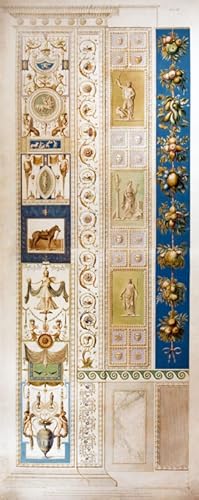
Decorative pilaster with fruit, flowers, and tendrils
Editore: Rome, 1772
Da: Donald A. Heald Rare Books (ABAA), New York, NY, U.S.A.
Membro dell'associazione: ABAA ILAB
Valutazione del venditore 5 su 5 stelle
Arte / Stampa / Poster
Copper engraving by Ottaviani after drawings by Savorelli and Camporesi, printed in light brown coloured ink with contemporary hand-colouring. Trimmed to platemark left margin. Good condition. A highly decorative print from the famous "Loggie di Rafaele nel Vaticano" series, with contemporary colouring of the highest quality from the golden age of the hand-coloured print. A very fine image from the first part of a work titled "Loggie di Rafaele nel Vaticano" depicting the decorative work executed by Raphael and his assistants between 1518-1519 in the Vatican. This remarkable print, one of the first to be published of the decoration of the Logge on the main storey of the Vatican apartments, was probably planned as early as 1760, but was not executed until between 1772 and 1776. The project as a whole was carried out by the painter Gaetano Savorelli, the draughtsman Ludovico Teseo, the architect Pietro Camporesi, and the engravers Giovanni Ottaviani and Giovanni Volpato. The plate is remarkable not only as the first important visual record of Raphael's work, but also for the quality of the hand-colouring - the work on this image is, in our opinion, some of the greatest to be produced in Europe during the whole of the eighteenth century: the golden age of the hand-coloured print. The whole series was of importance not just for the size and magnificent colouring of the prints, but also because of the influence they had on contemporary taste. The decision was made to "borrow" elements from Raphael's Vatican tapestries and insert them where the original frescoes were in too poor a state to be legible. The finished plates therefore represented an amalgam of design elements presented with a crisp freshness of colour that held enormous appeal and stimulated the taste for the "grotesque" in the neo-classical period. Cf. Brunet IV, 1110; cf. Berlin Katalog 4068; cf. Lambert Pattern and Design (V. & A.: 1983), p. 26; "Raphael Invenit: Stampe da Rafaello" (1985) Ottaviano 11; Raphael: Reproduktions-graphik aus vier Jahrhunderten (Coburg: 1984), p. 104.
-
![Immagine del venditore per [Jacob's Ladder] Vidit Jacob in somnis scalam stantem super terram, et cacumen illius tangens Coelum: Angelos ascendentes et descendentes: et Dnum innixum scalæ venduto da Donald A. Heald Rare Books (ABAA)](https://pictures.abebooks.com/inventory/md/md1875946672.jpg)
[Jacob's Ladder] Vidit Jacob in somnis scalam stantem super terram, et cacumen illius tangens Coelum: Angelos ascendentes et descendentes: et Dnum innixum scalæ
Editore: Rome, 1770
Da: Donald A. Heald Rare Books (ABAA), New York, NY, U.S.A.
Membro dell'associazione: ABAA ILAB
Valutazione del venditore 5 su 5 stelle
Arte / Stampa / Poster
Copper engraving, on two joined sheets, by Ottaviani after drawings by Savorelli and Camporesi, printed in light brown coloured ink with contemporary hand-colouring. Neat marginal restoration. A stunning plate from "Logge di Rafaele nel Vaticano": with contemporary colouring of the highest quality from the golden age of the hand-coloured print. The main panel shows Jacob at Luza having a vision of the angels ascending and descending by a ladder which reached from earth to heaven. A very fine image from the second part of a work titled "Loggie di Rafaele nel Vaticano" depicting the decorative work executed by Raphael and his assistants between 1518-1519 in the Vatican. They were drawn by Gaetano Savorelli, a Roman painter and draughtsman best known for his Raphael drawings, and Pietro Camporesi, a Roman architect, who worked for Pope Clemens XIII and Pius VI on rooms for the Vatican Museum. The first to illustrate the famous frescoes, these beautiful plates were probably planned as early as 1760, but were not executed until 1772 to 1776. The plate is remarkable not only as the first important visual record of Raphael's work, but also for the quality of the hand-colouring - the work on this image is, in our opinion, some of the greatest to be produced in Europe during the whole of the eighteenth century: the golden age of the hand-coloured print. They were remarkable not just for their size and magnificent colouring, but also because of the influence they had on contemporary taste. The decision was made to "borrow" elements from Raphael's Vatican tapestries and insert them where the original frescoes were in too poor a state to be legible. The finished plates therefore represented an amalgam of design elements presented with a crisp freshness of colour that held enormous appeal and did much to stimulate the taste for the "grotesque" in the Neo-classical period. A year after the death of his principal patron Julius II, Raphael succeeded Donato Bramante in 1514 as the official Vatican architect. Having previously adorned the "Stanze" or chambers of Julius on the second floor of the papal apartments in the Vatican palace, he was commissioned by Leo X in 1517 to decorate the adjacent Logge. He designed an elaborate cycle of ornamental frescoes for the room's ceiling vaults, doors and auxiliary pillars, which were executed by his assistants Giulio Romano and Giovanni da Udine. Twelve of the quadrilateral ceiling vaults were adorned with murals of familiar Old Testament scenes and one with a scene from the New Testament, while the more decorative frescoes painted on the pilasters by Udine were covered with imaginative compositions of 'grotesque' motifs like foliage, fruit, and chimerical beasts. Cf. Brunet IV, 1110 & 1111; cf. Berlin Katalog 4068 & 4066; "Raphael Invenit: Stampe da Rafaello" (1985) Ottaviano 22; cf. "Raphael: Reproduktions-graphik aus vier Jahrhunderten" (Coburg 1984) 104 & no. 245.
-
![Immagine del venditore per [King David in Triumph] Subacta Syria, tulit David arma aurea, et detula ea in Jerusalem venduto da Donald A. Heald Rare Books (ABAA)](https://pictures.abebooks.com/inventory/md/md1875946670.jpg)
[King David in Triumph] Subacta Syria, tulit David arma aurea, et detula ea in Jerusalem
Editore: Rome, 1774
Da: Donald A. Heald Rare Books (ABAA), New York, NY, U.S.A.
Membro dell'associazione: ABAA ILAB
Valutazione del venditore 5 su 5 stelle
Arte / Stampa / Poster
Copper engraving, on two joined sheets, by Ottaviani after drawings by Savorelli and Camporesi, printed in light brown coloured ink with contemporary hand-colouring. Neat marginal restoration. A stunning plate from "Logge di Rafaele nel Vaticano": with contemporary colouring of the highest quality from the golden age of the hand-coloured print. The main panel shows King David, having subdued Syria, returning to Jersusalem with armour made of gold. A very fine image from the second part of a work titled "Loggie di Rafaele nel Vaticano" depicting the decorative work executed by Raphael and his assistants between 1518-1519 in the Vatican. They were drawn by Gaetano Savorelli, a Roman painter and draughtsman best known for his Raphael drawings, and Pietro Camporesi, a Roman architect, who worked for Pope Clemens XIII and Pius VI on rooms for the Vatican Museum. The first to illustrate the famous frescoes, these beautiful plates were probably planned as early as 1760, but were not executed until 1772 to 1776. The plate is remarkable not only as the first important visual record of Raphael's work, but also for the quality of the hand-colouring - the work on this image is, in our opinion, some of the greatest to be produced in Europe during the whole of the eighteenth century: the golden age of the hand-coloured print. They were remarkable not just for their size and magnificent colouring, but also because of the influence they had on contemporary taste. The decision was made to "borrow" elements from Raphael's Vatican tapestries and insert them where the original frescoes were in too poor a state to be legible. The finished plates therefore represented an amalgam of design elements presented with a crisp freshness of colour that held enormous appeal and did much to stimulate the taste for the "grotesque" in the Neo-classical period. A year after the death of his principal patron Julius II, Raphael succeeded Donato Bramante in 1514 as the official Vatican architect. Having previously adorned the "Stanze" or chambers of Julius on the second floor of the papal apartments in the Vatican palace, he was commissioned by Leo X in 1517 to decorate the adjacent Logge. He designed an elaborate cycle of ornamental frescoes for the room's ceiling vaults, doors and auxiliary pillars, which were executed by his assistants Giulio Romano and Giovanni da Udine. Twelve of the quadrilateral ceiling vaults were adorned with murals of familiar Old Testament scenes and one with a scene from the New Testament, while the more decorative frescoes painted on the pilasters by Udine were covered with imaginative compositions of 'grotesque' motifs like foliage, fruit, and chimerical beasts. Cf. Brunet IV, 1110 & 1111; cf. Berlin Katalog 4068 & 4066; "Raphael Invenit: Stampe da Rafaello" (1985) Ottaviano 22; cf. "Raphael: Reproduktions-graphik aus vier Jahrhunderten" (Coburg 1984) 104 & no. 245.
-
![Immagine del venditore per [Joseph and His Brothers] Vidi consurgere manipulum meum, et stare, vestrosq: manipulos adorare meum . Et vidi quasi solem, et lunam, et stallas undecim adorare me venduto da Donald A. Heald Rare Books (ABAA)](https://pictures.abebooks.com/inventory/md/md1875946677.jpg)
[Joseph and His Brothers] Vidi consurgere manipulum meum, et stare, vestrosq: manipulos adorare meum . Et vidi quasi solem, et lunam, et stallas undecim adorare me
Editore: Rome, 1774
Da: Donald A. Heald Rare Books (ABAA), New York, NY, U.S.A.
Membro dell'associazione: ABAA ILAB
Valutazione del venditore 5 su 5 stelle
Arte / Stampa / Poster
Copper engraving, on two joined sheets, by Ottaviani after drawings by Savorelli and Camporesi, printed in light brown coloured ink with contemporary hand-colouring. Neat marginal restoration. A stunning plate from "Logge di Rafaele nel Vaticano": with contemporary colouring of the highest quality from the golden age of the hand-coloured print. The main panel shows Joseph telling his brothers of his prophetic dreams "Hear my dream which I dreamed. I thought we were binding sheaves in the field: and my sheaf arose as it were, and stood, and your sheaves standing about bowed down before my sheaf . I saw in . [another] dream, as it were the sun, and the moon, and eleven stars worshipping me." A very fine image from the second part of a work titled "Loggie di Rafaele nel Vaticano" depicting the decorative work executed by Raphael and his assistants between 1518-1519 in the Vatican. They were drawn by Gaetano Savorelli, a Roman painter and draughtsman best known for his Raphael drawings, and Pietro Camporesi, a Roman architect, who worked for Pope Clemens XIII and Pius VI on rooms for the Vatican Museum. The first to illustrate the famous frescoes, these beautiful plates were probably planned as early as 1760, but were not executed until 1772 to 1776. The plate is remarkable not only as the first important visual record of Raphael's work, but also for the quality of the hand-colouring - the work on this image is, in our opinion, some of the greatest to be produced in Europe during the whole of the eighteenth century: the golden age of the hand-coloured print. They were remarkable not just for their size and magnificent colouring, but also because of the influence they had on contemporary taste. The decision was made to "borrow" elements from Raphael's Vatican tapestries and insert them where the original frescoes were in too poor a state to be legible. The finished plates therefore represented an amalgam of design elements presented with a crisp freshness of colour that held enormous appeal and did much to stimulate the taste for the "grotesque" in the Neo-classical period. A year after the death of his principal patron Julius II, Raphael succeeded Donato Bramante in 1514 as the official Vatican architect. Having previously adorned the "Stanze" or chambers of Julius on the second floor of the papal apartments in the Vatican palace, he was commissioned by Leo X in 1517 to decorate the adjacent Logge. He designed an elaborate cycle of ornamental frescoes for the room's ceiling vaults, doors and auxiliary pillars, which were executed by his assistants Giulio Romano and Giovanni da Udine. Twelve of the quadrilateral ceiling vaults were adorned with murals of familiar Old Testament scenes and one with a scene from the New Testament, while the more decorative frescoes painted on the pilasters by Udine were covered with imaginative compositions of 'grotesque' motifs like foliage, fruit, and chimerical beasts. Cf. Brunet IV, 1110 & 1111; cf. Berlin Katalog 4068 & 4066; "Raphael Invenit: Stampe da Rafaello" (1985) Ottaviano 22; cf. "Raphael: Reproduktions-graphik aus vier Jahrhunderten" (Coburg 1984) 104 & no. 245.
-
![Immagine del venditore per [Angels appear to Abraham] Apparuerunt ei tres viri, et cucurrit Abraham de ostio Tabernaculi sui, et adoravit in Terram venduto da Donald A. Heald Rare Books (ABAA)](https://pictures.abebooks.com/inventory/md/md1875946668.jpg)
[Angels appear to Abraham] Apparuerunt ei tres viri, et cucurrit Abraham de ostio Tabernaculi sui, et adoravit in Terram
Editore: Rome, 1774
Da: Donald A. Heald Rare Books (ABAA), New York, NY, U.S.A.
Membro dell'associazione: ABAA ILAB
Valutazione del venditore 5 su 5 stelle
Arte / Stampa / Poster
Copper engraving by Ottaviani after drawings by Savorelli and Camporesi, printed in light brown coloured ink with contemporary hand-colouring. Neat marginal restoration. A stunning plate from "Logge di Rafaele nel Vaticano": with contemporary colouring of the highest quality from the golden age of the hand-coloured print. The scene in the main panel shows the three angels that appeared to Abraham and told him that he and his wife Sarah will have a son. A very fine image from the second part of a work titled "Loggie di Rafaele nel Vaticano" depicting the decorative work executed by Raphael and his assistants between 1518-1519 in the Vatican. They were drawn by Gaetano Savorelli, a Roman painter and draughtsman best known for his Raphael drawings, and Pietro Camporesi, a Roman architect, who worked for Pope Clemens XIII and Pius VI on rooms for the Vatican Museum. The first to illustrate the famous frescoes, these beautiful plates were probably planned as early as 1760, but were not executed until 1772 to 1776. The plate is remarkable not only as the first important visual record of Raphael's work, but also for the quality of the hand-colouring - the work on this image is, in our opinion, some of the greatest to be produced in Europe during the whole of the eighteenth century: the golden age of the hand-coloured print. They were remarkable not just for their size and magnificent colouring, but also because of the influence they had on contemporary taste. The decision was made to "borrow" elements from Raphael's Vatican tapestries and insert them where the original frescoes were in too poor a state to be legible. The finished plates therefore represented an amalgam of design elements presented with a crisp freshness of colour that held enormous appeal and did much to stimulate the taste for the "grotesque" in the Neo-classical period. A year after the death of his principal patron Julius II, Raphael succeeded Donato Bramante in 1514 as the official Vatican architect. Having previously adorned the "Stanze" or chambers of Julius on the second floor of the papal apartments in the Vatican palace, he was commissioned by Leo X in 1517 to decorate the adjacent Logge. He designed an elaborate cycle of ornamental frescoes for the room's ceiling vaults, doors and auxiliary pillars, which were executed by his assistants Giulio Romano and Giovanni da Udine. Twelve of the quadrilateral ceiling vaults were adorned with murals of familiar Old Testament scenes and one with a scene from the New Testament, while the more decorative frescoes painted on the pilasters by Udine were covered with imaginative compositions of 'grotesque' motifs like foliage, fruit, and chimerical beasts. Cf. Brunet IV, 1110 & 1111; cf. Berlin Katalog 4068 & 4066; "Raphael Invenit: Stampe da Rafaello" (1985) Ottaviano 22; cf. "Raphael: Reproduktions-graphik aus vier Jahrhunderten" (Coburg 1984) 104 & no. 245.
-
![Immagine del venditore per [Last Supper] Discumbentibus, et edentibus Discipulis, dixit Jesus unus ex Vobis me proditurus est venduto da Donald A. Heald Rare Books (ABAA)](https://pictures.abebooks.com/inventory/md/md1875946680.jpg)
[Last Supper] Discumbentibus, et edentibus Discipulis, dixit Jesus unus ex Vobis me proditurus est
Editore: Rome, 1774
Da: Donald A. Heald Rare Books (ABAA), New York, NY, U.S.A.
Membro dell'associazione: ABAA ILAB
Valutazione del venditore 5 su 5 stelle
Arte / Stampa / Poster
Copper engraving, on two joined sheets, by Ottaviani after drawings by Savorelli and Camporesi, printed in light brown coloured ink with contemporary hand-colouring. Neat marginal restoration. A stunning plate from "Logge di Rafaele nel Vaticano": with contemporary colouring of the highest quality from the golden age of the hand-coloured print. The main panel shows the moment during the Last Supper when Jesus announces that one of the twelve disciples will betray him. A very fine image from the second part of a work titled "Loggie di Rafaele nel Vaticano" depicting the decorative work executed by Raphael and his assistants between 1518-1519 in the Vatican. They were drawn by Gaetano Savorelli, a Roman painter and draughtsman best known for his Raphael drawings, and Pietro Camporesi, a Roman architect, who worked for Pope Clemens XIII and Pius VI on rooms for the Vatican Museum. The first to illustrate the famous frescoes, these beautiful plates were probably planned as early as 1760, but were not executed until 1772 to 1776. The plate is remarkable not only as the first important visual record of Raphael's work, but also for the quality of the hand-colouring - the work on this image is, in our opinion, some of the greatest to be produced in Europe during the whole of the eighteenth century: the golden age of the hand-coloured print. They were remarkable not just for their size and magnificent colouring, but also because of the influence they had on contemporary taste. The decision was made to "borrow" elements from Raphael's Vatican tapestries and insert them where the original frescoes were in too poor a state to be legible. The finished plates therefore represented an amalgam of design elements presented with a crisp freshness of colour that held enormous appeal and did much to stimulate the taste for the "grotesque" in the Neo-classical period. A year after the death of his principal patron Julius II, Raphael succeeded Donato Bramante in 1514 as the official Vatican architect. Having previously adorned the "Stanze" or chambers of Julius on the second floor of the papal apartments in the Vatican palace, he was commissioned by Leo X in 1517 to decorate the adjacent Logge. He designed an elaborate cycle of ornamental frescoes for the room's ceiling vaults, doors and auxiliary pillars, which were executed by his assistants Giulio Romano and Giovanni da Udine. Twelve of the quadrilateral ceiling vaults were adorned with murals of familiar Old Testament scenes and one with a scene from the New Testament, while the more decorative frescoes painted on the pilasters by Udine were covered with imaginative compositions of 'grotesque' motifs like foliage, fruit, and chimerical beasts. Cf. Brunet IV, 1110 & 1111; cf. Berlin Katalog 4068 & 4066; "Raphael Invenit: Stampe da Rafaello" (1985) Ottaviano 22; cf. "Raphael: Reproduktions-graphik aus vier Jahrhunderten" (Coburg 1984) 104 & no. 245.
-
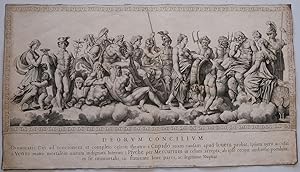
[Psyches et Amoris nuptiae fabula a Raphaele Sanctio Urbinate Romae in Farnesianis hortis Transtyberim ad veterum aemulationem ac laudem colorum luminibus expressa a. Dorigny. delineata et incisa, et a Ioanne Petro Belloriio notis illustrata]
Editore: Domenico de' Rossi, Rome, 1693
Da: Donald A. Heald Rare Books (ABAA), New York, NY, U.S.A.
Membro dell'associazione: ABAA ILAB
Valutazione del venditore 5 su 5 stelle
Large folio. 10 hand-coloured engraved plates by Dorigny on laid paper (each 15 7/8 x 26 inches approximately), titles and imprints printed in gold, black ink-ruled borders, each plate cut to the edge of the image, mounted on large sheets of contemporary thick laid paper (each 29 3/8 x 40 3/8 inches approximately). Unbound A suite of ten engraved plates with very fine original hand colouring offering a stunning visual record of one of the best of the decorative interior schemes carried out by Raphael in Rome. This wonderful series records Raphael's 'Cupid and Psyche' series of frescoes, carried out by him between 1516 and 1518 in the Loggia of Psyche in the villa Farnesina in Rome. The series also comes with a title and an eleventh plate of the ceiling fresco in the adjoining Sala di Galatea, executed in 1512: neither the plate nor the title are present here. Originally published by the Rossis, the engravings are the work of Nicolas Dorigny (1658-1746) who lived and worked in Rome between about 1690 and 1719. The painter, classicist, and art historian Giovanni Pietro Bellori (1613-1696) provided the text at the foot of the plates (appropriate excerpts from Apuleuis's Golden Ass). "Raphael Invenit: Stampe da Rafaello" (1985) Dorigny 37-46; cf. Brunet IV, 1111; cf. Berlin Katalog 4066.
-
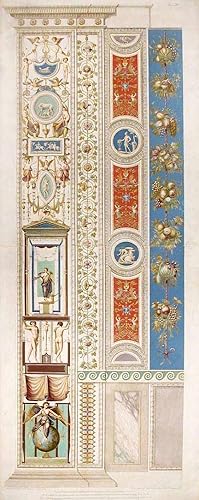
Decorative pilaster with fruit, flowers, and tendrils
Editore: Rome, 1772
Da: Donald A. Heald Rare Books (ABAA), New York, NY, U.S.A.
Membro dell'associazione: ABAA ILAB
Valutazione del venditore 5 su 5 stelle
Arte / Stampa / Poster
Copper engraving by Ottaviani after drawings by Savorelli and Camporesi, printed in light brown coloured ink with contemporary hand-colouring. Good condition. Trimmed to just within plate mark along lower margin, expert repair to upper left corner just affecting image area, small repairs to right blank margin. A highly decorative print from the famous "Loggie di Rafaele nel Vaticano" series, with contemporary colouring of the highest quality from the golden age of the hand-coloured print. A very fine image from the first part of a work titled "Loggie di Rafaele nel Vaticano" depicting the decorative work executed by Raphael and his assistants between 1518-1519 in the Vatican. This remarkable print, one of the first to be published of the decoration of the Logge on the main storey of the Vatican apartments, was probably planned as early as 1760, but was not executed until between 1772 and 1776. The project as a whole was carried out by the painter Gaetano Savorelli, the draughtsman Ludovico Teseo, the architect Pietro Camporesi, and the engravers Giovanni Ottaviani and Giovanni Volpato. The plate is remarkable not only as the first important visual record of Raphael's work, but also for the quality of the hand-colouring - the work on this image is, in our opinion, some of the greatest to be produced in Europe during the whole of the eighteenth century: the golden age of the hand-coloured print. The whole series was of importance not just for the size and magnificent colouring of the prints, but also because of the influence they had on contemporary taste. The decision was made to "borrow" elements from Raphael's Vatican tapestries and insert them where the original frescoes were in too poor a state to be legible. The finished plates therefore represented an amalgam of design elements presented with a crisp freshness of colour that held enormous appeal and stimulated the taste for the "grotesque" in the neo-classical period. Cf. Brunet IV, 1110; cf. Berlin Katalog 4068; cf. Lambert Pattern and Design (V. & A.: 1983), p. 26; "Raphael Invenit: Stampe da Rafaello" (1985) Ottaviano 5; Raphael: Reproduktions-graphik aus vier Jahrhunderten (Coburg: 1984), p. 104.
-
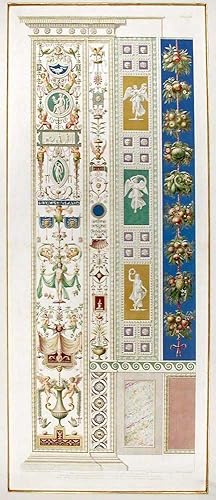
Decorative pilaster with fruit, flowers, and tendrils
Editore: Rome, 1772
Da: Donald A. Heald Rare Books (ABAA), New York, NY, U.S.A.
Membro dell'associazione: ABAA ILAB
Valutazione del venditore 5 su 5 stelle
Arte / Stampa / Poster
Copper engraving by Ottaviani after drawings by Savorelli and Camporesi, printed in light brown coloured ink with contemporary hand-colouring. Good condition. Sight size: 43 x 17 1/4 inches. A highly decorative print from the famous "Loggie di Rafaele nel Vaticano" series, with contemporary colouring of the highest quality from the golden age of the hand-coloured print. A very fine image from the first part of a work titled "Loggie di Rafaele nel Vaticano" depicting the decorative work executed by Raphael and his assistants between 1518-1519 in the Vatican. This remarkable print, one of the first to be published of the decoration of the Logge on the main storey of the Vatican apartments, was probably planned as early as 1760, but was not executed until between 1772 and 1776. The project as a whole was carried out by the painter Gaetano Savorelli, the draughtsman Ludovico Teseo, the architect Pietro Camporesi, and the engravers Giovanni Ottaviani and Giovanni Volpato. The plate is remarkable not only as the first important visual record of Raphael's work, but also for the quality of the hand-colouring - the work on this image is, in our opinion, some of the greatest to be produced in Europe during the whole of the eighteenth century: the golden age of the hand-coloured print. The whole series was of importance not just for the size and magnificent colouring of the prints, but also because of the influence they had on contemporary taste. The decision was made to "borrow" elements from Raphael's Vatican tapestries and insert them where the original frescoes were in too poor a state to be legible. The finished plates therefore represented an amalgam of design elements presented with a crisp freshness of colour that held enormous appeal and stimulated the taste for the "grotesque" in the neo-classical period. Cf. Brunet IV, 1110; cf. Berlin Katalog 4068; cf. Lambert Pattern and Design (V. & A.: 1983), p. 26; "Raphael Invenit: Stampe da Rafaello" (1985) Ottaviano 13;Raphael: Reproduktions-graphik aus vier Jahrhunderten (Coburg: 1984), p. 104.
-
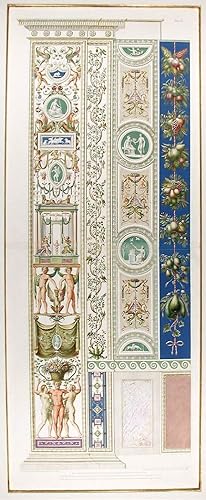
Decorative pilaster with fruit, flowers, and tendrils
Editore: Rome, 1772
Da: Donald A. Heald Rare Books (ABAA), New York, NY, U.S.A.
Membro dell'associazione: ABAA ILAB
Valutazione del venditore 5 su 5 stelle
Arte / Stampa / Poster
Copper engraving by Ottaviani after drawings by Savorelli and Camporesi, printed in light brown coloured ink with contemporary hand-colouring. Good condition. Sight size: 43 x 17 inches. A highly decorative print from the famous "Loggie di Rafaele nel Vaticano" series, with contemporary colouring of the highest quality from the golden age of the hand-coloured print. A very fine image from the first part of a work titled "Loggie di Rafaele nel Vaticano" depicting the decorative work executed by Raphael and his assistants between 1518-1519 in the Vatican. This remarkable print, one of the first to be published of the decoration of the Logge on the main storey of the Vatican apartments, was probably planned as early as 1760, but was not executed until between 1772 and 1776. The project as a whole was carried out by the painter Gaetano Savorelli, the draughtsman Ludovico Teseo, the architect Pietro Camporesi, and the engravers Giovanni Ottaviani and Giovanni Volpato. The plate is remarkable not only as the first important visual record of Raphael's work, but also for the quality of the hand-colouring - the work on this image is, in our opinion, some of the greatest to be produced in Europe during the whole of the eighteenth century: the golden age of the hand-coloured print. The whole series was of importance not just for the size and magnificent colouring of the prints, but also because of the influence they had on contemporary taste. The decision was made to "borrow" elements from Raphael's Vatican tapestries and insert them where the original frescoes were in too poor a state to be legible. The finished plates therefore represented an amalgam of design elements presented with a crisp freshness of colour that held enormous appeal and stimulated the taste for the "grotesque" in the neo-classical period. Cf. Brunet IV, 1110; cf. Berlin Katalog 4068; cf. Lambert Pattern and Design (V. & A.: 1983), p. 26; "Raphael Invenit: Stampe da Rafaello" (1985) Ottaviano 11; Raphael: Reproduktions-graphik aus vier Jahrhunderten (Coburg: 1984), p. 104.
-

Doorway to Vatican Loggia
Editore: Rome, 1772
Da: Donald A. Heald Rare Books (ABAA), New York, NY, U.S.A.
Membro dell'associazione: ABAA ILAB
Valutazione del venditore 5 su 5 stelle
Arte / Stampa / Poster
Copper engraving by Ottaviani after drawings by Savorelli and Camporesi, printed in light brown coloured ink with contemporary hand-colouring. Good condition. Three repaired tears to the left blank margin. Sight size: 31 1/8 x 18 1/4 inches. A highly decorative print from the famous "Loggie di Rafaele nel Vaticano" series, with contemporary colouring of the highest quality from the golden age of the hand-coloured print. A very fine image from the first part of a work titled "Loggie di Rafaele nel Vaticano" depicting the decorative work executed by Raphael and his assistants between 1518-1519 in the Vatican. This remarkable print, one of the first to be published of the decoration of the Logge on the main storey of the Vatican apartments, was probably planned as early as 1760, but was not executed until between 1772 and 1776. The project as a whole was carried out by the painter Gaetano Savorelli, the draughtsman Ludovico Teseo, the architect Pietro Camporesi, and the engravers Giovanni Ottaviani and Giovanni Volpato. The plate is remarkable not only as the first important visual record of Raphael's work, but also for the quality of the hand-colouring - the work on this image is, in our opinion, some of the greatest to be produced in Europe during the whole of the eighteenth century: the golden age of the hand-coloured print. The whole series was of importance not just for the size and magnificent colouring of the prints, but also because of the influence they had on contemporary taste. The decision was made to "borrow" elements from Raphael's Vatican tapestries and insert them where the original frescoes were in too poor a state to be legible. The finished plates therefore represented an amalgam of design elements presented with a crisp freshness of colour that held enormous appeal and stimulated the taste for the "grotesque" in the neo-classical period. Cf. Brunet IV, 1110; cf. Berlin Katalog 4068; cf. Lambert Pattern and Design (V. & A.: 1983), p. 26; "Raphael Invenit: Stampe da Rafaello" (1985) Ottaviano 17; Raphael: Reproduktions-graphik aus vier Jahrhunderten (Coburg: 1984), p. 104.
-
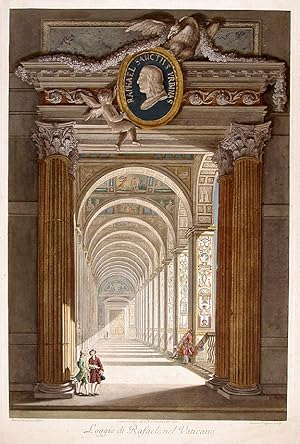
Loggie di Rafaele nel Vaticano
Editore: Rome, 1777
Da: Donald A. Heald Rare Books (ABAA), New York, NY, U.S.A.
Membro dell'associazione: ABAA ILAB
Valutazione del venditore 5 su 5 stelle
Arte / Stampa / Poster
Copper engraving by Volpato after a drawing by Camporesi, later professional hand-colouring. Good condition. Expert strengthening to verso of right outer blank margin, some old light creasing to 3 inches of the sheet. This beautiful perspective view of Raphael's Loggia, served as the frontispiece to the celebrated text, "Loggie di Rafaele nel Vaticano". This arresting print is a general perspective view of Raphael's design for the Loggia at the Vatican, with a large profile portrait of Raphael in a medallion over the entrance to the corridor. The plate served as the frontispiece to the first part of the "Logge di Rafaele nel Vaticano", which depicted the decorative work executed by Raphael and his assistants between 1518-1519 in the Vatican. This remarkable print, one of the first to be published of the decoration of the Logge on the main storey of the Vatican apartments, was probably planned as early as 1760, but was not executed until between 1772 and 1776. The project as a whole was carried out by the painter Gaetano Savorelli, the draughtsman Ludovico Teseo, the architect Pietro Camporesi, and the engravers Giovanni Ottaviani and Giovanni Volpato. The whole series was of importance not just for the size and magnificent colouring of the prints, but also because of the influence they had on contemporary taste. The decision was made to "borrow" elements from Raphael's Vatican tapestries and insert them where the original frescoes were in too poor a state to be legible. The finished plates therefore represented an amalgam of design elements presented with a crisp freshness of colour that held enormous appeal and stimulated the taste for the "grotesque" in the neo-classical period. Cf. Brunet IV, 1110; cf. Berlin Katalog 4068; Lambert Pattern and Design (V. & A.: 1983), p. 26; "Raphael Invenit: Stampe da Rafaello" (1985) Volpato 1; Raphael: Reproduktions-graphik aus vier Jahrhunderten (Coburg: 1984), p. 104; G. Marini (editor) Giovanni Volpato 1735-1803 (1988) no. 198.
-
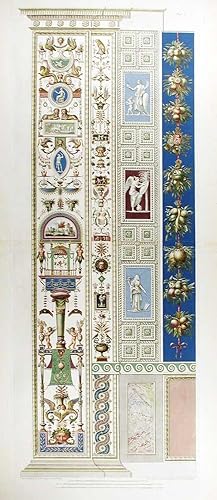
Decorative pilaster with fruit, flowers, and tendrils
Editore: Rome, 1772
Da: Donald A. Heald Rare Books (ABAA), New York, NY, U.S.A.
Membro dell'associazione: ABAA ILAB
Valutazione del venditore 5 su 5 stelle
Arte / Stampa / Poster
Copper engraving by Ottaviani after drawings by Ludovico Teseo, printed in black with stunning later professional hand-colouring. Very good condition. A highly decorative print from the famous "Loggie di Rafaele nel Vaticano" series, with later professional hand-colouring. A very fine image from the first part of a work titled "Loggie di Rafaele nel Vaticano" depicting the decorative work and executed by Raphael and his assistants between 1518-1519 in the Vatican. This remarkable print, one of the first to be published of the decoration of the Logge on the main storey of the Vatican apartments, was probably planned as early as 1760, but was not executed until between 1772 and 1776. The project as a whole was carried out by the painter Gaetano Savorelli, the draughtsman Ludovico Teseo, the architect Pietro Camporesi, and the engravers Giovanni Ottaviani and Giovanni Volpato. The whole series was remarkable not just for the size and magnificent colouring of the prints, but also because of the influence they had on contemporary taste. The decision was made to "borrow" elements from Raphael's Vatican tapestries and insert them where the original frescoes were in too poor a state to be legible. The finished plates therefore represented an amalgam of design elements presented with a crisp freshness of colour that held enormous appeal and stimulated the taste for the "grotesque" in the neo-classical period. Cf. Brunet IV, 1110; cf. Berlin Katalog 4068; cf. Lambert Pattern and Design (V. & A.: 1983), p. 26; "Raphael Invenit: Stampe da Rafaello" (1985) Ottaviano 2; Raphael: Reproduktions-graphik aus vier Jahrhunderten (Coburg: 1984), p. 104.
-
"Maddalena Doni" und "Angelo Doni". Gegenstücke. Hüftbilder nach halbrechts bzw. halblinks, sitzend vor einer Landschaft, unten Inschrift.
Da: Franziska Bierl Antiquariat, Eurasburg, Germania
Valutazione del venditore 4 su 5 stelle

Arte / Stampa / Poster
EUR 190,00
Spedizione EUR 40,00
Spedito da Germania a U.S.A.Quantità: 1 disponibili
Aggiungi al carrello2 Lithographien von F. Pierucci bzw. F. Pieraccini nach Raffael bei L. Bardi, Firenze, 1829, je 26 x 18,5 cm. Thiem-Becker Bd. XXVI, S. 598; Nagler, Pieraccini 1 und Pierucci 1; Höper B 17 und B 18: "Angelo Doni heiratete 1503 die 1489 geborene Maddalena Strozzi und ließ das Bildnis seiner Frau sowie sein eigenes von Raffael anfertigen". - Minimal fleckig. Breitrandig.


![Immagine del venditore per [Psyches et Amoris nuptiae fabula a Raphaele Sanctio Urbinate Romae in Farnesianis hortis Transtyberim ad veterum aemulationem ac laudem colorum luminibus expressa a. Dorigny. delineata et incisa, et a Ioanne Petro Belloriio notis illustrata] venduto da Donald A. Heald Rare Books (ABAA)](https://pictures.abebooks.com/inventory/md/md1186158343.jpg)