Importo totale (1 articolo articoli):
Destinazione ordine:

preface john fulton (8 risultati)
Vai alla pagina principale dei risultati di ricerca
Filtri di ricerca
Tipo di articolo
- Tutti i tipi di prodotto
- Libri (8)
- Riviste e Giornali (Nessun altro risultato corrispondente a questo perfezionamento)
- Fumetti (Nessun altro risultato corrispondente a questo perfezionamento)
- Spartiti (Nessun altro risultato corrispondente a questo perfezionamento)
- Arte, Stampe e Poster (Nessun altro risultato corrispondente a questo perfezionamento)
- Fotografie (Nessun altro risultato corrispondente a questo perfezionamento)
- Mappe (Nessun altro risultato corrispondente a questo perfezionamento)
- Manoscritti e Collezionismo cartaceo (Nessun altro risultato corrispondente a questo perfezionamento)
Condizioni Maggiori informazioni
- Nuovo (Nessun altro risultato corrispondente a questo perfezionamento)
- Come nuovo, Ottimo o Quasi ottimo (3)
- Molto buono o Buono (4)
- Discreto o Mediocre (Nessun altro risultato corrispondente a questo perfezionamento)
- Come descritto (1)
Legatura
- Tutte
- Rilegato (8)
- Brossura (Nessun altro risultato corrispondente a questo perfezionamento)
Ulteriori caratteristiche
- Prima ed. (8)
- Copia autograf. (Nessun altro risultato corrispondente a questo perfezionamento)
- Sovracoperta (6)
- Con foto (6)
- Non Print on Demand (8)
Lingua (1)
Prezzo
- Qualsiasi prezzo
- Inferiore a EUR 20 (Nessun altro risultato corrispondente a questo perfezionamento)
- EUR 20 a EUR 45 (Nessun altro risultato corrispondente a questo perfezionamento)
- Superiore a EUR 45
Spedizione gratuita
- Spedizione gratuita in U.S.A. (Nessun altro risultato corrispondente a questo perfezionamento)
Paese del venditore
Valutazione venditore
-

A BIBLIOGRAPHY OF THE WORKS OF ANTOINE LAURENT LAVOISIER 1743-1794 (WITH) SUPPLEMENT TO A BIBLIOGRAPHY OF THE WORKS OF ANTOINE LAURENT LAVOISIER 1743-1794 (2 volume set)
Editore: Wm. Dawson & Sons, Ltd. and E. Weil, London, 1954
Da: Frey Fine Books, Rougemont, NC, U.S.A.
Valutazione del venditore 5 su 5 stelle

Prima edizione
Cloth. Condizione: Very Good +. Condizione sovraccoperta: Very Good. 1st edition. 1st editions,1954, 1965. A Very Good + set in Very Good dust jackets. 4to., [Vol.1] xxiii, 491 pp., illustrated with reproductions of title pages and portrait frontispiece. Bound in blue cloth in light blue, printed dust jackets. Light edge wear, with some uneven sunning, especially to the Supplement. Both volumes have a reproduction of Lavoisier's book plate at the front. Vol. 1 has the previous owner's name on the front end paper ,and on the bottom edge of the text block. The dust jackets are now protected in mylar sleeves.
-
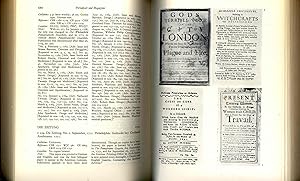
American medical bibliography 1639-1783; a chronological catalogue, and critical and bibliographical study of books, pamphlets, broadsides, and articles in periodical publications relating to the medical sciences: medicine, surgery, pharmacy, dentistry, and veterinary medicine; printed in the present territory of the United States of America during British Dominion and the Revolutionary War. Yale University. School of Medicine. Dept. of the History of Science and Medicine. Publication, no. 40
Editore: New York, Harper, 1962, 1962
Da: Joseph Valles - Books, Stockbridge, GA, U.S.A.
Valutazione del venditore 5 su 5 stelle
Prima edizione
Hardcover. Condizione: Fine. 1st Edition. [1st ed.] ; 885 p. ill. ; Series: Yale University. School of Medicine. Dept. of the History of Science and Medicine. Publication, no. 40 ; LCCN: 61-17786 ; LC: Z6659; Dewey: 016.61; NLM: W1; OCLC: 710107 ; blue cloth with gold lettering ; no dustjacket ; extremely important bibliography of historical medical publications in the Americas ; Contents: Introduction : Books and pamphlets -- Broadsides -- Official publications -- Almanacs -- Periodical publications -- The scientific value of this literature and its contributions to medicine, surgery, public health, forensic medicine, psychiatry, pharmacy, dentistry, and veterinary medicine -- Part I Books, pamphlets and broadsides -- Part II Almanacs -- Part III Periodical publications, magazines and newspapers -- Part IV Illustrations -- Part V Section: Table of abbreviations -- Reference symbols -- Location symbols -- Pseudonyms -- Table of authors -- Table of almanacs -- Table of periodical publications -- Colonial American official publications -- American reprints of Colonial American medical publications -- Facsimile editions of Colonial American medical publications -- COlonial American reprints of European medical publications -- European reprints of Colonial American medical publications -- Colonial American medical manuscripts printed in America after 1783 -- Medical publications by Colonial American authors printed abroad before 1784 -- Bibliography of bibliographies and references -- Part VI List of illustrations -- Index of Subjects -- Index of Names. ; presentation by previous owners on front endpaper; huge, thick volume ; FINE. Book.
-

A Bibliography of the Works of Antoine Laurent Lavoisier, 1743-1794 and Supplement to a Bibliography of the Works of Antoine Laurent Lavoisier, 1743-1794 (complete in 2 volumes)
Editore: London: Wm. Dawson & Sons, Ltd. & E. Weil (Vol. I) - Dawsons of Pall Mall (Vol. II)
Da: Arnold M. Herr, Los Angeles, CA, U.S.A.
Valutazione del venditore 5 su 5 stelle
Prima edizione
Hardcover. Condizione: Fine. Condizione sovraccoperta: Fine. 1st Edition. Publication dates: Vol. I: 1954; Vol. II: 1965. Two large octavo volumes. B&W illustrations; reproductions of Lavoisier's bookplate inside front cover of both volumes. Condition: small amount of light spotting near bottom edge of front cover of Vol. I; slight damage to fold-out chart facing page 126; else fine in fine dust jackets. Pages: Volume I: xxiii, 491; Volume II: xiii, 175.
-
A Bibliography of the Works of Antoine Laurent Lavoisier, 1743-1794, with Supplement
Editore: Wm. Dawson & Sons, Ltd.; E. Weil 1954-1965, London, 1954
Da: Rooke Books PBFA, Bath, Regno Unito
Membro dell'associazione: PBFA
Valutazione del venditore 5 su 5 stelle
Prima edizione
EUR 173,39
Spedizione EUR 23,21
Spedito da Regno Unito a U.S.A.Quantità: 1 disponibili
Aggiungi al carrelloCloth. Condizione: Very Good Indeed. Condizione sovraccoperta: Very Good. Not Stated (illustratore). First edition. The first edition of the bibliography, with the supplement, of the works of the renowned French nobleman and "father of modern chemistry" Antoine Laurent Lavoisier. The first edition of this two volume work in the publisher's original cloth bindings, with the original unclipped dust wrappers. As called for, both volumes feature a facsimile of Lavoisier's bookplate, engraved by de la Gardette, to the front pastedown. The bibliography is illustrated with a frontispiece and forty-two plates. The supplement is illustrated with a frontispiece and six plates. Collated, complete. Lavoisier was a renowned French chemist and leading figure in the eighteenth-century chemical revolution, best known for developing an experimentally based theory of the chemical reactivity of oxygen. This bibliography, along with the supplement, details Lavoisier's contributions to the fields of economics, finance, agriculture, political science, sociology, education, and chemistry. These are organised into the following sections: A. Contributions to Periodical Works; B. Major Separate Works; C. Minor Separate Works and Contributions to Separate Works; D. Miscellanea in other Works; E. Reports by Lavoisier to the Academie on other Works; F. Collected Works; E. Addenda. Compiled by the renowned chemical historians Denis I. Duveen and Herbert S. Klickstein, with a preface by the notable American neurophysiologist and science writer John Farquhar Fulton. In the publisher's original cloth bindings, with the original unclipped dust wrappers. Externally, very bright and smart, with minor shelf wear to the tail of the spine to the bibliography. The spine to the bibliography is slightly cocked. Internally, firmly bound. Pages are bright and clean. Dust wrappers are generally smart, with a scattering of handling marks. Light chipping to the head and tail of the spine of the wrap to the bibliography. Very Good Indeed. book.
-
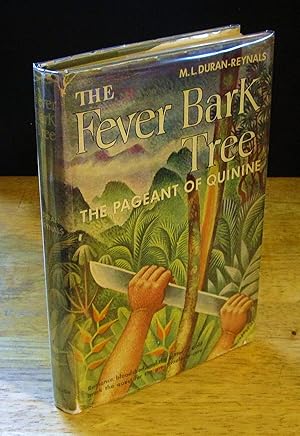
The Fever Bark Tree: The Pageant of Quinine
Editore: W. H. Allen - A Howard & Wyndham Company, Essex Street, London, 1947
Da: The BiblioFile, Rapid River, MI, U.S.A.
Valutazione del venditore 5 su 5 stelle
Prima edizione
Hard Cover. Condizione: Good. Polaine, H. G. (Jacket Painting) (illustratore). First Edition. Stated at copyright: "First Published in Great Britain 1947." The scarce British first edition. Handy 5" x 7 1/2" design. Green cloth boards, black spine titles with W. H. Allen gilt colophon, moderate shelf wear, some sunning, discoloration. Pages very good; no writing. Remains of antiquarian book plate inside cover featuring the intricate and angular cross of St. John.: "St. John and Red Cross Hospital Library. This book is the property of Joint Committe of St. John of Jerusalem and the." Blank manila card sleeve inside back cover. Bind fine, square; hinges intact. Solid rarity with near very good leaves. Romance, bloodshed, and the glitter of gold mark the quest for the great malaria cure. Malaria has resulted in more poverty, sickness, and death than almost any other scourge, even war. Presented here is the story of humanity's battle with this disease from a likely cause of Alexander of Macedon's death at the height of his power. From B. C. to World War II, when malaria may have accounted for more than half the total causualties as malaria was a major concern of the Pacific campaign. Contents: "Of Fevers; The Countess's Powder; The Jesuits' Powder; Philosophical Interlude; The Wonderful Secret of the Englishman; The Fever Bark Tree; The Botanical Institute of the New Kingdom of Granada; The Breaking of the Spell; Scientific Interlude; Poor Man's Quinine; The Betrayal; Rich Man's Quinine; Hercules, the Hydra, and the Birds; Bataan, and Corregidor; and, Of Fevers". This is the story of quinine, the life-saving remedy that has been the only effective remedy for controlling the dreaded disease. M. L. Duran-Reynals presents an interesting narrative thread jockeying between key individuals and eras that were instrumental in bringing quinine - finally - into the light for everyone to use. The Jesuits and Britain kept it hidden as an advantage. Cinchona, the fever bark tree quinine is derived, was sacred to the natives of the high Andes where it grew. When first discovered by the Spanish, death was the punishment for those who tried to exploit its magic. Later Cardinal de Lugo promoted the use of quinine, but his efforts were in vain when the "Jesuits' Powder" became the center of a raging religious controversy. An Englishman, who was not a physician by trade, cured the aristocracy of two countries; but, was forced hide this to avoid the Popish Plot of King Charles II's. Indians on the high Andes slopes, planters in India and Java, powerful financiers in Lond and Amsterdam, all played their part with the botantists, chemists, and naturalistis in the amazing pageant of quinine. The Fever Bark Tree is the result of years of research, but Druan-Reynals, with her back ground of medicine and scholarship on two contenents, has preseneted her myriad facts into a colorful fast-paced suspense that is an enjoyable informative read. Made and Printed in Great Britain by Hazel, Watson and Viney, Limited, London and Aylesbury. 251 pages. Insured post. Size: 12mo - over 6¾" - 7¾" tall.
-
The Fever Bark Tree: The Pageant of Quinine
Editore: W. H. Allen, Essex Street, London, 1947
Da: The BiblioFile, Rapid River, MI, U.S.A.
Valutazione del venditore 5 su 5 stelle
Prima edizione
Hard Cover. Condizione: Fine. Condizione sovraccoperta: Very Good. Polaine, H. G. (Jacket Painting) (illustratore). First Edition. Stated at copyright: "First Published in Great Britain 1947." The scarce British first edition in original wrapper. Handy 5" x 7 1/2" design. Green cloth boards, sharp stylized gilt spine titles with W. H. Allen gilt colophon, light shelf wear. Pages near fine; no writing. Beautiful green floral owner's stamp at front pastedown: "John Stanley Gledhill". Bind fine, square; hinges intact. Original pictorial wrapper, light edge wear, rub; clipped, protected in new clear sleeve. Unique wrapper art for this edition by H. G. Polaine. Near fine rarity in very good dust wrapper. Romance, bloodshed, and the glitter of gold mark the quest for the great malaria cure. Malaria has resulted in more poverty, sickness, and death than almost any other scourge, even war. Presented here is the story of humanity's battle with this disease from a likely cause of Alexander of Macedon's death at the height of his power. From B. C. to World War II, when malaria may have accounted for more than half the total causualties as malaria was a major concern of the Pacific campaign. Contents: "Of Fevers; The Countess's Powder; The Jesuits' Powder; Philosophical Interlude; The Wonderful Secret of the Englishman; The Fever Bark Tree; The Botanical Institute of the New Kingdom of Granada; The Breaking of the Spell; Scientific Interlude; Poor Man's Quinine; The Betrayal; Rich Man's Quinine; Hercules, the Hydra, and the Birds; Bataan, and Corregidor; and, Of Fevers". This is the story of quinine, the life-saving remedy that has been the only effective remedy for controlling the dreaded disease. M. L. Duran-Reynals presents an interesting narrative thread jockeying between key individuals and eras that were instrumental in bringing quinine - finally - into the light for everyone to use. The Jesuits and Britain kept it hidden as an advantage. Cinchona, the fever bark tree quinine is derived, was sacred to the natives of the high Andes where it grew. When first discovered by the Spanish, death was the punishment for those who tried to exploit its magic. Later Cardinal de Lugo promoted the use of quinine, but his efforts were in vain when the "Jesuits' Powder" became the center of a raging religious controversy. An Englishman, who was not a physician by trade, cured the aristocracy of two countries; but, was forced hide this to avoid the Popish Plot of King Charles II's. Indians on the high Andes slopes, planters in India and Java, powerful financiers in Lond and Amsterdam, all played their part with the botantists, chemists, and naturalistis in the amazing pageant of quinine. The Fever Bark Tree is the result of years of research, but Druan-Reynals, with her back ground of medicine and scholarship on two contenents, has preseneted her myriad facts into a colorful fast-paced suspense that is an enjoyable informative read. Made and Printed in Great Britain by Hazel, Watson and Viney, Limited, London and Aylesbury. 251 pages. Insured post. Size: 12mo - over 6¾" - 7¾" tall.
-
The Fever Bark Tree: The Pageant of Quinine
Editore: Doubleday & Company, Inc., Garden City, New York, 1946
Da: The BiblioFile, Rapid River, MI, U.S.A.
Valutazione del venditore 5 su 5 stelle
Prima edizione
Hard Cover. Condizione: Very Good. Condizione sovraccoperta: Very Good. Covvarubias, Miguel (Jacket Painting) (illustratore). First Edition. Rare first edition in original dust wrapper. Includes a Doubleday pre-publication original 8" x 10" photograph of the dynamic cover art in black & white. Stated First Edition at copyright. 1946 at title page and Copyright 1946 by M. L. Duran-Reynals. Dark grey full cloth boards, gilt spine titles, moderate shelf wear. Between spine titles is unique patterned gilt design that almost appears as two vertical helixes emblematic of helical DNA strands popularized in 1968. Deckled pages near fine, clean; attractive toning. Sepia antiquarian bookplate inside cover of potted plant upon book stack: "Donna Davidson" and printed below name: "Durban, S. Africa, 1946". Bind fine; hinges intact. Scarce original wrapper, moderate edge wear, rub, discoloration; unclipped 2.75, protected in new clear sleeve. Classic mid-century color painting wrapping around to spine by Miguel Covarrubias in rich green and earthen hues of hands with machete slicing bark from jungle forest. Sharp complete first edition of this prescient historical content for humanity. Romance, bloodshed, and the glitter of gold mark the quest for the great malaria cure. Malaria has resulted in more poverty, sickness, and death than almost any other scourge, even war. Presented here is the story of humanity's battle with this disease from a likely cause of Alexander of Macedon's death at the height of his power. From B. C. to World War II, when malaria may have accounted for more than half the total causualties as malaria was a major concern of the Pacific campaign. Contents: "Of Fevers; The Countess's Powder; The Jesuits' Powder; Philosophical Interlude; The Wonderful Secret of the Englishman; The Fever Bark Tree; The Botanical Institute of the New Kingdom of Granada; The Breaking of the Spell; Scientific Interlude; Poor Man's Quinine; The Betrayal; Rich Man's Quinine; Hercules, the Hydra, and the Birds; Bataan, and Corregidor; Of Fevers; and, a Bibliography". This is the story of quinine, the life-saving remedy that has been the only effective remedy for controlling the dreaded disease. M. L. Duran-Reynals presents an interesting narrative thread jockeying between key individuals and eras that were instrumental in bringing quinine - finally - into the light for everyone to use. The Jesuits and Britain kept it hidden as an advantage. Cinchona, the fever bark tree quinine is derived, was sacred to the natives of the high Andes where it grew. When first discovered by the Spanish, death was the punishment for those who tried to exploit its magic. Later Cardinal de Lugo promoted the use of quinine, but his efforts were in vain when the "Jesuits' Powder" became the center of a raging religious controversy. An Englishman, who was not a physician by trade, cured the aristocracy of two countries; but, was forced hide this to avoid the Popish Plot of King Charles II's. Indians on the high Andes slopes, planters in India and Java, powerful financiers in Lond and Amsterdam, all played their part with the botantists, chemists, and naturalistis in the amazing pageant of quinine. The Fever Bark Tree is the result of years of research, but Druan-Reynals, with her back ground of medicine and scholarship on two contenents, has preseneted her myriad facts into a colorful fast-paced suspense that is an enjoyable informative read. Features a detailed chapter by chapter 8-page bibliography; also, fine 8-page index. Printed in the United States of America by The Country Life Press, Garden City, N. Y. 275 pages. Insured post. Size: 8vo - over 7¾ - 9¾" Tall.
-
A Bibliography of the Works of Antoine Laurent Lavoisier 1743 - 1794.
Da: Antiquariaat Wim de Goeij, Kalmthout, ANTW, Belgio
Membro dell'associazione: ILAB
Valutazione del venditore 5 su 5 stelle
Prima edizione
EUR 174,00
Spedizione EUR 34,80
Spedito da Belgio a U.S.A.Quantità: 1 disponibili
Aggiungi al carrello6. London, Dawson & Sons, 1954, in-8°, 491 pp, some ills. of title pages, blue publisher's cloth with original dustjacket (some soiling and wear at binding and jacket, but still a clean copy with a fine interior.). First original edition (without a supplement which was published some years later).