

Importo totale (1 articolo articoli):
Destinazione ordine:

stephen hodkinson eds (6 risultati)
Vai alla pagina principale dei risultati di ricerca
Filtri di ricerca
Tipo di articolo
- Tutti i tipi di prodotto
- Libri (6)
- Riviste e Giornali (Nessun altro risultato corrispondente a questo perfezionamento)
- Fumetti (Nessun altro risultato corrispondente a questo perfezionamento)
- Spartiti (Nessun altro risultato corrispondente a questo perfezionamento)
- Arte, Stampe e Poster (Nessun altro risultato corrispondente a questo perfezionamento)
- Fotografie (Nessun altro risultato corrispondente a questo perfezionamento)
- Mappe (Nessun altro risultato corrispondente a questo perfezionamento)
- Manoscritti e Collezionismo cartaceo (Nessun altro risultato corrispondente a questo perfezionamento)
Condizioni Maggiori informazioni
- Nuovo (1)
- Come nuovo, Ottimo o Quasi ottimo (1)
- Molto buono o Buono (2)
- Discreto o Mediocre (Nessun altro risultato corrispondente a questo perfezionamento)
- Come descritto (2)
Legatura
Ulteriori caratteristiche
- Prima ed. (1)
- Copia autograf. (Nessun altro risultato corrispondente a questo perfezionamento)
- Sovracoperta (2)
- Con foto (3)
- Non Print on Demand (6)
Lingua (2)
Prezzo
- Qualsiasi prezzo
- Inferiore a EUR 20 (Nessun altro risultato corrispondente a questo perfezionamento)
- EUR 20 a EUR 45
- Superiore a EUR 45
Spedizione gratuita
- Spedizione gratuita in U.S.A. (Nessun altro risultato corrispondente a questo perfezionamento)
Paese del venditore
Valutazione venditore
-
softcover. Condizione: very good. no jacket. Corners slightly scuffed.
-
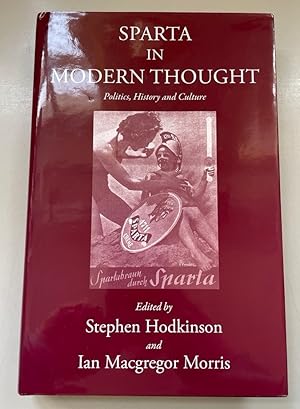
Sparta in Modern Thought: Politics, History and Culture.
Lingua: Inglese
Editore: Swansea: The Classical Press of Wales, 2012
ISBN 10: 190512547X ISBN 13: 9781905125470
Da: Borkert, Schwarz und Zerfaß GbR, Berlin, Germania
Membro dell'associazione: BOEV GIAQ
Valutazione del venditore 5 su 5 stelle

EUR 49,00
Spedizione EUR 40,00
Spedito da Germania a U.S.A.Quantità: 1 disponibili
Aggiungi al carrelloHardcover with dust jacket. Condizione: Gut. XXVI, 462 p.: Ill. Lediglich der Schutzumschlag ist leicht berieben, sonst ein tadelloses Exemplar / Only the dust jacket is slightly rubbed, otherwise a pristine copy. - CONTENTS Introduction Ian Macgregor Morris and Stephen Hodkinson PART I MEDIEVAL AND EARLY MODERN EUROPE 1 Lycurgus in late medieval political culture Ian Macgregor Morris (University of Nottingham) 2 Sparta and Rome in early modern thought: a comparative approach Kostas Vlassopoulos (University of Nottingham) PART II ENLIGHTENMENT TO POST-REVOLUTIONARY FRANCE 3 Sparta and the French Enlightenment Haydn Mason (University of Bristol) 4 Spartans and savages: mirage and myth in eighteenth-century France Michael Winston (University of Oklahoma) 5 Treatments of Spartan land tenure in eighteenth- and nineteenth-century France: from François Fénelon to Fustel de Coulanges Paul Christesen (Dartmouth College) PART III GERMANY: FROM LITERARY HELLENISM ?? NATIONAL SOCIALISM 6 Spartanic verses: Hölderlin and the role of Sparta in German literary hellenism, c. 1800 Uta Degner (University of Salzburg) 7 The Spartan tradition in Germany, 1870-1945 Volker Losemann (University of Marburg) 8 Spartanische Pimpfe: The importance of Sparta in the educational ideology of the Adolf Hitler Schools Helen Roche (University of Cambridge) PART IV COLD WAR POLITICS AND CONTEMPORARY POPULAR CULTURE 9 Sparta and the Soviet Union in U.S. Cold War foreign policy and intelligence analysis Stephen Hodkinson (University of Nottingham) 10 The positive portrayal of Sparta in late-twentieth- century fiction Lynn S. Fotheringham (University of Nottingham) 11 'This is Cake-Town!': 300 (2006) and the death of allegory Gideon Nisbet (University of Birmingham) Index. ISBN 9781905125470 Sprache: Englisch Gewicht in Gramm: 972.
-
Sparta: New Perspectives
Da: Windows Booksellers, Eugene, OR, U.S.A.
Membro dell'associazione: CBA IOBA
Valutazione del venditore 5 su 5 stelle
Hardcover with dust jacket. VG/VG 427 pp.
-

Climate Change, Ecology and Systematics
Libro 1 di 14: Systematics Association Special Volume SeriesLingua: Inglese
Editore: Cambridge University Press, 2011
ISBN 10: 0521766095 ISBN 13: 9780521766098
Da: PEMBERLEY NATURAL HISTORY BOOKS BA, ABA, Iver, Regno Unito
Membro dell'associazione: ABA ILAB PBFA
Valutazione del venditore 5 su 5 stelle
EUR 77,27
Spedizione EUR 25,39
Spedito da Regno Unito a U.S.A.Quantità: 1 disponibili
Aggiungi al carrelloCondizione: Fine. xi, 524, [8], text figs. . HB. Fine. Climate change has shaped life in the past and will continue to do so in the future. Understanding the interactions between climate and biodiversity is a complex challenge to science. With contributions from 60 key researchers, this book examines the ongoing impact of climate change on the ecology and diversity of life on earth. It discusses the latest research within the fields of ecology and systematics, highlighting the increasing integration of their approaches and methods. Topics covered include the influence of climate change on evolutionary and ecological processes such as adaptation, migration, speciation and extinction, and the role of these processes in determining the diversity and biogeographic distribution of species and their populations. This book ultimately illustrates the necessity for global conservation actions to mitigate the effects of climate change in a world that is already undergoing a biodiversity crisis of unprecedented scale. [9780521766098].
-
![Immagine dell'editore per THE SHADOW OF SPARTA venduto da Pórtico [Portico]](https://pictures.abebooks.com/isbn/9780415104135-it-300.jpg)
THE SHADOW OF SPARTA
Da: Pórtico [Portico], ZARAGOZA, Z, Spagna
Valutazione del venditore 4 su 5 stelle

Prima edizione
EUR 112,75
Spedizione EUR 35,00
Spedito da Spagna a U.S.A.Quantità: 1 disponibili
Aggiungi al carrelloTapa blanda. Condizione: New. 1ª edición. POWELL, A. / S. HODKINSON, EDS.: THE SHADOW OF SPARTA. LONDON, 1994, vii 408 p. , 678 gr. Encuadernacion original. Nuevo. (C/CA) 678 gr. Libro.
-

The Shadow of Sparta
Editore: Routledge, London,, 1994
Da: lamdha books, Wentworth Falls, NSW, Australia
Valutazione del venditore 5 su 5 stelle
EUR 83,78
Spedizione EUR 21,23
Spedito da Australia a U.S.A.Quantità: 1 disponibili
Aggiungi al carrelloOctavo hardcover; blue boards with silver gilt spine titling; 408pp. Minor wear; a few faint spots and marks on text block edges. Near fine. No dustwrapper. Postage quoted is for a standard format octavo book. Final charges may vary depending on size and weight. In the past twenty years the study of Sparta has come of age. Images prevalent earlier in the 20th century, of Spartans as hearty good fellows or scarlet-cloaked automata, have been superseded by more complex scholarly reactions. As interest has grown in the self-images projected by this most secretive of Greek cities, increasing attention has focused on how individual Greek writers from other states reacted to information, or disinformation about Sparta. The studies in this volume provide new insights into the traditional historians' question, 'What actually happened at Sparta?'. But the implications of the work go far beyond Laconia. They concern preoccupations of some of the most studied of Greek writers, and help towards an understanding of how Athenians defined the achievement, or the failure, of their own city.

