

Importo totale (1 articolo articoli):
Destinazione ordine:

taylor mottram (12 risultati)
Vai alla pagina principale dei risultati di ricerca
Filtri di ricerca
Tipo di articolo
- Tutti i tipi di prodotto
- Libri (12)
- Riviste e Giornali (Nessun altro risultato corrispondente a questo perfezionamento)
- Fumetti (Nessun altro risultato corrispondente a questo perfezionamento)
- Spartiti (Nessun altro risultato corrispondente a questo perfezionamento)
- Arte, Stampe e Poster (Nessun altro risultato corrispondente a questo perfezionamento)
- Fotografie (Nessun altro risultato corrispondente a questo perfezionamento)
- Mappe (Nessun altro risultato corrispondente a questo perfezionamento)
- Manoscritti e Collezionismo cartaceo (Nessun altro risultato corrispondente a questo perfezionamento)
Condizioni Maggiori informazioni
- Nuovo (5)
- Come nuovo, Ottimo o Quasi ottimo (2)
- Molto buono o Buono (4)
- Discreto o Mediocre (1)
- Come descritto (Nessun altro risultato corrispondente a questo perfezionamento)
Legatura
Ulteriori caratteristiche
- Prima ed. (2)
- Copia autograf. (Nessun altro risultato corrispondente a questo perfezionamento)
- Sovracoperta (Nessun altro risultato corrispondente a questo perfezionamento)
- Con foto (3)
- Non Print on Demand (10)
Lingua (2)
Spedizione gratuita
Paese del venditore
Valutazione venditore
-
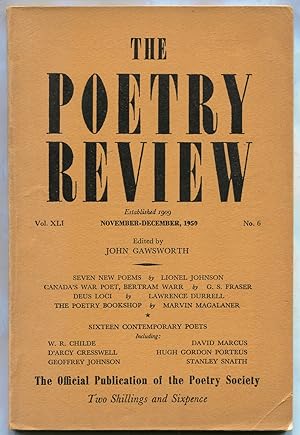
The Poetry Review Vol. XLI, No. 6 (November-December 1950)
Editore: Poetry Society, London / New York, 1950
Da: Between the Covers-Rare Books, Inc. ABAA, Gloucester City, NJ, U.S.A.
Membro dell'associazione: ABAA ESA ILAB IOBA
Valutazione del venditore 5 su 5 stelle

Prima edizione
Softcover. Condizione: Very Good. First edition. Octavo. 301-356pp. Perfect bound paper wraps. Slight tanning to the wraps, crease to corner and miniscule chip, about near fine. Poetry anthology with contributions from Lawrence Durrell ("Deus Loci"), Rachel Annand Taylor, Wilfrid Gibson, R.H. Mottram, Wilfred Rowland Childe, Stanley Snaith, D'Arcy Cresswell, Wrenne Jarman, Geoffrey Johnson, Gawsworth, Hugh Gordon Porteus, Phoebe Hesketh, John Heath-Stubbs, David Marcus, George Moor, Arthur Caddick, James Brockway, Theodore Roscoe, Lionel Johnson, and Marvin Magalaner.
-

Flabour Science Recent Developments
Lingua: Inglese
Editore: Royal Society of Chemistry, Cambridge, 1996
ISBN 10: 0854047026 ISBN 13: 9780854047024
Da: Webbooks, Wigtown, Wigtown, Regno Unito
Membro dell'associazione: PBFA
Valutazione del venditore 5 su 5 stelle
Prima edizione
EUR 14,29
Spedizione EUR 34,68
Spedito da Regno Unito a U.S.A.Quantità: 1 disponibili
Aggiungi al carrelloHard Cover. Condizione: Good. No Jacket. First Edition. From an academic library with the usual stamps etc. This item is heavy and will attract postal surcharges.
-

Rune, issue 2.
Editore: London University, no date [c. 1979]., 1979
Da: Cornell Books Limited, Tewkesbury, Regno Unito
Membro dell'associazione: PBFA
Valutazione del venditore 5 su 5 stelle
EUR 23,81
Spedizione EUR 17,28
Spedito da Regno Unito a U.S.A.Quantità: 1 disponibili
Aggiungi al carrelloCondizione: Good. Issue number 2 (softcover). 8vo (21cm by 15cm), 33pp. Original printed yellow card wrappers. There is some foxing to the covers and the edges of the text block; overall, this booklet is in good condition.
-
Flavour Science: Recent Developments
Lingua: Inglese
Editore: The Royal Society of Chemistry, 1997
ISBN 10: 0854047026 ISBN 13: 9780854047024
EUR 78,53
Spedizione EUR 15,72
Spedito da Regno Unito a U.S.A.Quantità: 1 disponibili
Aggiungi al carrelloCondizione: Fair. This is an ex-library book and may have the usual library/used-book markings inside.This book has hardback covers. In fair condition, suitable as a study copy. No dust jacket. Please note the Image in this listing is a stock photo and may not match the covers of the actual item,950grams, ISBN:9780854047024.
-

Controlling Maillard Pathways To Generate Flavors (ACS Symposium Series)
Da: Goodwill, Brooklyn Park, MN, U.S.A.
Valutazione del venditore 4 su 5 stelle

Condizione: good. All pages and cover are intact including the dust cover, if applicable . Spine may show signs of wear. Pages may include limited notes and highlighting. May include "From the library of" labels. Shrink wrap, dust covers, or boxed set case may be missing. Item may be missing bundled media.
-

Controlling Maillard Pathways To Generate Flavors (ACS Symposium Series)
Da: JIM1024, WEST DES MOINES, IA, U.S.A.
Valutazione del venditore 2 su 5 stelle

hardcover. Condizione: As New. LOOKS LIKE NEW.
-
FLAVOUR SCIENCE: RECENT DEVELO (Special Publications)
Lingua: Inglese
Editore: Royal Society of Chemistry, 1997
ISBN 10: 0854047026 ISBN 13: 9780854047024
Da: Mispah books, Redhill, SURRE, Regno Unito
Valutazione del venditore 4 su 5 stelle
EUR 170,25
Spedizione EUR 28,90
Spedito da Regno Unito a U.S.A.Quantità: 1 disponibili
Aggiungi al carrelloHardcover. Condizione: Like New. LIKE NEW. SHIPS FROM MULTIPLE LOCATIONS. book.
-
Controlling Maillard Pathways To Generate Flavors (ACS Symposium Series)
Da: Ria Christie Collections, Uxbridge, Regno Unito
Valutazione del venditore 5 su 5 stelle
EUR 207,93
Spedizione EUR 13,85
Spedito da Regno Unito a U.S.A.Quantità: Più di 20 disponibili
Aggiungi al carrelloCondizione: New. In.
-

Controlling Maillard Pathways To Generate Flavors
Lingua: Inglese
Editore: Oxford University Press Inc, US, 2011
ISBN 10: 0841225796 ISBN 13: 9780841225794
Da: Rarewaves.com USA, London, LONDO, Regno Unito
Valutazione del venditore 5 su 5 stelle
EUR 253,32
Spedizione gratuita
Spedito da Regno Unito a U.S.A.Quantità: Più di 20 disponibili
Aggiungi al carrelloHardback. Condizione: New. The role of the Maillard reaction in forming flavors from amino acid and sugar precursors has been studied for many years. To establish the basic chemistry of the reaction, researchers have used model systems, often solutions of a single amino acid with a single sugar. Despite the apparent simplicity of the system, heating such a solution can generate tens if not hundreds of compounds, which requires careful and time-consuming analysis to identify and quantify eachcomponent. Data from the model systems has allowed researchers to study the pathways that lead to flavor formation, and various schemes have been proposed to identify the main "routes" that lead to flavor compounds. Such schemes have led to one of the main control principles, namely an understanding of the role of amino acids in forming some characteristic aromas, e.g., bread flavor from proline, as well as an appreciation of the role of C5 and C6 sugars in controlling the rate of reaction. Recently, the formation of taste compounds through the Maillard reaction has been investigated and new potent compounds have been discovered that can contribute to the overall flavor formed during the Maillard reaction. These findings also offer the potential for control and manipulation of the Maillard reaction to form specific types of flavor. Although the nature of the end-products of the Maillard reaction in both food and model systems are well documented, applying these principles tocontrol flavor formation in real foods has proved difficult. This book describes recent research and developments related to the control of the Maillard reaction to give optimum flavor quality. These include kinetic modeling of the reaction, the effect of physical parameters (temperature, time, moisture content, pH), and the effect of chemical parameters (amino acid and sugar composition, the presence of other components). The topics covered relate to real food systems and reaction product flavorings, as well as model systems. Contributors from academiaand industry have come together to provide an up to date overview of progress in this important area of flavor research.
-
Controlling Maillard Pathways To Generate Flavors: 1042 (ACS Symposium Series)
Da: Rarewaves.com UK, London, Regno Unito
Valutazione del venditore 5 su 5 stelle
EUR 238,18
Spedizione EUR 75,13
Spedito da Regno Unito a U.S.A.Quantità: Più di 20 disponibili
Aggiungi al carrelloPaperback. Condizione: New.
-
Controlling Maillard Pathways To Generate Flavors 1042 ACS Symposium Series
Da: PBShop.store UK, Fairford, GLOS, Regno Unito
Valutazione del venditore 5 su 5 stelle
EUR 216,49
Spedizione EUR 4,81
Spedito da Regno Unito a U.S.A.Quantità: Più di 20 disponibili
Aggiungi al carrelloHRD. Condizione: New. New Book. Delivered from our UK warehouse in 4 to 14 business days. THIS BOOK IS PRINTED ON DEMAND. Established seller since 2000.
-
Controlling Maillard Pathways To Generate Flavors (Hardcover)
Lingua: Inglese
Editore: Oxford University Press Inc, New York, 2011
ISBN 10: 0841225796 ISBN 13: 9780841225794
Da: CitiRetail, Stevenage, Regno Unito
Valutazione del venditore 5 su 5 stelle
EUR 222,02
Spedizione EUR 42,77
Spedito da Regno Unito a U.S.A.Quantità: 1 disponibili
Aggiungi al carrelloHardcover. Condizione: new. Hardcover. The role of the Maillard reaction in forming flavors from amino acid and sugar precursors has been studied for many years. To establish the basic chemistry of the reaction, researchers have used model systems, often solutions of a single amino acid with a single sugar. Despite the apparent simplicity of the system, heating such a solution can generate tens if not hundreds of compounds, which requires careful and time-consuming analysis to identify and quantify eachcomponent. Data from the model systems has allowed researchers to study the pathways that lead to flavor formation, and various schemes have been proposed to identify the main"routes" that lead to flavor compounds. Such schemes have led to one of the main control principles, namely an understanding of the role of amino acids in forming some characteristic aromas, e.g., bread flavor from proline, as well as an appreciation of the role of C5 and C6 sugars in controlling the rate of reaction. Recently, the formation of taste compounds through the Maillard reaction has been investigated and new potent compounds have been discovered that cancontribute to the overall flavor formed during the Maillard reaction. These findings also offer the potential for control and manipulation of the Maillard reaction to form specific types of flavor. Althoughthe nature of the end-products of the Maillard reaction in both food and model systems are well documented, applying these principles to control flavor formation in real foods has proved difficult. This book describes recent research and developments related to the control of the Maillard reaction to give optimum flavor quality. These include kinetic modeling of the reaction, the effect of physical parameters (temperature, time, moisture content, pH), and the effect ofchemical parameters (amino acid and sugar composition, the presence of other components). The topics covered relate to real food systems and reaction product flavorings, as well as model systems.Contributors from academia and industry have come together to provide an up to date overview of progress in this important area of flavor research. This book describes recent research and developments related to the control of the Maillard reaction to give optimum flavor quality. These include kinetic modeling of the reaction, the effect of physical parameters (temperature, time, moisture content, pH), and the effect of chemical parameters (amino acid and sugar composition, the presence of other components). This item is printed on demand. Shipping may be from our UK warehouse or from our Australian or US warehouses, depending on stock availability.


