

Importo totale (1 articolo articoli):
Destinazione ordine:

map russia (64 risultati)
Vai alla pagina principale dei risultati di ricerca
Filtri di ricerca
Tipo di articolo
- Tutti i tipi di prodotto
- Libri (10)
- Riviste e Giornali (Nessun altro risultato corrispondente a questo perfezionamento)
- Fumetti (Nessun altro risultato corrispondente a questo perfezionamento)
- Spartiti (Nessun altro risultato corrispondente a questo perfezionamento)
- Arte, Stampe e Poster (Nessun altro risultato corrispondente a questo perfezionamento)
- Fotografie (Nessun altro risultato corrispondente a questo perfezionamento)
- Mappe (54)
- Manoscritti e Collezionismo cartaceo (Nessun altro risultato corrispondente a questo perfezionamento)
Condizioni Maggiori informazioni
- Nuovo (Nessun altro risultato corrispondente a questo perfezionamento)
- Come nuovo, Ottimo o Quasi ottimo (Nessun altro risultato corrispondente a questo perfezionamento)
- Molto buono o Buono (11)
- Discreto o Mediocre (Nessun altro risultato corrispondente a questo perfezionamento)
- Come descritto (53)
Legatura
Ulteriori caratteristiche
- Prima ed. (3)
- Copia autograf. (Nessun altro risultato corrispondente a questo perfezionamento)
- Sovracoperta (Nessun altro risultato corrispondente a questo perfezionamento)
- Con foto (53)
- Non Print on Demand (64)
Lingua (4)
Spedizione gratuita
- Spedizione gratuita in U.S.A. (Nessun altro risultato corrispondente a questo perfezionamento)
Paese del venditore
Valutazione venditore
-
Imago Mvndi The Journal Of International Society For The History Of Cartography, Volume 37
Da: William H. Allen Bookseller, Shillington, PA, U.S.A.
Valutazione del venditore 5 su 5 stelle

Hardcover. Condizione: Good. No Jacket. Vol. 37 Only. A Few Scratches On Front Cover. Worn Spot On Outer Edge Of Front Cover.
-

RUSSIA IN EUROPE,, AN ANTIQUE MAP CIRCA 1860
Lingua: Inglese
Editore: LONDON PRINTING AND PUBLISHING COMPANY, London, 1860
Da: K Books Ltd ABA ILAB, York, YORKS, Regno Unito
Membro dell'associazione: ABA ILAB PBFA
Valutazione del venditore 5 su 5 stelle
Prima edizione
EUR 15,37
Spedizione EUR 22,55
Spedito da Regno Unito a U.S.A.Quantità: 1 disponibili
Aggiungi al carrelloSingle Sheet Engraving. Condizione: Very Good. No Jacket. First Edition. RUSSIA IN EUROPE , AN ANTIQUE MAP CIRCA 1860. MEASURES 13 X 10 INCHES, ELABORATE BORDER, CIRCA 1860. DISPATCH WELL PACKED ROLLED IN A STRONG TUBE, VERY GOOD CONDITION, SPLENDID VALUE.
-
Map of Russia in Europe - Acquisitions Since peter the Great - an Original Engraving
Lingua: Inglese
Da: K Books Ltd ABA ILAB, York, YORKS, Regno Unito
Membro dell'associazione: ABA ILAB PBFA
Valutazione del venditore 5 su 5 stelle
EUR 23,82
Spedizione EUR 22,55
Spedito da Regno Unito a U.S.A.Quantità: 1 disponibili
Aggiungi al carrelloNo Binding. Condizione: Very Good. A fine Engraving - printed circa 1870. Mounted and ready to frame. A fine opportunity to purchase an attractive and decorative engraved Map of Russia in Europe - Acquisitions Since peter the Great.
-
Map of Russia in Europe - Acquisitions Since the Time of Peter the Great - an Original Engraving
Lingua: Inglese
Da: K Books Ltd ABA ILAB, York, YORKS, Regno Unito
Membro dell'associazione: ABA ILAB PBFA
Valutazione del venditore 5 su 5 stelle
EUR 23,82
Spedizione EUR 22,55
Spedito da Regno Unito a U.S.A.Quantità: 1 disponibili
Aggiungi al carrelloNo Binding. Condizione: Very Good. A fine Engraving - printed circa 1870. Mounted and ready to frame. A fine opportunity to purchase an attractive and decorative engraved Map of Russia in Europe - Acquisitions Since the Time of Peter the Great.
-
North Sweden Part of Russia and Norway - an Antique Map
Lingua: Inglese
Da: K Books Ltd ABA ILAB, York, YORKS, Regno Unito
Membro dell'associazione: ABA ILAB PBFA
Valutazione del venditore 5 su 5 stelle
EUR 41,68
Spedizione EUR 22,55
Spedito da Regno Unito a U.S.A.Quantità: 1 disponibili
Aggiungi al carrelloNo Binding. Condizione: Very Good. Engraved By Walker (illustratore). A fine antique map in very good condition - printed in circa 1844. Mounted (matted) and ready to frame. Engraved size approx 16 x 13 Ins, 41 x 33 Cms. Mounted size approx 19 x 16 in, 49 x 41cm. Coloured in outline, hand colouring contemporary. A fine engraved map of North Sweden Part of Russia and Norway.
-
Russia and the Russian Empire Map Antique Map
Lingua: Inglese
Data di pubblicazione: 1840
Da: K Books Ltd ABA ILAB, York, YORKS, Regno Unito
Membro dell'associazione: ABA ILAB PBFA
Valutazione del venditore 5 su 5 stelle
EUR 41,68
Spedizione EUR 22,55
Spedito da Regno Unito a U.S.A.Quantità: 1 disponibili
Aggiungi al carrelloNo Binding. Condizione: Very Good. Antique map . Hand coloured, engraved map. mounted - matted - and ready to frame .12 x 10 inches. a vg copy of an attractive decorative hand coloured antique map. . A splendid map, colouring not contemporary but delicately and expertly done - a fine map of Russia and the Russian Empire.
-
Russia in Europe and Poland - Numerous Regions Outlined in Contemporary Colour and Named - Antiquarian Coloured Map
Lingua: Inglese
Data di pubblicazione: 1860
Da: K Books Ltd ABA ILAB, York, YORKS, Regno Unito
Membro dell'associazione: ABA ILAB PBFA
Valutazione del venditore 5 su 5 stelle
EUR 47,64
Spedizione EUR 22,55
Spedito da Regno Unito a U.S.A.Quantità: 1 disponibili
Aggiungi al carrelloNo Binding. Condizione: Very Good. An original antique map. Mounted and ready to frame. Hand coloured. In excellent condition, decorative and impressive.
-
Russia in Europe Map Antique Map
Lingua: Inglese
Data di pubblicazione: 1756
Da: K Books Ltd ABA ILAB, York, YORKS, Regno Unito
Membro dell'associazione: ABA ILAB PBFA
Valutazione del venditore 5 su 5 stelle
EUR 47,64
Spedizione EUR 22,55
Spedito da Regno Unito a U.S.A.Quantità: 1 disponibili
Aggiungi al carrelloNo Binding. Condizione: Very Good. Antique map . Hand coloured, engraved map. mounted - matted - and ready to frame .12 x 10 inches. a vg copy of an attractive decorative hand coloured antique map. . A splendid map, colouring not contemporary but delicately and expertly done - a fine map of Russia in Europe - entitled 'Carte De La Russie en Europe' - fine cartouche.
-
Map of Russia and Poland.
Editore: Edward Stanford. (London Atlas Series.) [c.1890], 1890
Da: Jarndyce, The 19th Century Booksellers, London, Regno Unito
Membro dell'associazione: ABA ILAB PBFA
Valutazione del venditore 4 su 5 stelle

EUR 229,86
Spedizione EUR 40,47
Spedito da Regno Unito a U.S.A.Quantità: 1 disponibili
Aggiungi al carrelloCol. engraved map, 20 compartments printed on linen-backed card, 56 x 67cm. Folded as issued into orig. green cloth boards, paper label on front. Ads on bright yellow e.ps. v.g. A very nice clean example from the London Atlas Series. Other maps in the series date to the 1890s. PLEASE NOTE: For customers within the UK this item is subject to VAT at 20%.
-
Russie Occidentale. Dresse par A.-H. Dufour. Gravee par Ch. Dyonnet.
Lingua: Francese
Editore: Paulin & Le Chevalier, Paris, 1860
Da: Antiquariat Renner OHG, Albstadt, Germania
Membro dell'associazione: BOEV
Valutazione del venditore 5 su 5 stelle
Mappa
EUR 75,00
Spedizione EUR 45,00
Spedito da Germania a U.S.A.Quantità: 1 disponibili
Aggiungi al carrelloKein Einband. Condizione: Gut. Paris, Paulin & Le Chevalier 1860. Grenzkolorierte Karte 55 x 75 cm. Blattgröße 83 x 61 cm. Die Karte zeigt den westlichen oder europäischen Teil von Russland.- Oben rechts Detailkarte "Environs de Saint Petersbourg". Unten links Titel, unten rechts Maßstäbe (Myriametres, Milles de Allemagne, Argachs de Turquie). Oben links ausserhalb des Kartenbildes "Atlas Universel Pl.27", rechts "Geographie moderne Pl.18".- Ränder leicht gebräunt und etwas fleckig, das Kartenbild ist sauber. Insgesamt gut erhalten.- The map shows the Western or European part of Russia, with an inset map of St. Petersburg.
-

An exact map of the course of the Great River Volga, from the Survey made by Order of the Russian Court agreeable to the set of Maps publish'd in St. Petersburg in 1745.
Data di pubblicazione: 1753
Da: Geographicus Rare Antique Maps, Brooklyn, NY, U.S.A.
Membro dell'associazione: ABAA ESA ILAB
Valutazione del venditore 4 su 5 stelle
Mappa
Very good. Margin reinstated at lower right corner with no impact on image. Faint offsetting, else very bright and sharp. Size 15 x 10.5 Inches. This is a superbly detailed chart of the Volga River, engraved by John Gibson in 1753, produced for inclusion in Jonas Hanway's An Historical Account of the British Trade Over the Caspian Sea. It relies on details provided Hanway by sources in the Russian Academy in St. Petersburg. In composing the map, Gibson has solved the problem of displaying a long, meandering river in detail by framing the map in three sections, adding a fourth general map to indicate how the detail maps connect. A General View of the Volga , positioned in the lower right quadrant of the sheet, shows the full length of the Volga from its source to the Caspian Sea with the letters 'A' and 'B' marking the points where the corresponding positions on the detail maps connect. Joining the Don and Volga Rivers One fascinating detail is the clear depiction of the Don-Volga Portage and its forts, pictured connecting the River Don and the River Volga at those rivers' nearest navigable point near Tsaritsyn (Volgograd / Stalingrad). The significance of this route extends through history: settlements along the Don-Volga Portage go back more than 2400 years. The Ottoman Empire may have attempted a canal there as early as the sixteenth century, although that project was abandoned. Eventually the region fell within the borders of the expanding Russian Empire, and Peter the Great made efforts to connecting the two rivers. Abortive attempts at canalizing the portage began as early as 1696 following the Russian capture of Azov, but were abandoned following the 1711 return of that fortress to the Ottomans. Railways were be built along the Portage in the 19th century but a modern canal linking the Don and the Volga was not be completed until 1952. Peter the Great's attempt to connect the upper Don and Volga far upriver at Yepifan were impractical due to the shallowness of the rivers. (The city, spelled Epifan, appears at the uppermost reach of the Don on the 'general' inset but is too remote to be included in any of the main maps.) The Petrov Val canal between the Don and Volga tributaries Ilovlya and Kamyshinka, operated with some success from 1702 until its abandonment in 1709. It is shown here (as the Kamyshinka River) emptying into the Volga near Dmitrowsk (Kamyshin). Publication History and Census The chart was engraved by John Gibson in 1753 for inclusion in Jonas Hanway's An Historical Account of the British Trade over the Caspian Sea. We are aware of three editions of the work, this example appeared in the third. We see eight examples of the complete work in institutional collections. We see only one example of this map catalogued in OCLC, at the National Library of Scotland. References: OCLC 316563998.
-

1698 Tab. II. Asiae Sarmatiam Asiaticam Repraesentans
Da: New World Cartographic, Chicago, IL, U.S.A.
Membro dell'associazione: ABAA ILAB
Valutazione del venditore 4 su 5 stelle
Mappa
By: Ptolemy/MercatorDate: 1698 (Published)AmsterdamDimensions: 14 x 17.8 inches (35.6 x 45.2 cm)This fascinating map illustrates the extent to which Mercator (based on Ptolemy) was correct in his depictions of various regions included in his work. This map of Western Asia compares remarkably favorably with modern-day satellite images of the region, and includes ancient names of peoples, places and kingdoms.The ancient Persian kingdom of Sarmatia is the focal point of the map. At its zenith the kingdom covered vast territories reaching as far north as the Baltic, with areas around the Black Sea extending to the west into modern-day Ukraine and stretching east to the region north of the Caspian. Examples of modern-day places that wholly or partially fall within the borders of the old Sarmatian territory are the south-eastern and central parts of Ukraine, parts of southern Russia and along the Volga, southern Ural, some smaller parts of north-eastern Balkans, and around Moldova.The Sarmatians are described by ancient historians as sharing many features with the Scythians, from their horsemanship to their artistic prowess with gold. Described as fair-haired and light-skinned by ancient writers, they are known to have traded foodstuffs (grains) with ancient Greece and ultimately to have conquered the Scythians. Sarmatian women were said to be fierce warriors and skilled huntresses who in infancy were subject to removal of the left breast in order to enable them to fight more effectively. The women could not marry till they had killed three enemies in battle and completed specific religious rites. Contents of their tombs confirm much of what was written of them in antiquity.The map is beautifully engraved and embellished with a lovely cartouche and an interesting scene of nomadic life in the steppes. Two marble columns labeled the 'Columns of Alexander' are featured near a region labeled 'Amazones'. The existence and provenance of the columns is documented in the travel journal of 19th century explorer Edward Daniel Clarke, who wrote of their having been moved from their original position in Asiatic Samartia (as described by Ptolemy) to a property of a Russian military commander in the region, a certain General Orlof. Their whereabouts at the present time is unknown.Condition: This intriguing map is in A+ condition.Inventory #113631200 W. 35th Street #425 Chicago, IL 60609 | P: (312) 496 - 3622.
-
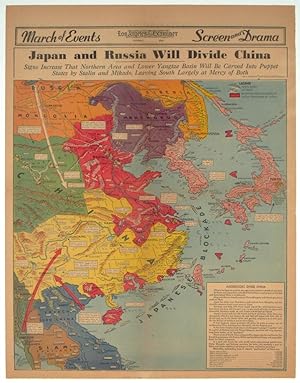
Japan and Russia Will Divide China. Signs Increase That Northern Area and Lower Yangtze Basin Will be Carved Into Puppet States by Stalin and Mikado, Leaving South Largely at Mercy of Both.
Editore: Los Angeles Examiner., Los Angeles., 1940
Da: Asia Bookroom ANZAAB/ILAB, Canberra, ACT, Australia
Membro dell'associazione: ANZAAB ILAB
Valutazione del venditore 5 su 5 stelle
EUR 791,80
Spedizione EUR 25,45
Spedito da Australia a U.S.A.Quantità: 1 disponibili
Aggiungi al carrelloPrinted colour pictorial map on a single newspaper leaf, 42.3 x 39.9 cms; 54.3 x 42.5 cms (sheet), archivally laid down on linen, slight discoloration to lower centrefold and sheet slightly age-toned, but in very good condition. A striking geopolitical map by Los Angeles Examiner artist Howard Burke covering China, Japan, Southern Russia and the northern part of French Indochina and Siam, showing how the "Aggressors Divide China." Areas under Japanese occupation are shown in red, and their naval blockade shown by an arc of naval vessels, with vivid arrows indicating lines of supply. Text labels (including sources of agricultural and raw materials) provide a dynamic overview of the geopolitical situation, and show the influence of American scientific illustrator and cartographer Richard Edes Harrison who argued for examining geographic issues from multiple perspectives , and Los Angeles Times artist Charles Owens.
-
Partie de la Russie d'Europe. Europe No. 10.
Lingua: Francese
Da: Antiquariat Renner OHG, Albstadt, Germania
Membro dell'associazione: BOEV
Valutazione del venditore 5 su 5 stelle
Mappa
EUR 75,00
Spedizione EUR 45,00
Spedito da Germania a U.S.A.Quantità: 1 disponibili
Aggiungi al carrelloKein Einband. Condizione: Gut. Grenzkolorierte lithogr. Karte 57 x 48,5 cm. Blattgröße 75 x 55 cm. Die Karte zeigt Zentral Russland mit Twer, Moskau, Smolensk, Iaroslaw, Wladimir.- Aus "Atlas Universel de geographie".- Die Karte ist etwas gebräunt, die Ränder sind etwas fleckig, der linke Rand etwas stärker, das Kartenbild aber sauber. Ränder unbeschnitten, einmal in der Mitte gefaltet.- Insgesamt von guter Erhaltung.- The map shows Cenrtal Russia with Moscow, Twer, Smolensk, Iaroslaw, Wladimir.
-
Russian Empire.
Lingua: Tedesco
Editore: London, 1814
Da: Antiquariat Renner OHG, Albstadt, Germania
Membro dell'associazione: BOEV
Valutazione del venditore 5 su 5 stelle
Mappa
EUR 100,00
Spedizione EUR 45,00
Spedito da Germania a U.S.A.Quantità: 1 disponibili
Aggiungi al carrelloKein Einband. Condizione: Gut. N.R. Hewitt Sc., 10 Broad Str., Bloomsberry, London. Drawn & engraved for John Thomson & Co.'s New General Atlas, 12. August 1814. Grenzkolorierte Kupferstichkarte 59 x 49 cm. Blattgröße 73 x 54 cm. Die Karte zeigt das gesamte Russische Reich und die angrenzenden Gebiete, Tartarei, China, Japan, Korea.- Oben in der Mitte Titel, darunter Maßstab (British Statute Miles).- Nr. 36 aus New General Atlas.- Die Karte ist leicht gebräunt, der Rand gering fleckig, unterer Rand unbeschnitten, Mittelfalz hinterlegt, rechts neben der Falz 2 leichte Knickfalten, insgesamt gut erhaltenes Exemplar.- The maps shows the Russian Empire in its entiretly, both in Europe and in Asia as well as adjacent parts of Tartary, Chinese Tartary, Japan, Korea, and the Gobi.
-

Russia.
Data di pubblicazione: 1845
Da: Geographicus Rare Antique Maps, Brooklyn, NY, U.S.A.
Membro dell'associazione: ABAA ESA ILAB
Valutazione del venditore 4 su 5 stelle
Mappa
Very good. Minor foxing at places. Blank on verso. Size 9.5 x 8 Inches. This is a fine example of Thomas Ewing's 1845 map of European Russia. It depicts the European portions of Russia from the Arctic Sea south to the Black Sea and Caspian Sea, and extending west as far as Poland and east as far as Orenburg and Perm, inclusive of the Ukraine. Various towns, rivers, cities, mountains and several other topographical details are noted with relief shown by hachure. When this map was printed, Russia was ruled by Tsar Nicholas I who adopted the doctrine of 'Orthodoxy, Autocracy, and Nationality' and was known to be one of the most reactionary monarchs in Russia. In 1825, Russian army officers, called the Decembrists, protested against Nicholas I's ascension to the throne. The Decembrists, so named because their revolt started in December, favored Nicholas I's brother, Constantine, who seemed amenable to a British style constitutional monarchy. When Constantine abdicated the throne in 1825, the Decembrists refused to accept the more autocratic rule of Nicholas I. Had Constantine not abdicated and the Decembrists been successful, the bloody Bolshevik Revolution may never have occurred. This map was published in 1845 by Oliver and Boyd as part of Ewing's New General Atlas .
-

Russie d'Europe.
Data di pubblicazione: 1834
Da: Geographicus Rare Antique Maps, Brooklyn, NY, U.S.A.
Membro dell'associazione: ABAA ESA ILAB
Valutazione del venditore 3 su 5 stelle

Mappa
Very good. Original centerfold. Light foxing. Blank on verso. Size 18 x 14 Inches. This is a fine example of Conrad Malte-Brun's 1834 map of european Russia. The map covers Russia from Arctic Ocean to Turkey and from Sweden to Tartary. In 1825, a few years before this map was drawn, Russian army officers, called the Decembrists, protested against Nicholas I's ascension to the throne. The Decembrists, so named because their revolt started in December, favored Nicholas's brother, Constantine, who seemed amenable to a British style constitutional monarchy. When Constantine abdicated the throne in 1825, the Decembrists refused to accept the more autocratic rule of Nicholas I. Had Constantine not abdicated and the Decembrists been successful, the bloody Bolshevik Revolution may never have occurred. Various cities, towns, rivers, lakes and other topographical details are marked, with relief shown by hachures. Boundaries are color coded according to states and districts. This map was issued as plate no. 45 in Conrad Malte-Brun's 1837 Atlas Complet du Precis de la Geographie Universelle . References: Rumsey 0458.045 (1833 edition). Phillips (Atlases) 6079.
-

Ost-Europa, Bl. 4: Central - Russland.
Data di pubblicazione: 1873
Da: Geographicus Rare Antique Maps, Brooklyn, NY, U.S.A.
Membro dell'associazione: ABAA ESA ILAB
Valutazione del venditore 3 su 5 stelle
Mappa
Very good. Blank on verso. Original platemark visible. Original centerfold exhibits slight wear. Size 14.5 x 17 Inches. This is a beautiful example of Stieler's 1873 map of central Russia. It covers from the eastern part of Lake Ladoga east as far as Perm and south as far as Okhtyrka (Achtyrka), now in the Ukraine. Russia at this time was under the suzerainty of Tzar Alexander the II. Alexander is best known for his liberal reforms including the emancipation Reform of 1861 which liberated Russia's countless serfs and is considered to be the most important event in 19th century Russian history. Map is densely detailed with both political and physical data. Various cities, mountains, roads, rivers and an assortment of additional topographical details are noted. Printed to a high production standard, as was typical of German and especially Perthes/Stieler maps of this period. Published by the Justus Perthes firm for issue as plate no. 37d in the 1873 edition of Stieler's Hand-Atlas . References: Rumsey 2449.057.
-

Eastern Europe.
Data di pubblicazione: 1858
Da: Geographicus Rare Antique Maps, Brooklyn, NY, U.S.A.
Membro dell'associazione: ABAA ESA ILAB
Valutazione del venditore 3 su 5 stelle
Mappa
Very good. Blank on verso. Stains on margins. Size 13.5 x 11 Inches. A rare example of Colton's 1858 map of eastern europe. Centered over Russia, the map covers Norway, Sweden, Turkey and Greece, and parts of Germany, Prussia, Italy and Austria. This beautiful hand colored map is a copper plate engraving, featuring a delicate floral style border only used by Colton in this particular atlas. It offers fine detail throughout with elevation rendered by hachure. Divided and color coded according to country, shows major towns and cities, railroads as well as geological features such as lakes and rivers. Russia at this time was under the suzerainty of Tzar Alexander the II. Alexander is best known for his liberal reforms including the emancipation Reform of 1861, considered to be the most important event in 19th century Russian history, which liberated Russia's countless serfs. Although this particular map is not dated, it is issued as part of the1859 edition of Colton's Illustrated Cabinet Atlas and Descriptive Geography . References: Rumsey 1690.216.
-

Russie d'Europe partie Septentrionale.
Data di pubblicazione: 1832
Da: Geographicus Rare Antique Maps, Brooklyn, NY, U.S.A.
Membro dell'associazione: ABAA ESA ILAB
Valutazione del venditore 4 su 5 stelle
Mappa
Very good. Blank on verso. Original platemark visible. Original cernterfold exhibits typical wear. Size 12 x 16 Inches. This is a fine example of the 1832 Delamarche map of european Russia. It covers the northern part of european Russia from the Arctic Ocean to Moscow and from Sweden to the Ural Mountains. In 1825, Russian army officers, called the Decembrists, protested against Nicholas I's ascension to the throne. The Decembrists, so named because their revolt started in December, favored Nicholas I'st brother, Constantine, who seemed amenable to a British style constitutional monarchy. When Constantine abdicated the throne in 1825, the Decembrists refused to accept the more autocratic rule of Nicholas I. Had Constantine not abdicated and the Decembrists been successful, the bloody Bolshevik Revolution may never have occurred. Various cities, towns, rivers, lakes and other topographical details are marked. Issued as part of Delamarche's Atlas de la Geographie .
-

Johnson's Russia.
Data di pubblicazione: 1864
Da: Geographicus Rare Antique Maps, Brooklyn, NY, U.S.A.
Membro dell'associazione: ABAA ESA ILAB
Valutazione del venditore 4 su 5 stelle
Mappa Prima edizione
Very good. Text on verso. Minor overall toning and foxing. Creasing near left border. Size 17 x 14 Inches. A beautiful example of Johnson and Ward's 1865 map of Russia. Depicts the european portions of Russia from the Arctic Sea south to the Black Sea and Caspian Sea. extends west as far as Warsaw and east as far as Orenburg and Perm. Includes the Ukraine. Features the fretwork style border common to Johnson's atlas work from 1864 to 1869. One of the more attractive American atlas maps of Russia to appear in the mid-19th century. Published by A. J. Johnson and Ward as plate number 92 in the 1865 edition of Johnson's New Illustrated Family Atlas. This is the first edition of the Johnson Atlas to be attributed to Johnson exclusively. References: Rumsey 0535.058. Philps (atlases) 4345.
-

Russia.
Data di pubblicazione: 1822
Da: Geographicus Rare Antique Maps, Brooklyn, NY, U.S.A.
Membro dell'associazione: ABAA ESA ILAB
Valutazione del venditore 3 su 5 stelle
Mappa
Very good. Minor overall toning. Some offsetting. Blank on verso. Minor wear over original centerfold. Size 10 x 8 Inches. This is a fine example of Samuel Butler's 1822 map of Russia. It covers the european part of Russia from Lapland to the Caspian Sea and from the Baltic Sea to the Ural Mountains. In 1825, shortly after this map was drawn, Russian army officers, called the Decembrists, protested against Nicholas I's ascension to the throne. The Decembrists (so named because their revolt started in December), favored Nicholas I's brother, Constantine, who seemed amenable to a British style constitutional monarchy. When Constantine abdicated the throne in 1825, the Decembrists refused to accept the more autocratic rule of Nicholas I. Had Constantine not abdicated and the Decembrists been successful, the bloody Bolshevik Revolution may never have occurred. The map is somewhat detailed with regional boundaries outlined in color. Various towns, cities, rivers, and several other topographical features are noted with relief shown by hachure. This map was engraved by Sidney Hall and published by Longman, Hurst, Rees, Orme & Brown for issue as plate no. X in the 1822 edition of Samuel Butler's An Atlas of Modern Geography .
-

Russia in Europe, Sweden and Norway. Map of Denmark. Map of Holland and Belgium.
Data di pubblicazione: 1887
Da: Geographicus Rare Antique Maps, Brooklyn, NY, U.S.A.
Membro dell'associazione: ABAA ESA ILAB
Valutazione del venditore 4 su 5 stelle
Mappa
Very good. Blank on verso. Size 11.5 x 14.5 Inches. This is a fine example of William M. Bradley's 1887 map of Russia, Norway, Sweden, Holland Belgium and Denmark. Maps of Denmark, Holland and Belgium relegated to insets on the left hand side of the sheet. The larger map covers Scandinavia and the european portion of Russia from the Arctic Ocean to Turkey, including the european portions of Russia as well as Finland, Ukraine, Latvia, Lithuania and estonia. Denmark is covered in full, from the Skagerrak to the Baltic Sea. Holland and Belgium are covered from the North Sea to France. Russia at this time was under the suzerainty of Tzar Alexander the II. Alexander is best known for his liberal reforms including the emancipation Reform of 1861. The Reform, considered the most important event in 19th century Russian history, liberated Russia's countless serfs. In 1830, the Belgian Revolution led to the secession of Belgium from the United Kingdom of Netherlands into the independent Kingdom of Belgium. Though Belgium had successfully made itself independent, the Netherlands refused to recognize the new country until the 1839 Treaty of London. Meanwhile Scandinavia and Denmark at the time were in the midst of a prolonged period of peace and prosperity that led to a cultural and economic boom. Various towns, cities, rivers and an assortment of additional topographical details are noted. Map is color coded according to regional and political boundaries with elevation rendered by hachure. Copyrighted 1887 by Wm. M. Bradley & Bro., for inssue as plate no. 112 in the 1887 edition of Mitchell's New General Atlas . References: Rumsey 0594.061.
-

Ost-Europa, Bl. 2: Nordost - Russland.
Data di pubblicazione: 1873
Da: Geographicus Rare Antique Maps, Brooklyn, NY, U.S.A.
Membro dell'associazione: ABAA ESA ILAB
Valutazione del venditore 4 su 5 stelle
Mappa
Very good. Blank on verso. Original platemark visible. Original centerfold exhibits slight wear. Size 14.5 x 17 Inches. This is a beautiful example of Stieler's 1873 map of northern Russia. The map covers from the Arctic Sea south to the Onega Lake and Petrosawodsk and from the Gulf of Kandalaksa to the Ural Mountains. The Kolguyev Island, unexplored until 1894, are identified as 'uninhabited.' Russia at this time was under the suzerainty of Tzar Alexander the II. Alexander is best known for his liberal reforms including the emancipation Reform of 1861 which liberated Russia's countless serfs and is considered to be the most important event in 19th century Russian history. Map is densely detailed with both political and physical data. Various cities, mountains, roads, rivers, islands and an assortment of additional topographical details are noted. Printed to a high production standard, as was typical of German and especially Perthes/Stieler maps of this period. Published by the Justus Perthes firm for issue as plate no. 37b in the 1873 edition of Stieler's Hand-Atlas . References: Rumsey 2449.055.
-

Russia in Europe.
Data di pubblicazione: 1844
Da: Geographicus Rare Antique Maps, Brooklyn, NY, U.S.A.
Membro dell'associazione: ABAA ESA ILAB
Valutazione del venditore 3 su 5 stelle
Mappa
Very good. Original platemark visible. Blank on verso. Minor wear along original centerfold. Size 20 x 15.5 Inches. This is a fine example of Adam and Charles Black's 1844 map of European Russia. It depicts the European portions of Russia from the Arctic Sea south to the Black Sea and Caspian Sea, and extending west as far as Poland and east as far as Orenburg and Perm, inclusive of the Ukraine. Various towns, rivers, cities, mountains and several other topographical details are noted with relief shown by hachure. When this map was printed, Russia was ruled by Tsar Nicholas I who adopted the doctrine of 'Orthodoxy, Autocracy, and Nationality' and was known to be one of the most reactionary monarchs in Russia. In 1825, Russian army officers, called the Decembrists, protested against Nicholas I's ascension to the throne. The Decembrists, so named because their revolt started in December, favored Nicholas I's brother, Constantine, who seemed amenable to a British style constitutional monarchy. When Constantine abdicated the throne in 1825, the Decembrists refused to accept the more autocratic rule of Nicholas I. Had Constantine not abdicated and the Decembrists been successful, the bloody Bolshevik Revolution may never have occurred. This map was engraved by Sidney Hall and issued as plate nos. XXVII and XXVIII in the 1844 edition of Black's General Atlas . References: Rumsey 2305.034 (1854 edition). Philips (atlases) 4334.
-

Das asiatische Russland jenseit des Ural.
Data di pubblicazione: 1952
Da: Geographicus Rare Antique Maps, Brooklyn, NY, U.S.A.
Membro dell'associazione: ABAA ESA ILAB
Valutazione del venditore 3 su 5 stelle
Mappa
Very good. Minor overall toning and spotting. Size 8.5 x 11 Inches. This is an attractive 1952 map of Russia in Asia by Joseph Meyer. It covers the Russian Empire in Asia east from the Ural Mountains as far as Kamchatka and Alaska, including parts of the Chinese Empire and European Russia. Throughout, the map identifies cities, towns, rivers and assortment of additional topographical details. During this time in Russia, around 1825, Russian army officers, called the Decembrists, protested against Nicholas I's ascension to the throne. They were however defeated and some were exiled to Siberia. There, against all odds, the Decembrists thrived making significant contributions to the cultural and economic growth of Siberia. In 1856, when the Decembrists received amnesty, only some returned to European Russia. This map was issued in Meyer's Zeitung Atlas . Although all the maps in this atlas are not individually dated, the title page and maps were often updated while the imprint with the date was not, causing confusion to the exact date for some of the maps. Moreover some maps in the atlas were taped in at a later date as an update to the atlas. We have dated the maps in this collection to the best of our ability.
-

Russia in Europe.
Data di pubblicazione: 1828
Da: Geographicus Rare Antique Maps, Brooklyn, NY, U.S.A.
Membro dell'associazione: ABAA ESA ILAB
Valutazione del venditore 3 su 5 stelle
Mappa
Very good. Blank on verso. Original platemark visible. Slight overall toning. Size 10 x 8 Inches. This is an attractive example of the 1828 Malte-Brun map of european Russia. The map covers Russia from Lapland to the Caspian Sea and from the Baltic Sea to the Ural Mountains. In 1825, shortly before this map was drawn, Russian army officers, called the Decembrists, protested against Nicholas I's ascension to the throne. The Decembrists (so named because their revolt started in December), favored Nicholas I's brother, Constantine, who seemed amenable to a British style constitutional monarchy. When Constantine abdicated the throne in 1825, the Decembrists refused to accept the more autocratic rule of Nicholas I. Had Constantine not abdicated and the Decembrists been successful, the bloody Bolshevik Revolution may never have occurred. Various, important rivers, islands, cities and other topographical details are noted. This map was published by Samuel Walker in 1828 as part of the American edition of Conrad Malte-Brun's System of Geography , Vol. I.
-

Russia in Europe, Sweden and Norway. / Map of Denmark. / Map of Holland and Belgium.
Data di pubblicazione: 1860
Da: Geographicus Rare Antique Maps, Brooklyn, NY, U.S.A.
Membro dell'associazione: ABAA ESA ILAB
Valutazione del venditore 3 su 5 stelle
Mappa
Very good condition. Blank on verso. Size 11 x 13.75 Inches. A beautiful example of S. A. Mitchell Jr.'s 1864 map of Russia, Norway, Sweden, Holland Belgium and Denmark. Maps of Denmark, Holland and Belgium relegated in insets on the left hand side of the map. Denotes both political and geographical details. Extends as far south and west as the boot of Italy and as far east as the Caspian Sea and the Gulf of Obi. One of the most attractive American atlas maps of this region to appear in the mid 19th century. Features the floral border typical of Mitchell maps from the 1860-65 period. Prepared by S.A. Mitchell for inclusion as plate no. 64 in the 1864 issue of Mitchell's New General Atlas . Dated and copyrighted, 'Entered according to Act of Congress in the Year 1860 by S. Augustus Mitchell in the Clerk's Office of the District Court of the U.S. for the Eastern District of Pennsylvania. References: Rumsey 0565.033 (1860 edition). Phillips (Atlases) 831. New York Public Library, Map Division, 1510828.
-

Russie d'Europe.
Data di pubblicazione: 1850
Da: Geographicus Rare Antique Maps, Brooklyn, NY, U.S.A.
Membro dell'associazione: ABAA ESA ILAB
Valutazione del venditore 3 su 5 stelle
Mappa
Very good. Some wear on original centerfold. Blank on verso. Size 18 x 12.5 Inches. This is a beautiful example of Alexandre Delamarche's 1850 map of Russia. It covers the european part of Russia from Sweden to the Ural Mountains and from the Arctic Ocean to the Caspian Sea. When this map was printed, Russia was ruled by Tsar Nicholas I who adopted the doctrine of 'Orthodoxy, Autocracy, and Nationality' and was known to be one of the most reactionary monarchs in Russia. In 1825, Russian army officers, called the Decembrists, protested against Nicholas I's ascension to the throne. The Decembrists, so named because their revolt started in December, favored Nicholas I'st brother, Constantine, who seemed amenable to a British style constitutional monarchy. When Constantine abdicated the throne in 1825, the Decembrists refused to accept the more autocratic rule of Nicholas I. Had Constantine not abdicated and the Decembrists been successful, the bloody Bolshevik Revolution may never have occurred. Throughout, the map identifies various cities, towns, rivers, mountain passes and an assortment of additional topographical details. Political and regional borders are highlighted in outline color. This map was issued by Delamarche as plate no. 30 in his Atlas Delamarche Geographie Modern .
-

Russie d'Europe.
Data di pubblicazione: 1843
Da: Geographicus Rare Antique Maps, Brooklyn, NY, U.S.A.
Membro dell'associazione: ABAA ESA ILAB
Valutazione del venditore 3 su 5 stelle
Mappa
Very good. Original centerfold visible. Blank on verso. Size 17.5 x 13.5 Inches. This is a fine example of Conrad Malte-Brun's 1843 map of european Russia. The map covers Russia from Arctic Ocean to Turkey and from Sweden to Tartary. In 1825, a few years before this map was drawn, Russian army officers, called the Decembrists, protested against Nicholas I's ascension to the throne. The Decembrists, so named because their revolt started in December, favored Nicholas's brother, Constantine, who seemed amenable to a British style constitutional monarchy. When Constantine abdicated the throne in 1825, the Decembrists refused to accept the more autocratic rule of Nicholas I. Had Constantine not abdicated and the Decembrists been successful, the bloody Bolshevik Revolution may never have occurred. Various cities, towns, rivers, lakes and other topographical details are marked, with relief shown by hachure. Boundaries are color coded according to states and districts. This map was issued as plate nos. 54 and 55 in Conrad Malte-Brun's 1843 Precis de la Geographie Universelle .


